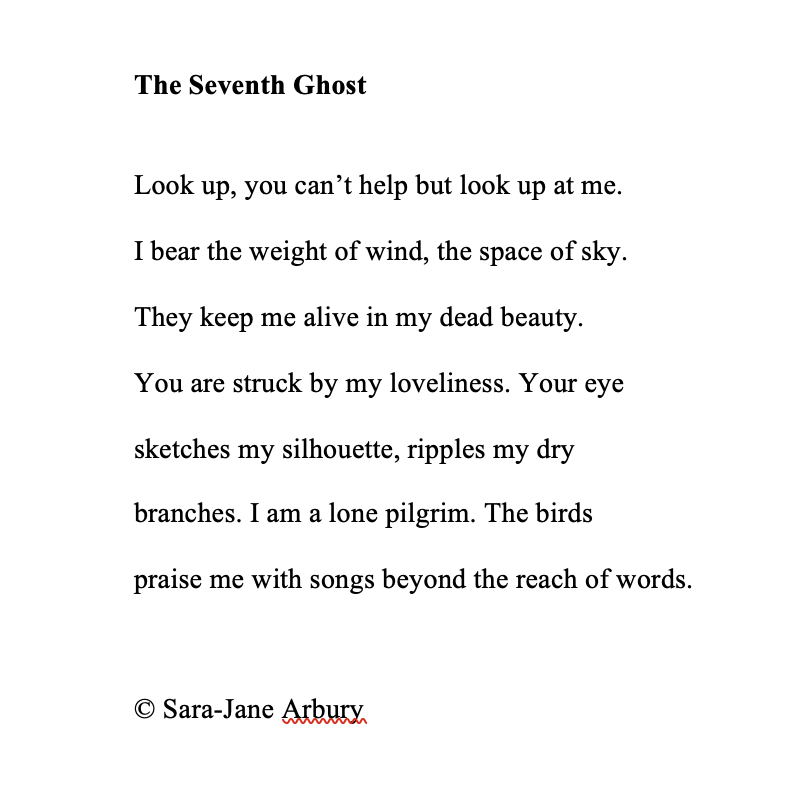
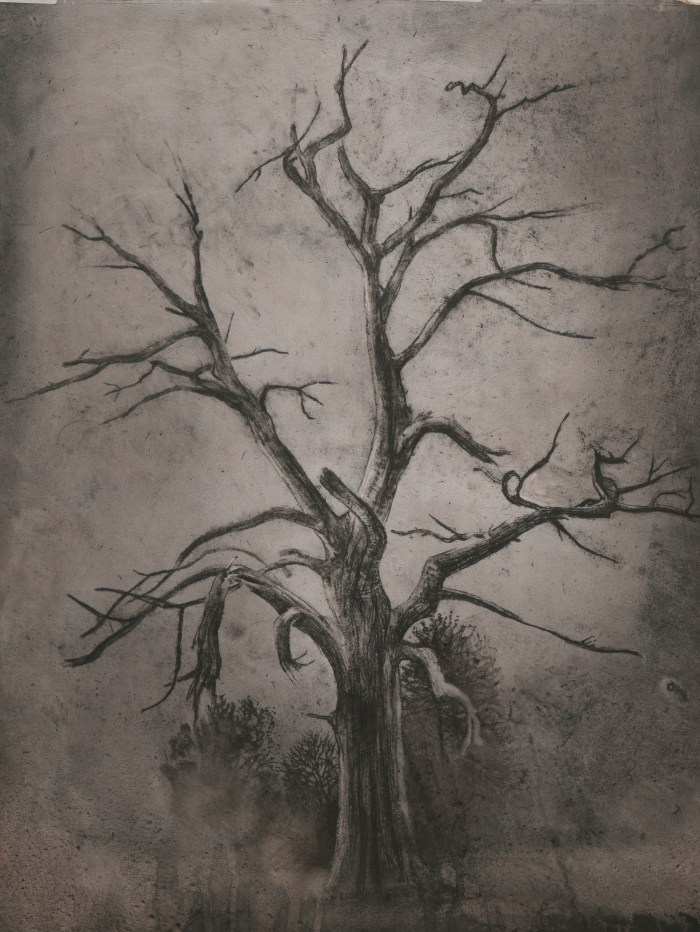
This blog explores ‘Ghost Trees’, a project led by Richard Gilbert including work by poet Sara-Jane Arbury and photographer Paul Ligas. Here, Richard delves into the ongoing project, process, and the threat that trees face as a result of human activity, and the image of the ‘seventh’ ghost, the charcoal drawing that is showing as part of the See Here Now exhibition at Grizedale Forest.
I hope this project will encourage more attention on and greater appreciation for these noble sentinels in our landscape. Even when dead, or ghosts of their former selves, they convey majesty, maybe menace, or simply mystery.
Ghost Trees is an ongoing project led by Richard Gilbert, with poet Sara-Jane Arbury and photographer Paul Ligas, commissioned by The National Trust in England that has taken a year to come to fruition. Ghost Trees is a combination of a contemporary art walk with banners installed at seven sites depicting the ghost of a tree through which you can view, as a ghost, the actual tree. Additionally, there is an exhibition of the original drawings, photographs and poetry in Croft Castle, community and individual workshops, and a theatre performance at the Market Theatre Ledbury at Halloween 2024 presenting a virtual tour of the walk with music, word and image.
The purpose was to invite the viewer to bear witness to seven of the magnificent, ancient, dead or dying trees in the landscape of Croft. The walk unites in a timeline a chronology from prehistory to the 21st century that explores the history of Croft. The aim was to celebrate the past whilst reflecting how trees die before their time through human agency such as climate change or disease. This is hoped to be a reminder of the ever-deepening crisis that faces the human and the natural world.


Depicting Trees
Having drawn and painted the trees at Croft over the years, this project focusing on the ghost trees has been a catalyst to a new understanding. To my mind, each of these particular trees has an individual character that I set out to portray and animate through drawing. Making drawings intended as a banner embedded with text and photography presented its own challenges and prompted a kind of response that developed through the course of the project, shifting mediums from pencil through ink to charcoal.
Perhaps the act of looking closely at and representing the distinctiveness of each tree inevitably lures one into the collective cultural memory bank. Three hundred years of depictions of trees in British art provides the ideal nursery to foster a creative response. Trees are fit subjects in themselves not just as compositional furniture in works of art but standalone subject matter that can invoke narratives about nationhood, politics, family, literature, and much more. This is in addition to the sheer pleasure of admiring the singular majesty of a tree. Climate change, disease and old age have undone so many at Croft but each tree has a story fit to tell about how Croft has endured, each has been a silent witness and perhaps a kind of transfiguration in the minds of many through the ages.
Heritage and loss
As one of the least wooded countries in Europe, 13% of our land area is wooded compared to 35% in Germany. The British cultural relationship to trees is, in part, informed by the loss of wooded habitats, field, and hedgerow trees to agriculture and infrastructure projects. The vulnerability of these individual trees, especially ancient trees, makes them icons of our heritage. Ancient trees are now largely confined to places like National Trust parks.
The IUCN (International Union for Conservation of Nature) is a membership Union of government and civil society organisations that work to advance sustainable development in a way that values and conserves nature. At the October 2024 ICUN conference in Cali, Columbia it was announced that of the 57,000 species of trees in the world, more than one in three tree species worldwide faces extinction. Thirty-eight per cent of the world’s trees are at risk of extinction according to the first Global Tree Assessment, lost to logging, agriculture, and infrastructure. To put that into the context of the UK, we have 86 species of trees and 35 are on the threatened list including rowan, whitebeam, pines, birches, junipers and more.
We are living in a time of crisis where the volatility of the climate threatens on many fronts. Tree diseases, pests and pathogens, pesticides, invasive species, changes in the growing season and increased rainfall are all potential hazards for woodland. Here we have evident examples, Camelthorn trees in the Kalahari that cannot grow in the arid baked clay; 42 million acres of Whitebark Pine lost in 10 states across the Rockies decimated by the mountain pine beetle that now advance to higher altitudes or drowned forests on the eastern seaboard of the United States.
Ghost Trees was launched at Croft Castle on Friday 21 June 2024. The exhibition at the Castle Stables is open until 31 October 2025, and the Ghost Trees art walk in the Croft parkland will be in place until early 2026.