How can it take twenty people to plant seven trees? That’s a fair question, an out-loud wondering from one of the participants joining the group to plant a Resonance circle in the Langstrath Valley. And it kind of gets to the point – the act of planting a Resonance circle is not about function, speed or efficiency, but about taking time, and about connection.
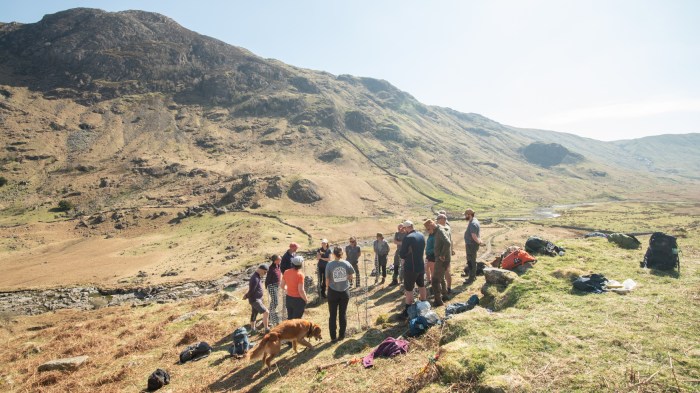
The seven trees planted on the fellside in the Langstrath valley where the last seven to go in during the year’s planting season – just enough time to get the trees into the ground before they woke from their winter slumber and began to open their leaves. Around the country, people have been planting trees maybe hundreds or thousands at a time, but for the Resonance circles, there are just seven trees. Each circle is planted with the same precise measurements: a diameter of 3.5 metres, with the seven trees set around the circumference of the circle in an equal spacing, angled 51.4 degrees from the centre.
This attention to detail is one of the elements that keeps the process slow and thoughtful.
Ten steps of a Resonance planting
Each planting event happens in stages …
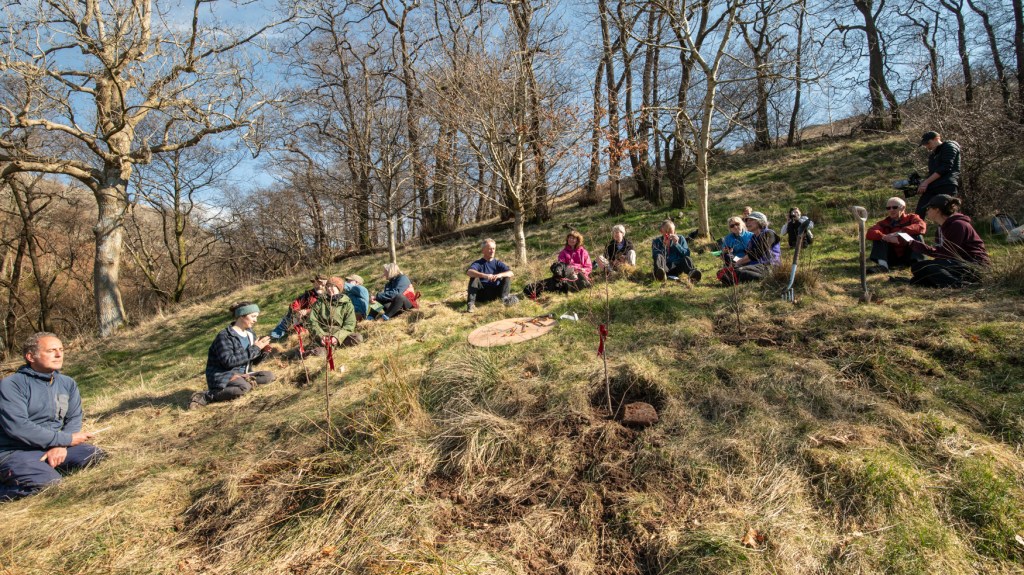
One: Walk in, with gentle chat among those taking part.
Two: Decide where to locate the centre of the circle.
Three: Mark out the locations for each of the seven trees – for this we follow the lines on the wooden circular form made for the purpose, with a peg at each end of a 1.75-metre piece of string to mark the spot for each tree.
Four: Share some words of recognition and gratitude for all life systems, then begin the digging: one hole for each tree.
Five: Pause.
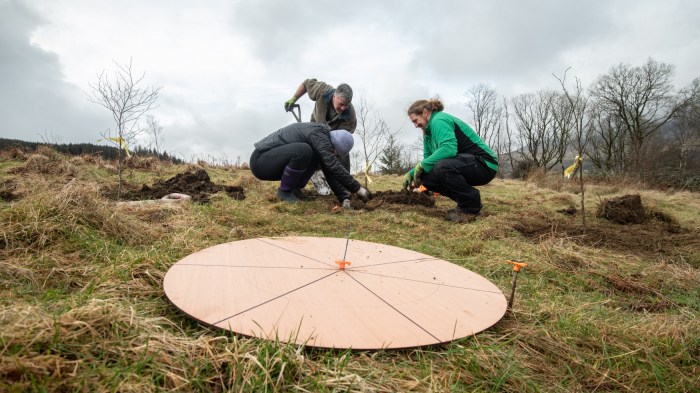
Six: Take a piece of paper and write a message for the trees and future generations (of any species) who may witness this growing circle and the surrounding landscape. Then place or bury the paper in the hole you have helped to dig.
Seven: Re-measure the location of each tree so that each trunk will stand exactly on the circle’s perimeter.
Eight: Select a tree for each hole, and settle it into place, taking care to allow the established roots to grow outwards, and not spiral inwards; you may need to make narrow slits in the earth to accomodate the roots.
Nine: Eat cake.
Ten: Share thoughts on issues of land use, and change, with prompts provided by a pack of cards.
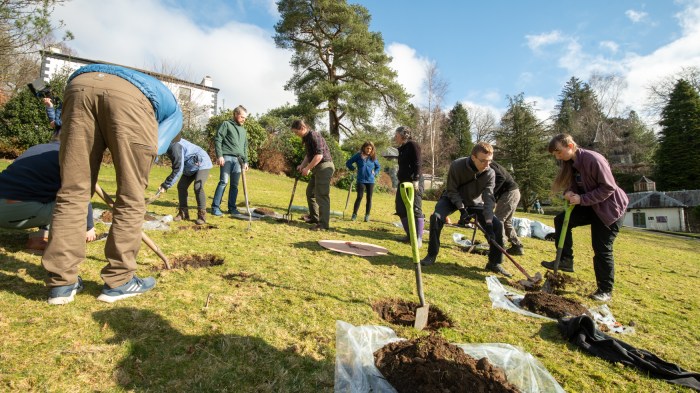
Working together
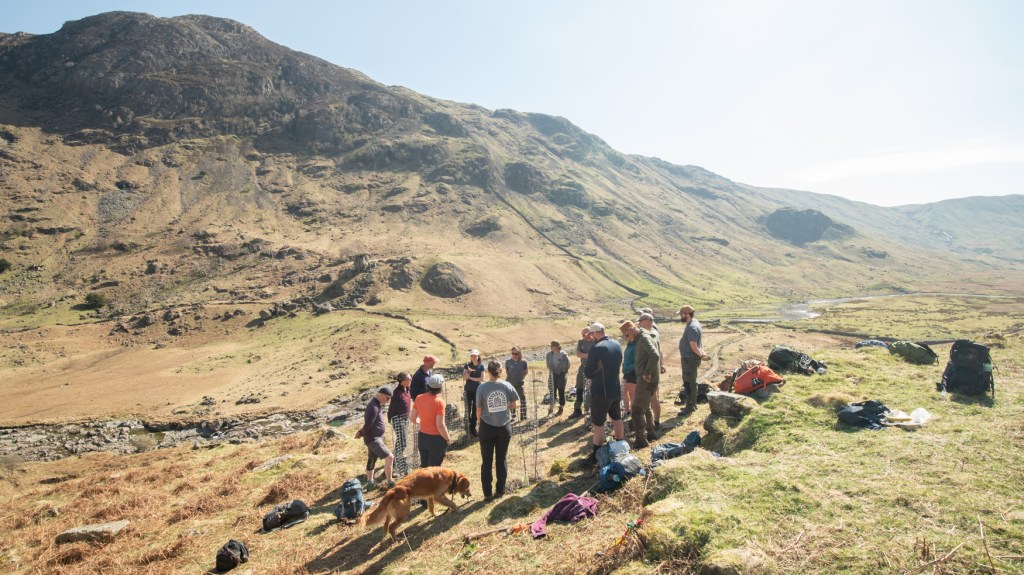
All of the above stages are collaborative: the overriding vibe of each of the five planting events we’ve done so far (the last two to come in the autumn) has been collaboration. There is laughter, enthusiasm, gentle conversation and a very practical co-working with tools and tasks shared between two or three people. Naturally, discussion arises: maybe about the soil, whether there are roots of grass, bracken or rush, the trees around us, the view; in some places pupae buried into the soil have been carefully set aside and then replaced. Interwoven between these observations, people talk about themselves and their own insights into particular places, trees, peat, farming, weather, land use – and more – and might challenge one another when there’s a difference in perspective.
The participation has led to new bonds being formed: people with the small, delicate circles of trees, in a relationship that will continue over the years; and people with one another. We know some people who met for the first time have stayed in touch, and the discussions on each day effortlessly involved sharing of knowledge and insights, and the emergence of ideas.
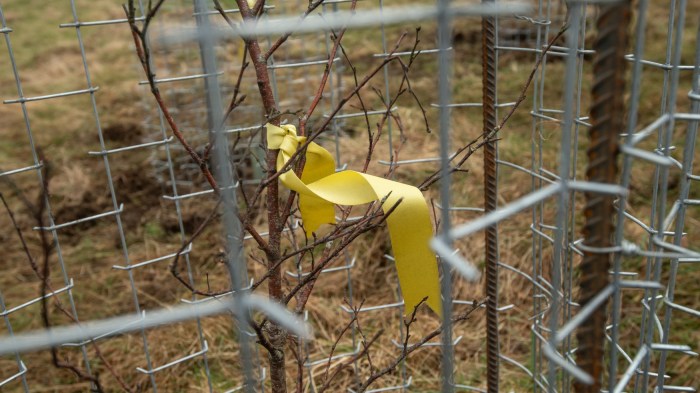
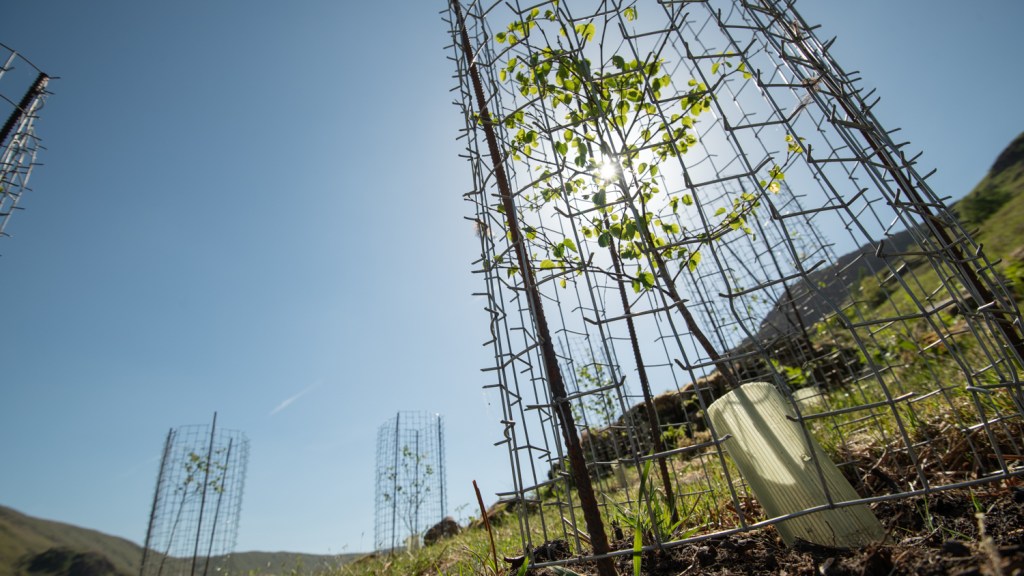
In two locations, cactus guards have been placed around each of the trees. These offer protection from the hungry mouths of deer and/or sheep. All the trees have been given ‘vole collars’ to ward off nibbling at the base of their trunks.
In all the locations, in spite of the record-breaking heat and dryness of this year’s post-winter months, the trees are doing well. They are in full leaf and are standing strong. We’ve been to check them several times and so have some of the people who helped to plant them.
what is it that carries forward?
The planting process is about the trees but just as importantly, it’s about the people; the two together. This reciprocal relationship is an example of what happens in many locations, through a combination of human intent and close observation of place, coupled with care, in the management of land. The small act of planting a circle of birch could be seen as a microcosm of what can play out at a landscape scale – involving reciprocity at many levels, through people sharing knowledge with one another, and working with soil and trees, woodlands, fields, valleys and watersheds.
It could be seen as a microcosm of what can play out at a landscape scale – involving reciprocity at many levels, through people sharing knowledge with one another, and working with soil and trees, woodlands, fields, valleys and watersheds.
And it sets something in motion that invites an attitude of connection and investment in something that is long term. These circles may last for 100 years, or more, and even when the seven trees in each circle fall or die, the land around them continues. What’s our vision and hope for this place we call home, and how can we work well together to nurture the land and ourselves? What actions can we take that will make a difference, in ways that are fair, and life-enhancing? These questions crop up during the planting days, just as they do at the LUNZ Hub consortium meetings*, and during the brain-straining thought processes of modellers and scenario builders, in the yards, fields and barns of farmers and the labs of hydrologists or agronomists, in the meeting rooms of land management NGOs, or in board rooms of policy makers. We are all grappling with these vital, pressing issues.


Where are the circles, and who has been involved?
The circles are situated on lines that radiate at angles of 51.4 degrees from the Under Helm Sycamore, near Grasmere. Each location has been selected in conversation with the land owners and land managers there – a wonderful process of brain-storming, poring over maps, and ground-truthing. Huge thanks to everyone who has helped to make this a reality, and to the volunteers who came along to the plantings.
- Grizedale Forest, looking west towards Coniston Water and the Coniston Massif; with thanks to Forestry England the crew from Grizedale Forest.
- Gillside, on the western edge of the Grasmere Valley, below Seat Sandal; with thanks to the site owners and to Friends of the Lake District who manage the site, and volunteers who tend it on a regular basis.
- Glencoyne Park, beside an alder carr, looking towards Ullswater and Place Fell; with thanks to the National Trust (land owners) and Sam and Can Hodgson (tenant farmers).
- Ambleside, University of Cumbria campus, looking over the town; with thanks to the staff at University of Cumbria and Centre for National Parks and Protected Areas.
- Langstrath Valley, below an old charcoal-burning platform, looking across the Langstrath Valley with thanks to the National Trust (land owners) and Jonny Bland who manages the intake where the circle is located.

Resonance, the LUNZ Hub, and the wider context
The Resonance project has been made possible through our work as part of the LUNZ Hub consortium and planning and logisitical support, and permissions, from the Lake District National Park Authority, the National Trust, Natural England, Friends of the Lake District, University of Cumbria, and farmers tending the land on which the trees have been planted. The project is a way to convene conversations around land use, and build or strengthen communities of people who are who are involved in caring for particular parcels of land, and/or want to connect with others through conversations and actions.
What’s our vision and hope for this place we call home, and how can we work well together to nurture the land and ourselves? We are all grappling with these vital, pressing issues.
Find out more about the Resonance project, and the origin of the birch trees, which have been collected from Bolton Fell Peat Bog, through the project page here: https://theplacecollective.org/resonance/.
