Daksha Patel is one of the four artists carrying out a Creative Collaborative Placement through the Land Use for Net Zero, Nature and People (LUNZ) Hub. As part of her enquiry centred on transitions in agricultural practices and systems, Daksha visited Dartmoor farmer Naomi Oakley, at Challacombe Farm. This blog gives a reflection on her visit, and follows on from her record of events at Rothamsted Research. Daksha is producing a film, combining learning from both locations – and we’ll share this later in the year.
At Challacombe Farm
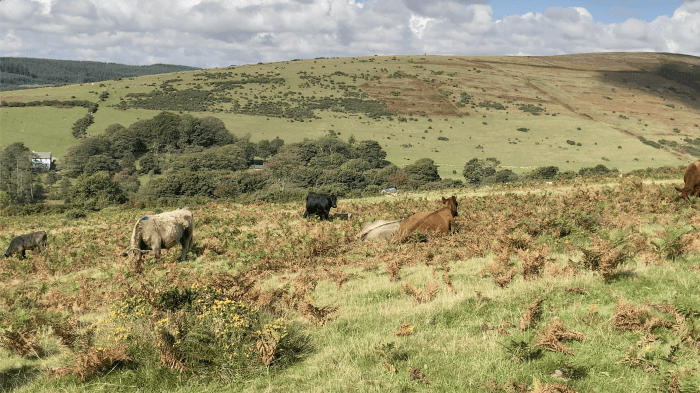
My strongest and most lasting impression of meeting Naomi Oakley at Challacombe farm was her deep connection to the place where she farms. It was almost palpable in her stories about the history of the farm, her livestock (they have names) and the myriad ways in which she has adapted and innovated her farming practice to work with nature high up on Dartmoor. She notices everything with a rigour that is informed by her scientific background (her previous life was as a Natural England peatland policy advisor to DEFRA). Naomi’s commitment to nature recovery informs every decision she makes about land use at Challacombe. Habitats and biodiversity are allowed space to thrive alongside her livestock; working with nature is in-built into the way she farms.
Habitats and biodiversity are allowed space to thrive alongside livestock; working with nature is in-built into the way Naomi farms.
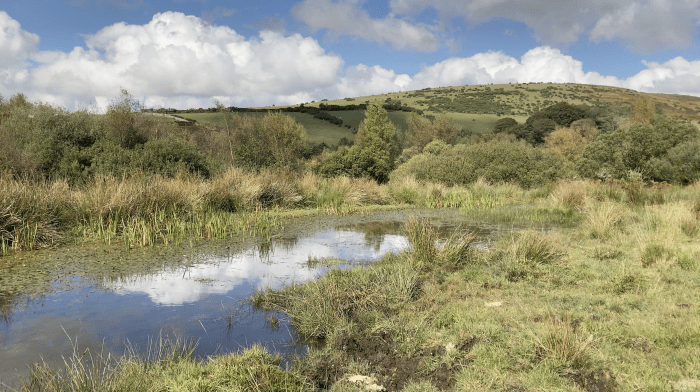
To achieve this, Naomi holds her livestock in a very delicate balance with their environment by creating what she calls ‘niches for nature’. For example, their dung is without pesticides or veterinary medicines because she farms organically. This becomes a food source for a wide range of flora and fauna, particularly the insects and everything that feed on the insects. She talked about ‘creating a cascade of nutrition’. She points out that the tussocks that cattle create as they move around on wet ground are perfect habitats for the Marsh Fritillary butterfly and the Greater Butterfly Orchid to thrive. A wetland habitat has been created by slowing the pace of a stream through her land.
Observation and reflection
At Rothamsted, technology plays a key role in measurement, whilst for Naomi observation is central.
There was a different relationship with the land at Rothamsted where the main aim of scientists is to answer research questions, which in a sense can create a separation from place through theory and the abstractions of science. And of course they do not live in the place, there is no personal history that connects them to the place. Nevertheless, acute observation and reflection upon farming practices is an ongoing process in both places. At Rothamsted, technology plays a key role in measurement, whilst for Naomi observation is central. She is a very astute observer and original thinker, who is not afraid to explore creative solutions to everyday farming challenges and to do things differently. For instance, when she moves sheep from one field to another – which can be a noisy and distressing experience for the herd – she allows a few male sheep (kept specifically for that purpose) to lead the herd and the sheep dogs stay well back and wait for the herd to quietly follow the tups. It’s a slower process, but much less stressful for everyone, including humans. She observes the behaviour of her livestock and tries to farm with them, rather than doing things to them. It is a profoundly radical approach.
Naomi’s livestock are exclusively fed on grass grown on the farm. She does not buy in feed such as cereals or soy. This is not only for ethical and environmental reasons, but because it makes sound economic sense. Under an organic system, Challacombe has built a customer base that is profitable before any government support. Naomi is entrepreneurial and uses social media to sell wool from her unusual and sought-after sheep varieties. She hosts exclusive (a whole field to yourself) eco-friendly camping holidays in the summer months, which are very popular. She invites dancers, poets and artists to her farm. I had a strong sense that she is building a like-minded community around her.
… in the past a good winter coat would suffice to get her through a day in the fields. In recent winters, the rain and winds are so unrelenting that she needs three separate coats in one day.
Naomi was open and honest about the emotional challenges of farming (it is recognised as a highly stressful profession with a high impact upon mental health). You can feel very isolated and alone in the long winters she told me. The weather can be brutal on the moors, and climate change is making it even more extreme. She described how in the past a good winter coat would suffice to get her through a day in the fields. In recent winters, the rain and winds are so unrelenting that she needs three separate coats in one day. Nevertheless, her stories always returned to what she loves about the place, to descriptions of dragonflies darting around her pond.
What I took away after meeting Naomi is a sense of hope for the future of farming. If she can share her enthusiasm and inspiration with other farmers, real change from the ground up is possible, particularly in the small hill farms. Her passion and lived experience can reach the farming community in a way that science alone can’t.
For more about Daksha Patel’s Creative Collaborative Placement, visit this page. You can read about Daksha’s time with Rothamsted Research (North Wyke) here.
To find out more about Challacombe Farm, follow this link to the Challacombe Farm website.