Three people sitting on a stage, one is talking and raising her hands.

exhibition reflections & conference

half lives / gathering / the flow
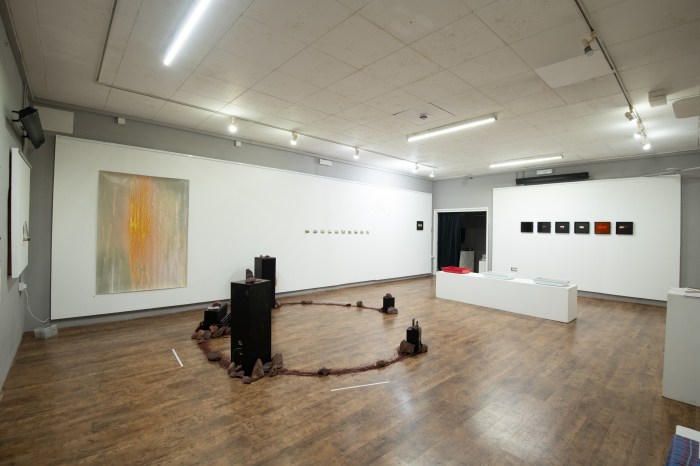
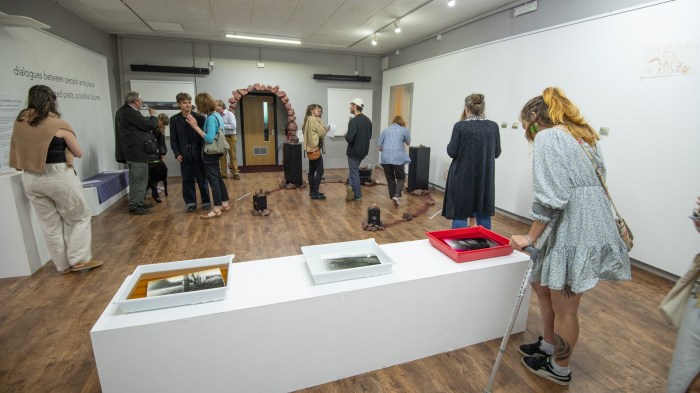
A few images of the exhibition in place at Florence Arts Centre: Half Lives / Gathering / The Flow, with artwork from Alistair Debling, Jamie Jenkinson and Cristina Picchi. Despite undertaking very different residency journeys, there’s a cohesion in their work – considering time, relationships to place, what’s seen and unseen. For more on their approaches, there’s background in our previous post here.


“Like layers of rock, these invisible and inaudible histories are within the foundations of these landscapes; hidden but not forgotten, lingering beneath our feet. The Flow raises questions about how we shape our environments and, in turn, how they shape us.” Cristina Picchi


“The installation not only portrays this process of collection but symbolises a convergence of people, landscapes and experiences, underscoring the communal essence at the heart of Jenkinson’s practice.” Will Rees

exhibition guide

For more, you can read reflections from each artist, with captions for each piece, in this exhibition guide, which has been put together by Will Rees.

ONE-DAY EVENT: PLACE, ART, RESEARCH

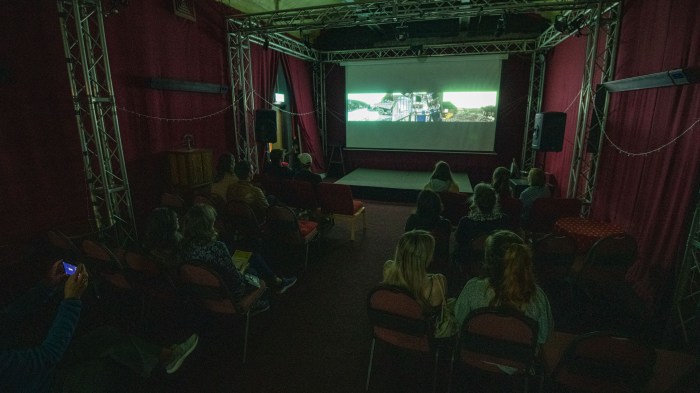
While the exhibition was on show a one-day event was held at Florence Arts Centre. This was an opportunity for the artists to talk about the process of their work, and join academics from CNPPA to reflect on the impact of their inter-disciplinary collaborations. Rich conversations explored the experience of artists working with scientists and specialists in other professions both in a panel discussion session, and in small groups.

Six people sit on a stage for a panel discussion in front of a crowd in a cinema setting
Six people sit on a stage; they are taking part in a panel discussion

The day was co-run with Dr Martin Fowler from University of Cumbria, and was attended by university students and by local artists. In breakout sessions, groups were invited to discuss the issues raised in the panel sessions, and talk about the role of artists today – both in West Cumbria and more widely.

It was a lively afternoon with one of those conversations that kept us all in the building longer than we planned to stay! There was a strong sentiment from the group about the necessity of artists – and other researchers and academics – to challenge current systems (including the education system), offer social commentary, and to contribute critical thinking to debates and discussions about caring for places, and the way stories are told, and by whom.

For students who attended the day, the discussions continued during their course with Dr Fowler and other lecturers, and have fed into their production of dissertations.

A view of people in a hall having a discussion. A man at the back of the room raises a piece of paper.


“Confronting the deep time of the nuclear industry gives us an opportunity to consider which parts of our culture are important to hold onto for future generations, and which areas might be radically reimagined.” Alistair Debling
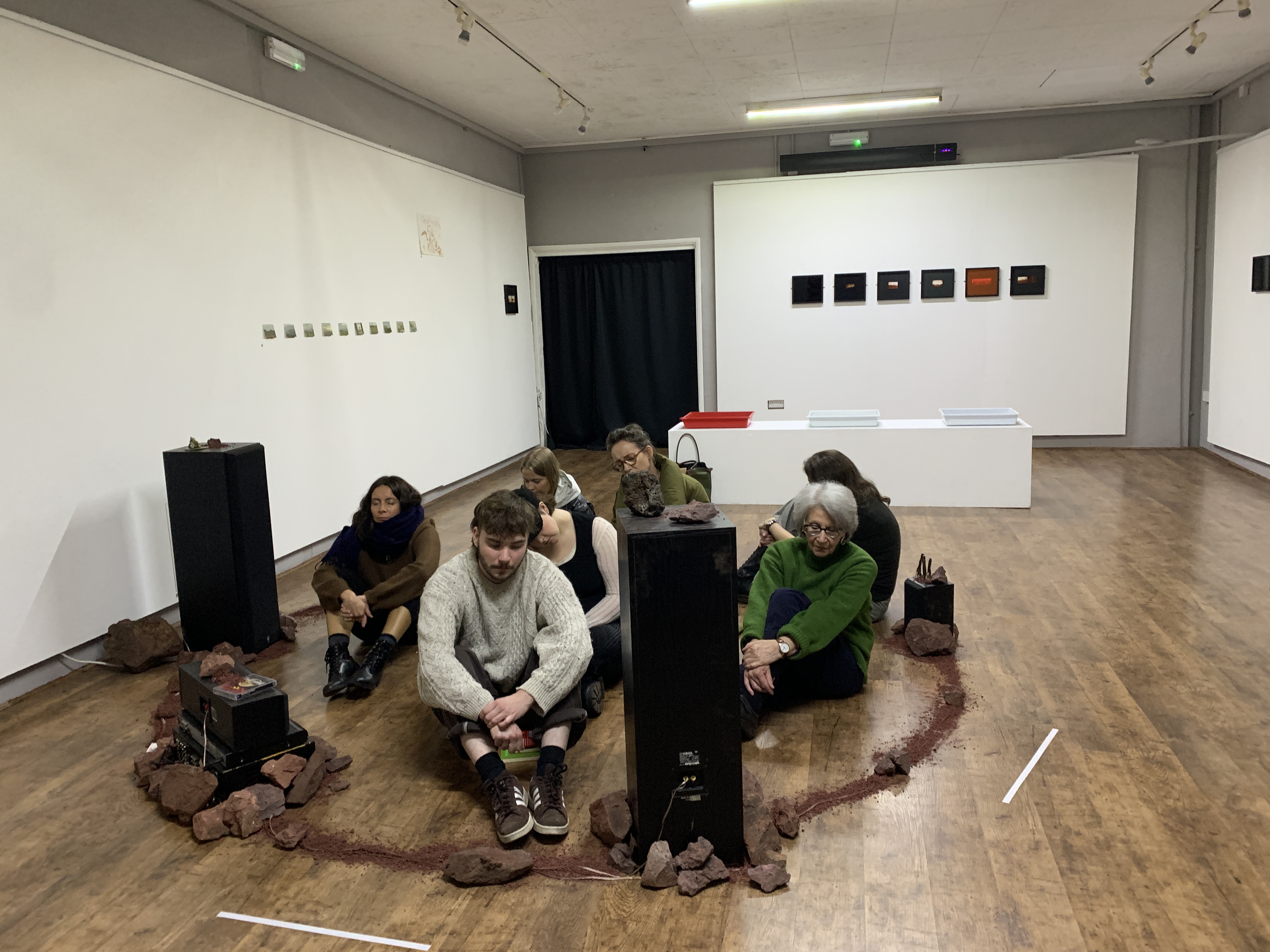
People sit inside a circle with speakers: they are listening to an immersive sound piece, in a gallery

Attendees sit inside Jamie Jenkinson’s immersive 5:1 surround system audio installation, ‘Gathering’
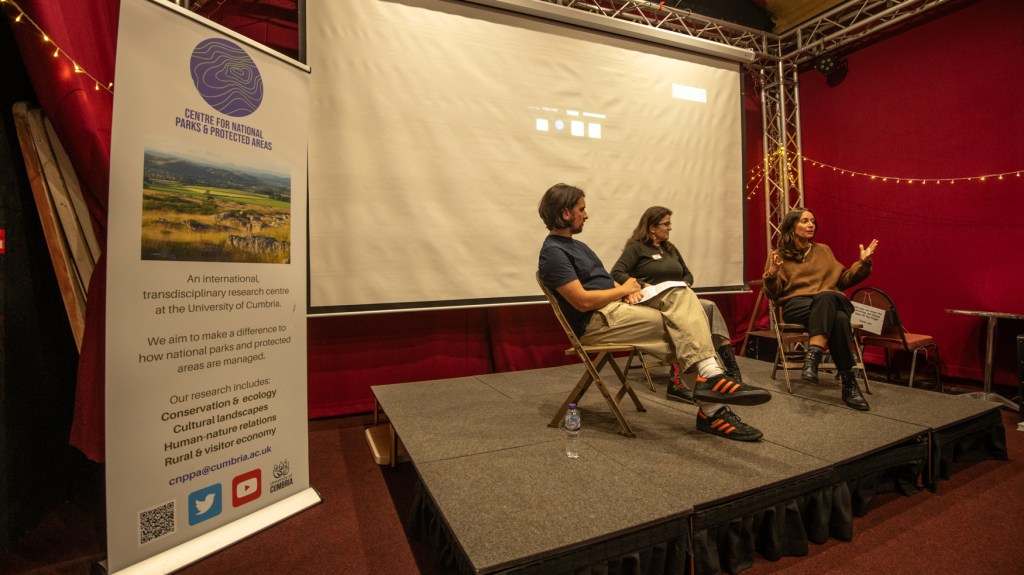
Three people sitting on a stage, one is talking and raising her hands.

The artists’ residency placements and the exhibition have been funded by Arts Council England and Cumberland Council, with support from the University of Cumbria and the Centre for National Parks and Protected Areas (CNPPA). The exhibition is curated by Harriet Fraser and Rob Fraser (somewhere nowhere) of the PLACE Collective, an environmental artists’ collective based at CNPPA. The event was run in partnership with University of Cumbria, Institute for Education – Arts and Society, and with support from Will Rees. The residencies and exhibition are part of Cumberland Council’s Coastal Programme.

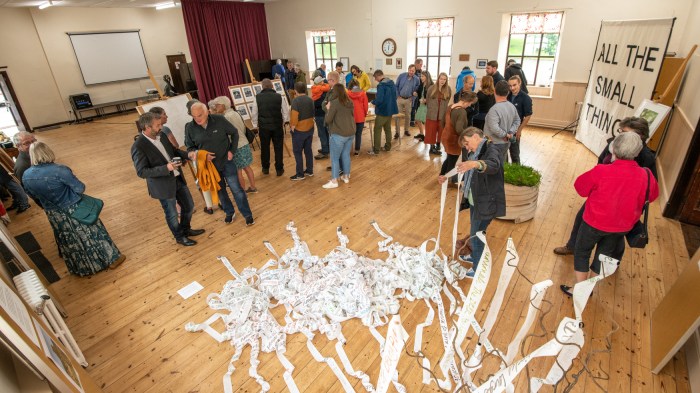
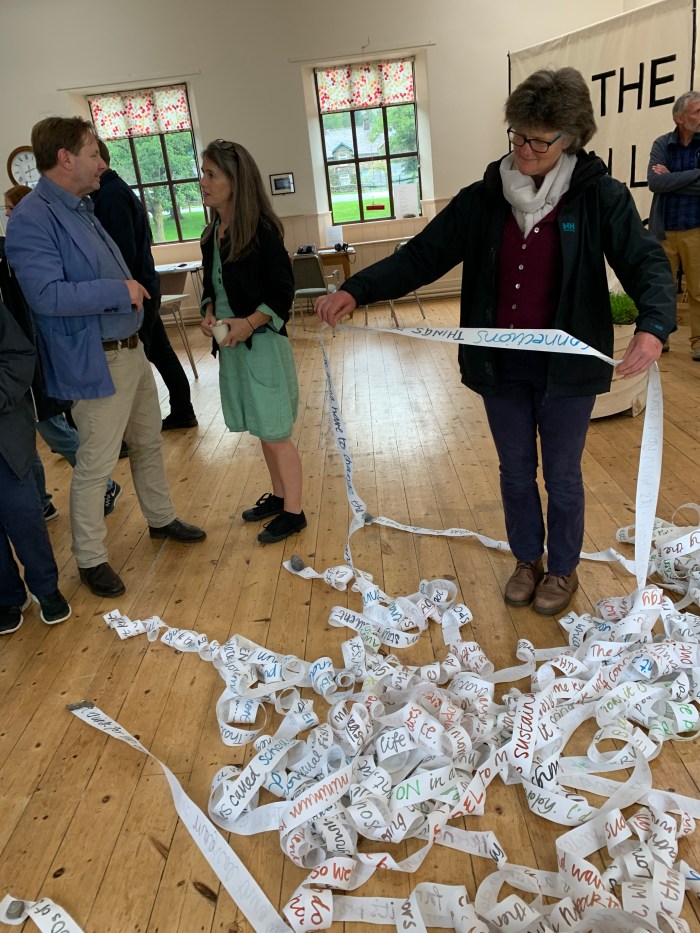
A group of people gather around artworks, with a woman in the foreground looking through long threads of paper

WATERSHED EXHIBITION

Last Tuesday evening, Glenridding Village Hall was buzzing: full of conversation, and a surround of artwork that’s been inspired by meetings these past few months.

This stage of the Watershed project has been guided by conversations with local residents and people whose work connects them with land use decisions in the valley. Back in March at a gathering in the village hall, the first conversations began, in a group setting. Since then, the five artists have been meeting people individually and building work in response. The event on Tuesday, and the exhibition, was a way to reflect back to the community what has been shared with us.

The work provides a frame for meetings and conversations, and prompts for thought. How do we individually and collectively care for the valley? What can we learn from each other? What does the natural living word express – and how do people ‘hear’ and respond to that? Where might decisions and actions be better joined up to support the local village communities, and the natural environment? These and other questions floated around the room nudging shoulders with conversations about music, water, poetry, farming, trees, maps and more.

  • People lean over a map which is placed on a table with test tubes in wooden holders arranged round the edge.
  • People at an exhibition looking at work on easels
  • A woman looks through long lines of paper, which have writing on them.
  • A man looks at work mounted on an easel, with a group of people in the background
  • A photograph of a long drawing in an exhibition space
  • A red book containing a small tree is suspended next to a window. The book spine reads 'unseen connections'
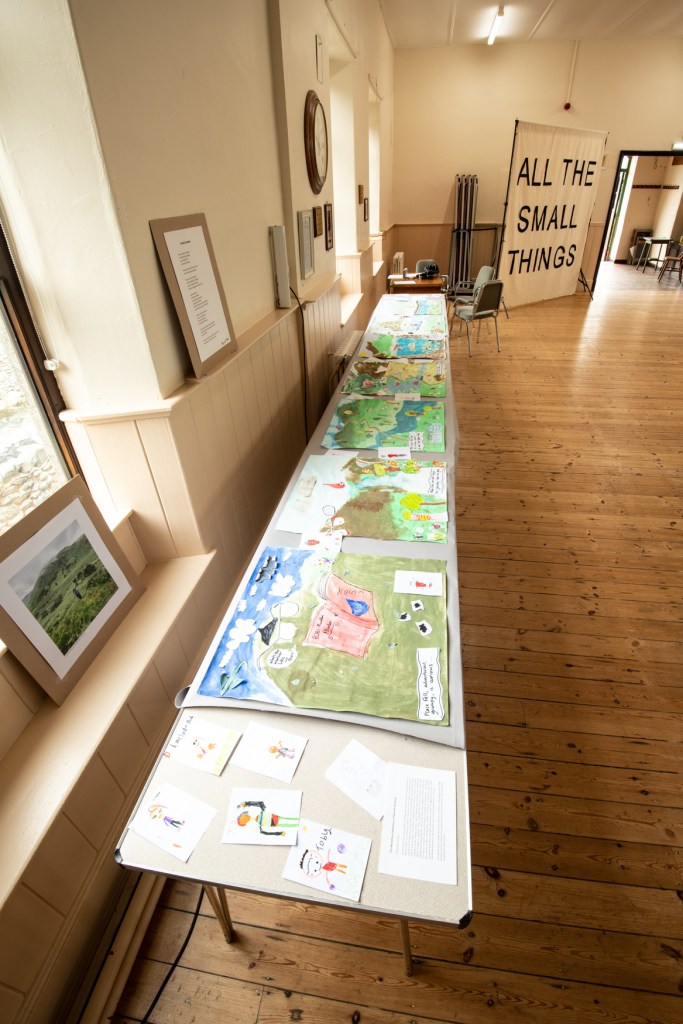
  • An image from an exhibition: a circle of grass-covered earth resting in a wooden sculpture, and a 2.5-metre high canvas with the words 'ALL THE SMALL THINGS'

Guided by Questions

Over the past few months, each artist has met 5 different people. As part of a longer informal conversation, we each asked the same five questions, covering five themes:

Wonder … Where is the wonder for you, in the Ullswater Valley?

Legacy … What would you, individually or as part of a community, like to pass on to future generations in the context of caring for this place?

Other-than-human perspectives … If we were to think about this landscape, with its vegetation and all the inhabitants that aren’t human, as having a voice – what do you think it or they might show us, or ask of us?

Curiosity … What are you curious to find out more about, in the context of this place?

Watershed ripples … What would you like visitors to the exhibition to come away with?

Meetings for the most part took place outside, in places chosen by the interviewees: locations included walks in woodlands and onto the open fells, wanders round farms, time on the lake (including at the wheel of a boat) and even underground, in the old lead mines. The layers of this place that have been shared are physical, historical, philosophical and metaphorical.

The opening event on Tuesday included a showing of Matt’s film, poetry from Harriet, and a performance by Sarah. You can revisit the material in the exhibition catalogue here, and there will be reflections from the artists about the process.

A woman plays cello to a small audience
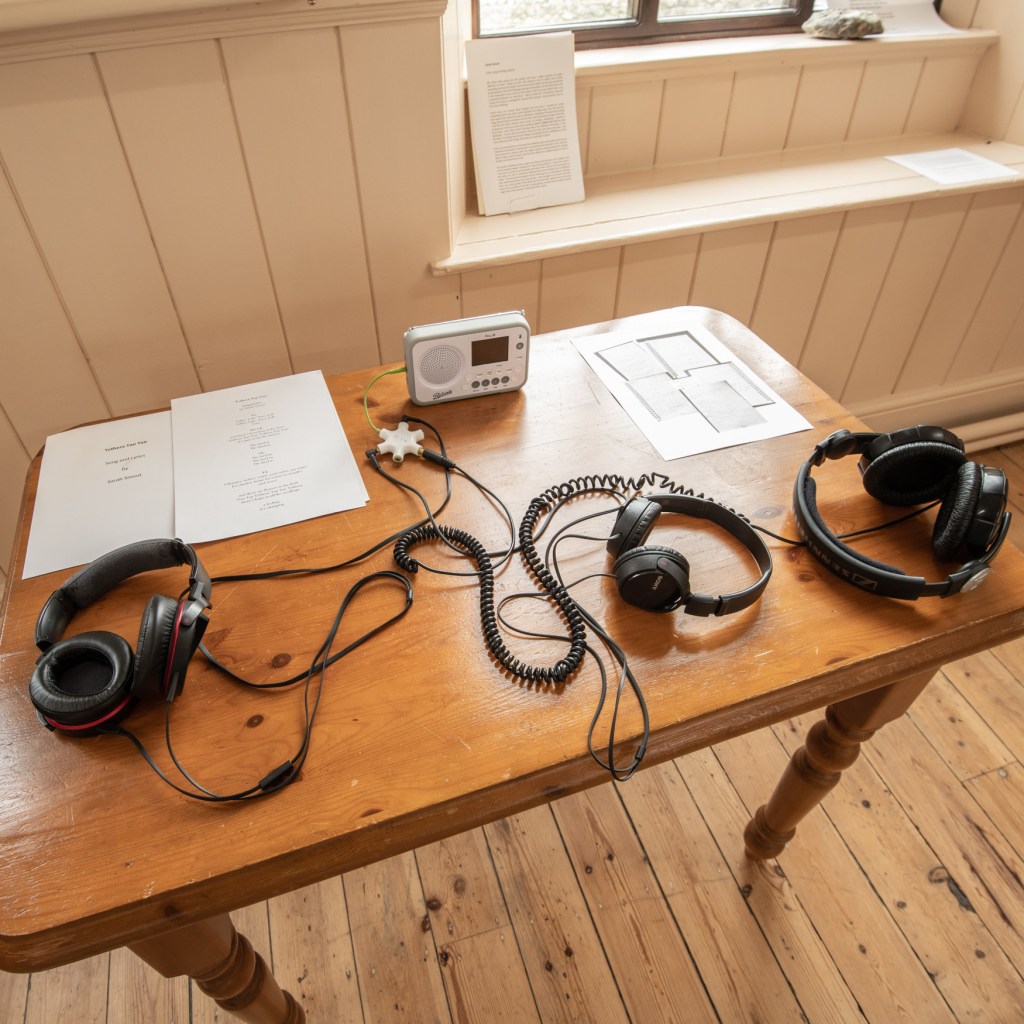
Sarah Smout played an acoustic version of the song she has written and recorded: ‘Tethera Tan Yan’.
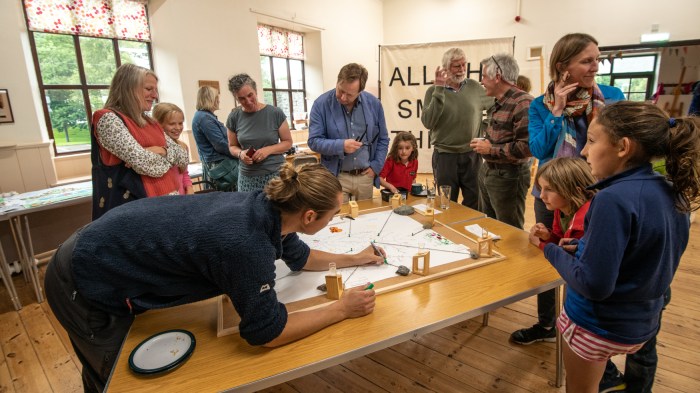
A group of people gather around a map on a table, with one man making marks on the map
The map of waterways, with ten water samples, was a focus for conversations, and became animated with peoples comments and drawings.
A board on an easel, holding ten portrait images; and a large format camera with a cloth
Rob Fraser shared a series of portraits made on his large format camera.
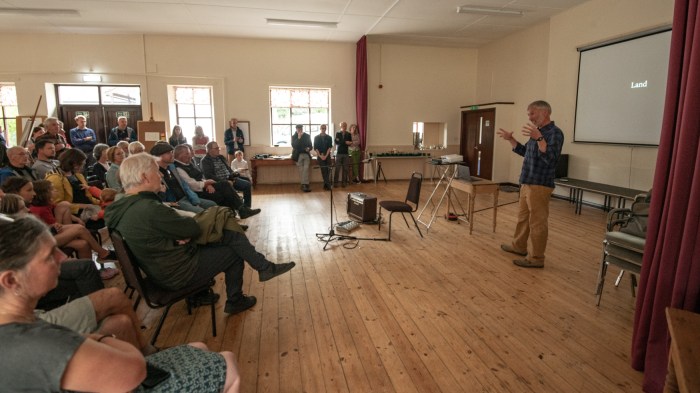
A man stands in front of a seated audience, talking and gesturing as he introduces a film
Matt Sharman introduces his film ‘LAND’
A woman stands in front of an audience in a village hall
Harriet Fraser introducing the project

After the evening event, the exhibition was open to the public for three days – around 270 people came through the doors. Many stayed a long while, pondering the work, and then talking between themselves or with Harriet and Rob. Quite a few people commented that the work ‘made you think – it’s so easy to take things for granted’; and issues highlighted here resonated with issues in other parts of the country. People shared a sense of pride in the place, and a reassurance that many people care deeply for this area. There was a balance of visitors from the valley, from Cumbria, from further afield across the UK, and a few overseas visitors too. One visitor from New York went away motivated to bring artists into a volunteer project campaigning for improved water quality in their harbour.

A series of coloured circles and writing arranged over a map of watercourses and named 'ALL THESE TRUTHS OVERLAP'
‘All These Truths Overlap’ by Rob Fraser
Rolls of paper are spread out on the floor, and tangled together, with writing on them
Kate Gilman Brundrett’s installation, an entanglement of conversations
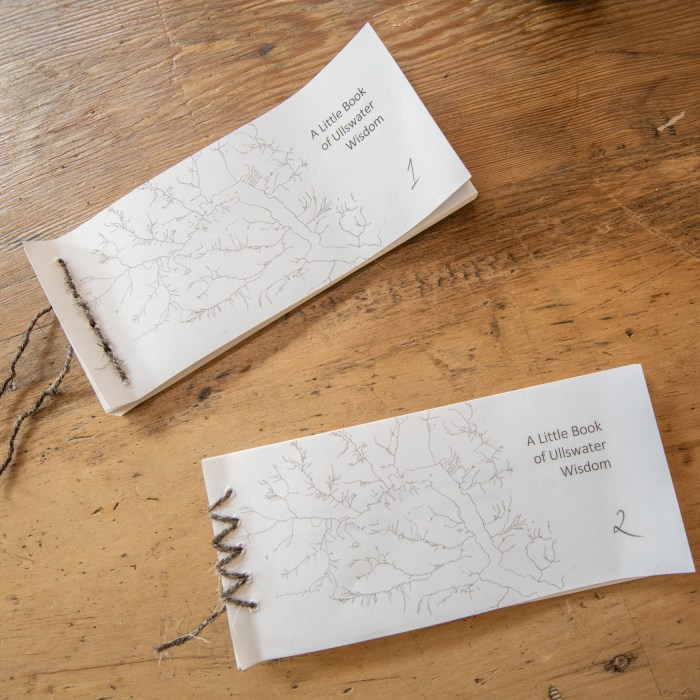
Two hand made books lying on a table.
Harriet Fraser’s pair of hand-made books: containing phrases from conversations in the valley.
A board with post-it notes on

The research will be continuing for 12-18 months, as part of Harriet’s PhD. Within the broad frame of using art as a tool to explore different perspectives and relationships, and to create spaces for conversations, the direction of research will be focused by what has emerged from this stage: a close analysis of the interviews, reflections on the exhibition, and people’s response to the process. ‘I’m curious about cohesion, connections, discussions and joining things up; and what artistic processes may be a useful part of this,’ says Harriet. ‘In the next phase of research I’m looking forward to many more conversations, and to helping out with activities including habitat monitoring and tree planting, and I’ll be taking many long walks within the watershed.’

Five people stand for a photograph, with an image on an easel next to them
Watershed Artists: from left, Harriet Fraser, Sarah Smout, Matt Sharman, Kate Gilman Brundrett, Rob Fraser
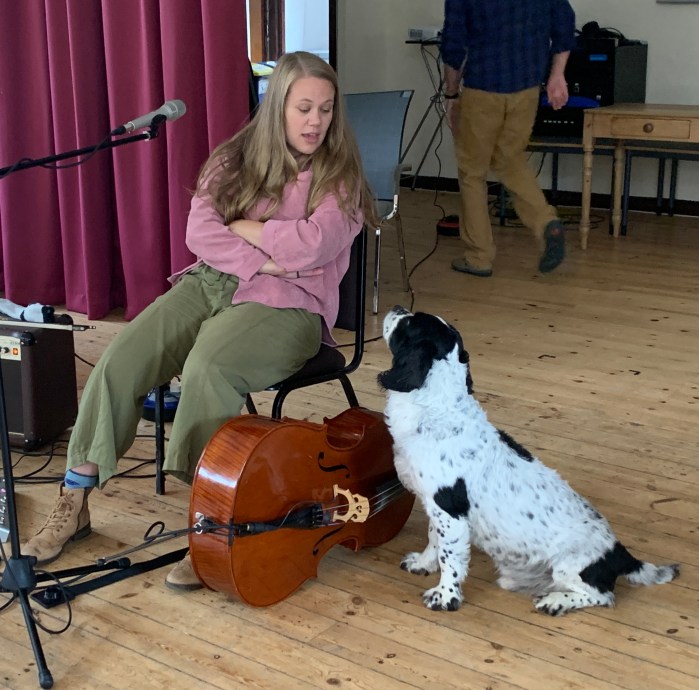
A woman sits on a chair, talking to a black and white dog, with a cello resting between them.
Is it possible to take musical advice from a dog? During sound check, Sarah Smout and Guilly the dog have a chat.
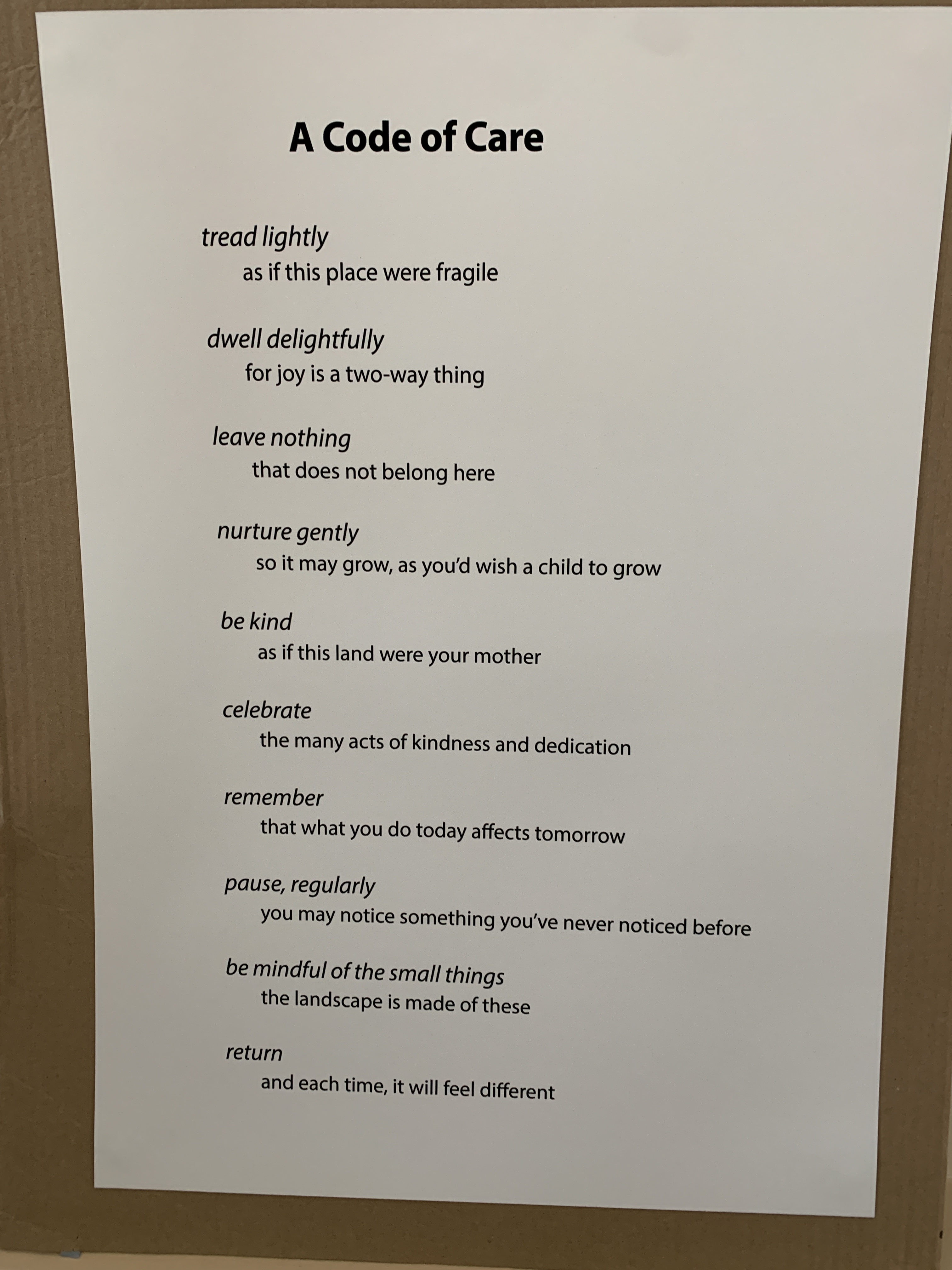
A poetic form of Code of Care writt
Harriet wrote 6 poems for the event. This ‘Code of Care’ was mounted on board outside the village hall, to welcome visitors. it was inspired by local concerns about wider education around caring for rural landscapes.

Two people stand in a stony river installing a 2.5 metre square canvas with the words ALL THE SMALL THINGS
Watershed Canvas: Harriet Fraser and Rob Fraser installing the canvas on Glencoyne Beck, July 2023

For more on the Watershed project, search this site for ‘Watershed’ … or visit the project page here. Or click to read a blog on Matt’s film-making process, or on Sarah’s journeys in the valley.