In times of uncertainty, it is worthwhile to examine what we can see, where we find it and what the moment requires.
The now-ness is clear; all who will work in good faith where they stand are needed -there is much work we need to do.
Lance Oditt has for many years been working with, and documenting, Pando – the world’s largest single tree. Here he introduces Pando, and the tree rubbings he is showing at the PLACE Collective’s See Here Now exhibition in Grizedale Forest.

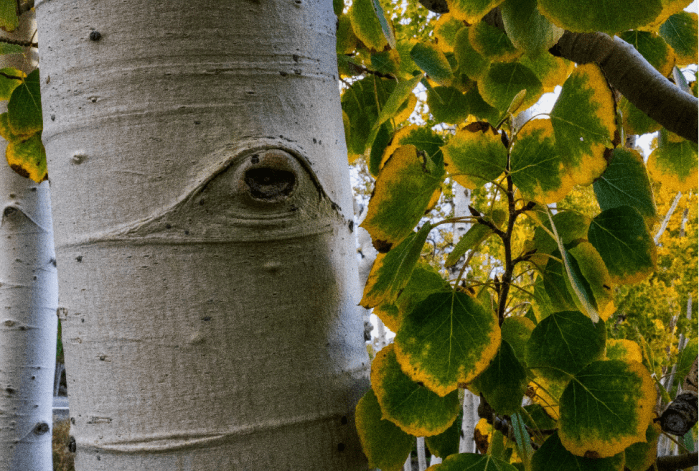
Pando spreads for more than 100 acres in Fishlake National Forest
Introducing Pando
The Pando Tree is the largest tree of any kind. Located in Fish Lake, Utah (Elev: 2804m), Pando is simultaneously the largest tree by weight (6000 metric tons/13.2 million pounds), the largest tree by landmass (42.8ha/106 acres/.75km²), the largest aspen tree (Populus tremuloides) and, the largest clone tree in the world. A recent ‘discovery’, Pando was first documented in 1976 and verified as a single tree by genetic testing in 2008. Although individual trunks do not live longer than about 150 years, the tree is in a constant state of regeneration and has been, for some 9,000 years, making Pando the oldest tree in the Americas, and one of the oldest lifeforms on Earth.
Comprised of an estimated 47,000 genetically identical trunks that are interconnected by a root system that could span halfway around the world, Pando is a master of collaboration.

Born of a seed the size of a piece of oatmeal, Pando, whose name is Latin for “I spread”, moves back and forth across its homeland amoeba-like; each new trunk forming a hub from which the root system spreads again. Comprised of an estimated 47,000 genetically identical trunks that are interconnected by a root system that could span halfway around the world, Pando is a master of collaboration. The roots and trunks coordinate energy production, defense and regeneration as a single organism: one tree operating on extraordinary scales of space and energy. In summer, the tree’s one billion leaves capture enough sunlight to power 191 homes every day, transforming 986 pounds of carbon dioxide and light into 205,000 calories of energy per hour during peak growing season (June to September).
Hiding in plain sight for thousands of years, Pando had grown beleaguered by management policies put in place before its ‘discovery’ by people. Today, Friends of Pando works alongside Fishlake National Forest and our community partners to expand protections, monitor the tree, and to restore arable land to promote Pando’s health.
Print Making with Pando
Inspired by Pando and the works of Anna Atkins, a botanist who was the first person to illustrate a book with photographs, in 2019, I began to explore ways to document Pando directly. With so many concepts for Pando tangled up with network-era neologisms, I wanted to work in black and white and in analog. As the tree had never been fully documented, I wanted to work without artifice or conceit to create prints that showed a direct relationship between the tree, and humans.
Using rolls of rice paper draped around individual trunks, I rub the paper with printmaking crayons, allowing shapes and textures to guide the finished print. An ongoing effort, the prints provide a scientific and aesthetic record that reveals intricate dynamics at play. As Pando’s root coordinates action below ground, above ground we find extraordinary variation in the trunks which reveals insights about the whole tree. In these seven prints; stories of weather, water and competition, animals, insects and light. In all, 7 prints that reveal variation that provides a richer story about this ancient wonder we are just coming to know.
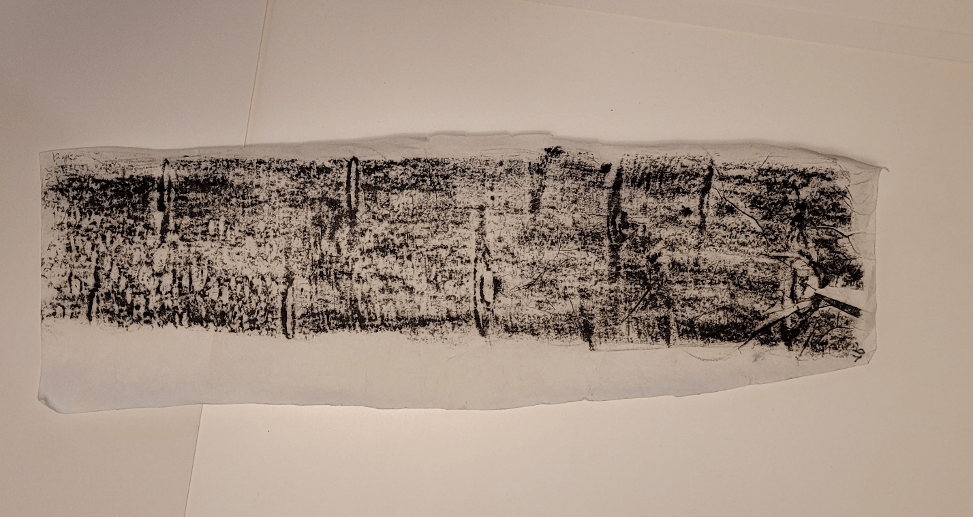
“I wanted to work without artifice or conceit to create prints that showed a direct relationship between the tree, and humans.”
Click ‘Watch on YouTube (bottom right) to open in new tab
What does the moment require?
In times of uncertainty, it is worthwhile to examine what we can see, where we find it and what the moment requires. In Pando, we find the largest tree of any kind, and one of the oldest living things on Earth. Arguably, were we to ignore the care this ancient being needs, what could we say about our best efforts elsewhere? As Pando’s remote mountain home provides a high desert oasis used by humans for some 10,000 years, its protection, study and care is fully in our hands. The now-ness is clear; all who will work in good faith where they stand are needed—there is much work we need to do.
Arguably, were we to ignore the care this ancient being needs, what could we say about our best efforts elsewhere?
In many ways we can protect, monitor and restore Pando quite like we would a perineal crop, year over year. Those who can work here, can help remove some 26.5 acres (10.72ha) of Juniper Bush, and doomed conifer trees, to open up arable land and help oxygenate the soil stimulating new growth. Those who cannot join work in Pando should know, we need strong voices that can surmount the nonsensical din of click-bait media coverage that would have you believe Pando is dying, doomed, or a lost cause. A state of affairs which not only exhausts interest, goodwill and investment, but also shifts responsibility from now, to some future time.
Just as the Pando Tree is able to connect and re-connect to expand outward and sustain itself, we too must connect to build a network of concern. Work to gather light and speak for this now—each new connection, a hub from which work can spread again.

Just as the Pando Tree is able to connect and re-connect to expand outward and sustain itself, we too must connect to build a network of concern.

Upcoming Talk: May 14, 2025
The artist also welcomes you to join in a talk about the tree at the Royal Scottish Geographic Society in Perth, Scotland on May 14th, 2025.