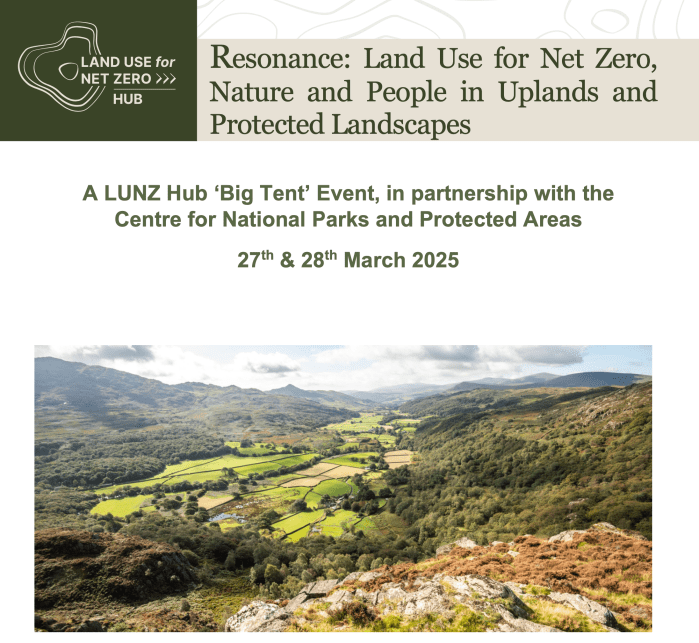
Super excited about the upcoming event in Cumbria, focusing on Land Use for Net Zero, Nature and People in Uplands and Protected Landscapes. The PLACE Collective is running this through our work with the UK LUNZ Hub, and in partnership with the Centre for National Parks and Protected Areas.
It’s a multi-person effort with site visits and an evening meal on Thursday March 27, and a full-day of discussions on Friday March 28. There’s info about the event on this website here; and if you’re curious to see the detail, download the Delegate Information Pack here.
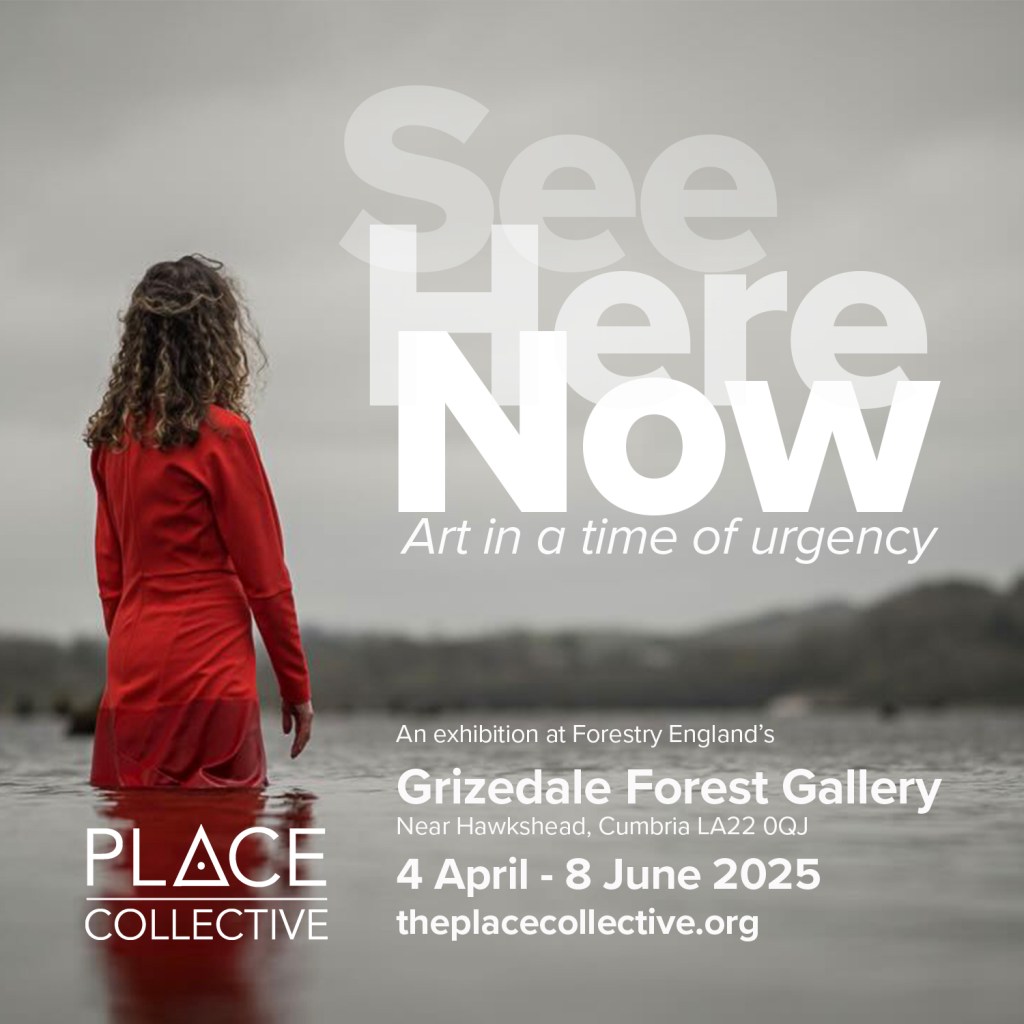
After a long time planning, a group of PLACE Collective artists will be exhibiting work in the stunning galleries of Grizedale Forest, Cumbria, in response to the theme of Art in a Time of Urgency.
All of our practices are concerned with better understanding and caring for the living world – yet in a time of increasingly frequent severe weather events, melting glaciers, political instability, and a critical need for nature recovery, what might artists do? What work do we create, what questions do we ask, what stories do we tell? What might we do differently?
MEET THE ARTISTS AND JOIN THE EXHIBITION PREVIEW, APRIL 5TH
Mark your diaries for a visit, and watch out for blog posts in the coming weeks featuring insights from exhibiting artists.
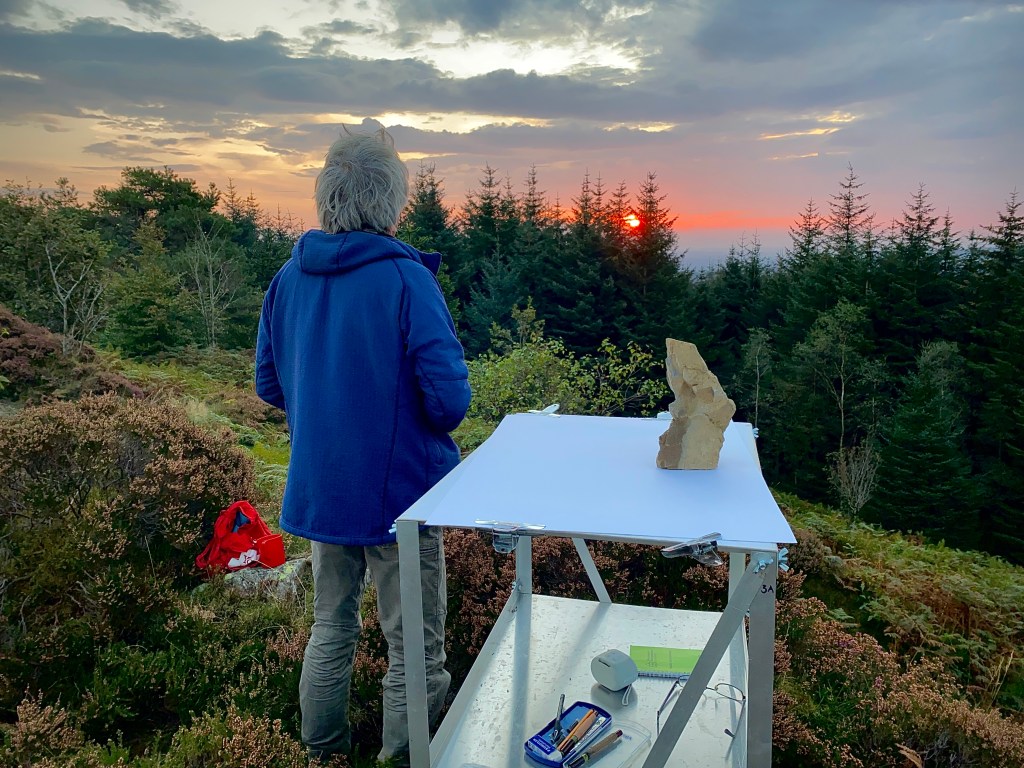
Exhibiting in Grizedale Forest is to build on a legacy of thoughtful and often boundary-pushing art. It’s a privilege to bring an exhibition to this venue, and while not all work centres on the forest, or even on trees, some artists have chosen to create work in and in response to Grizedale Forest – more will be revealed when the show opens.
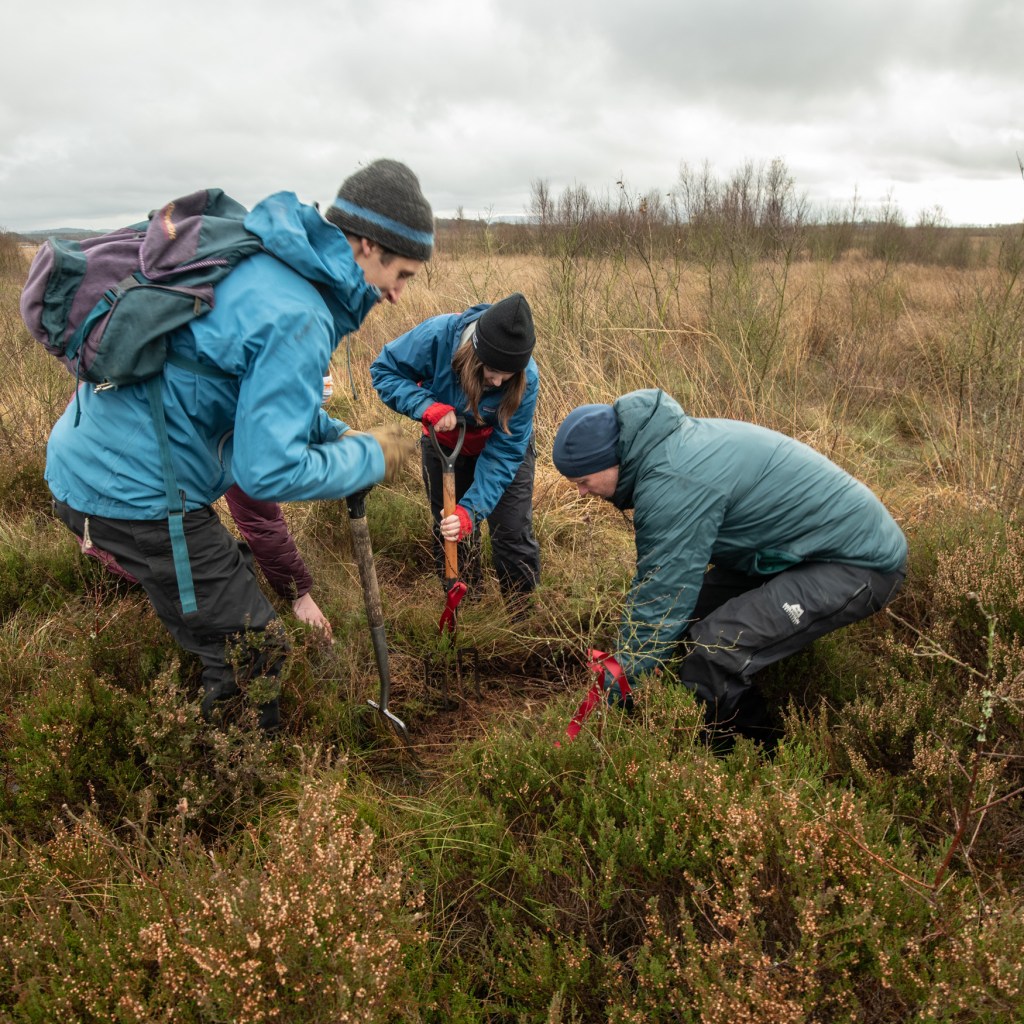
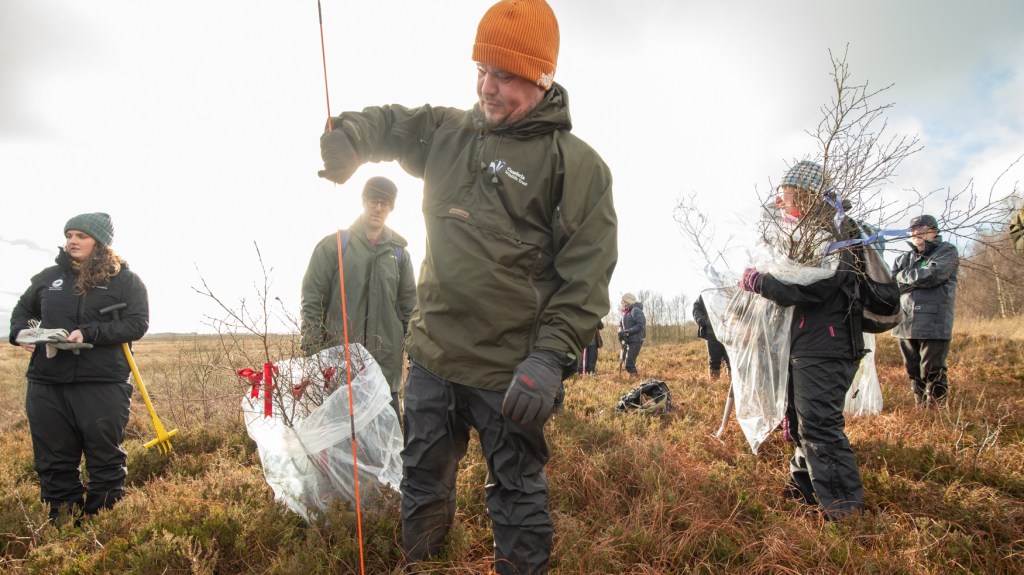
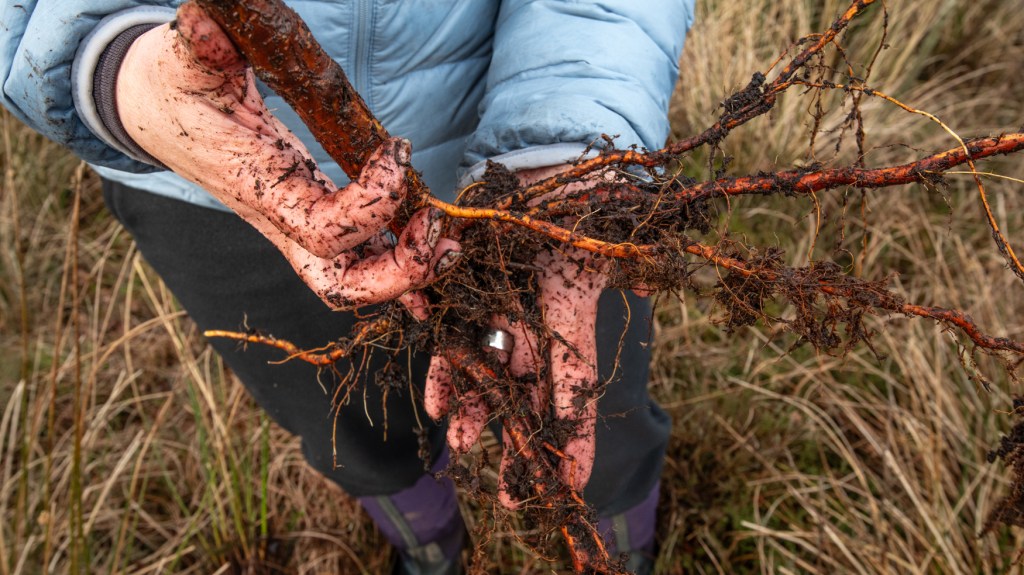
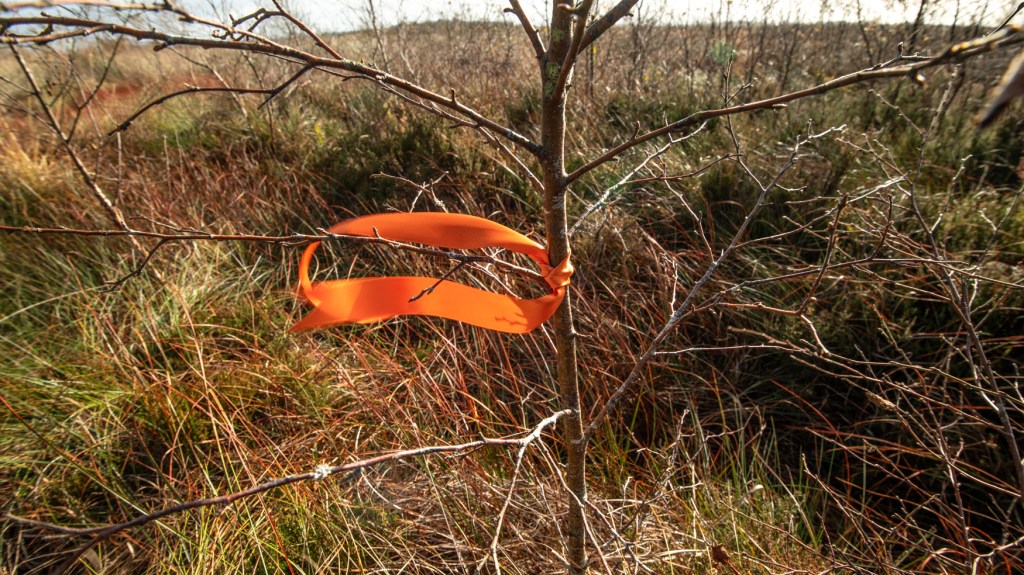
Since last November, the Resonance project has been moving on. It revolves around 49 silver birch trees, which have been collected from Bolton Fell Moss peat bog that’s in a process of restoration, and are being planted out in seven tight circles, each of seven trees, across the Lake District National Park.
This is part of the PLACE Collective’s work through the UK-wide Land Use for Net Zero, Nature and People Hub – or LUNZ HUb for short. Working within the LUNZ Hub team, we’re convening opportunities for people from across practice, research and policy to get together, share learning, and focus on actions; all part of a just transition in a time when changes in land management need to be big, and at scale, to mitigate impacts of climate change, nurture recovery of biodiversity and ecosystems, and embed resilience and natural regeneration in UK land use.
Head over to the project page for Resonance to find out more, and watch for updates – there are reflections on the Big Dig Day here, and a reflection on the key take outs from that event on the LUNZ Hub website.
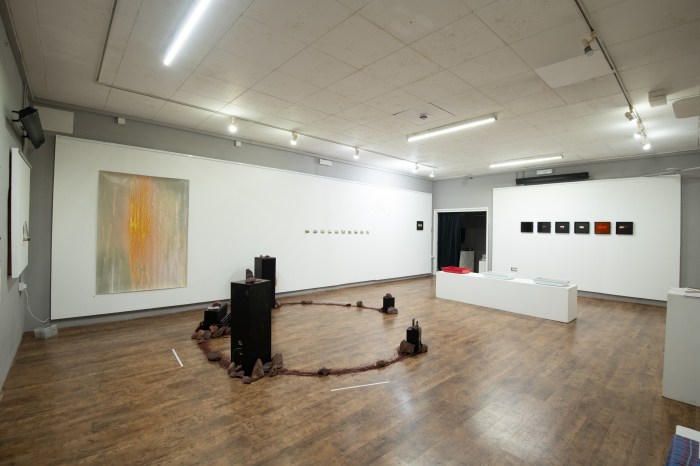
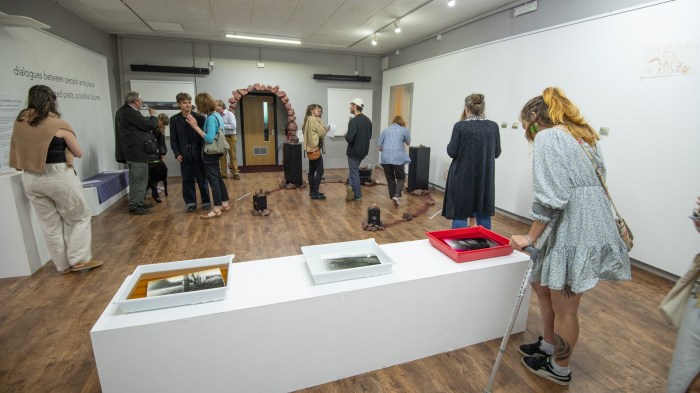
A few images of the exhibition in place at Florence Arts Centre: Half Lives / Gathering / The Flow, with artwork from Alistair Debling, Jamie Jenkinson and Cristina Picchi. Despite undertaking very different residency journeys, there’s a cohesion in their work – considering time, relationships to place, what’s seen and unseen. For more on their approaches, there’s background in our previous post here.
“Like layers of rock, these invisible and inaudible histories are within the foundations of these landscapes; hidden but not forgotten, lingering beneath our feet. The Flow raises questions about how we shape our environments and, in turn, how they shape us.” Cristina Picchi
“The installation not only portrays this process of collection but symbolises a convergence of people, landscapes and experiences, underscoring the communal essence at the heart of Jenkinson’s practice.” Will Rees
exhibition guide
For more, you can read reflections from each artist, with captions for each piece, in this exhibition guide, which has been put together by Will Rees.
ONE-DAY EVENT: PLACE, ART, RESEARCH
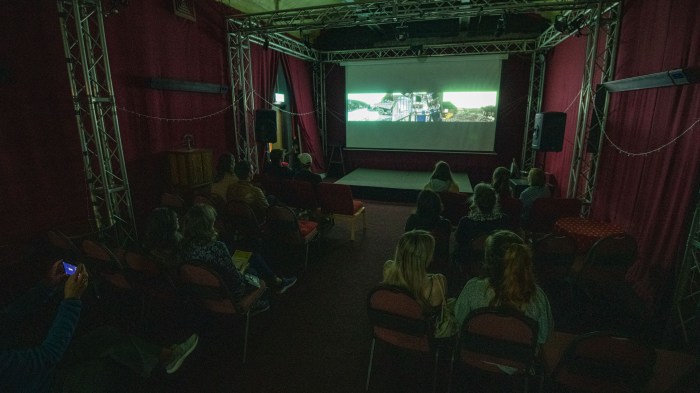
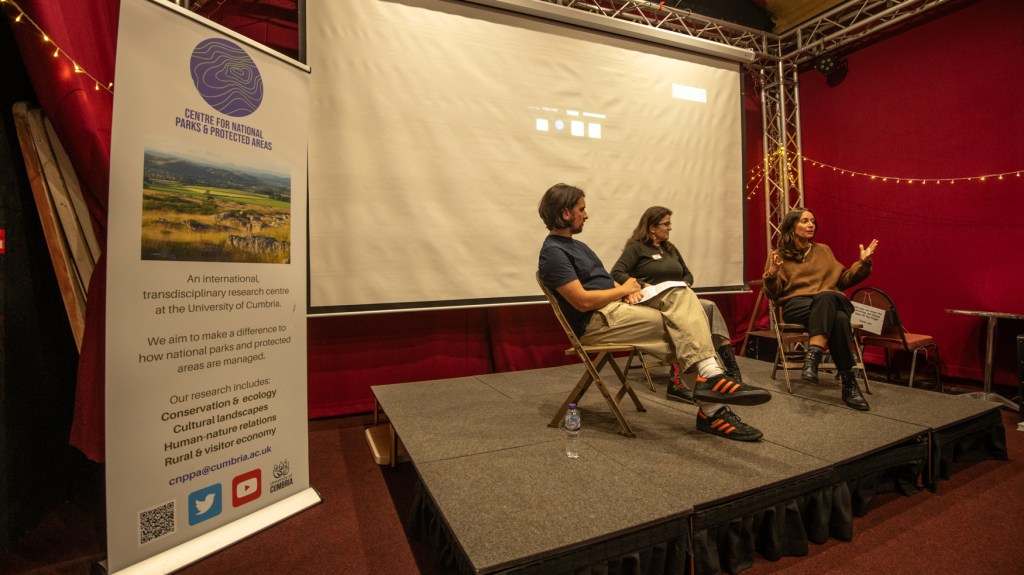
While the exhibition was on show a one-day event was held at Florence Arts Centre. This was an opportunity for the artists to talk about the process of their work, and join academics from CNPPA to reflect on the impact of their inter-disciplinary collaborations. Rich conversations explored the experience of artists working with scientists and specialists in other professions both in a panel discussion session, and in small groups.
The day was co-run with Dr Martin Fowler from University of Cumbria, and was attended by university students and by local artists. In breakout sessions, groups were invited to discuss the issues raised in the panel sessions, and talk about the role of artists today – both in West Cumbria and more widely.
It was a lively afternoon with one of those conversations that kept us all in the building longer than we planned to stay! There was a strong sentiment from the group about the necessity of artists – and other researchers and academics – to challenge current systems (including the education system), offer social commentary, and to contribute critical thinking to debates and discussions about caring for places, and the way stories are told, and by whom.
For students who attended the day, the discussions continued during their course with Dr Fowler and other lecturers, and have fed into their production of dissertations.
“Confronting the deep time of the nuclear industry gives us an opportunity to consider which parts of our culture are important to hold onto for future generations, and which areas might be radically reimagined.” Alistair Debling
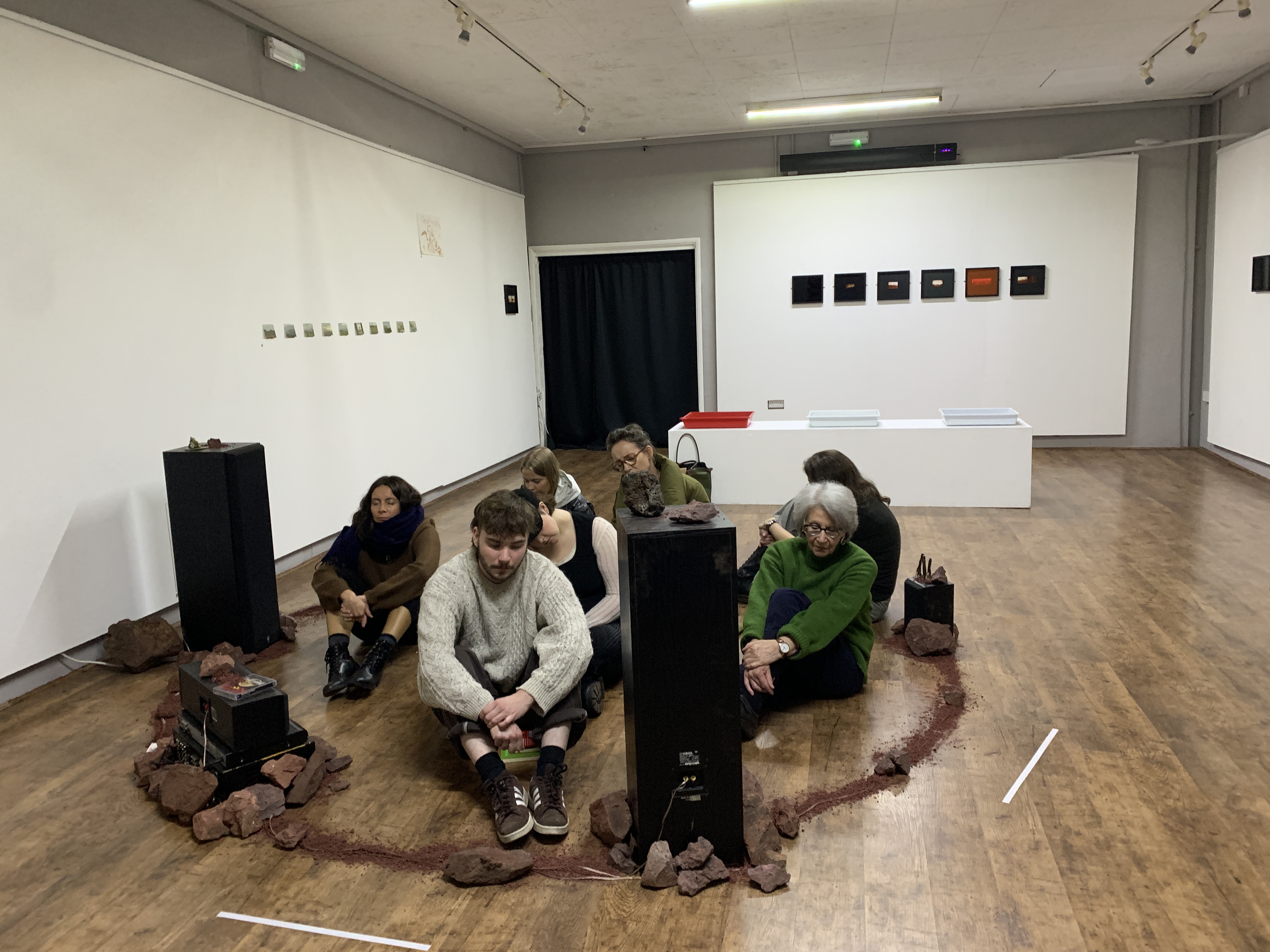
Attendees sit inside Jamie Jenkinson’s immersive 5:1 surround system audio installation, ‘Gathering’
The artists’ residency placements and the exhibition have been funded by Arts Council England and Cumberland Council, with support from the University of Cumbria and the Centre for National Parks and Protected Areas (CNPPA). The exhibition is curated by Harriet Fraser and Rob Fraser (somewhere nowhere) of the PLACE Collective, an environmental artists’ collective based at CNPPA. The event was run in partnership with University of Cumbria, Institute for Education – Arts and Society, and with support from Will Rees. The residencies and exhibition are part of Cumberland Council’s Coastal Programme.
Cumbria Coastal Residencies: Exhibition at Florence Arts Centre, Egremont
September 6 – October 13, 2024
A year on from their research along Cumbria’s coast, three artists will be sharing work at Florence Arts Centre. It’s an exciting and thought-provoking exhibition that gives insights into each artist’s work and the role of collaboration and process in arts-research.
Alistair Debling, Jamie Jenkinson and Cristina Picchi were selected from more than 100 applicants. In 2022 they headed to the west coast of Cumbria as part of Cumberland’s Coastal Programme. The artists were paired with an academic specialist at the Centre for National Parks and Protected Areas at Cumbria University, to promote interdisciplinary collaborations in place-based research. It’s been great for the PLACE Collective to have helped with creating these connections, and to co-curate the exhibition.
Each artist approached their exploration of the west coast of Cumbria in a different way, encountering new places and perspectives with the support of local residents, and developing their specific line of enquiry and their creative responses.
About the artists and their work
The artists’ work is concerned with place, queer ecologies, what goes unseen, how nature and industry interact, arts-science research, and the power of art to shift narratives. They resist Romantic visions of the Lake District; instead, their research has been driven by an interest in in/visibility, safety and scales of time.
Their film, photography, installation and audio pieces reveal unseen aspects of lives on the west coast and invite discussions about identity, belonging, heritage and futures.
Alistair Debling: ‘Half Lives’
– architectures of safety; (re)presentations of nuclear, mining and farming perspectives. Film and installations.
“Half Lives features interviews with members of Sellafield Nuclear Power Station’s internal LGBTQ+ network. Sellafield stands on the site of the UK’s first nuclear weapons tests, which then became Britain’s first nuclear power station. It had an extended life recycling European nuclear waste until finally starting a 100 year decommissioning process in 2022. Sellafield is a seemingly unlikely host of one of West Cumbria’s only public-facing queer groups. However, conversations with queer-identifying staff reveal unexpected connections between the work of decommissioning—of building, architecturally, extraordinarily safe spaces—and the work of the network to build socially safe spaces within a historically unwelcoming industry.”
Based in Cumbria, Alistair Debling makes films, photographs, performances, meals and installations that share unexpected stories about rural life. His work investigates the relationships between diverse fields, from ecology and queer nightlife to militarism, agriculture and architecture.
Jamie Jenkinson: ‘Gathering’
– local voices and shifting of scales in time and place Side specific sound installation, illustrations and images.
Towsey Hole Bats ≈ Gathering ≈ Jamie Jenkinson. image taken while recording audio with local guides, iPhone 13 pro, 2022IMG_5479, from Fleeting photo series, iPhone 13 pro, 2022
gathering is a 5.1 surround sound archive, recorded in 2022 during 30 days backpacking across what was the Copeland District. This alternative archive — currently exhibited as nattering at Millom Library — comes together around experiences of gatherings. Reflecting current and lost pockets of habitation / community / sharing that have left their marks across the district. Pubs / vapour bars / repurposed nightclubs / the peak of Scafell Pike / peak tourist season / ancient stone circles / Roman ruins / banks of Sand Martins / St Bees’ Guillemots / sands of Drigg / cairns / Sellafield’s nuclear waste / Haverigg’s Black-headed gulls / caves of Alcathoes bats / fires on the beach / … These places became sites of dialogue with people / animals / foliage / landscapes / elements, recorded and collated to surround and traverse the listener, as a place of gathering.
Jamie Jenkinson is an artist, researcher, and programmer based in sunny Morecambe. He is interested in low-cost and accessible creative practices, user cultures, quantum philosophies, improvisation and decentralisation. Jamie is an associate tutor at the Royal College of Art, and co-programmes the online platform xviix, and Morecambe project space, Jewellers.
Cristina Picchi: ‘Flow’
– water, the shaping of place, and the microscopic worlds within water Film, three screen presentation.
“For The Flow, I followed a metaphorical river (in reality, made of different streams and rivers) from its source, through the fells, the lakes and eventually to the sea taking in abandoned mines, lighthouses, and the slow mechanic movement of the off shore wind farm. Local biologist Gill Notman gathered and tested water samples and the results and microscopic images are featured in the film. Sound design is a vital part of my practice and I used contact microphones to capture the vibrations of objects and locations on land and underwater, which became part of an immersive soundscape reflecting the place and people’s past and present, against a backdrop of ghostly industrial leftovers and breathtaking coastline.”
Cristina Picchi is an Italian filmmaker, artist and writer. Her short films, documentaries and video installations have been screened worldwide, winning prizes including the Silver Leopard in Locarno, and a nomination for Best Short Film at the Italian Academy Awards and at the European Film Awards. Picchi is currently developing a feature creative documentary, About The End, exploring apocalyptic scenarios and fantasies in different communities and continents. The film was nominated for the Solinas Scriptwriting Prize and is supported by the Swedish Film Institute and the Sundance Institute.
Alistair Debling met with Dr Lois Mansfield, former Professor of Upland Landscapes at the University, and now Rural and Environmental Land Management consultant at Environmentors, and with Dr Jamie Mcphie.
Funding
The artists’ residency placements and the exhibition have been funded by Arts Council England and Cumberland Council, with support from the University of Cumbria and the Centre for National Parks and Protected Areas. The exhibition is being curated by Harriet Fraser and Rob Fraser (PLACE Collective co-founders), with additional support from Will Rees. The residencies and exhibition are part of Cumberland Council’s Coastal Programme.
How might we hear leaves speaking? What does it mean to share soil, water and air with trees and other living things? Can sound and technology open up new empathic relationships? Reiko Goto Collins (Collins + Goto Studio) will be sharing Hakoto performances, followed by a discussion, this June at Glasgow International Festival of Contemporary Art. She’ll be coming to Glasgow after performing in Vienna and Cologne.
Reiko’s work also features in the Peace Arbour: her creation of a fruit tree nursery alongside Yoko Ono’s Wish Tree and Zana Araki’s Diverse Beings – Feel My Frequency – Lines of Connection. The trio’s work responds to the themes of trees, hope and healing; it offers a space for discussions and the expression of wishes, needs and aspirations for peaceful futures.
Last Tuesday evening, Glenridding Village Hall was buzzing: full of conversation, and a surround of artwork that’s been inspired by meetings these past few months.
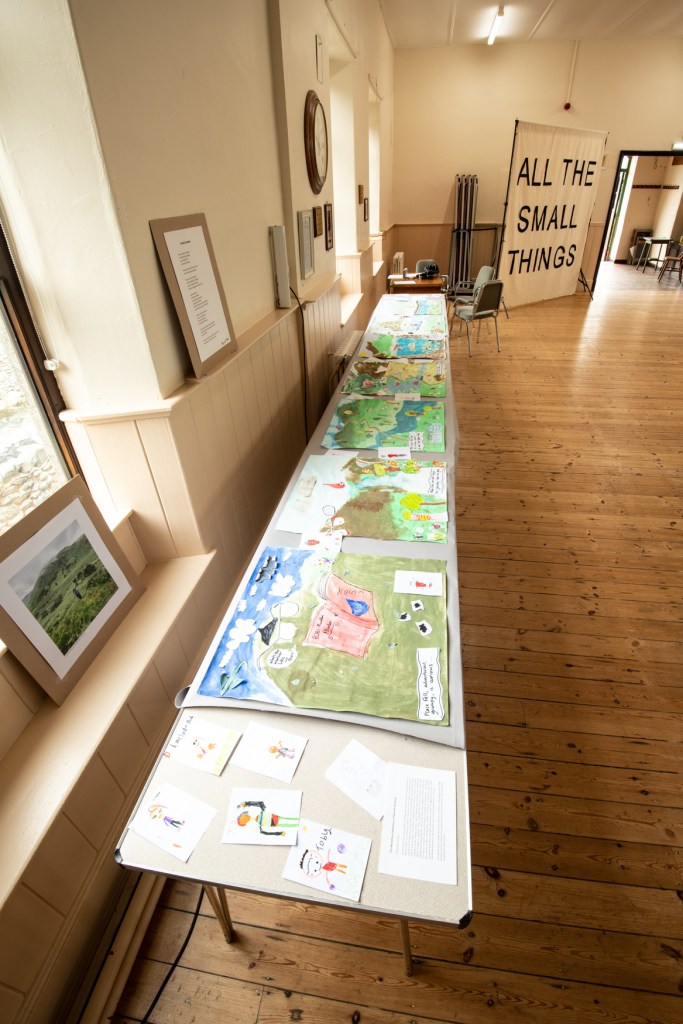
This stage of the Watershed project has been guided by conversations with local residents and people whose work connects them with land use decisions in the valley. Back in March at a gathering in the village hall, the first conversations began, in a group setting. Since then, the five artists have been meeting people individually and building work in response. The event on Tuesday, and the exhibition, was a way to reflect back to the community what has been shared with us.
The work provides a frame for meetings and conversations, and prompts for thought. How do we individually and collectively care for the valley? What can we learn from each other? What does the natural living word express – and how do people ‘hear’ and respond to that? Where might decisions and actions be better joined up to support the local village communities, and the natural environment? These and other questions floated around the room nudging shoulders with conversations about music, water, poetry, farming, trees, maps and more.
Guided by Questions
Over the past few months, each artist has met 5 different people. As part of a longer informal conversation, we each asked the same five questions, covering five themes:
Wonder … Where is the wonder for you, in the Ullswater Valley?
Legacy … What would you, individually or as part of a community, like to pass on to future generations in the context of caring for this place?
Other-than-human perspectives … If we were to think about this landscape, with its vegetation and all the inhabitants that aren’t human, as having a voice – what do you think it or they might show us, or ask of us?
Curiosity … What are you curious to find out more about, in the context of this place?
Watershed ripples … What would you like visitors to the exhibition to come away with?
Meetings for the most part took place outside, in places chosen by the interviewees: locations included walks in woodlands and onto the open fells, wanders round farms, time on the lake (including at the wheel of a boat) and even underground, in the old lead mines. The layers of this place that have been shared are physical, historical, philosophical and metaphorical.
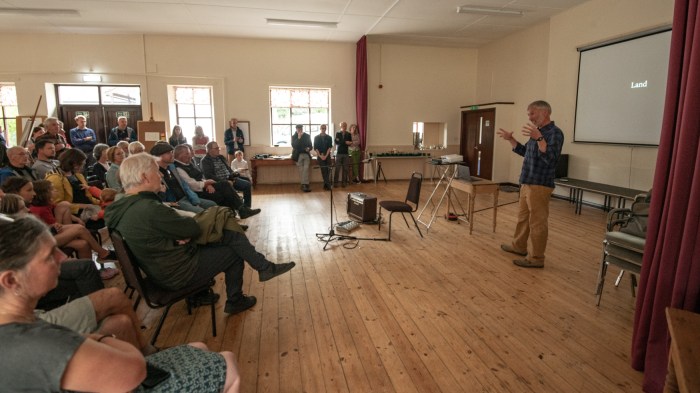
The opening event on Tuesday included a showing of Matt’s film, poetry from Harriet, and a performance by Sarah. You can revisit the material in the exhibition catalogue here, and there will be reflections from the artists about the process.
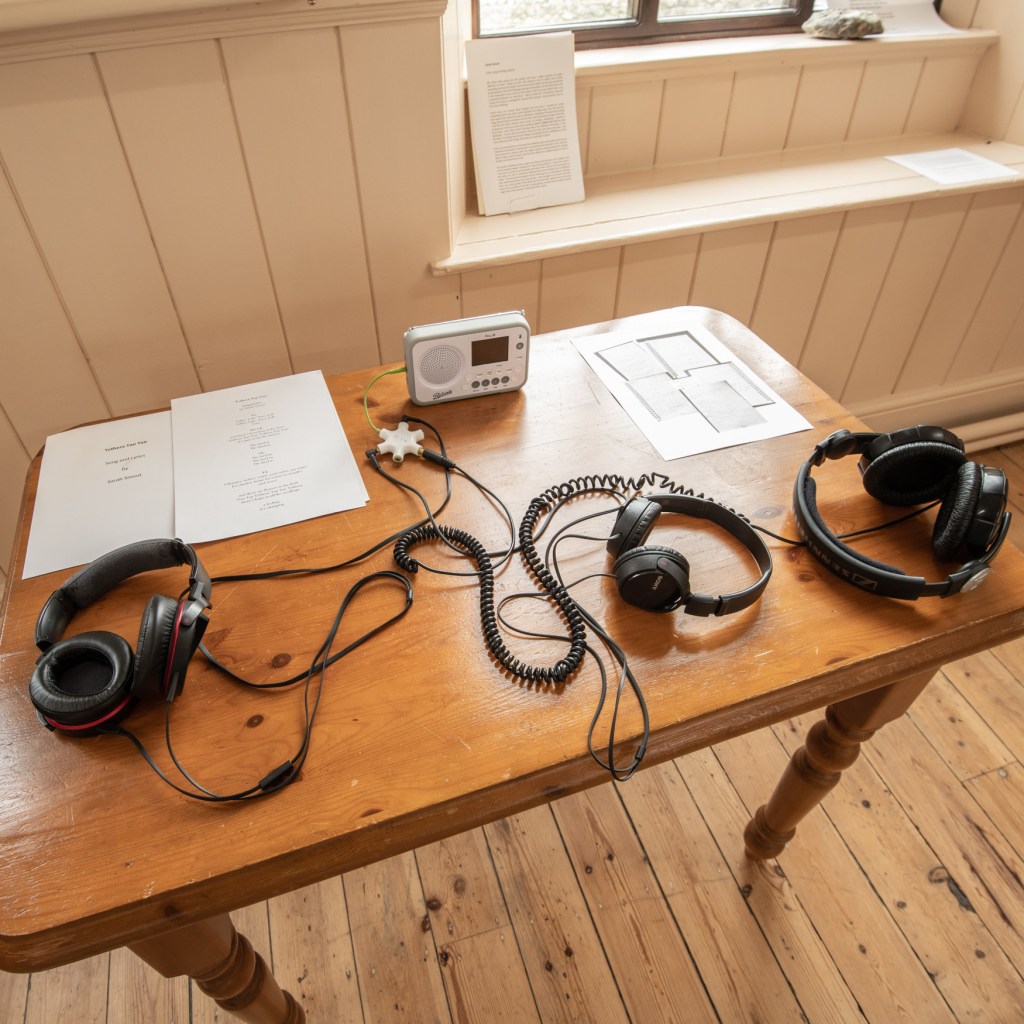
Sarah Smout played an acoustic version of the song she has written and recorded: ‘Tethera Tan Yan’.
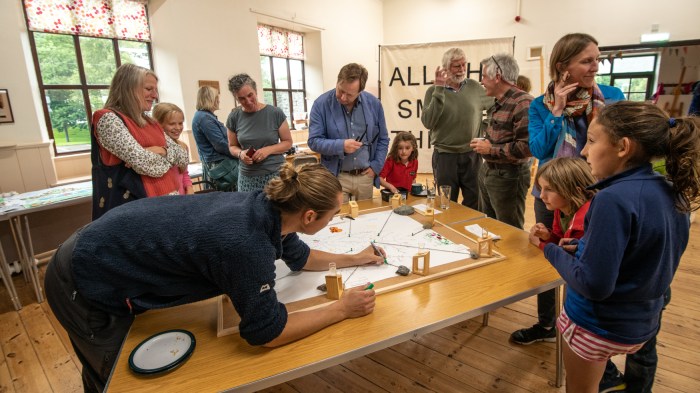
The map of waterways, with ten water samples, was a focus for conversations, and became animated with peoples comments and drawings.
Rob Fraser shared a series of portraits made on his large format camera.
Matt Sharman introduces his film ‘LAND’
Harriet Fraser introducing the project
After the evening event, the exhibition was open to the public for three days – around 270 people came through the doors. Many stayed a long while, pondering the work, and then talking between themselves or with Harriet and Rob. Quite a few people commented that the work ‘made you think – it’s so easy to take things for granted’; and issues highlighted here resonated with issues in other parts of the country. People shared a sense of pride in the place, and a reassurance that many people care deeply for this area. There was a balance of visitors from the valley, from Cumbria, from further afield across the UK, and a few overseas visitors too. One visitor from New York went away motivated to bring artists into a volunteer project campaigning for improved water quality in their harbour.
‘All These Truths Overlap’ by Rob Fraser
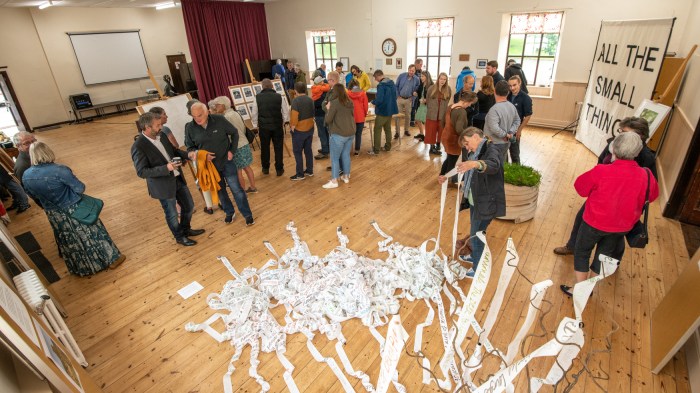
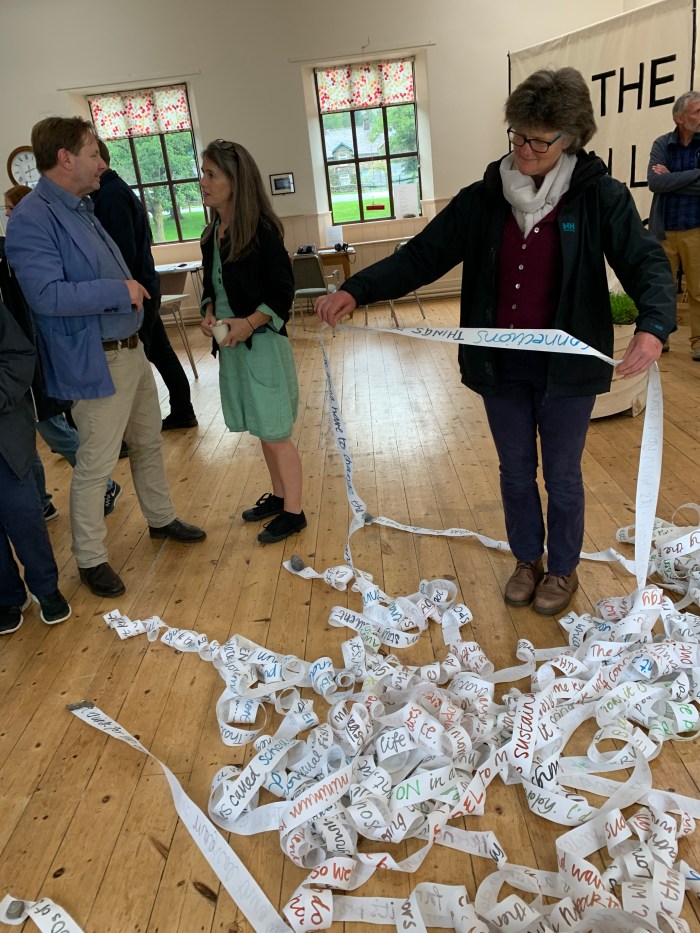
Kate Gilman Brundrett’s installation, an entanglement of conversations
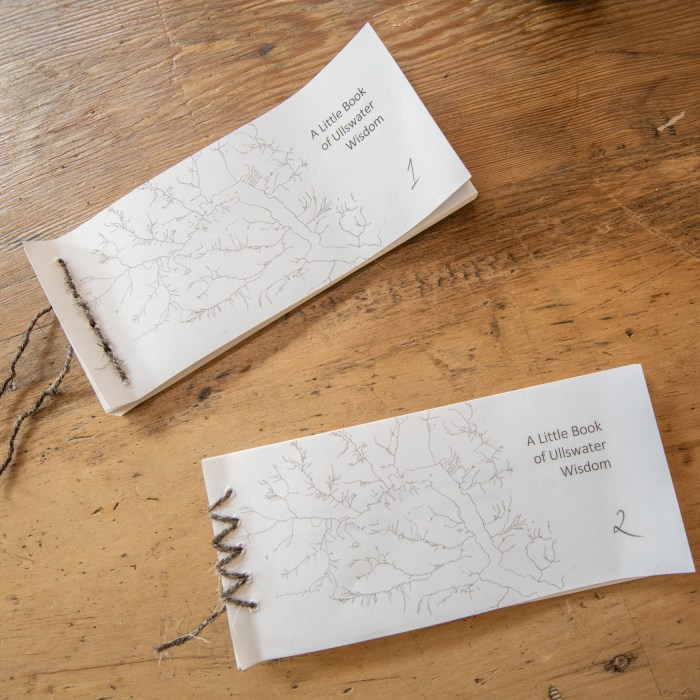
Harriet Fraser’s pair of hand-made books: containing phrases from conversations in the valley.
The research will be continuing for 12-18 months, as part of Harriet’s PhD. Within the broad frame of using art as a tool to explore different perspectives and relationships, and to create spaces for conversations, the direction of research will be focused by what has emerged from this stage: a close analysis of the interviews, reflections on the exhibition, and people’s response to the process. ‘I’m curious about cohesion, connections, discussions and joining things up; and what artistic processes may be a useful part of this,’ says Harriet. ‘In the next phase of research I’m looking forward to many more conversations, and to helping out with activities including habitat monitoring and tree planting, and I’ll be taking many long walks within the watershed.’
Watershed Artists: from left, Harriet Fraser, Sarah Smout, Matt Sharman, Kate Gilman Brundrett, Rob Fraser
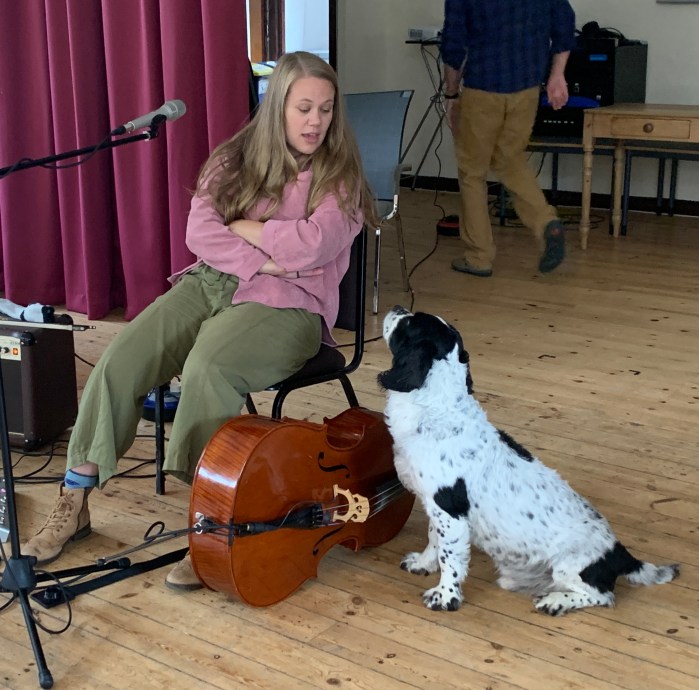
Is it possible to take musical advice from a dog? During sound check, Sarah Smout and Guilly the dog have a chat.
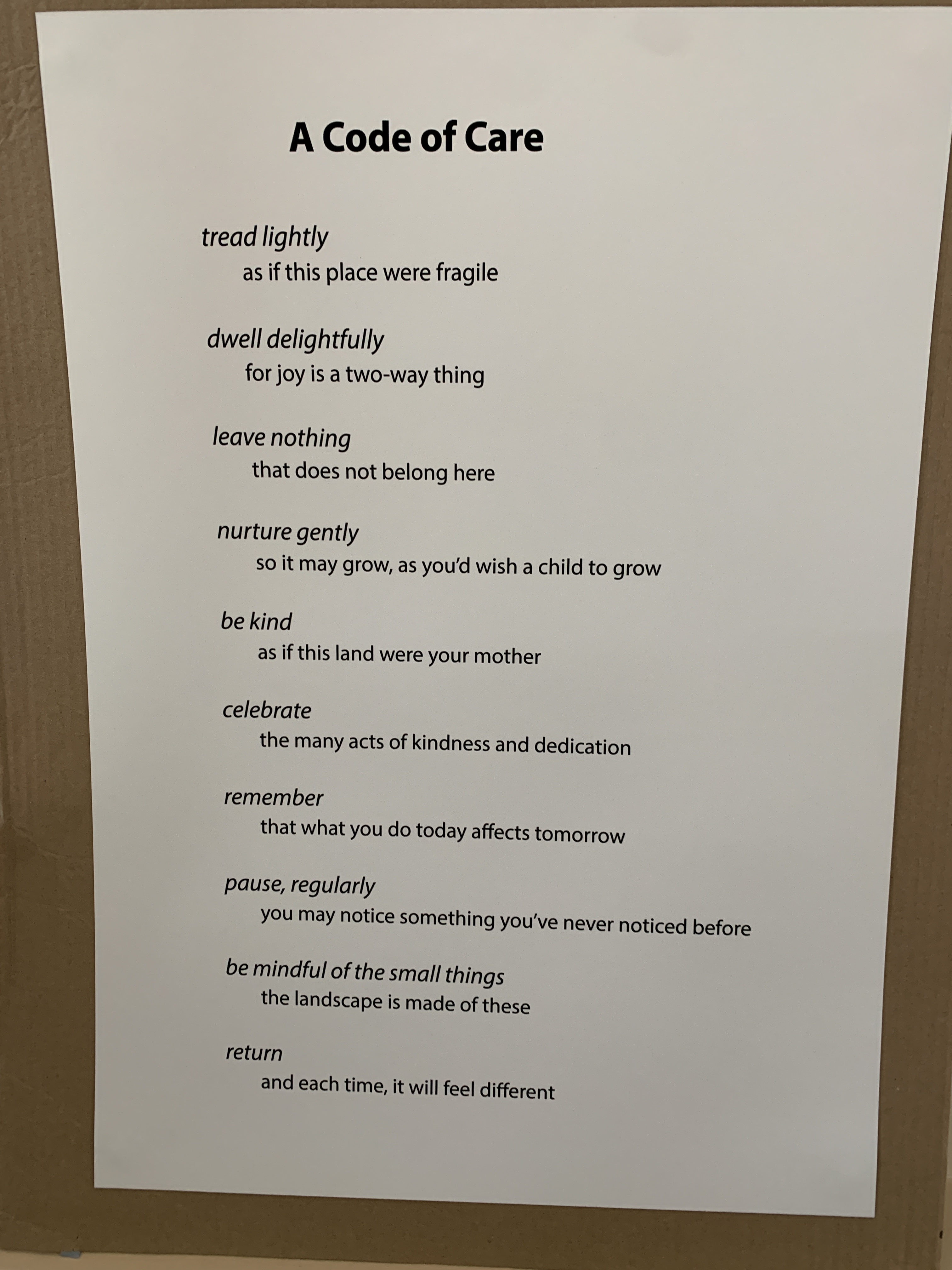
Harriet wrote 6 poems for the event. This ‘Code of Care’ was mounted on board outside the village hall, to welcome visitors. it was inspired by local concerns about wider education around caring for rural landscapes.
Watershed Canvas: Harriet Fraser and Rob Fraser installing the canvas on Glencoyne Beck, July 2023
Guest Blog from Colin Riley – sharing reflections on using field recordings, and news of the premier of ‘Hearing Places’ in performance with the BBC National Orchestra of Wales.
For the last ten years most of my work as a composer has sprung from two interconnected themes; ‘the environment’ and ‘place’. In other art forms there is a way to weave in a direct message, but with music alone you are really just dealing with patterns and implied emotions. It’s inevitably more oblique. Since I love collaborating and interdisciplinary work, this has all fitted together quite naturally for me, and involving other art forms has been common practice.
In 2017 I released an album and toured the UK with a project called In Place. This involved commissioning new texts from a range of writers engaged with place including Robert Facfarlane, Richard Skelton, Jackie Morris, Nick Papadimitriou, Paul Farley, and Selina Nwulu. These texts ranged from nature writing to psychogeography and ideas around our personal place in society. This ever-evolving project began as a song cycle, mutating into a concept album, radio podcasts, music videos, remixes and education projects.
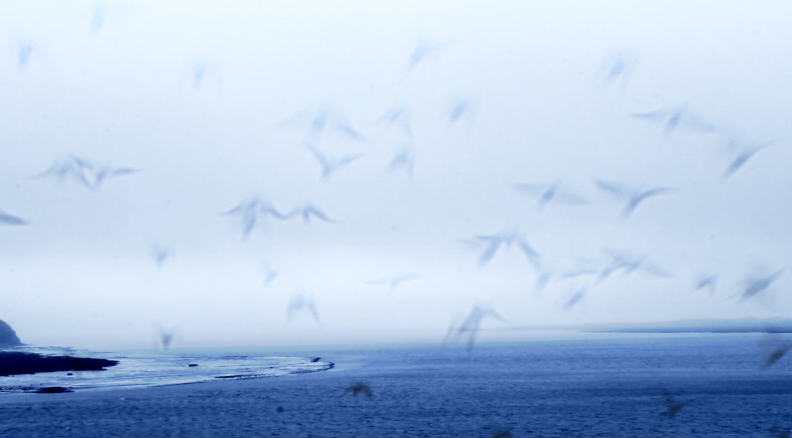
In 2019 I was commissioned to write Earth Voices, a large-scale orchestral work for a Swedish orchestra. Earth Voices is a celebration of noticing the magnificent and fragile things in our natural world. It was pure orchestral writing with no texts, and I attempted to portray different natural phenomena in each of the movements. There were bird murmurations, sunlight through trees, majestic mountains, and a slow twilight.
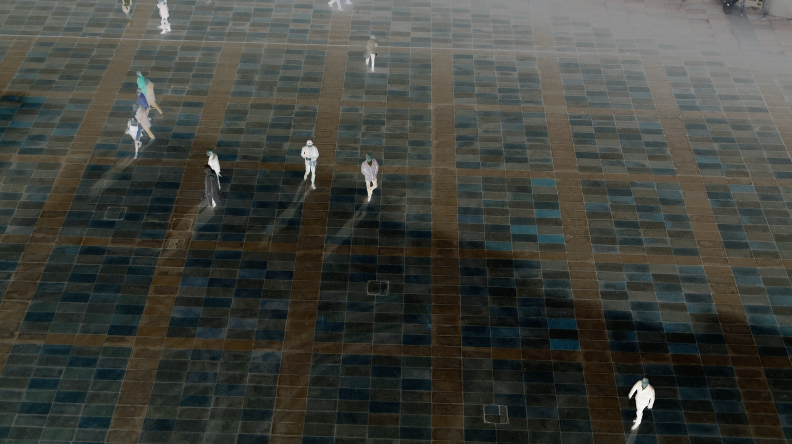
Filming and recording in Central Square, Cardiff
I have just finished composing a second orchestral work Hearing Places, which is in many ways an amalgam of the previous two pieces. Instead of using text or just orchestral colour, Hearing Places blends field recordings and video clips into a multi-sensory experience for the concert hall. Again it celebrates the noticing of our surroundings, engaging the listening with a close affinity with place in both nature and man-made environments. The specific locations are all in Wales: Port Talbot Steel Works, Porthmadog Harbour, Dylan Thomas’s writing hut in Laugharne, Solva Woollen Mill, a stream in the Brecons, Cardiff Central Square, and Llanfwrog Church, Ruthin.
Porthmadog Harbour (left); Llanfwrog Church, Ruthin at twilight (right)
With this suite of seven movements I am aiming for a new kind of symphonic experience. It involves immersive listening, and a way of sharing in the noticing of often inconsequential, yet hugely-beautiful sounds. The music aims to capture both the delicate fragility and massive power of our world, and to illustrate simply what we stand to lose in the environment crisis we are now in. It is my view that through the act of noticing our surroundings, we can begin to value our world more. Natural elements are frequently referenced in the music (weather, times of day, natural phenomena and the seasons), as are the human imprints left in our world (machinery, vehicles, pattern-making, conversation).
Stills from video
Hearing Places celebrates the rich audio and visual patterns found all around us, and I’ve spent the last year travelling to all corners of Wales collecting field recordings and video clips of interesting places that have captured my imagination.
These small building blocks of pitch, rhythm, and pattern in turn then became the materials for the creation of the music itself. Sometimes I simply made a natural emotional response in terms of mood and feeling, and at other times took a more forensic approach. The audio forms a strand of the orchestral fabric, woven differently in each movement, and is ‘played’ from within the orchestra by the keyboardist. Similarly the video clips form an additional textural layer for the audience, and likewise are triggered by the keyboard in different ways. Sometimes a place may be recognizable, but very often it remains abstract and mysterious.
Hearing Places is premiered on Friday 17th February in the Hoddinott Hall Cardiff by the BBC National Orchestra of Wales.
Colin’s routes, mapped; and images of work in progress.
Colin has also written about his process in three blogs:
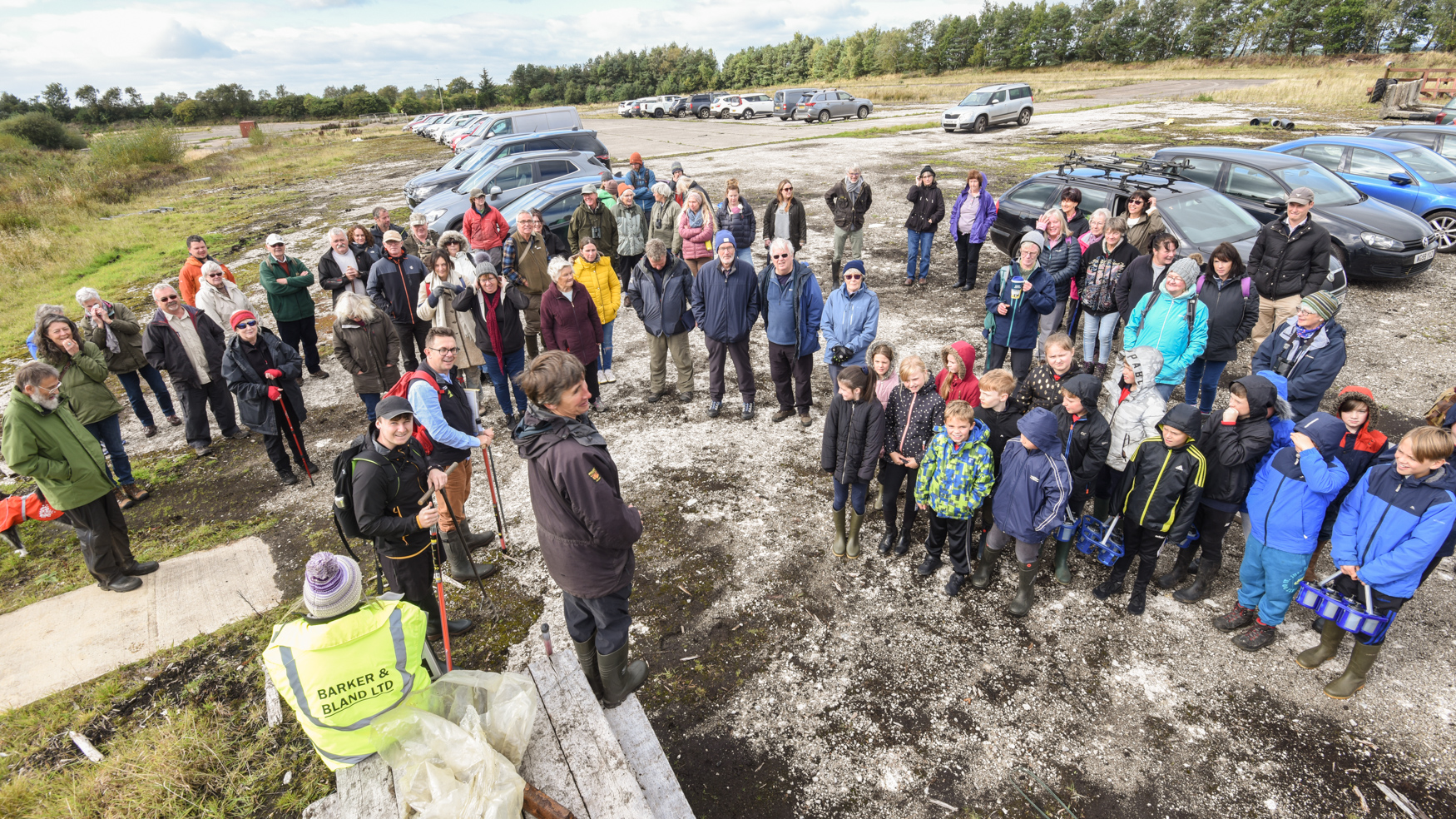
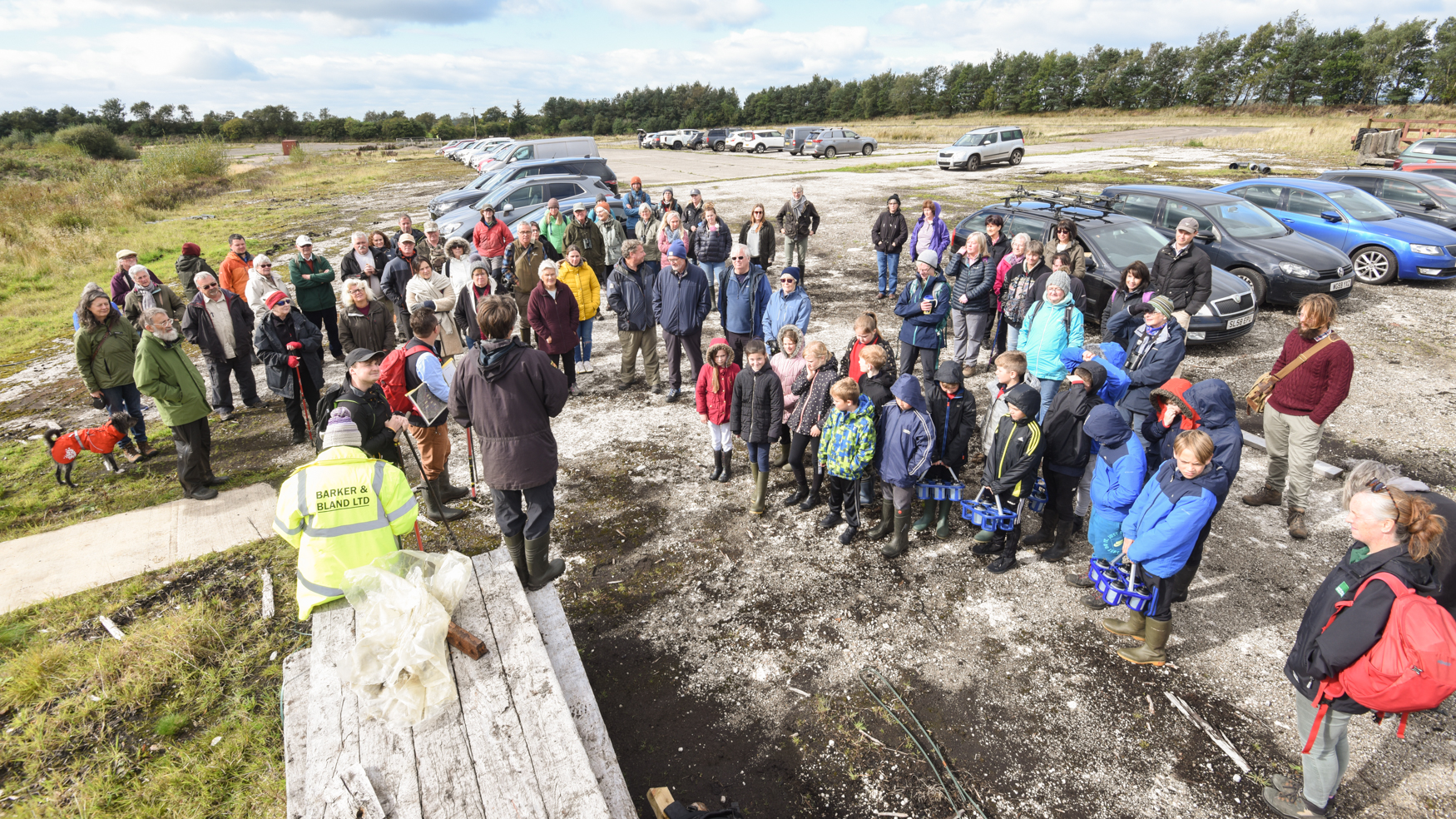
What a day on Monday to celebrate Bolton Fell Moss and the work that’s been done through the Moss of Many Layers project. We were blessed with dry weather for the walk, and the buzz continued in Hethersgill Village Hall afterwards.
We were quite astounded with the uptake of tickets for the walk – more than seventy people came along. We separated into four smaller groups, each led by two members of the Moss of Many Layers team who shared insights about the bog.
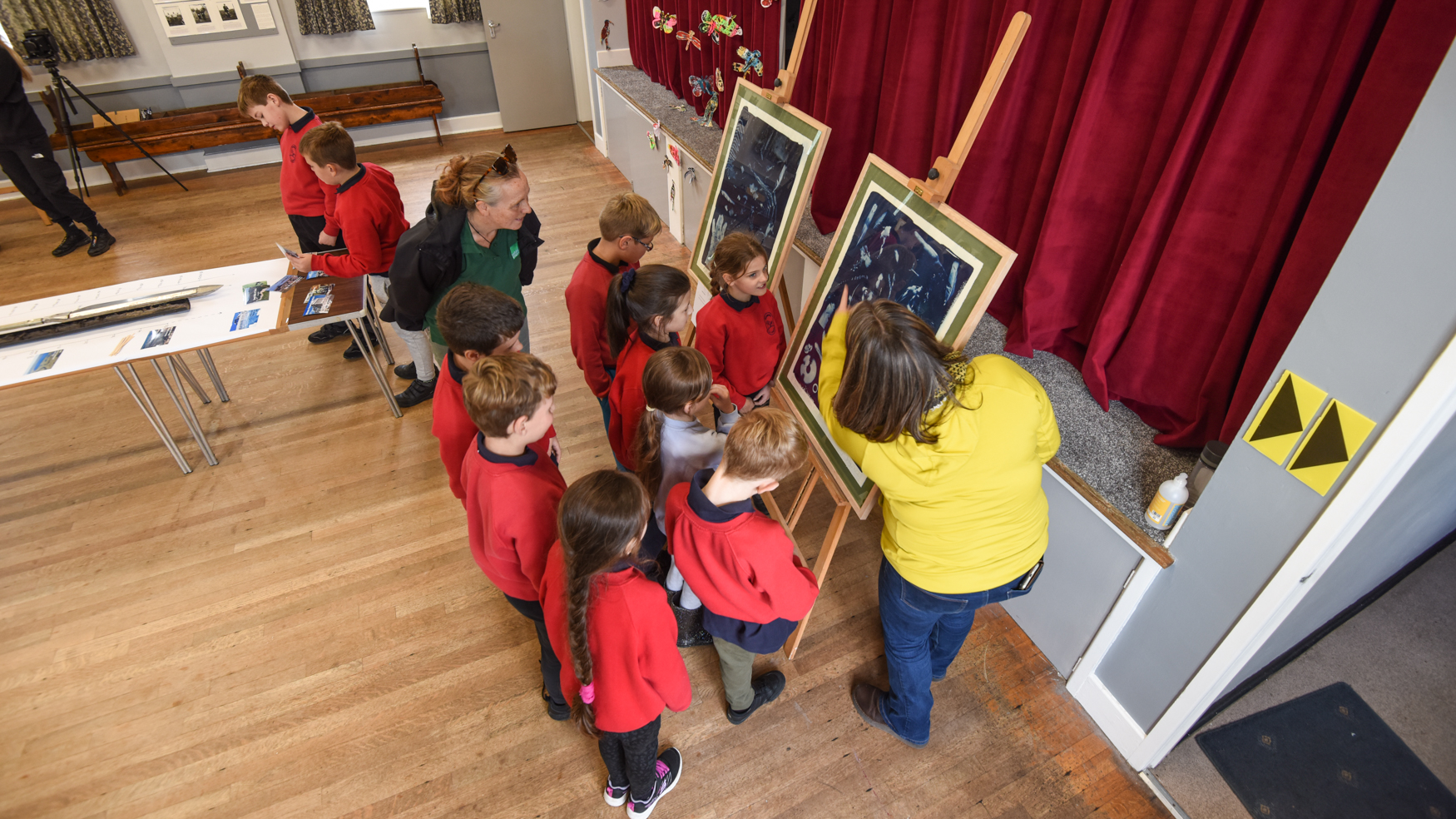
Huge thanks to everyone who came along – in each group there were people who had never been here before, as well as people who have connections with this place, so there was a lot to be shared, including stories of working here during the bog’s time as a site of peat extraction, or of working on restoration tasks, surveying and conservation. The children shared their own stories and the knowledge they’ve gained during the past year and were able to show others the peat ‘bunds’ they had created, which are now holding water, ready for sphagnum mosses to become established.
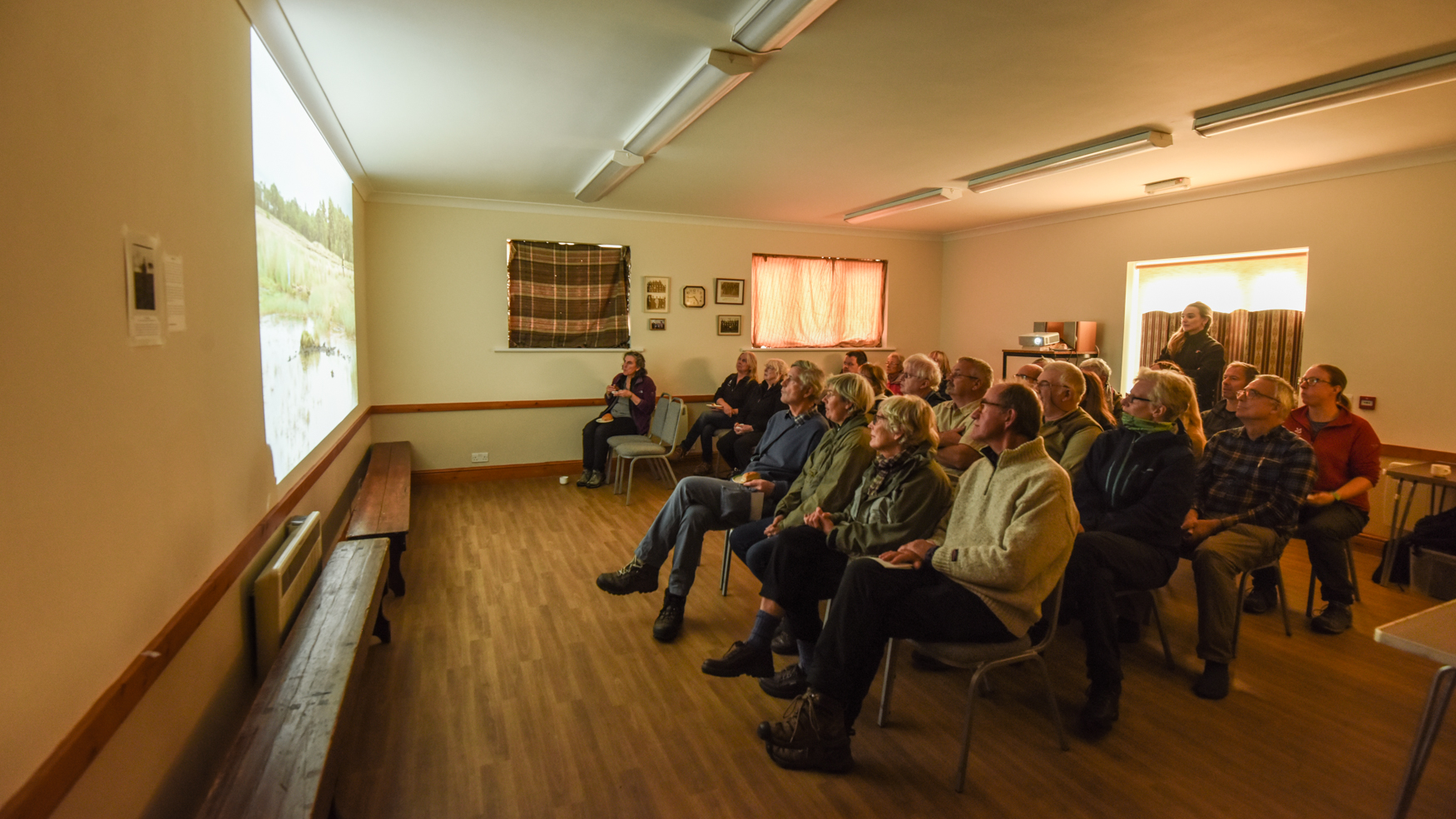
In the hall there was plenty of time for people to chat and find out more about Bolton Fell Moss and about the Moss of Many Layers project. People arrived who hadn’t joined the walk, it was a real pleasure to meet so many people who live locally and have their own connections with the bog. There is a lot of pride in this wonderful place!
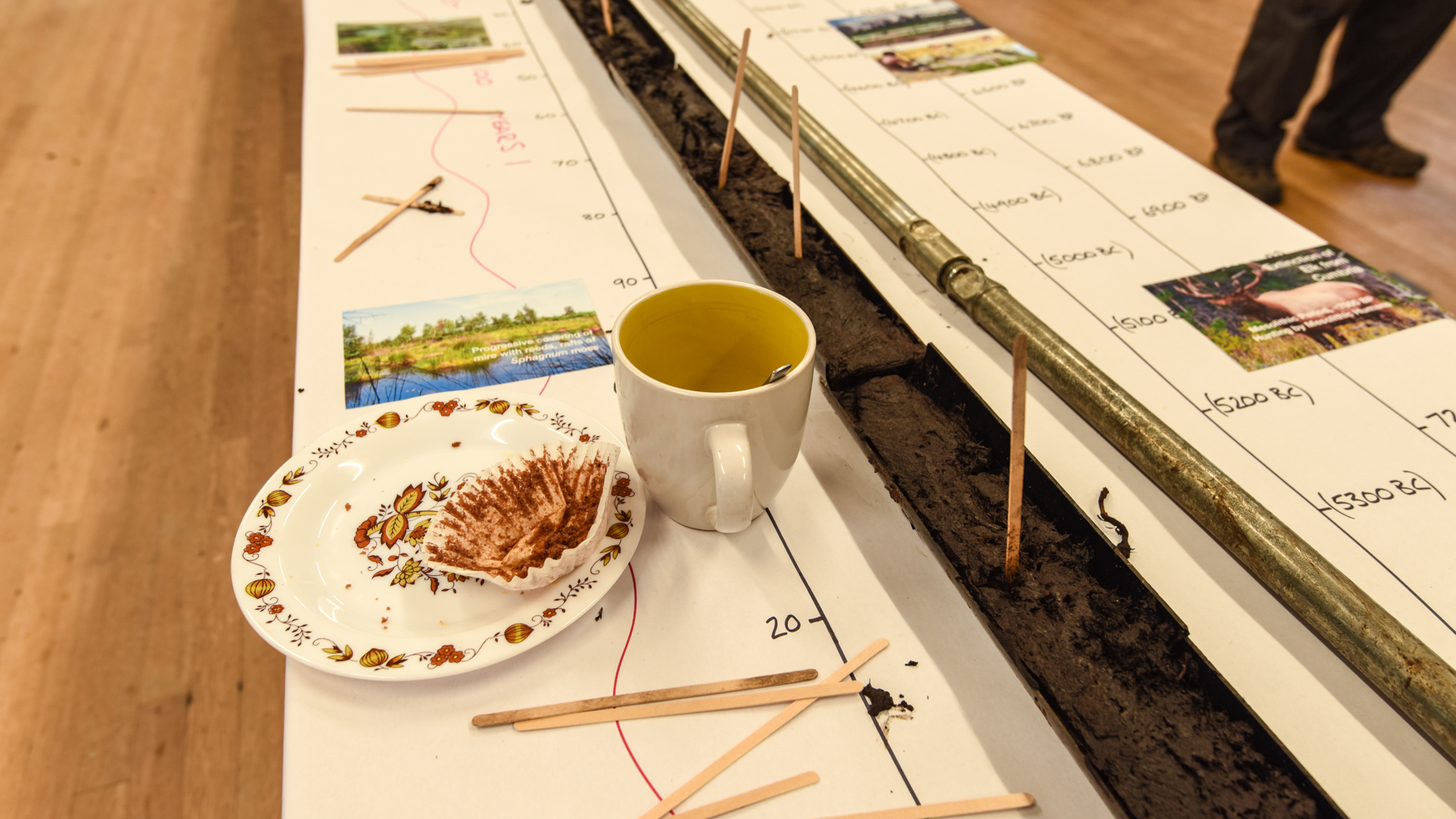
The ‘star’ of the show was the peat core, which at more than 8-metres long took pride of place. Other work on display included Helen’s beautiful map; a series of portrait images taken by Rob, to share the faces and stories of people connected with this place; artwork from Shankhill Primary School children and young people from William Howard School who have worked with Anne; information about the Moss put together by Emma; a set of poetry written by Harriet; and a drone and GPS tracking devices that the scientists have been using for their research. And Juliet’s film had its premier with back to back screenings.
As with most gatherings, the party extended into the kitchen, and around the wonderful ‘Moss of Many Layers’ cake.
The best way to tell the story is through some images of the day. A digital collection of the work that’s been produced will be coming in due course, and we’ll be sharing the film as well. Watch this space!
How can art dream, reimagine and help shape the future …
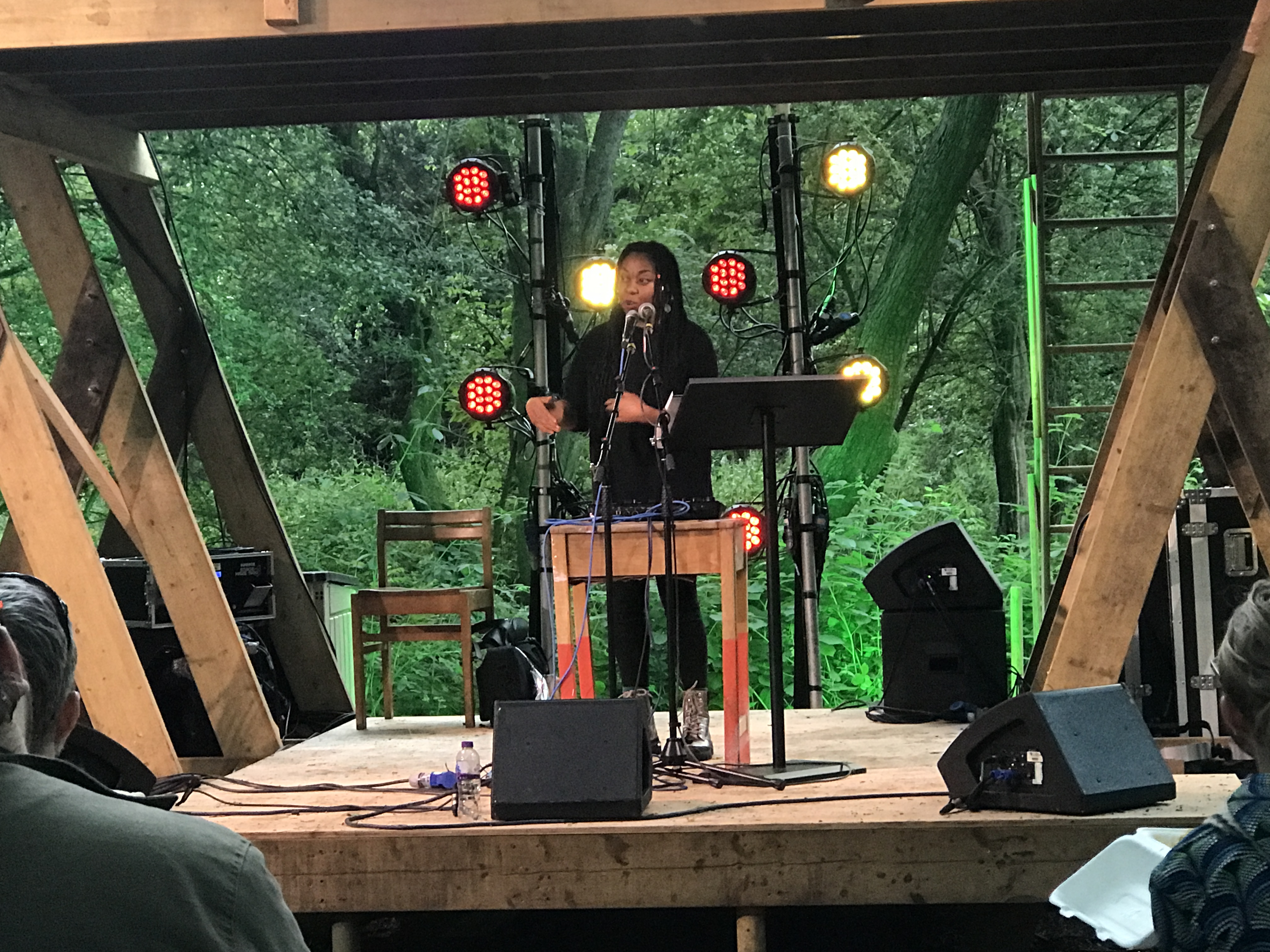
Here’s a quick blog to share some smiles and reflections from the recent Timber Festival where a crew of five from the PLACE Collective took to the stage to share a conversation with the audience. The threads that ran through the session touched on ways that art can ignite an ever greater love for the natural world, how artists are part of discussions about critical issues, and the value of art to help us all dream, reimagine and shape the future.
From left to right: Harriet Fraser, Rob Fraser, Sarah Smout, Charlie Whinney, Kate Brundrett, Charlotte (signing). Image credit: Alex Johnston-Seymour
Our conversations followed on from many thought-provoking discussions and performances during the weekend. There were poets, musicians, writers, dancers, DJs, as well as open conversations held both on the Field Notes stage and around the campfire to explore pressing issues around environmental change.
We weren’t the only ones to come to the Field Notes stage from Cumbria. Earlier in the weekend, specialists in forests, biodiversity and ecology, including Ian Convery, took to the stage to talk about the expansion of woodlands and forests across the UK. This theme of expansion was picked up later in a panel discussion where Harriet from the PLACE Collective joined the CEO of the National Forest, a woodland creation specialist from Defra and member of the Youth Landscapers Collective to discuss the vision for a new Midlands Forest Network.
In the spirit of the festival, there was a strong sense of working together for positive change. This is in no small part ignited by the story of the National Forest, which covers 200 square miles across parts of Leicestershire, Derbyshire and Staffordshire. The area was previously dominated by coal mines and clay pits, and after these industries closed down, the idea for a new forest emerged: the first trees were planted in the late 1980s. Since then, almost 9 million trees have been planted, the landscape has been transformed, and the forest has become a rich, and highly valued part of daily life for so many of the people who live there. Timber Festival is part of the National Forest’s ethos of involving communities, and bringing people and trees together.
So, back to the PLACE Collective conversation … each person on the panel brought an object with them (listed below*), and introduced their practice and personal reflections while sharing the story behind their piece.
Questions and observations from the audience included an affirmation that scientists and artists should work together more in research and in communities, as we collectively devise ways to inspire, affect and enact change. This fits really nicely with the ethos behind the PLACE Collective where we’re always seeking ways to bring together people with different knowledge sets, and from many different backgrounds.
One question came from a young person wanting to pursue their own art practice, and looking for advice. Each person on the panel had much to share, but perhaps what was most memorable was the advice to ‘stay on your bus’ … don’t get off at other stops, or follow routes just because others are. Keep going, keep following what feels right. This relates to the Helsinki Bus Station theory outlined by photographer Arno Rafael Minkkinen in 2006, but could be relevant whatever field of work you’re in – if you’re curious, read about the Helsinki Bus Station Theory here. It might inspire you!
When the panel session was over, people from the audience came up to look at the objects and talk to the artists, and the chat continued into the sunshine and the beer tents, becoming part of the gentle and colourful interweave of the festival.
Talking about young people, among the many inspirations from the festival what really stood out for us was the Youth Landscapers Collective. This group of young people from the local area has been growing over the years, taking part in forest-based activities, developing creative work and leading important conversations. Their installation for this year’s Timber Festival was all about fungal networks – and a reflection not just on what grows in the soil, but perhaps about the value of more entangled, rhizomatic thinking about all of us humans …
And to finish, a word from Kate Brundrett, who joined the panel. Kate is on the Advisory Board of the PLACE Collective. She’s also an artist and a wellbeing coach, and founded Studio Morland, a community-arts and wellness centre in the Eden Valley, in Cumbria.
“How can art and artists make impact? Presenting ideas that are outside of our day to day framework, to stretch our imaginations into other worldly possibilities. Allowing us to feel, to connect, to reconnect and come home to ourselves. And if the process challenges people out of their comfort zones then all the better.”
*Maker Charlie Whinney arrived with a huge heart-shaped sculpture, steam-bent oak from an off-cut of a fallen tree. Sarah Smout brought her cello, Bernard. Rob Fraser carried a tiny oak tree onto the stage, which was rescued from a woodland cut down to make way for HS2. Kate Brundrett shared a piece called SOTWO (State of the World Overwhelm). And Harriet Fraser shared a segment of poetry, stitched around a heavy rock borrowed from beneath a sycamore tree in central Cumbria.
A short glimpse of the video installation by the Youth Landscapers Collective
The ‘What is Natural Beauty?’ Symposium, run by the PLACE Collective through the Centre for National Parks and Protected Areas, and in partnership with Wye Valley AONB and the Lake District National Park, took place on December 1st, 2021. And what a success it was – the provocative (and unanswerable?) question raised through the symposium invited a diversity of views and opened up many avenues for discussion among more than 100 participants.
A formal report will be shared early in 2022, but for now we thought a perfect way to summarise the symposium would be to share this reflection from Howard Davies, former CEO of the National Association for Areas of Outstanding Natural Beauty. Read on …
Howard begins:
“I think it begins with 3 main sets of questions:
What is beauty?
Does it exist objectively in things themselves? Is it an inherent quality of some landscapes, and not others?
Does it exist only subjectively in the mind of the perceiver?
Do landscapes possess special qualities that are perceived as beautiful in the mind of all perceivers? Is there a shared, cultural component to this? Do perceptions of landscape beauty vary, dependent upon societal values and norms?
What is the scope of things to which beauty can be applied?
Purely sensible – perceived through the senses? See, feel, hear, smell …
Or is it something more profound – is there an Intellectual or moral quality to beauty?
And if the scope is this wide does sensible beauty lead you to moral or intellectual beauty?
The romantic poets spoke of natural beauty as a spiritual, almost other-worldly experience that was accessed through our relationship with nature. For example, Shelley’s ‘Hymn to Intellectual beauty’ – Natural Beauty was what you experienced, as a result of your relationship with nature. It was a natural phenomenon connected to the experience of nature, not nature itself.
How does natural beauty relate to other value concepts?
The functional, the sustainable, the spiritual? And does natural beauty align with the concept of a sustainable, ecologically rich and functioning landscapes?
Presenters and performers
Kate Humble opened this seminar with reference to the picturesque and the role of landowners in transforming landscapes in accordance with the aesthetic of counterfeit neglect. She challenged us to reconsider what makes our landscapes beautiful and suggested we take a steer from nature.
Desperate Men provided an entertaining take on the notion that the map is definitely not the territory and questioned the full scope of outstanding natural beauty, and whether beauty is entirely in the eye of the beholder
PennyBradshaw introduced us to the romantic poets and writers, the picturesque in more detail, and Edmund Burke’s notion of the sublime – the agreeable horror associated with some of our more dramatic landscapes.
Crystal Moore challenged us to rethink how we value our environment within the frame of the climate and human emergency that now faces us, and to reinvent ourselves. SteveRatcliffe also framed natural beauty within the wider context of sustainable development and personal impact, with examples drawn from his experience in the globally important, vibrantly lived-in, distinctively special, Lake District National Park
Mike Collier introduced colonialism into the argument, and talked about the impact of race, class, power and privilege and the history of land ownership. Touching on identity, beliefs, and deep-seated cultural values. He made the case for celebrating beauty in difference, rather than the industrial green landscapes of curated, ‘rural’ Britain.
Anjana Khatwa gave a personal reflection of her lived experience as a woman of colour, geologist, earth scientist, and mother in the British landscape and how these lenses affect her view of beauty. Ruth highlighted the benefits of performing in the natural environment, and some of the barriers that exclude people of colour from the countryside. She asserted that no environment can be outstandingly beautiful if it is exclusive.
Sally Marsh examined how we might consider natural beauty today if we embraced its full scope, not just visual amenity, in the planning and management of landscape.
Matt Larsen Daw drew on our nurturing love-affair with nature and our ultimate inter-dependency on this for the wellbeing of our body and mind. I was particularly taken by his description of landscape as “Time and nature made solid”.
Neil Heseltine took us beyond physical attributes and face value, to remind us of the complexity of nature. He made the point that nature needs space and time to play out its processes and intricacies and that the way land has been stewarded over the last 50 years has limited this. He highlighted the important role that National Parks and AONBs can play in helping people understand the complexity of nature and their impact on it, especially with regards the way we produce our food.
So, by way of a summary – for me, sensible and intellectual beauty strike at the heart of what it is to be human. It is the tension between the finite and the infinite, life and death, permanence and transience, lost and found, past and future, harmonious and discordant – it is this symmetry that we inherit from the classical approach to beauty. The wonder, awe, majesty, and drama of nature and our small place within it, we inherit from the notion of the sublime. These marry together to form the yardstick by which we have historically qualified our current suite of protected landscapes, protected for their natural beauty … a concept that is still valid, and indeed important for our wellbeing. Many landscapes however have difficult histories that have given rise to multiple challenges, many of which have been clearly expressed today, and all landscapes are subject, like us, to the existential crisis that is now upon us.
Landscapes are the product of processes and interventions. Ultimately I think, we need to focus less on the product, and more on our relationships with each other and the environment within which we exist, and on which we depend.
We need to be more creative, recalibrate these relationships urgently, and reposition ourselves, our economic systems, and the way society operates, such that a supportive, functioning, environment is the natural outcome. We might therefore focus our search for natural beauty and elegance in these relationships, and become more comfortable in letting our environment be what it will be.
AONBs and National Parks are the perfect vehicles to lead this change and champion what essentially needs to be a new, more diverse, social contract around landscape and natural beauty, but to do this with the intention of triggering systemic change on the basis of kindness, and active and open listening – the point made my Harriet in the poem that started this discussion.
Thank you.
To find out more about Howard Davies, and the other presenters and performers who took part in the symposium; and to browse through some resources, view the symposium programme here.
Kate Gilman Brundrett’s reflections on the symposium … evolving!