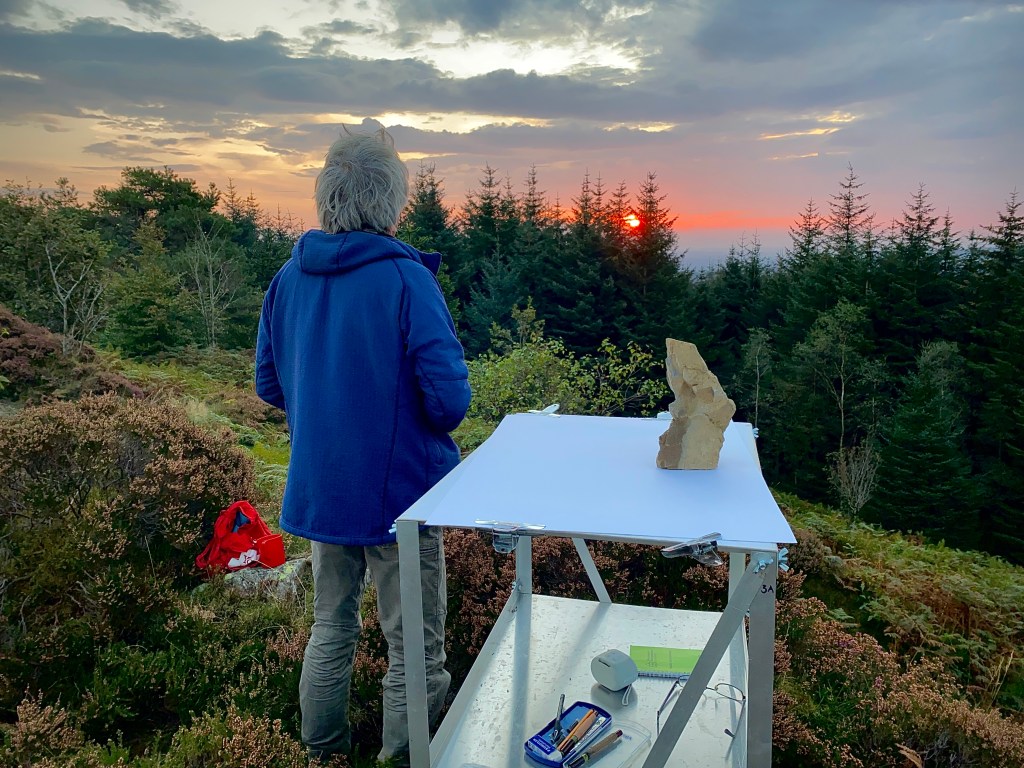
Tom Morton (Arc) and Becky Little (Rebearth) join the team of Creative Collaborative Placement artists. They will be working in Scotland, liaising initially with specialists at the James Hutton Institute, with an enquiry focused on soil.
Read on for more about the artists, and their placement focus.
Welcome to the LUNZ Hub Creative Collaborative Placement artist in Wales: Jacqui Symons. Jacqui will begin her enquiry in conversation with a team from the Centre for Ecology and Hydrology (CEH) in Bangor.
Read on for more about Jacqui Symons and the placement focus.
In Northern Ireland, poet Kate Caoimhe Arthur will be enquiring into Land, Livestock and Livelihoods, meeting with researchers at the Agrifood and Biosciences Institute and livestock farmers across Northern Ireland.
Read on for more about Kate Arther and the focus of this placement.
In England, the LUNZ Hub Creative Collaborative Placement artist Daksha Patel has begun her process of research with Rothamsted Research, working with an enquiry into agrosystems transition. Daksha has been liaising with Rothamsted to refine the direction of the enquiry and is underway with her research.
Read on for more about Daksha Patel, and the placement focus.
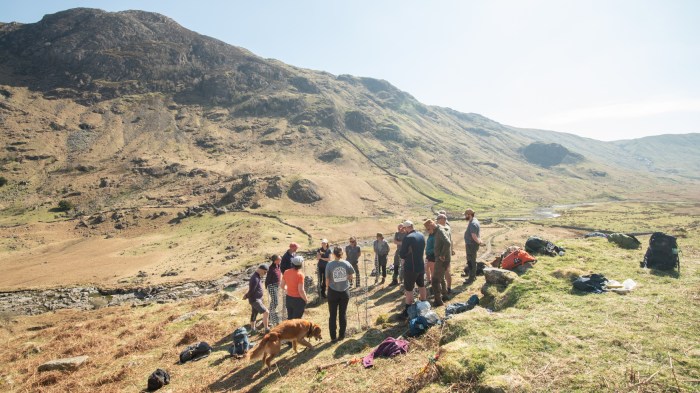
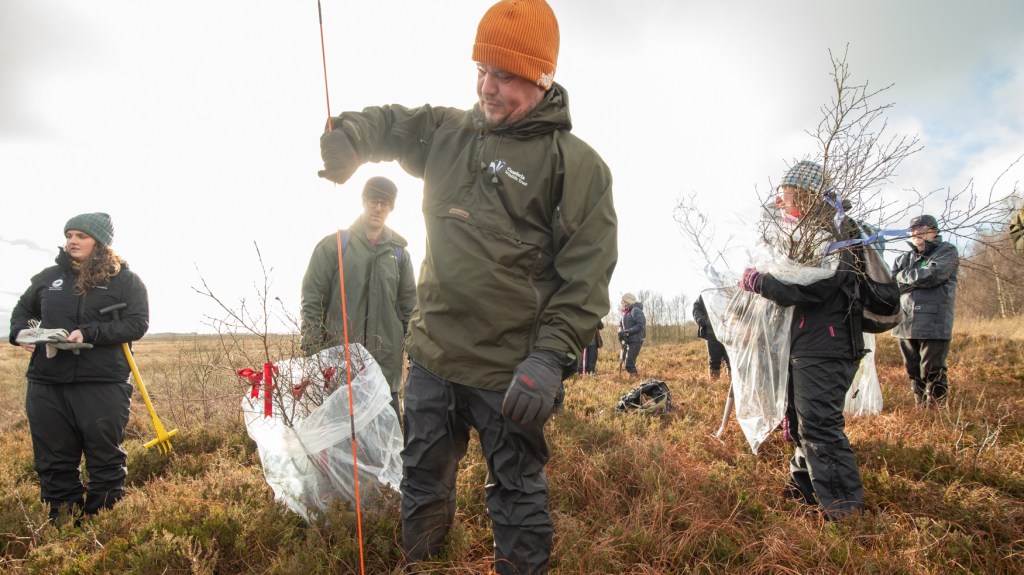
How can it take twenty people to plant seven trees? That’s a fair question, an out-loud wondering from one of the participants joining the group to plant a Resonance circle in the Langstrath Valley. And it kind of gets to the point – the act of planting a Resonance circle is not about function, speed or efficiency, but about taking time, and about connection.
Planting a Resonance circle in the Langstrath Valley
The seven trees planted on the fellside in the Langstrath valley where the last seven to go in during the year’s planting season – just enough time to get the trees into the ground before they woke from their winter slumber and began to open their leaves. Around the country, people have been planting trees maybe hundreds or thousands at a time, but for the Resonance circles, there are just seven trees. Each circle is planted with the same precise measurements: a diameter of 3.5 metres, with the seven trees set around the circumference of the circle in an equal spacing, angled 51.4 degrees from the centre.
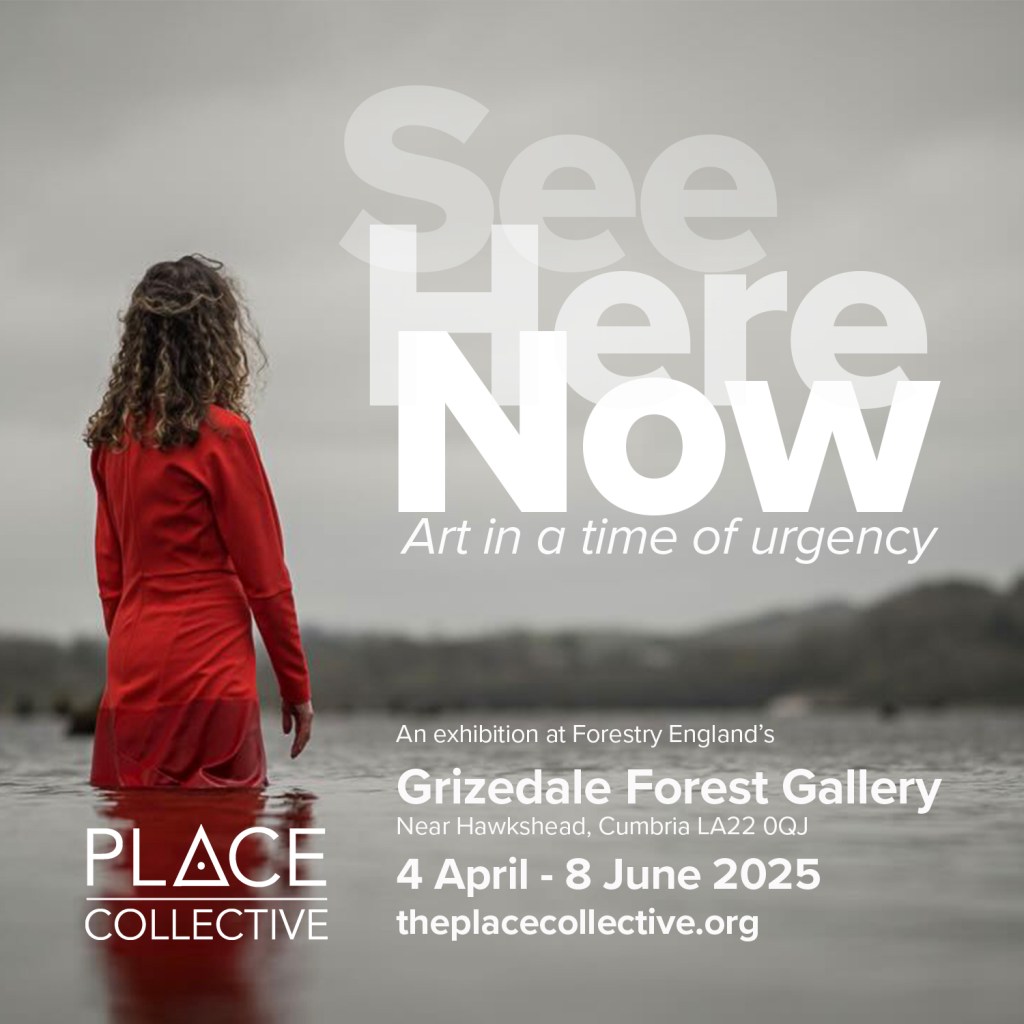
After a long time planning, a group of PLACE Collective artists will be exhibiting work in the stunning galleries of Grizedale Forest, Cumbria, in response to the theme of Art in a Time of Urgency.
All of our practices are concerned with better understanding and caring for the living world – yet in a time of increasingly frequent severe weather events, melting glaciers, political instability, and a critical need for nature recovery, what might artists do? What work do we create, what questions do we ask, what stories do we tell? What might we do differently?
MEET THE ARTISTS AND JOIN THE EXHIBITION PREVIEW, APRIL 5TH
Mark your diaries for a visit, and watch out for blog posts in the coming weeks featuring insights from exhibiting artists.
Exhibiting in Grizedale Forest is to build on a legacy of thoughtful and often boundary-pushing art. It’s a privilege to bring an exhibition to this venue, and while not all work centres on the forest, or even on trees, some artists have chosen to create work in and in response to Grizedale Forest – more will be revealed when the show opens.
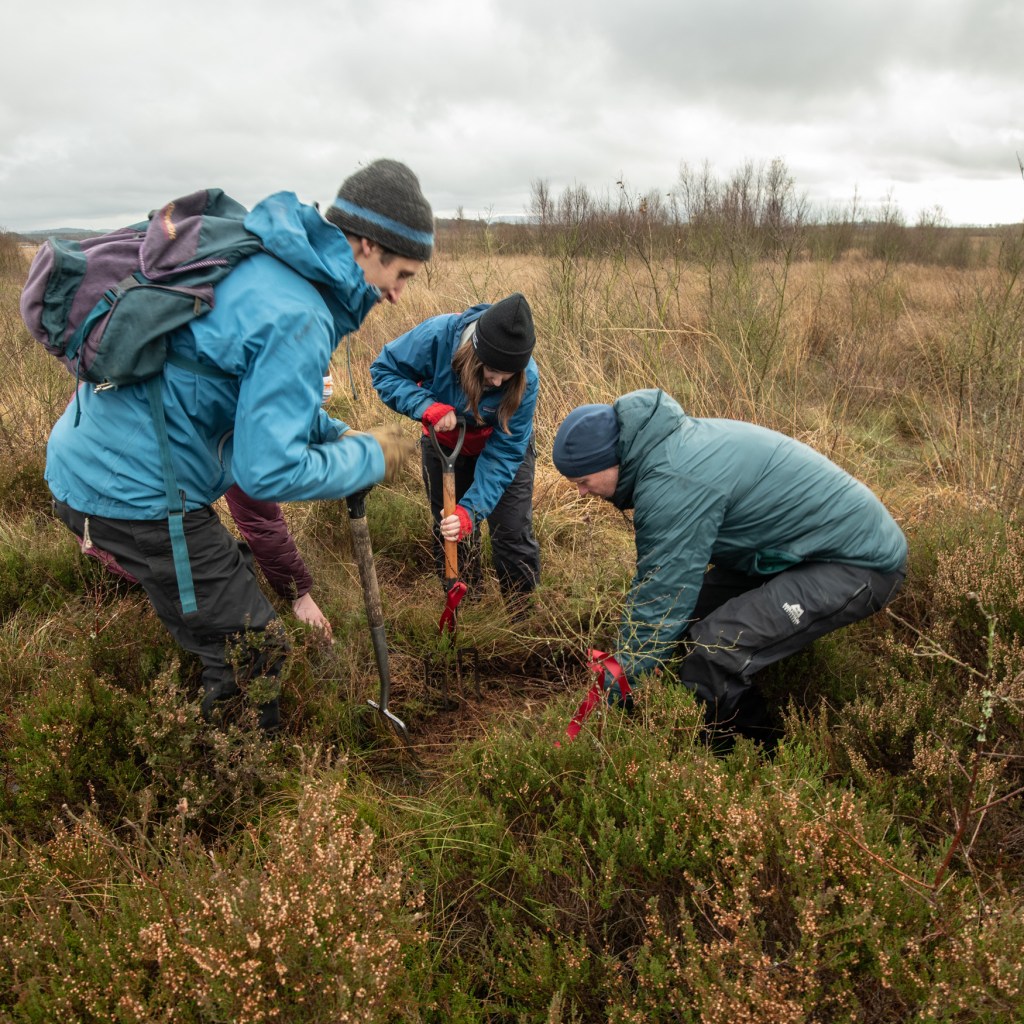
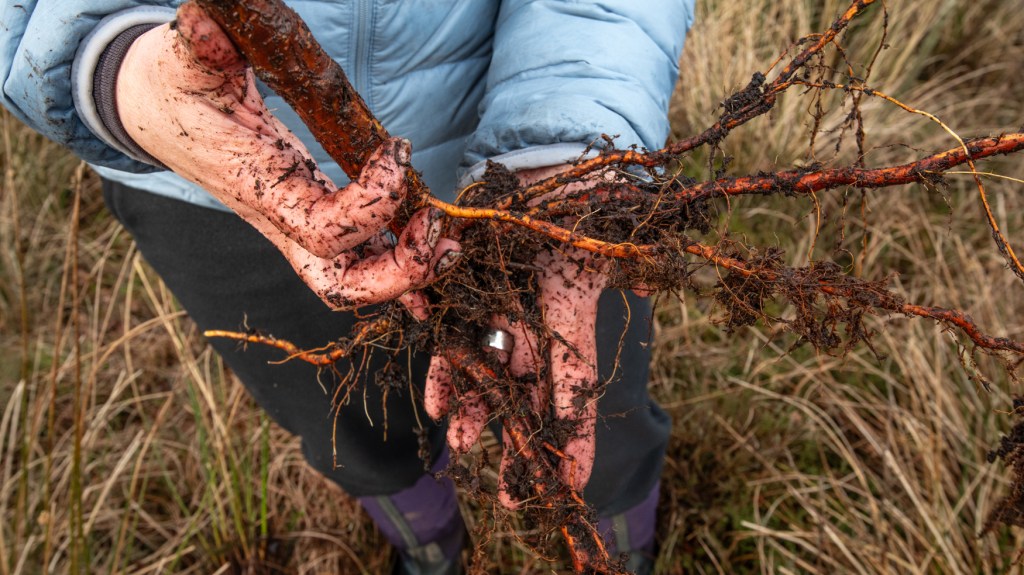
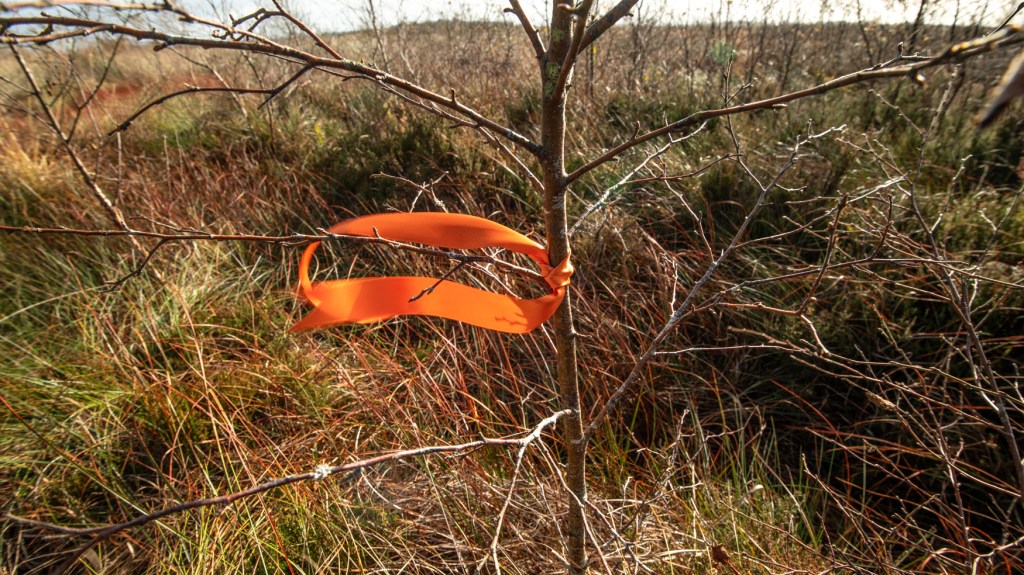
Since last November, the Resonance project has been moving on. It revolves around 49 silver birch trees, which have been collected from Bolton Fell Moss peat bog that’s in a process of restoration, and are being planted out in seven tight circles, each of seven trees, across the Lake District National Park.
This is part of the PLACE Collective’s work through the UK-wide Land Use for Net Zero, Nature and People Hub – or LUNZ HUb for short. Working within the LUNZ Hub team, we’re convening opportunities for people from across practice, research and policy to get together, share learning, and focus on actions; all part of a just transition in a time when changes in land management need to be big, and at scale, to mitigate impacts of climate change, nurture recovery of biodiversity and ecosystems, and embed resilience and natural regeneration in UK land use.
Head over to the project page for Resonance to find out more, and watch for updates – there are reflections on the Big Dig Day here, and a reflection on the key take outs from that event on the LUNZ Hub website.
Artist Rita Leduc has been co-imaging and co-creating with other humans and with a forest for some time now. In this blog, she reflects on the intersection – and coexistence of intelligences – and how her practice continues to ask questions. Including but not limited to, how can we be guided by the natural world, and how can we treat our work as something that’s constantly unfolding, not something that focuses on endings?
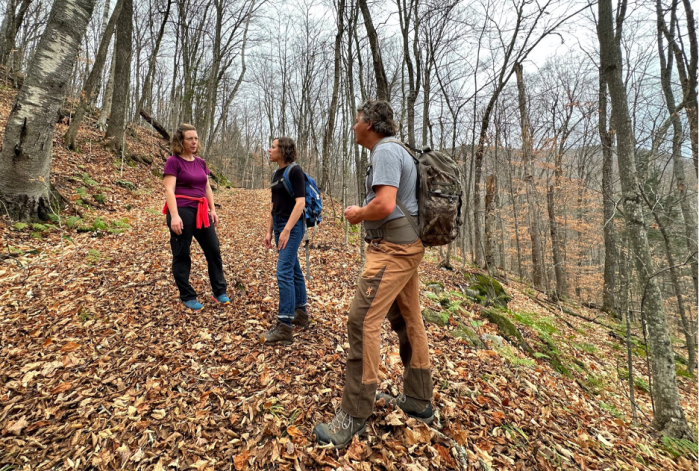
Rita Leduc and Dr. Rich Blundell in Hubbard Brook Experimental Forest (White Mountains, NH)
Keeping the “-ing” in Extending Ecology, by Rita Leduc
“The nature of nature is that it’s dynamic and relational. It doesn’t stop nor end, and it does not follow a linear trajectory.
The Oika project, Extending Ecology, is an ongoing collaboration between an ecologist (Dr. Rich Blundell), an artist (myself), and a forest (Hubbard Brook Experimental Forest). The methodology of our project is for the ecologist and artist to share their individual ways of understanding with each other and the forest through the lens of Oika: a philosophy of ecological intelligence. This philosophy includes concepts and practices that span science, deep natural history, creativity, and contemplation. The intention of the project is for the humans to function as emissaries of the forest, activating their own rigorous, multimodal participation to acutely absorb and prudently extend nature’s intelligence into culture.
The intention of the project is for the humans to function as emissaries of the forest …
Rita, Rich, and Hubbard Brook
Six months into this project, curator Meghan Doherty approached us to have an exhibition at the Museum of the White Mountains at Plymouth State University. Throughout the following eighteen months, the three of us had countless sessions to determine how this exhibition could hold, and be an extension of, the living, unfolding project – which is a direct extension of the living, unfolding forest.
Simultaneously nurturing the project’s development with the exhibition’s development required us to be on our most ecological behavior. We managed it with sensitivity and fluidity, allowing the exhibition to form within the context of the project…which, as stated, forms within the context of the forest. So as long as we could establish and maintain that continuity authentically, the forest would design the exhibition. And without diminishing the heroic efforts of human team members, being designed by the forest is actually exactly how I would describe the way in which this exhibition came about.
Curator Dr. Meghan Doherty with Rita and Rich in Hubbard Brook Experimental Forest
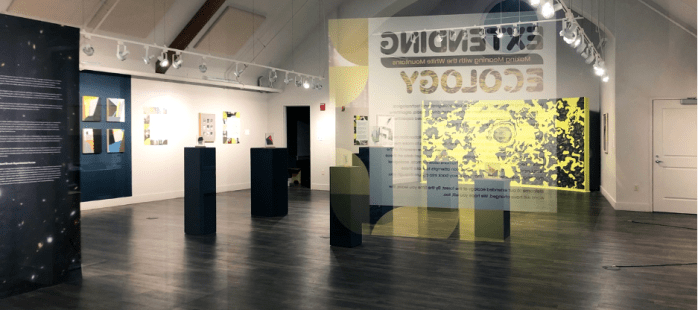
“Extending Ecology: Making Meaning with the White Mountains” opened at the Museum of the White Mountains on October 7, 2023. It was a celebratory moment, but as we paused to honor this achievement, I felt the not-so-subtle elevation of an ever-present consideration. If Extending Ecology is going to remain continuous with nature, then like nature it must remain dynamic and ongoing. Unlike many exhibitions, this one is not presenting a culmination but rather an ongoing sharing-thus-far. So, the project’s dynamism rose to the fore: as we present the project-thus-far to the public, how do we keep the exhibition from feeling like the project’s conclusion? How do we keep the project living and unfolding, like the nature from which it came? How do we keep the “-ing” in extending? It’s a question I’ve granted myself the duration of the exhibition to deliberate.
If Extending Ecology is going to remain continuous with nature, then like nature it must remain dynamic and ongoing.
“Extending Ecology: Making Meaning with the White Mountains,” exhibition documentation from The Museum of the White Mountains, Plymouth New Hampshire
“Extending Ecology: Making Meaning with the White Mountains,” exhibition documentation from The Museum of the White Mountains, Plymouth New Hampshire
Now halfway through the run of the show, my sense is that the above consideration is the same challenge as the exhibition but in reverse. Instead of taking a living thing and putting our fingers on it just enough to open a cohesive exhibition, we need to lift our fingers just enough to let it breathe, evolve, extend. So, much like navigating the forest without a trail, we have spent the last month looking up, scanning the landscape, and sensing the direction toward which the project wants to continue. Furthermore, we are trusting that sense, feeding it, and allowing it to feed us.
Feed us it is. Multiple directions have emerged, all brimming with possibility. There is a feeling of not just extension but motion. Extending and moving, all while necessarily remaining studiously (and joyfully) tethered to our firsthand relationships with this particular forest.
So what’s my point here, why is this worth examining? I believe this question is more than just an interesting challenge in an outcome-oriented world. Rather, I believe it is a challenge we should be taking on more often, in all spaces and across all scales. At the innermost core of my being is an impulse to participate with the living world. Not with the surface-level stuff slathered on top but rather with what Oika refers to as the creative life force from which we all come and are all made. Extending Ecology is a case study in Oika’s thesis that if we sincerely, deeply allow ourselves to be guided by nature, it will teach us how to cultivate life.
… if we sincerely, deeply allow ourselves to be guided by nature, it will teach us how to cultivate life.
There is ending and there is extending. One is narrow, determinate and final. The other is boundless, adaptive, and vivacious. In this moment of social, ecological, and technological precipice, honing the wisdom to feel the difference and choose the latter is well worth our time.”
Documentation of Extending Ecology extensions (Gallery talks and Oika Art+Science Leadership workshops at Hubbard Brook Experimental Forest and Clark Reservation)
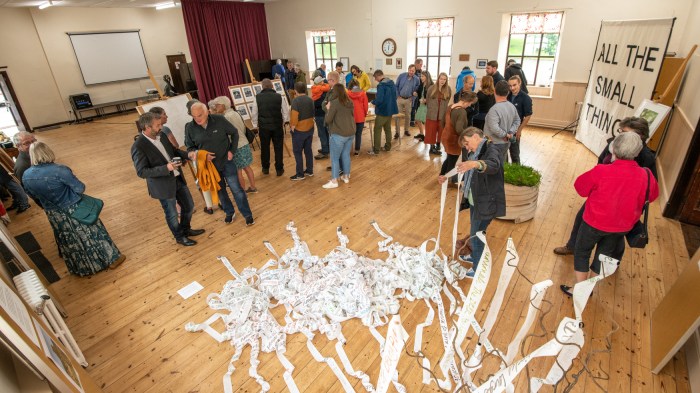
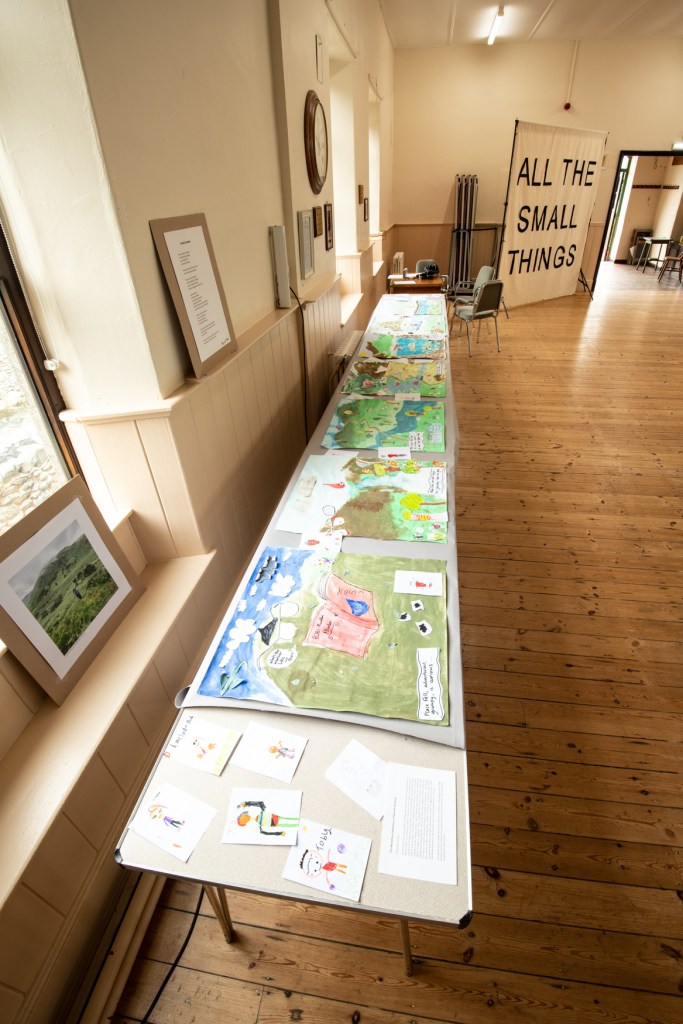
Last Tuesday evening, Glenridding Village Hall was buzzing: full of conversation, and a surround of artwork that’s been inspired by meetings these past few months.
This stage of the Watershed project has been guided by conversations with local residents and people whose work connects them with land use decisions in the valley. Back in March at a gathering in the village hall, the first conversations began, in a group setting. Since then, the five artists have been meeting people individually and building work in response. The event on Tuesday, and the exhibition, was a way to reflect back to the community what has been shared with us.
The work provides a frame for meetings and conversations, and prompts for thought. How do we individually and collectively care for the valley? What can we learn from each other? What does the natural living word express – and how do people ‘hear’ and respond to that? Where might decisions and actions be better joined up to support the local village communities, and the natural environment? These and other questions floated around the room nudging shoulders with conversations about music, water, poetry, farming, trees, maps and more.
Guided by Questions
Over the past few months, each artist has met 5 different people. As part of a longer informal conversation, we each asked the same five questions, covering five themes:
Wonder … Where is the wonder for you, in the Ullswater Valley?
Legacy … What would you, individually or as part of a community, like to pass on to future generations in the context of caring for this place?
Other-than-human perspectives … If we were to think about this landscape, with its vegetation and all the inhabitants that aren’t human, as having a voice – what do you think it or they might show us, or ask of us?
Curiosity … What are you curious to find out more about, in the context of this place?
Watershed ripples … What would you like visitors to the exhibition to come away with?
Meetings for the most part took place outside, in places chosen by the interviewees: locations included walks in woodlands and onto the open fells, wanders round farms, time on the lake (including at the wheel of a boat) and even underground, in the old lead mines. The layers of this place that have been shared are physical, historical, philosophical and metaphorical.
The opening event on Tuesday included a showing of Matt’s film, poetry from Harriet, and a performance by Sarah. You can revisit the material in the exhibition catalogue here, and there will be reflections from the artists about the process.
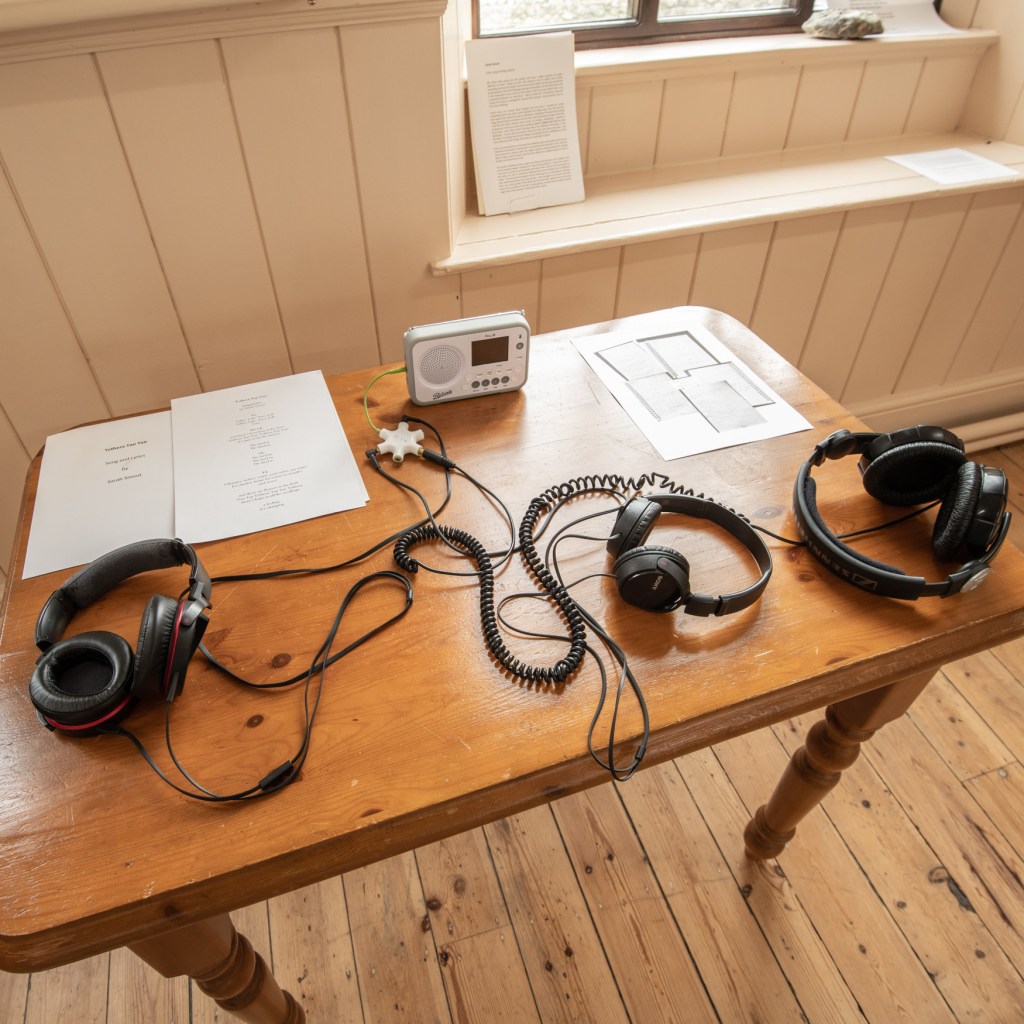
Sarah Smout played an acoustic version of the song she has written and recorded: ‘Tethera Tan Yan’.
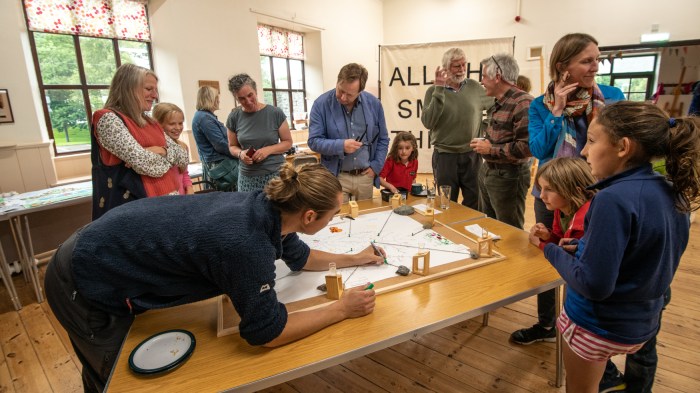
The map of waterways, with ten water samples, was a focus for conversations, and became animated with peoples comments and drawings.
Rob Fraser shared a series of portraits made on his large format camera.
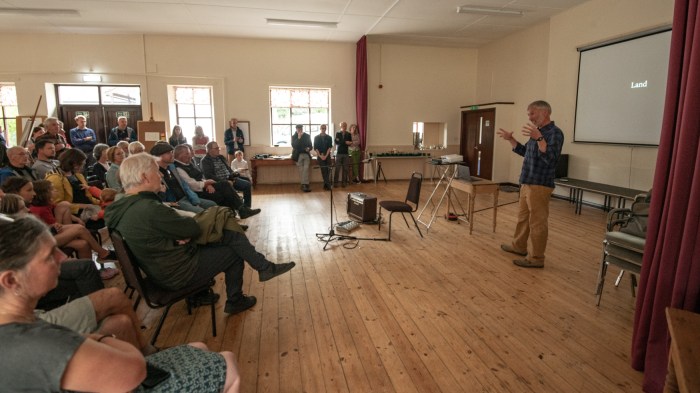
Matt Sharman introduces his film ‘LAND’
Harriet Fraser introducing the project
After the evening event, the exhibition was open to the public for three days – around 270 people came through the doors. Many stayed a long while, pondering the work, and then talking between themselves or with Harriet and Rob. Quite a few people commented that the work ‘made you think – it’s so easy to take things for granted’; and issues highlighted here resonated with issues in other parts of the country. People shared a sense of pride in the place, and a reassurance that many people care deeply for this area. There was a balance of visitors from the valley, from Cumbria, from further afield across the UK, and a few overseas visitors too. One visitor from New York went away motivated to bring artists into a volunteer project campaigning for improved water quality in their harbour.
‘All These Truths Overlap’ by Rob Fraser
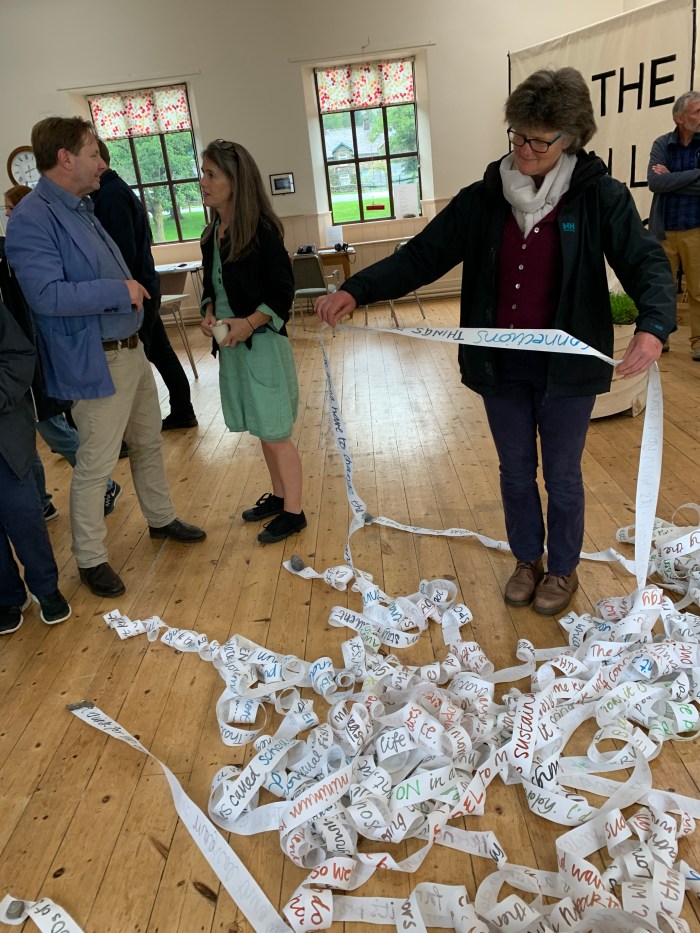
Kate Gilman Brundrett’s installation, an entanglement of conversations
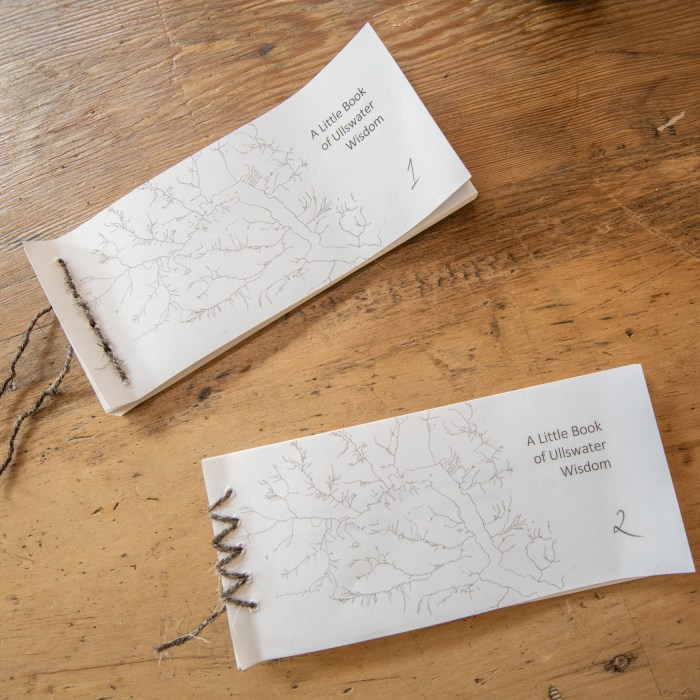
Harriet Fraser’s pair of hand-made books: containing phrases from conversations in the valley.
The research will be continuing for 12-18 months, as part of Harriet’s PhD. Within the broad frame of using art as a tool to explore different perspectives and relationships, and to create spaces for conversations, the direction of research will be focused by what has emerged from this stage: a close analysis of the interviews, reflections on the exhibition, and people’s response to the process. ‘I’m curious about cohesion, connections, discussions and joining things up; and what artistic processes may be a useful part of this,’ says Harriet. ‘In the next phase of research I’m looking forward to many more conversations, and to helping out with activities including habitat monitoring and tree planting, and I’ll be taking many long walks within the watershed.’
Watershed Artists: from left, Harriet Fraser, Sarah Smout, Matt Sharman, Kate Gilman Brundrett, Rob Fraser
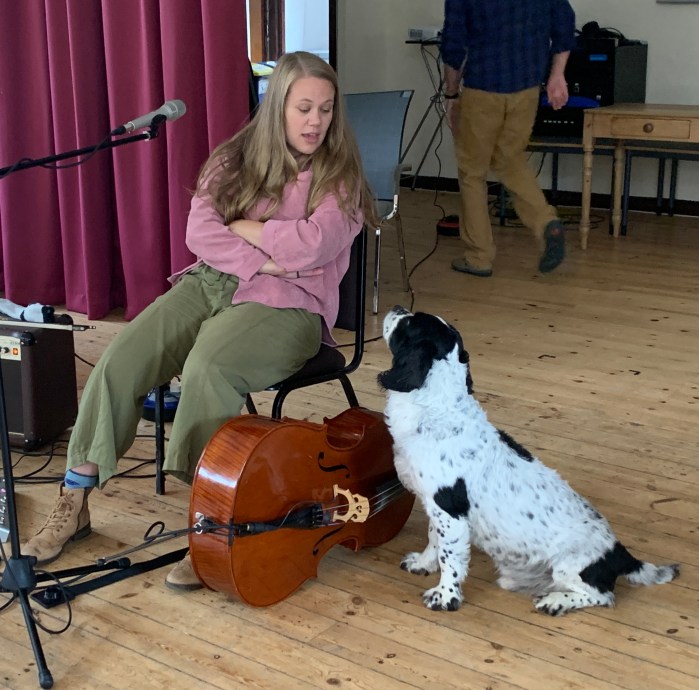
Is it possible to take musical advice from a dog? During sound check, Sarah Smout and Guilly the dog have a chat.
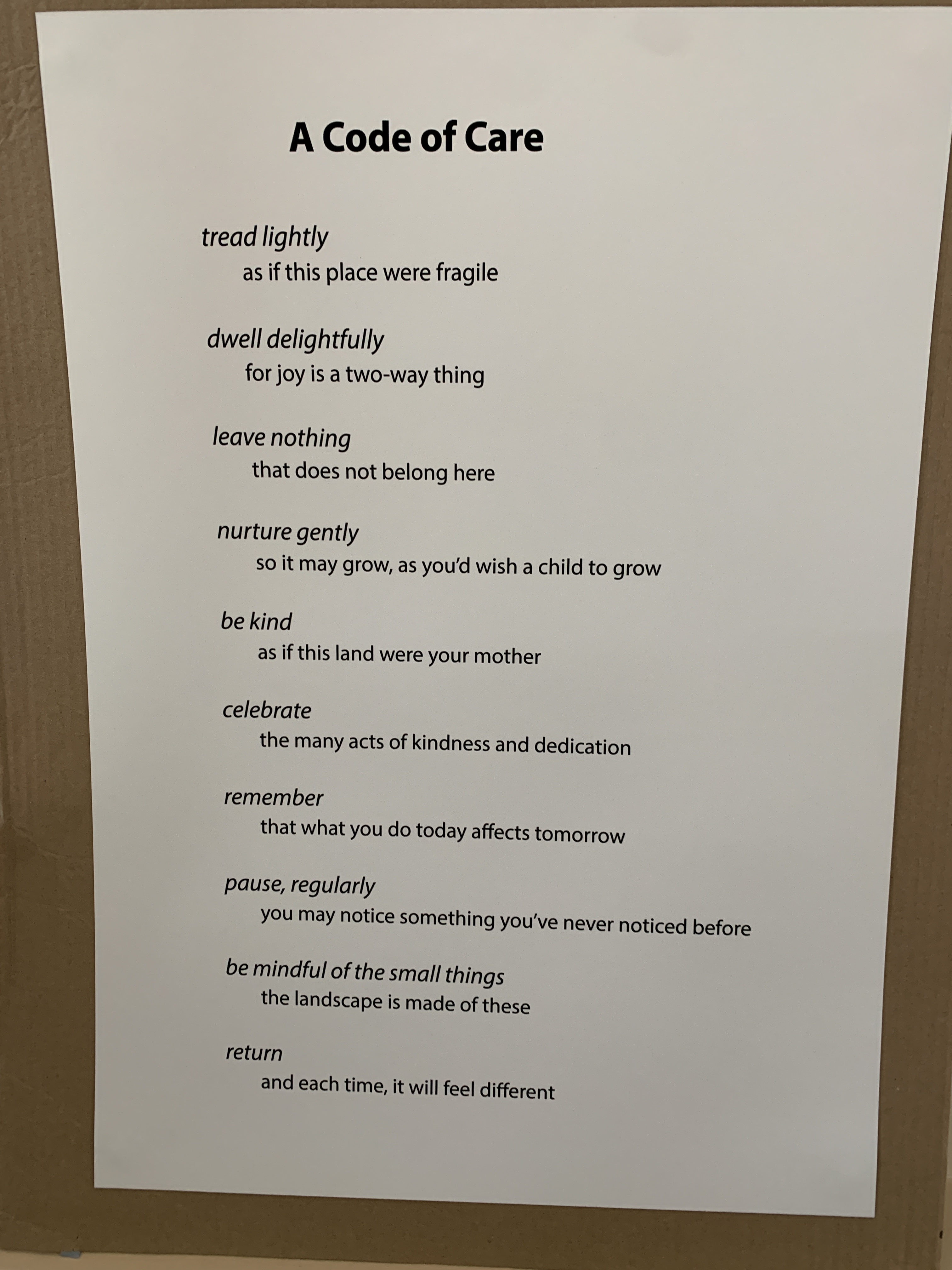
Harriet wrote 6 poems for the event. This ‘Code of Care’ was mounted on board outside the village hall, to welcome visitors. it was inspired by local concerns about wider education around caring for rural landscapes.
Watershed Canvas: Harriet Fraser and Rob Fraser installing the canvas on Glencoyne Beck, July 2023
The ‘What is Natural Beauty?’ Symposium, run by the PLACE Collective through the Centre for National Parks and Protected Areas, and in partnership with Wye Valley AONB and the Lake District National Park, took place on December 1st, 2021. And what a success it was – the provocative (and unanswerable?) question raised through the symposium invited a diversity of views and opened up many avenues for discussion among more than 100 participants.
A formal report will be shared early in 2022, but for now we thought a perfect way to summarise the symposium would be to share this reflection from Howard Davies, former CEO of the National Association for Areas of Outstanding Natural Beauty. Read on …
Howard begins:
“I think it begins with 3 main sets of questions:
What is beauty?
Does it exist objectively in things themselves? Is it an inherent quality of some landscapes, and not others?
Does it exist only subjectively in the mind of the perceiver?
Do landscapes possess special qualities that are perceived as beautiful in the mind of all perceivers? Is there a shared, cultural component to this? Do perceptions of landscape beauty vary, dependent upon societal values and norms?
What is the scope of things to which beauty can be applied?
Purely sensible – perceived through the senses? See, feel, hear, smell …
Or is it something more profound – is there an Intellectual or moral quality to beauty?
And if the scope is this wide does sensible beauty lead you to moral or intellectual beauty?
The romantic poets spoke of natural beauty as a spiritual, almost other-worldly experience that was accessed through our relationship with nature. For example, Shelley’s ‘Hymn to Intellectual beauty’ – Natural Beauty was what you experienced, as a result of your relationship with nature. It was a natural phenomenon connected to the experience of nature, not nature itself.
How does natural beauty relate to other value concepts?
The functional, the sustainable, the spiritual? And does natural beauty align with the concept of a sustainable, ecologically rich and functioning landscapes?
Presenters and performers
Kate Humble opened this seminar with reference to the picturesque and the role of landowners in transforming landscapes in accordance with the aesthetic of counterfeit neglect. She challenged us to reconsider what makes our landscapes beautiful and suggested we take a steer from nature.
Desperate Men provided an entertaining take on the notion that the map is definitely not the territory and questioned the full scope of outstanding natural beauty, and whether beauty is entirely in the eye of the beholder
PennyBradshaw introduced us to the romantic poets and writers, the picturesque in more detail, and Edmund Burke’s notion of the sublime – the agreeable horror associated with some of our more dramatic landscapes.
Crystal Moore challenged us to rethink how we value our environment within the frame of the climate and human emergency that now faces us, and to reinvent ourselves. SteveRatcliffe also framed natural beauty within the wider context of sustainable development and personal impact, with examples drawn from his experience in the globally important, vibrantly lived-in, distinctively special, Lake District National Park
Mike Collier introduced colonialism into the argument, and talked about the impact of race, class, power and privilege and the history of land ownership. Touching on identity, beliefs, and deep-seated cultural values. He made the case for celebrating beauty in difference, rather than the industrial green landscapes of curated, ‘rural’ Britain.
Anjana Khatwa gave a personal reflection of her lived experience as a woman of colour, geologist, earth scientist, and mother in the British landscape and how these lenses affect her view of beauty. Ruth highlighted the benefits of performing in the natural environment, and some of the barriers that exclude people of colour from the countryside. She asserted that no environment can be outstandingly beautiful if it is exclusive.
Sally Marsh examined how we might consider natural beauty today if we embraced its full scope, not just visual amenity, in the planning and management of landscape.
Matt Larsen Daw drew on our nurturing love-affair with nature and our ultimate inter-dependency on this for the wellbeing of our body and mind. I was particularly taken by his description of landscape as “Time and nature made solid”.
Neil Heseltine took us beyond physical attributes and face value, to remind us of the complexity of nature. He made the point that nature needs space and time to play out its processes and intricacies and that the way land has been stewarded over the last 50 years has limited this. He highlighted the important role that National Parks and AONBs can play in helping people understand the complexity of nature and their impact on it, especially with regards the way we produce our food.
So, by way of a summary – for me, sensible and intellectual beauty strike at the heart of what it is to be human. It is the tension between the finite and the infinite, life and death, permanence and transience, lost and found, past and future, harmonious and discordant – it is this symmetry that we inherit from the classical approach to beauty. The wonder, awe, majesty, and drama of nature and our small place within it, we inherit from the notion of the sublime. These marry together to form the yardstick by which we have historically qualified our current suite of protected landscapes, protected for their natural beauty … a concept that is still valid, and indeed important for our wellbeing. Many landscapes however have difficult histories that have given rise to multiple challenges, many of which have been clearly expressed today, and all landscapes are subject, like us, to the existential crisis that is now upon us.
Landscapes are the product of processes and interventions. Ultimately I think, we need to focus less on the product, and more on our relationships with each other and the environment within which we exist, and on which we depend.
We need to be more creative, recalibrate these relationships urgently, and reposition ourselves, our economic systems, and the way society operates, such that a supportive, functioning, environment is the natural outcome. We might therefore focus our search for natural beauty and elegance in these relationships, and become more comfortable in letting our environment be what it will be.
AONBs and National Parks are the perfect vehicles to lead this change and champion what essentially needs to be a new, more diverse, social contract around landscape and natural beauty, but to do this with the intention of triggering systemic change on the basis of kindness, and active and open listening – the point made my Harriet in the poem that started this discussion.
Thank you.
To find out more about Howard Davies, and the other presenters and performers who took part in the symposium; and to browse through some resources, view the symposium programme here.
Kate Gilman Brundrett’s reflections on the symposium … evolving!
So the PLACE Collective is here – but how did it come about?
The PLACE Collective is an ambitious and exciting venture. And for the first blog we thought we’d share some musings about the early sparks of ideas, and the journey to get to here.