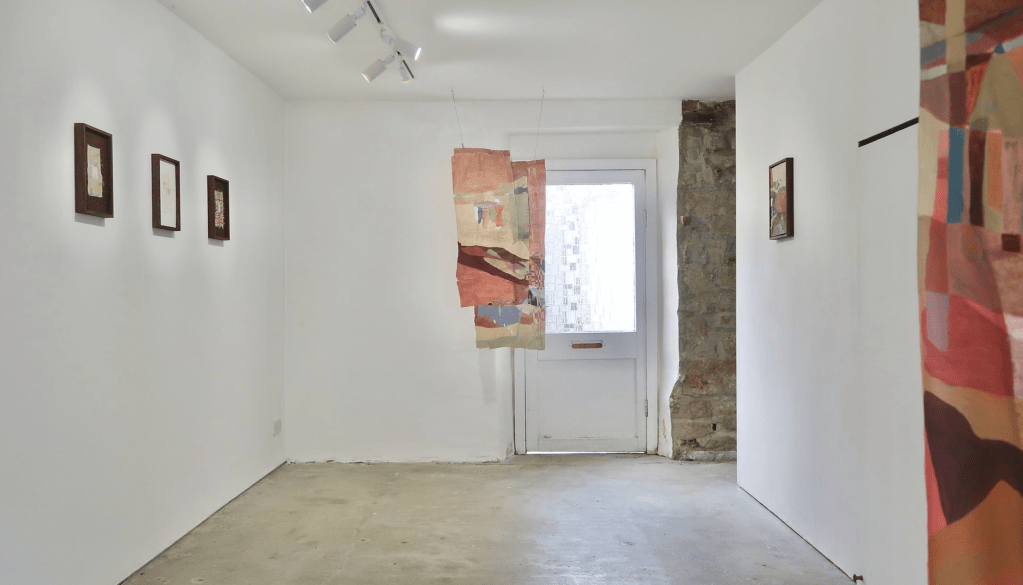
An exhibition space with white walls, a concrete floor, and a door in the back with a window. There is a corridor at the back of the room with grey stone walls. On the left wall there are three frames images. Hanging by the door is a piece made from remnant textiles with sandy pink tones. Another similar textile piece is hung on the right hand wall, so close to the front of the image you can only see a little bit of it.

Standing Stone/Oil Rig – Siobhan McLaughlin

Siobhan McLaughlin brings her piece Standing Stone/Oil rig to the SEE HERE NOW exhibition. The work asks ‘what do we really see when we slow down and how can this help us care for our land and each other?’ Read on for more.

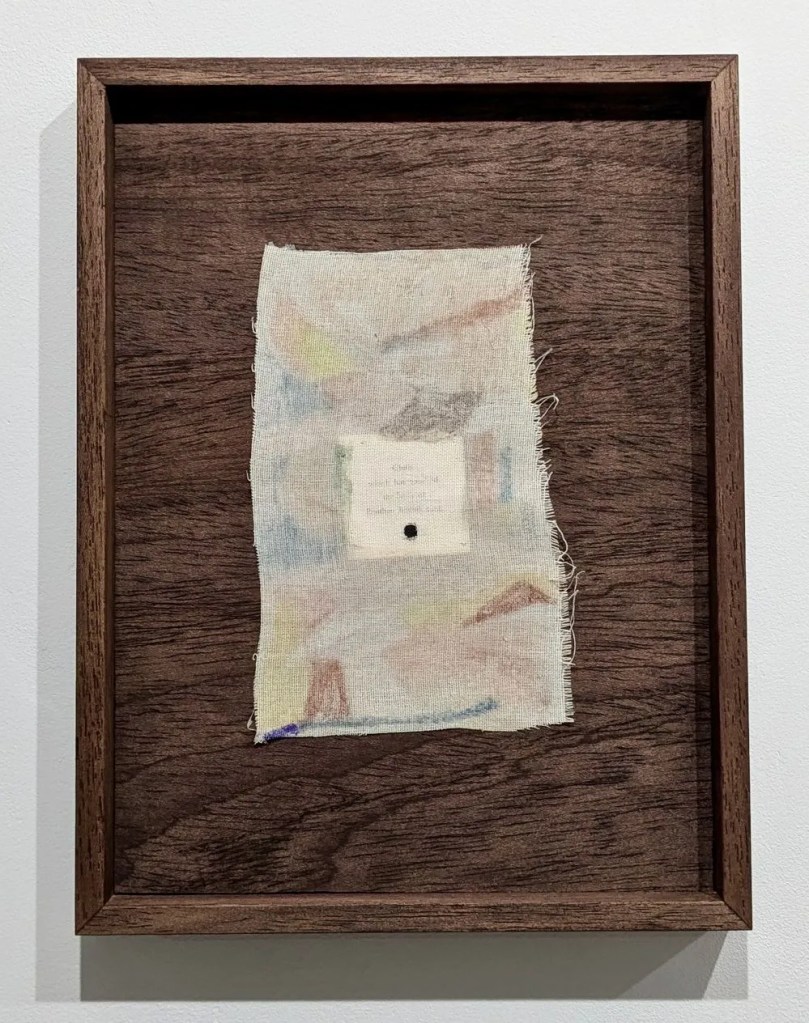
An image of a textile showing blocks of colour from earth pigments and oil paint

This work considers land use and mineral extraction, as well as mending and care at a bodily scale. It is made from paintings woven with remnant textiles gathered from the landscapes and communities I meet.

Earth gathered with care from Cornish mining run-off is ground into paint to form the image of a decommissioned oil rig on the Black Isle, where the Cromarty Firth has become a kind of graveyard for decommissioned structures.

By using a material palette so connected to the earth, the work asks ‘what do we really see when we slow down and how can this help us care for our land and each other?’. 

The following text is an excerpt from Belongings,a piece by Martin Holman written in response to McLaughlin’s show Pilgrimages at  Hweg gallery, Penzance 22nd November 2024 – 11th January 2025.

‘If you aestheticise too much,’ says Siobhan McLaughlin, ‘you risk ignoring landscapes for their ecological, social and labour values.’ While toil is not the main subject of this artist’s work within the genre of landscape painting, the presence of labour is nonetheless a notable feature. She approaches the task of making imagery by realising in materiality her visual experiences of the external world. They become manifest through the acts of seeing, touching and being. McLaughlin describes her objective as creating non-traditional landscape painting. For her, that means deviating from the quintessentially British tendency to romanticise the ‘view’ or the ‘experience’ of nature. Because historically ‘landscape’ has been perceived in many instances as a visual salve. The result has been, and I imagine McLaughlin will agree, that notions of the ‘land’, as a product of constant movement by nature and man, has been lost – or, at best, downplayed. 

By contrast, her images are constructed with an interrelationship of means. Material layers seem to correspond with physical sensations. We might recognise in the complex edges and surfaces of her work our own encounters with a dramatic natural environment. That experience is inevitably fractured and multidimensional, made up of air, land and sea and the visual tapestry of the piecemeal subdivisions. Mankind has parcelled land into fields and moors, and altered borders to suit changing needs and ownerships, so that echoes of previous patterns remain as vague imprints. 

Read the full essay here.

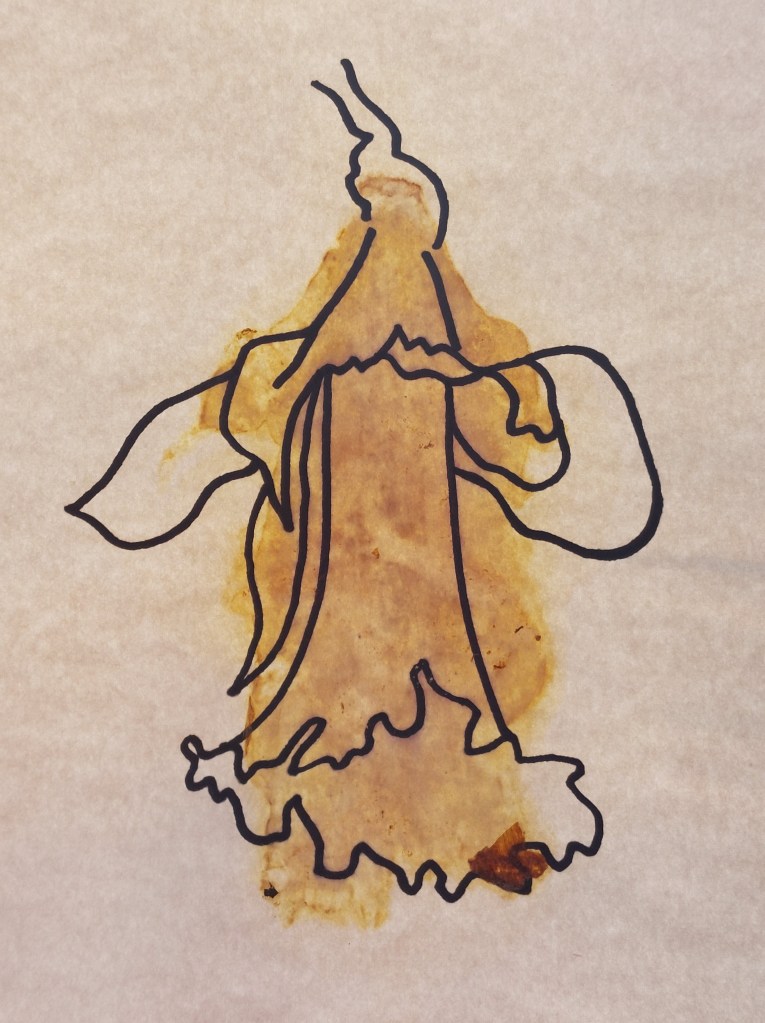
Three images next to each other, the first is a faint yellow imprint left on paper where a daffodil head had been pressed, the second is a stronger brown silhouette of a daffodil head, the third has a yellow imprint with a black outline of a daffodil overlaid.

How to Draw: A Daffodil Triptych – Camilla Nelson

Camilla Nelson brings Daffodil Tryptych (2023) to the SEE HERE NOW exhibition. In this post, Camilla describes her process and shares some of the questions it prompts.

What is the cost of human art making and reproduction to the world we seek to celebrate with our representations?

What is the shadow ecology embedded within our making? 

Daffodils have occupied a key place in the popular imagination of English landscape since Wordsworth’s “daffodil” poem (“I Wandered Lonely as a Cloud”) secured their popularity in 1807. Who speaks in these representations? The loudest voice, in this work, is the black pen on the white paper (a combination of bleached tree and plastic, oil-based marker pen). The black line is the voice of human agency using natural materials as a mouthpiece. So often, the human representation of another life form entails the death, destruction, damage, silencing, drawing out or over of the nonhuman form.  

In How to Draw: A Daffodil Triptych(2023), the black line drawn on paper was pressed together with daffodil heads to produce two further works: one is an imprint made by the colour leached from the daffodil flower and the black pen lines of its human representation; the other is a ghostly imprint, a paper shroud, where the form of the daffodil heads, now absent, leave their indent in the page. Through this printing process, something of the flowers is drawn out or into the paper leaving a tangle of responses to the human effort to remake them, a quiet speaking back to or about what happens, the silent costs, of this process of representation.  

This seemingly innocuous work asks what the cost of human art making and reproduction is to the world we seek to celebrate with our representations. What is the shadow ecology embedded within our making? 

Find out more about Camilla Nelson here: Camilla Nelson.