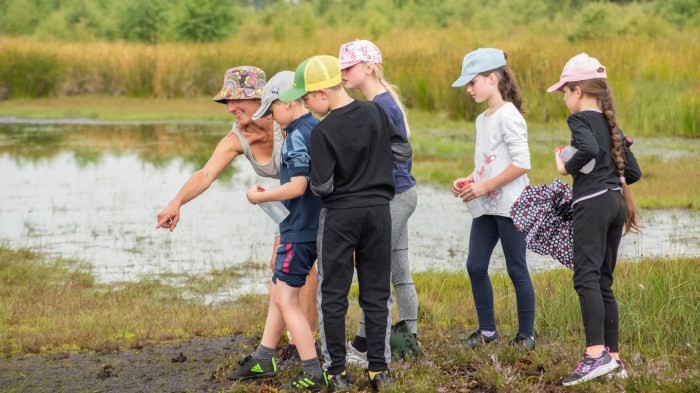
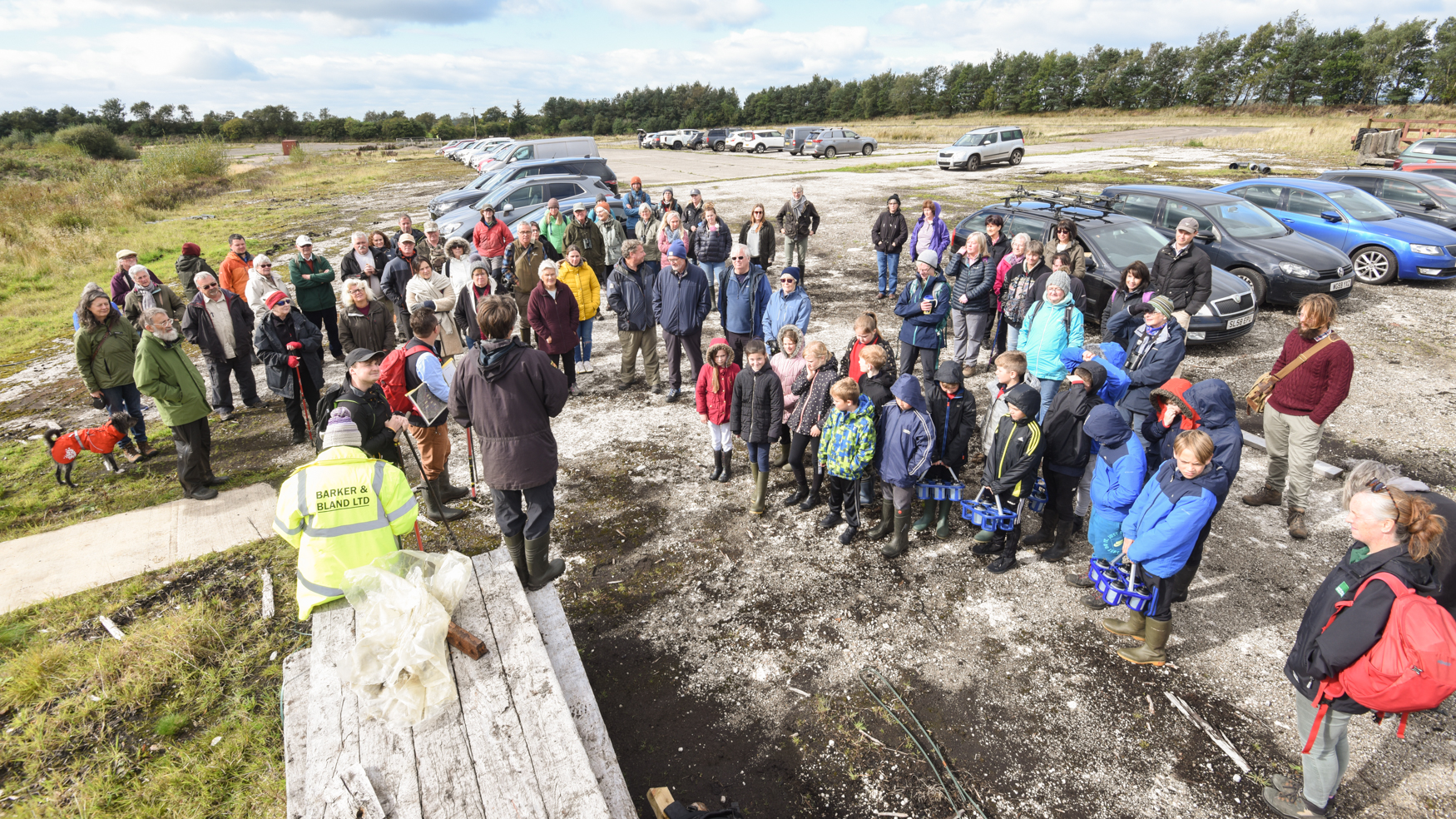
From North America to North Yorkshire, the Moss of Many Layers film has been journeying to different cinemas and film festivals across the world. The first showing (and for me the most important) was in a village hall in Hethersgill, close to the Moss. The audience was made up of the local community and the many people included in the film: the school children, neighbouring farmers, researchers, artists and conservationists.
But now the film is shared far and wide, telling the story of the moss beyond its neighbours and the scientific community.
Still from the film
Art within science serves as a mirror: it can communicate ideas and data accessibly as different attention is required. Additionally, it acts as a versatile tool, allowing us to manipulate scale, delve into details, and expand our understanding of the landscape.
When recording or decoding science – as an artist – it’s important to include the human story that is connected to the Moss. That’s my motivation for including the ‘breathing portraits’ of subjects in the film.
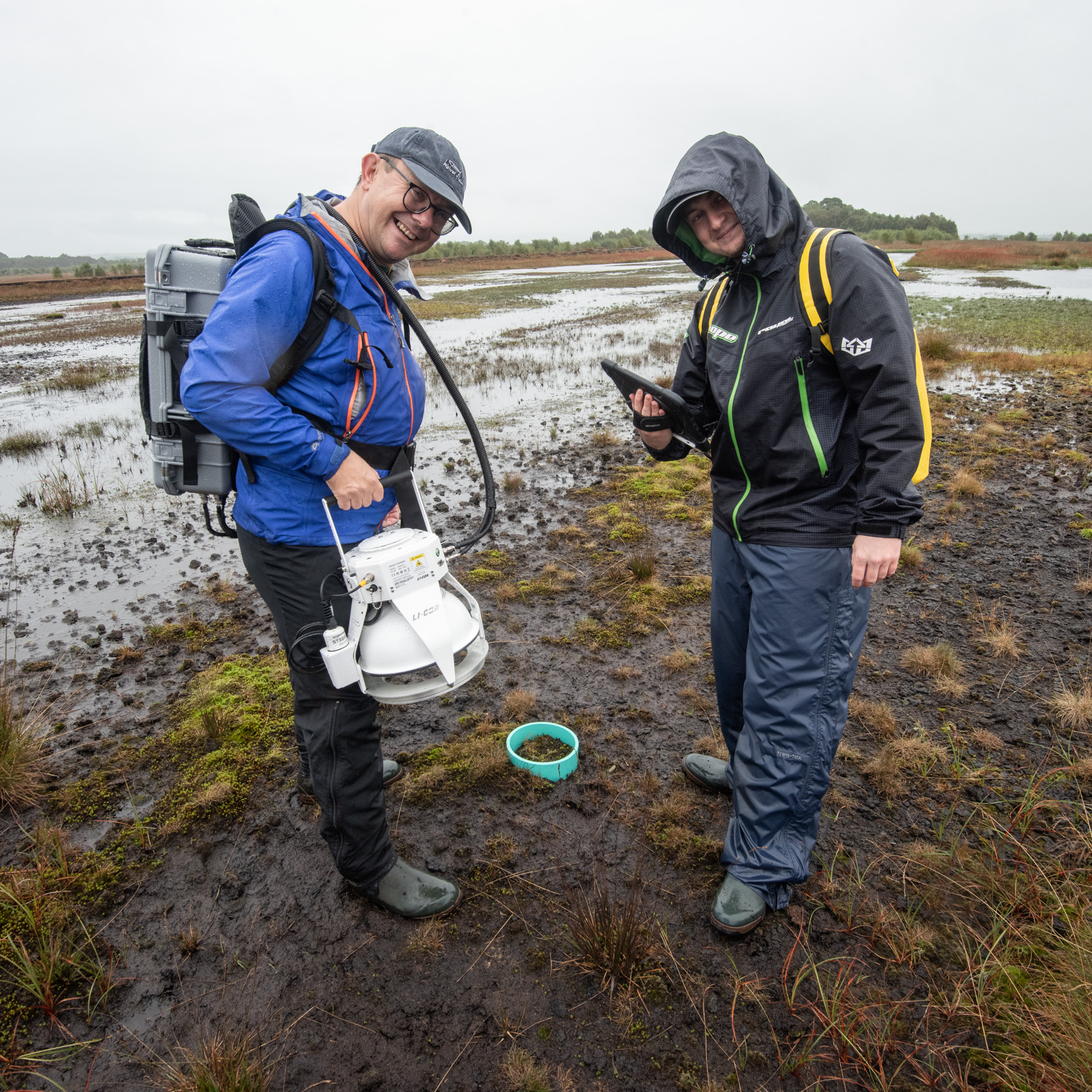
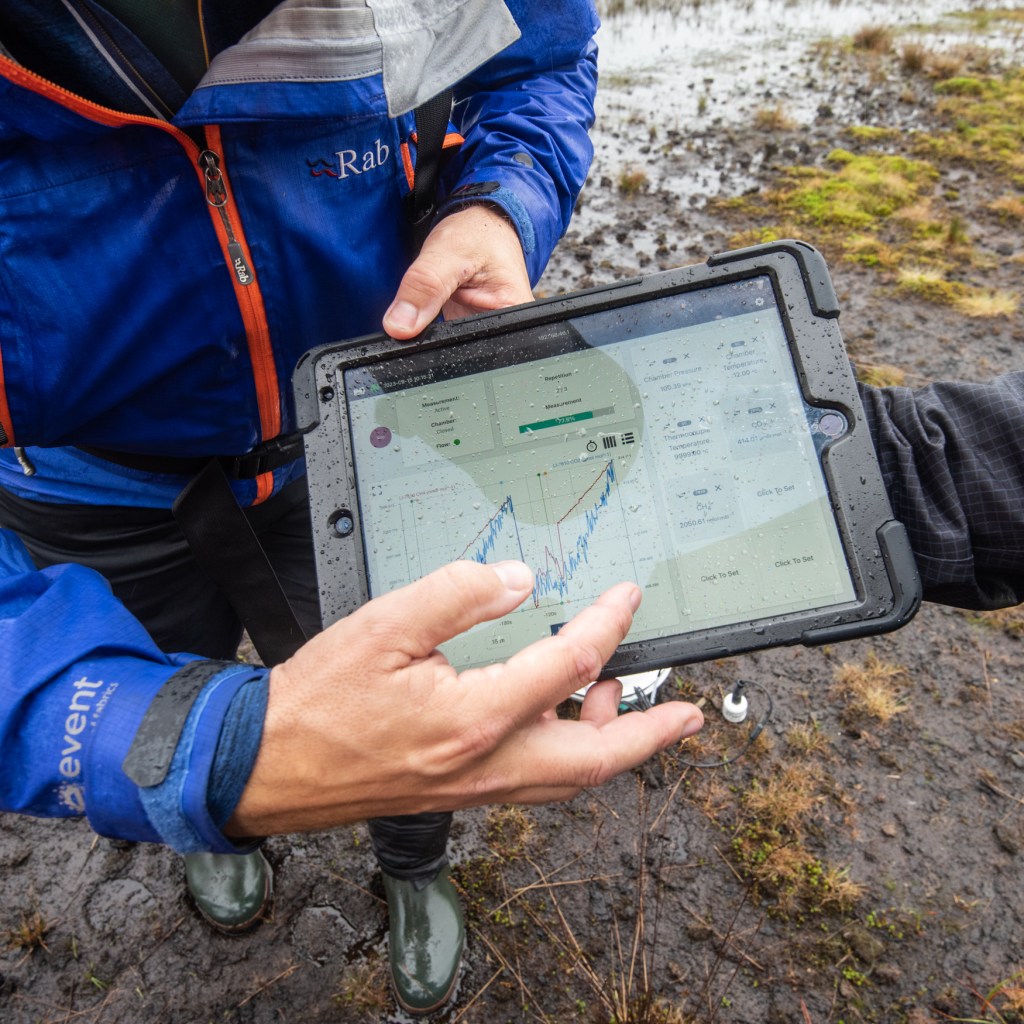
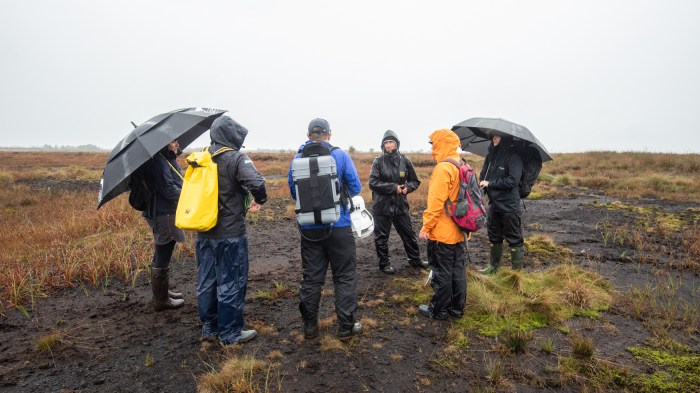
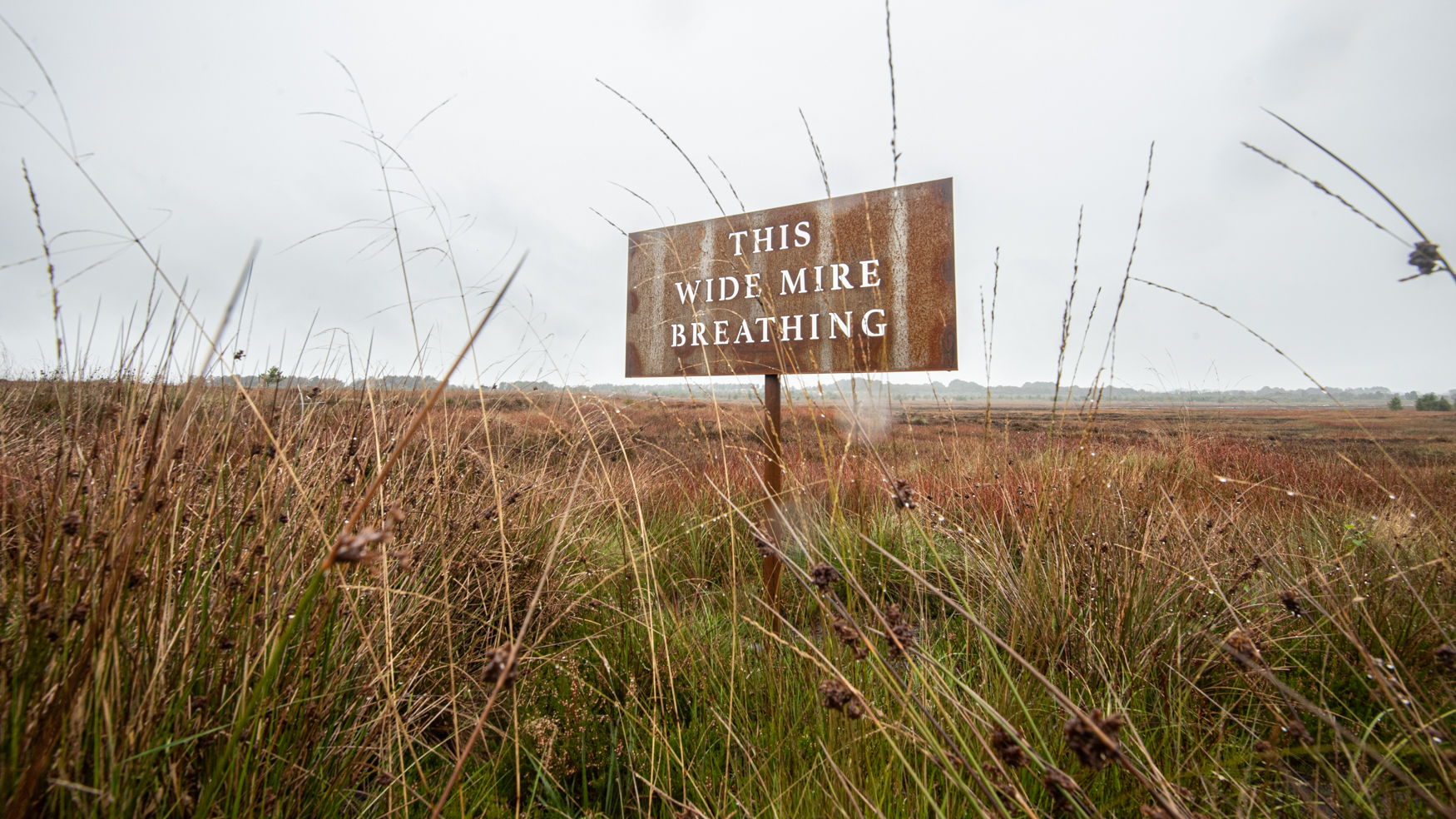
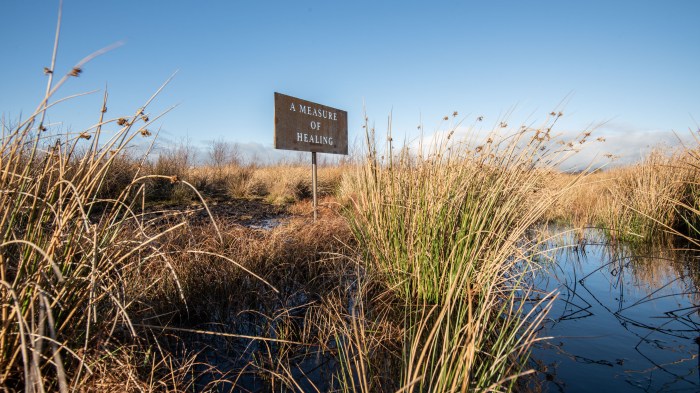
I certainly haven’t stopped thinking about Bolton Fell Moss, and am happy to keep going back. Here are two images from my last visit to the Moss, to see Harriet’s Poetry Signs and watch Dr Simon Carr and PHD Student Jack Brennan use a carbon flux monitor.
Simon Carr and Jack Brennand with the carbon flux monitor, on Bolton Fell Moss; image by Juliet Klottrup (taken using real film)
Poetry sign on Bolton Fell Moss, image by Juliet Klottrup (real film)
emma austin, natural england, in conversation with harriet fraser and rob fraser
It has been said more than once, and it’s true: it’s not possible to give a final ‘evaluation’ of the impact of a project until some time has passed. Arts interventions and multi-disciplinary engagement in community, scientific and conservation work have effects across a wide timescale: in the days, weeks or months in which direct research and engagement take place, and then in the months and years following that. Moss of Many Layers (MoML) is a case in point. So, 14 months on from the Wide Open Day celebratory event, we (Harriet and Rob) sat down with Emma Austin to hear her reflections.
Emma Austin. Still from Juliet Klottrup’s ‘Moss of Many Layers’ film
Emma, Natural England Senior Reserves Manager for North Cumbria, was part of the MoML project team. She already had an established relationship with Bolton Fell Moss – the vast area of peatland that is currently under restoration – and with some of the residents living around the edges of the moss before the project began. So what was the impact, or the novelty, of a project that brought together artists, scientists, restoration specialists, reserve managers and local residents? This was the first question we put to Emma.
What was the impact, or the novelty, of a project that brought together artists, scientists, restoration specialists, reserve managers and local residents?
Emma tells us that she really hoped the project would focus on the local community, helping to build bridges where people had been impacted by the difficult transition from an industrial site of peat extraction with local jobs and income, to a National Nature Reserve. ‘Having new faces that had no prior history with the place, artists who were independent, scientist with new knowledge, was brilliant,’ says Emma. ‘And the things that were introduced – whether it was a camera, a poem, specialist kit – these were new, and fresh, and I think the local community who became involved perhaps felt involved in a way they hadn’t been before.’
Emma taking part in the schools events, co-designed with artist Anne Waggot Knott
Emma says that she senses the project’s impact through the new links made with the local community. The first time this hit home for her was the huge turnout for the Wide Open Day. Emma always grins when she talks about this: the peat core extending the length of the hall, the room buzzing with conversation, curiosity about the artworks, school children and their parents, and local people meeting one another, some for the first time.
Emma tells us there has been a real growth in interest in the moss since then, nicely coinciding with the completion of the new 3km boardwalk. Juliet Klottrup’s film has been a feature at local discussion events, and there is a definite interest for more of these. The mailing list for news of Bolton Fell Moss has grown fourfold; and events on site run by an engagement officer over the summer were really popular.
In June 2023, during a nationwide heatwave, there was a fire at Bolton Fell Moss, and for six days people worked together to tackle it.
In June 2023, during a nationwide heatwave, there was a fire at Bolton Fell Moss, and for six days people worked together to tackle it. ‘It sounds strange,’ says Emma, ‘but I think the fact that we did the Moss of Many Layers project may have made a difference. I certainly felt able to ask for help in a way I would have been wary of in the past. It’s hard to say for sure that this is linked with MoML, but the project may well have played a part in the way it helped create new friendships and familiarity.’ The intervention of artists helped to bring people together, and the continuing use of the film in Emma’s meetings helps to spotlight local people who are connected with the moss – who live nearby, who once worked there, who are engaged in monitoring, or just love to visit, and who have stories to share.
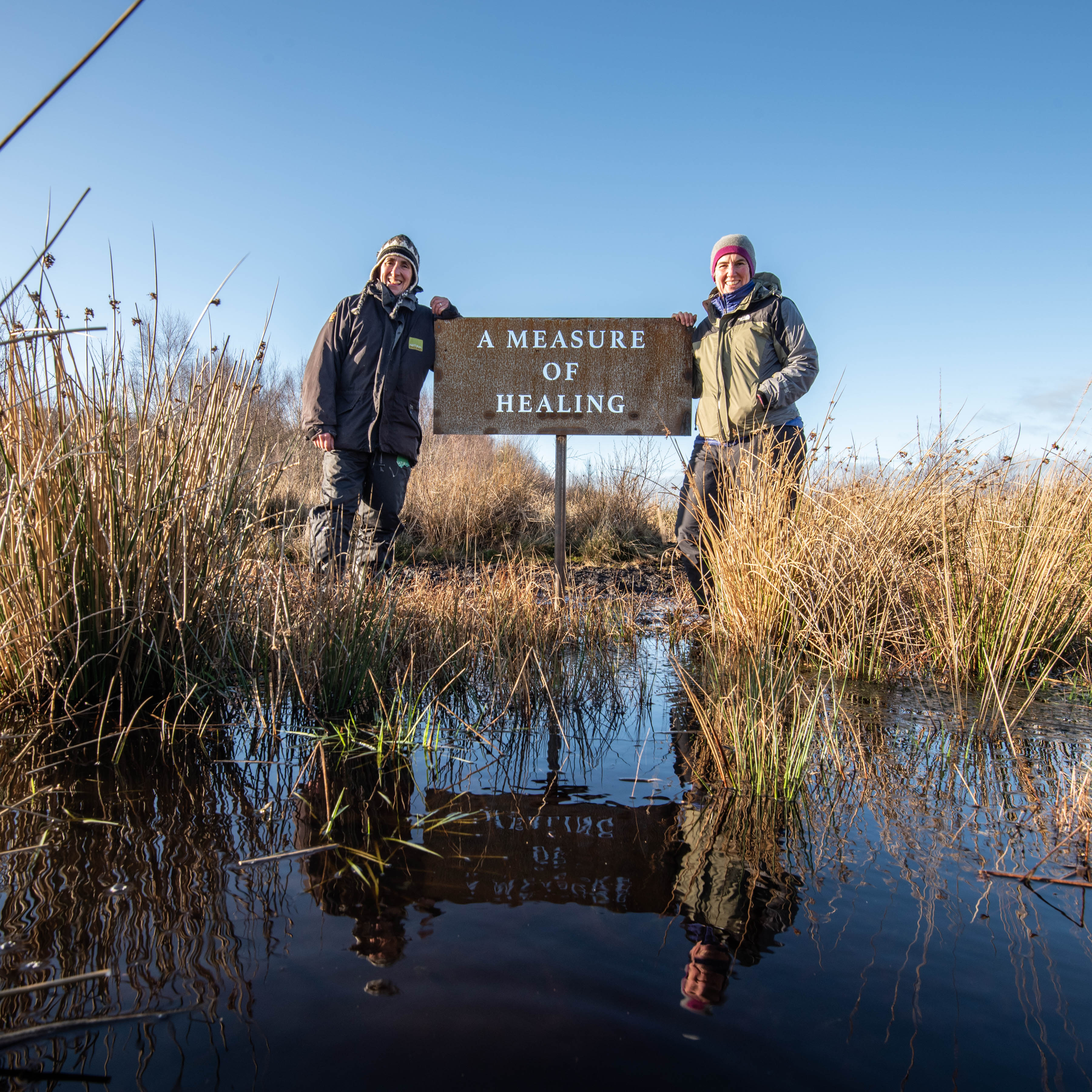
Emma Austin (left) and Harriet Fraser with one of the seven poetry signs
Emma smiles as she talks about the poem signs on the bog. She often hears positive comments about them, and just last week she heard from a group of MSc students who had said they loved the poem and had a WOW moment when they learnt that the signs are anchored and so they will act as a measure of peat accumulation for centuries to come – a novel combination of art and science.
‘People get used to seeing things in a certain way,’ says Emma, ‘We all do. But seeing it from a different perspective – through the arts – can bring a different outlook.’
One of the central elements of Emma’s role with Natural England is to get to know people and liaise with land owners and farmers about changes that are needed to support restoration of the moss. Emma thinks that the inclusion of art, and the presence of the artists and scientists in the area during the project, has helped people understand the bog more and feel the importance of it, and has also helped to soften the edges of difficult conversations. ‘People get used to seeing things in a certain way,’ says Emma, ‘We all do. But seeing it from a different perspective – through the arts – can bring a different outlook.’
For her, the Moss of Many Layers project helped, above all, to put the community first. ‘How do you make sure that you create a discussion or a conversation where the person whose place you’re in feels as important, or the most important, part of the jigsaw. Because if we are going to achieve any of the things we want to achieve for nature, we’ve got to involve everybody – and the way the Moss of Many layers brought different strands together, through art and science, helped to create a neutral space of shared ownership.’
‘… if we are going to achieve any of the things we want to achieve for nature, we’ve got to involve everybody – and the way the Moss of Many layers brought different strands together, through art and science, helped to create a neutral space of shared ownership.’
Emma Austin and MoML team members welcome people to the Wide Open Day, 2022
Also tap into these blogs about the process, including work with schools, the Wide Open Day, Scientist Jack Brennand’s reflections and you can use the search function, looking for Moss of Many Layers to explore further.
Simon Carr talks to Harriet Fraser about monitoring greenhouse gases at Bolton Fell Moss .. carbon, climate and the living, breathing bog
The bog is wide and grey, the rain is slashing down, and we’re all dressed in wellies and full waterproofs. We have umbrellas too – useful to protect camera equipment, and give a little shelter to Simon and Jack as they bend down and get busy with their tools to measure emissions of carbon dioxide and methane. Understanding how much of these gases the bog is emitting, and how more is held over time, is a critical part of the restoration work.
In this recording, Simon reflects on the current levels of greenhouse gases in the atmosphere, introduces the carbon flux monitor, and explains what he hopes to learn from monitoring the bog. Every month, he and Jack visit ten monitoring sites spread across this vast bog; and they walk 10km in the process. The white carbon flux monitor, which is aesthetically beautiful and almost personal, is continually taking in gases, and periodically it lets out a ‘burp’, which you can hear on the recording.
This Wide Mire Breathing – one of seven signs that complete a poem (Harriet Fraser) Lunch and a Moss of Many Layers meeting (almost) out of the rain
A blog from Harriet Fraser and Rob Fraser, working on the Moss of Many Layers project.
Landmark day! After a year of planning, with research, poetry composition, design, engineering and finger-crossing, on Friday, together with Natural England Senior Reserves Manager Emma Austin, we headed out to Bolton Fell Moss to test the installation of a poetry sign. And phew, the install went perfectly! Hurray!
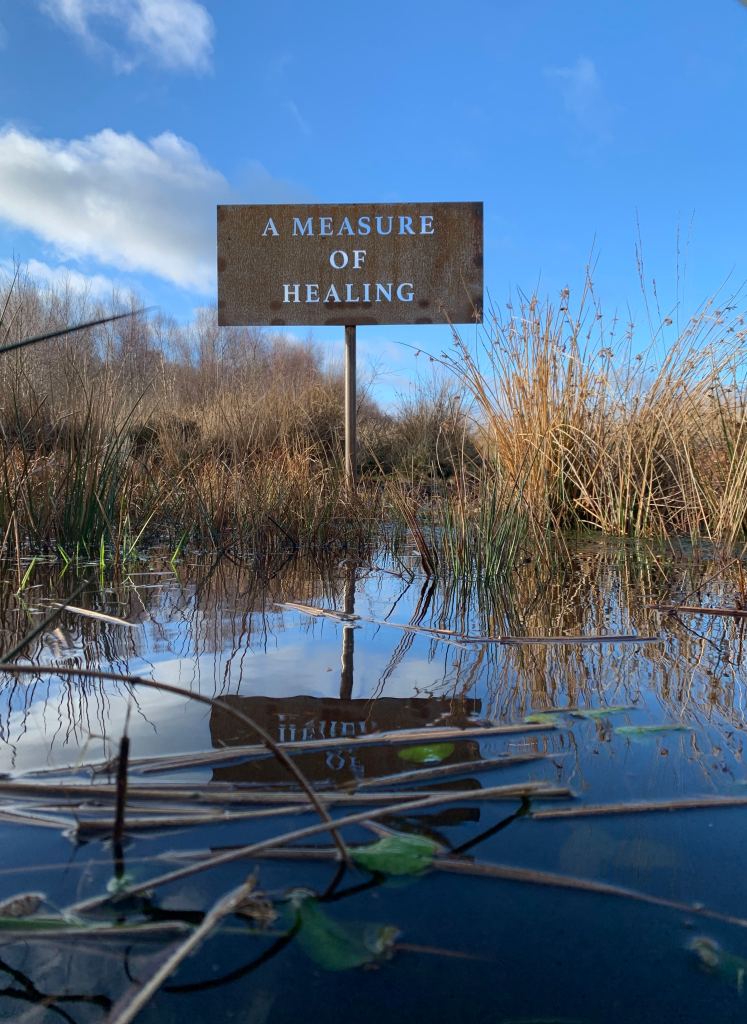
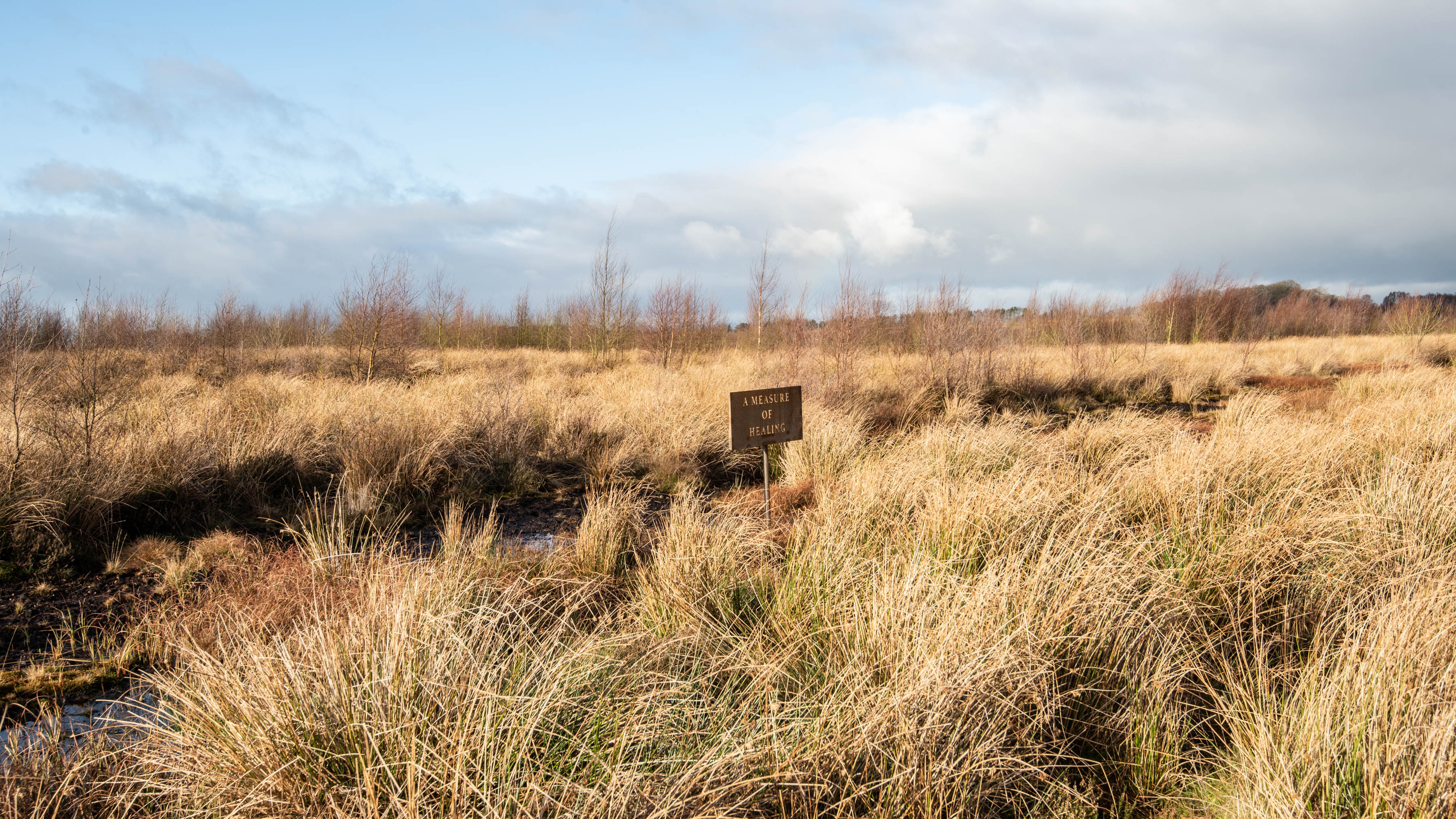
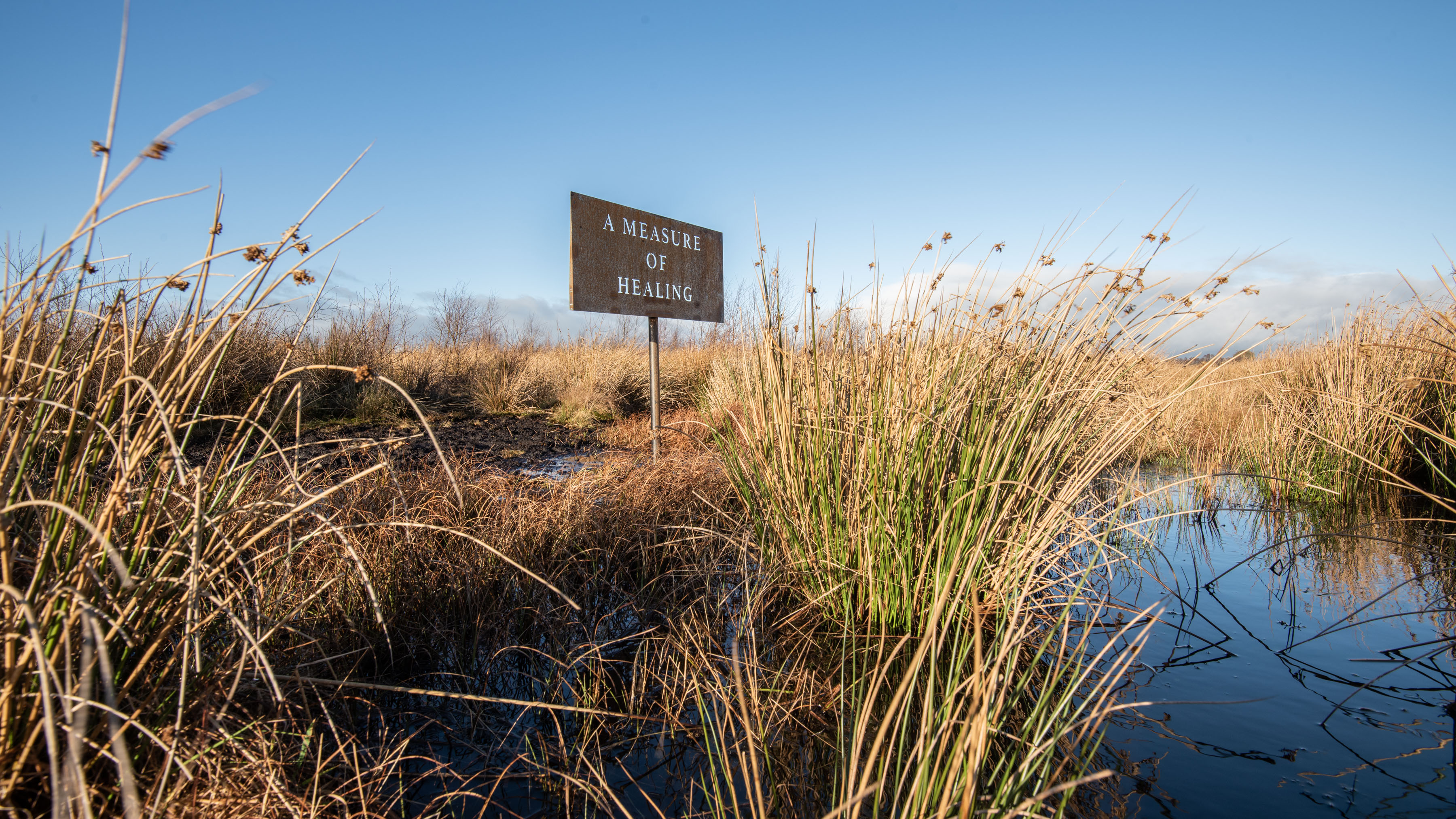
This is one of a set of seven signs that will be placed within sight of the boardwalk, which runs for a circuit of 3km. Together, the signs will form a seven-phrase poem that can be read clockwise or anti-clockwise, or can be read in couplets. Each sign will rust up, blending in with the colours of the bog.
A tool for scientists
The support pole for each sign acts as a surface level rod, so the team monitoring the growth of sphagnum moss (and, very very slowly, peat itself), will be able to measure incremental change. The support poles extend down to the mineral layer beneath the peat, which is a marker of the end of the last ice age before peat began to form here. The range on chosen sites is 227cm – 578cm, reflecting different levels of extraction around the site.
Process, and first impressions
When you dream something up, then work through the ideas, encounter and overcome design challenges, and get to this stage, you think you know how it will look, but it’s only a guess. You only really know once it’s in …
We’re really happy with it – this first sign carries the qualities that we had hoped it would. The form and material reflect the industrial heritage of the site, where steel was used extensively in the machinery used for peat extraction, and angular shapes were common. The cut-out letters allow the signs to also have a softness, reflecting the softness of the mosses and grasses: as the light changes, or as you walk past the sign, the sign seems somehow to float, and the words are airy. It helps with the invitation for a pause – the words help to convey the ongoing story of this wonderful place, and perhaps for some will be a catalysts for thoughts, feelings, questions and further conversations.
This sign is the third in the sequence, if you follow the boardwalk in a clockwise direction; or the fourth if you walk anticlockwise.
Team work
Massive thanks to Emma at Natural England who has been a really important part of the evolution of this piece, and to Martin Lucas, engineer extraordinaire, whose attention to detail always pays off. And thanks to the rest of the Moss of Many Layers team – scientists, artists, conservationists, rangers – and the local community, who have all been part of the learning that inspired Harriet’s composition of the poem.
Emma Austin (left) and Harriet Fraser with the poetry sign
Opening yet to come
The site is a National Nature Reserve but will not be open to the public until later this year. Once the site opens, all the poetry signs will be in place, as will a new shelter on the central ‘island’. We’ll share updates as they happen.
Juliet Klottrup was one of the five artists who worked as part of the team on the Moss of Many Layers project – here’s the film she made after months of research. Click the link and enjoy – it’s a 15-minute watch.
The film now features in the COP26 Virtual Peat Pavillion – visit it there and find out more about peat, mires, mosses and bogs across the world.
To find out more about the project, and the extraordinary Bolton Fell Moss National Nature Reserve, visit the project page here.