Simon Hitchens’ durational day drawings are made in, of and about the landscape, the result of a particular set of conditions, in a particular place, over a particular span of time. His work 06.58 Carron Crag 19.10 Epoch was created in Grizedale Forest, and is being shown in the SEE HERE NOW exhibition. Read on for more.
Read more: 06.58 Carron Crag 19.10 Epoch – SIMON HITCHENSThe British Isles have a rich and varied geology, with rocks ageing from the present to some of the oldest on our planet. Each day these rocks get a little older as we too get older. To be able to comprehend the deep time of rocks is to a shine a light upon our own short lifespan and to begin to understand the transient but interconnected nature of what we share with the world.
For this exhibition I have made a durational-day-drawing of a specific rock found on the summit of Carron Crag in Grizedale: Silurian, aged 443-419 million years old. The process was simple: arrive at Carron Crag at least half an hour before dawn, giving me enough time to set up my collapsable drawing table and materials. For this drawing I bivvied on the summit of Carron Crag the night before to save me a long walk in before dawn, as the combined weight of my rucksack full of drawing kit, clothes for all weathers, food and drink etc. was considerable. Once the paper is on the surface of the table and I have placed my chosen stone (which I found the night before) upon the surface of the paper, I waited for the sun to rise.
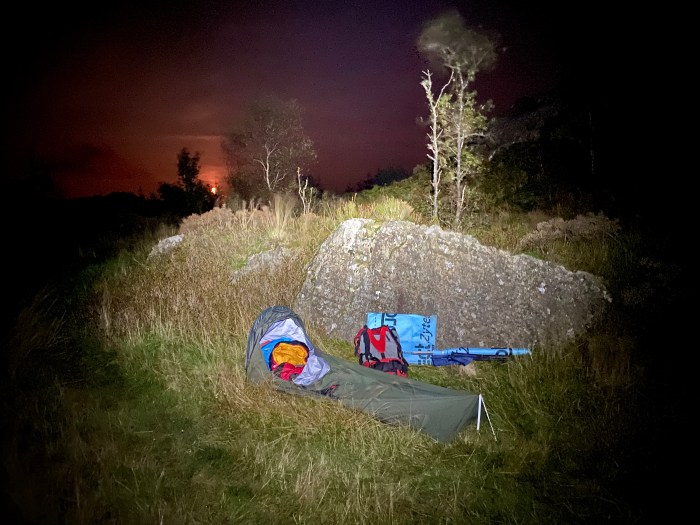
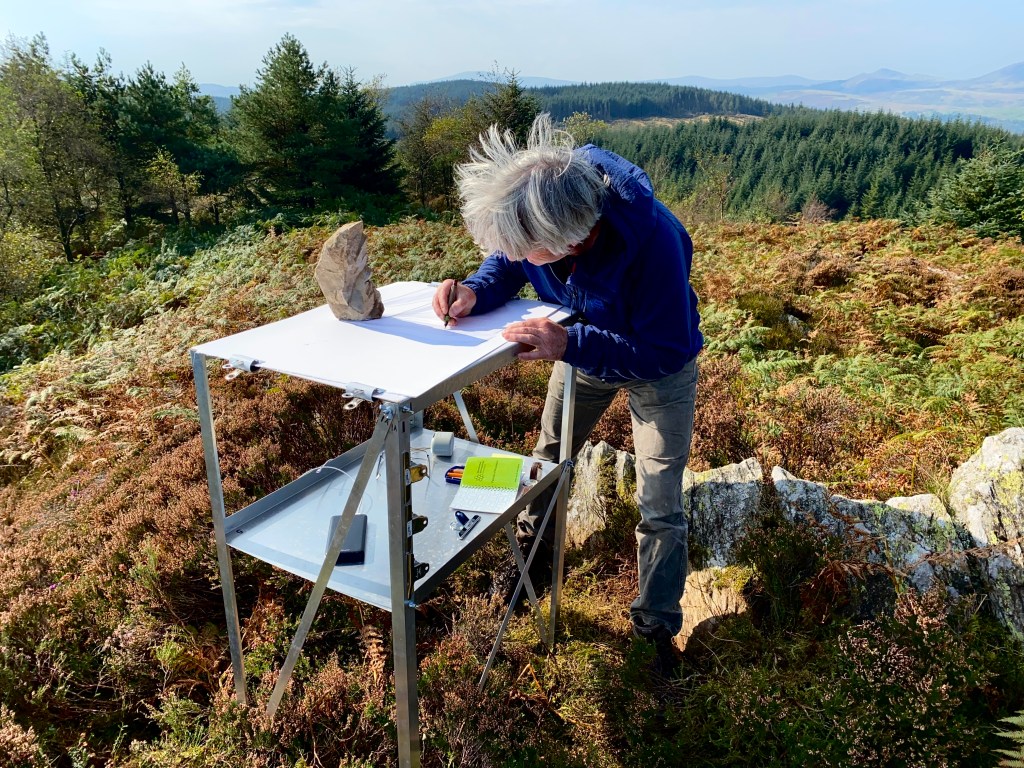

Simon Hitchens at work, tracing the stone’s shadow from dawn to dusk.
As the sun rose in the east, casting a shadow of an ancient geological object to the west, I traced its shadow lines on the paper beneath. It took between two and two and a half minutes to complete the drawn shadow line – once this is completed, I immediately start drawing the next line, as the shadow itself has shifted a little due to the incessant rotation of planet earth beneath my feet. This process was repeated relentlessly until either a cloud obscured the sun, and there was no shadow to draw, or the sun dipped below the western horizon at the end of the day.
This is a process-based drawings made in, of and about the landscape, the result of a particular set of conditions, in a particular place, over a particular span of time. It records celestial time, geological time and human time as well as the weather patterns unique to that day and site: a meditation on time and space.
Even the solidity of rock and mountains given time, will eventually erode into nothing, echoing the transience of human life.
I have chosen to exhibit this drawing in combination with the rock itself, the source of the drawn shadows, on a purpose-made steel-framed table which is the same height and size of the drawing table I use to make the drawing. The drawing sits upon a low carbon concrete slab made with crushed Silurian rock sourced from Grizedale, the exact same rock type which I used to make my drawing.


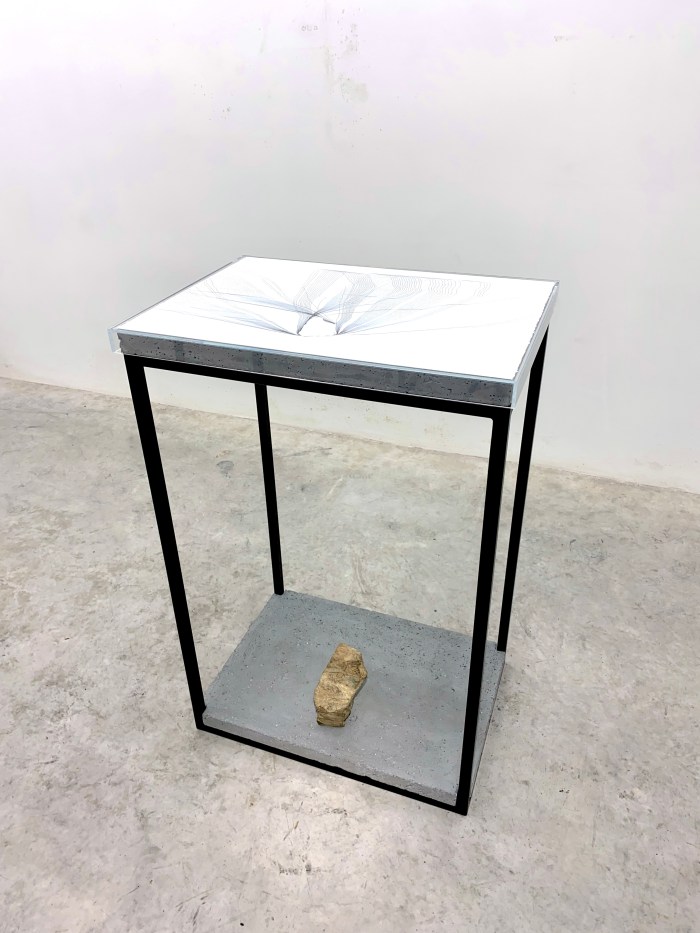
- Drawing size: 50 x 70 cm. (Rotring ink on 300gms Fabriano paper)
- Rock: Silurian, aged 443-419 ma
- Table size: H – 110cm, W – 51, D – 71 cm.
- Date 2024/2025
The low carbon cement used to make the concrete has a 50% less carbon footprint than standard Portland cement. Under the drawing is another shelf of low carbon concrete, which supports the very stone that was used to make the drawing above it. It’s displacement from the drawing, and indeed the drawing itself, references time and transience. The work also speaks of presence and absence, subject and object, art and nature.
The drawing accurately records the haptic qualities of the Earth’s geology at a specific time and location, linking us to the past through the present and connecting us to something larger than ourselves.

06.58 Carron Crag 19.10 Epoch