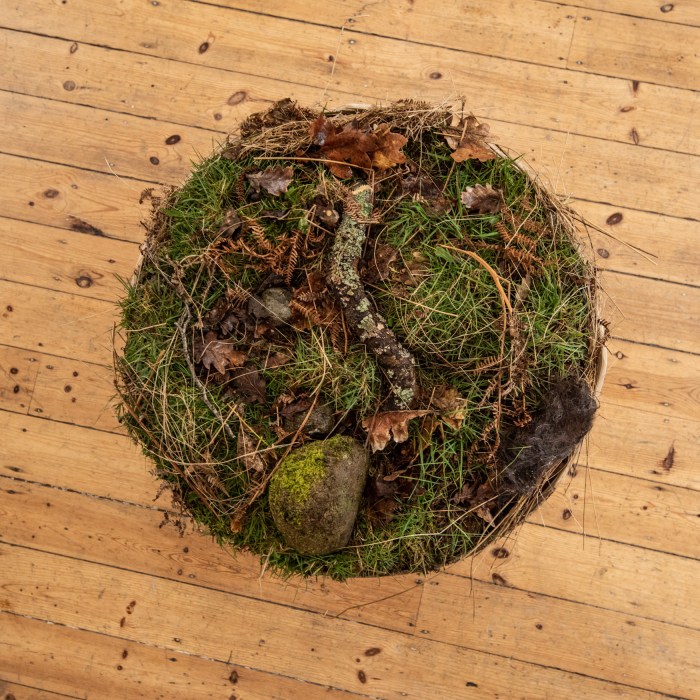
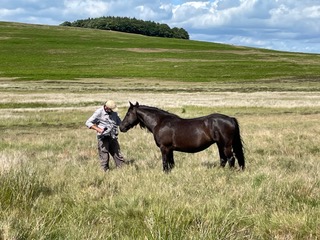
As part of the Watershed project, Harriet Fraser and Rob Fraser have been keen to include the land in conversations. They, and the other artists involved, have explored a number of ways to do this. And for group meetings in the valley, we have been including a ‘Circle of Earth’. This will feature at intervals over the coming year, each time featuring a circle of earth taken from the valley, for a short period. The Frasers developed the idea and worked with Charlie Whinney to realise it: Charlie used the process of steam-bending to create the piece out of ash.
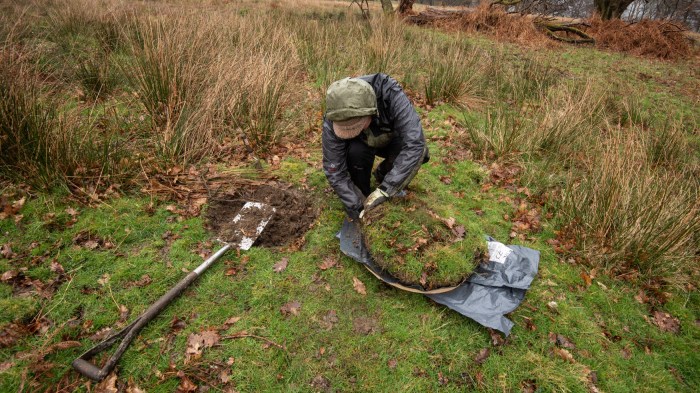
The Circle of Earth has appeared twice so far. First, in March, at a group event in Glenridding Village Hall; and for a second time, in the village hall again, as part of the exhibition. On both occasions it has been ‘borrowed’ from Glencoyne Farm, with thanks to Can and Sam Hodgson.
Circle of Earth, March 2023
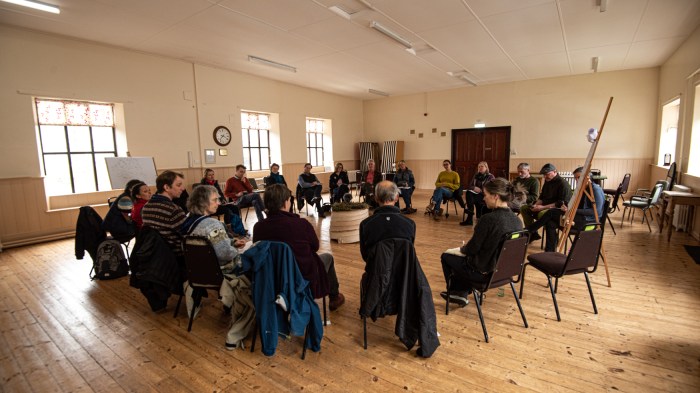
Meeting with the earth at the centre
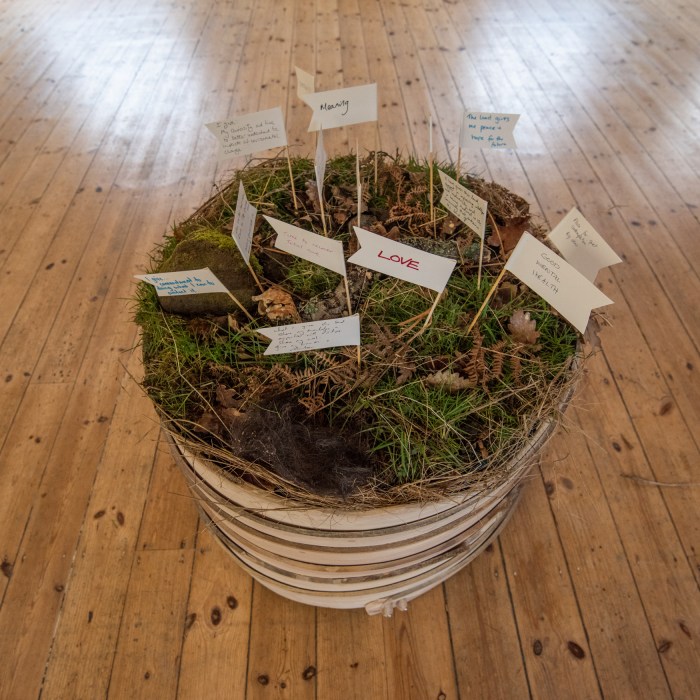
Watershed: Circle of Earth. The flags hold thoughts from participants on our ‘give and take’ relationship with the earth.
The Spaces In Between
in between the names of places and the endless flow of water
love for what is treasured what has been lost what can be gained
in between the names of places mouthfuls of cloud the sound of water over rock hands in soil struggle and joy
earth at the centre of all we know and all we don’t yet know
earth at the centre of lives that are not ours but are ours to guard
in between the named and the counted things this breathing earth stories to be heard and told
in between us all a future waiting
Harriet Fraser, written for the Watershed event, March 28th, 2023
Circle of Earth, July 2023
Collecting a ‘circle of earth’ to reside for a few days in Glenridding Village Hall
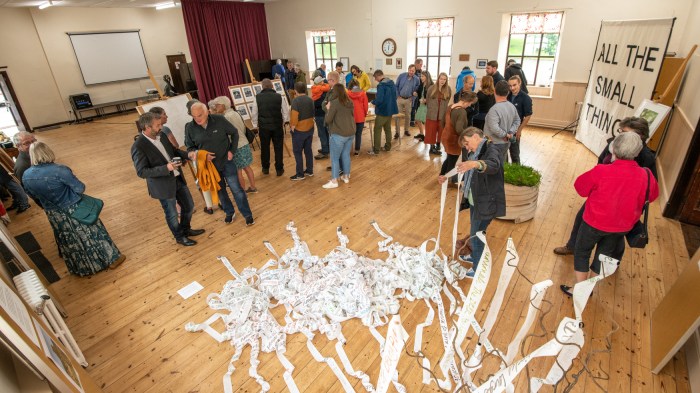
Last Tuesday evening, Glenridding Village Hall was buzzing: full of conversation, and a surround of artwork that’s been inspired by meetings these past few months.
This stage of the Watershed project has been guided by conversations with local residents and people whose work connects them with land use decisions in the valley. Back in March at a gathering in the village hall, the first conversations began, in a group setting. Since then, the five artists have been meeting people individually and building work in response. The event on Tuesday, and the exhibition, was a way to reflect back to the community what has been shared with us.
The work provides a frame for meetings and conversations, and prompts for thought. How do we individually and collectively care for the valley? What can we learn from each other? What does the natural living word express – and how do people ‘hear’ and respond to that? Where might decisions and actions be better joined up to support the local village communities, and the natural environment? These and other questions floated around the room nudging shoulders with conversations about music, water, poetry, farming, trees, maps and more.
Guided by Questions
Over the past few months, each artist has met 5 different people. As part of a longer informal conversation, we each asked the same five questions, covering five themes:
Wonder … Where is the wonder for you, in the Ullswater Valley?
Legacy … What would you, individually or as part of a community, like to pass on to future generations in the context of caring for this place?
Other-than-human perspectives … If we were to think about this landscape, with its vegetation and all the inhabitants that aren’t human, as having a voice – what do you think it or they might show us, or ask of us?
Curiosity … What are you curious to find out more about, in the context of this place?
Watershed ripples … What would you like visitors to the exhibition to come away with?
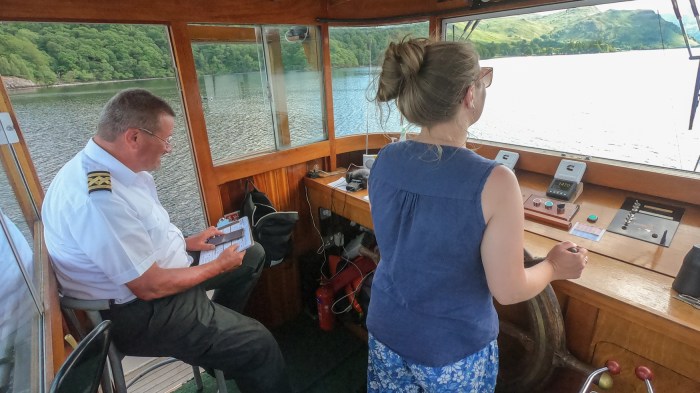
Meetings for the most part took place outside, in places chosen by the interviewees: locations included walks in woodlands and onto the open fells, wanders round farms, time on the lake (including at the wheel of a boat) and even underground, in the old lead mines. The layers of this place that have been shared are physical, historical, philosophical and metaphorical.
The opening event on Tuesday included a showing of Matt’s film, poetry from Harriet, and a performance by Sarah. You can revisit the material in the exhibition catalogue here, and there will be reflections from the artists about the process.
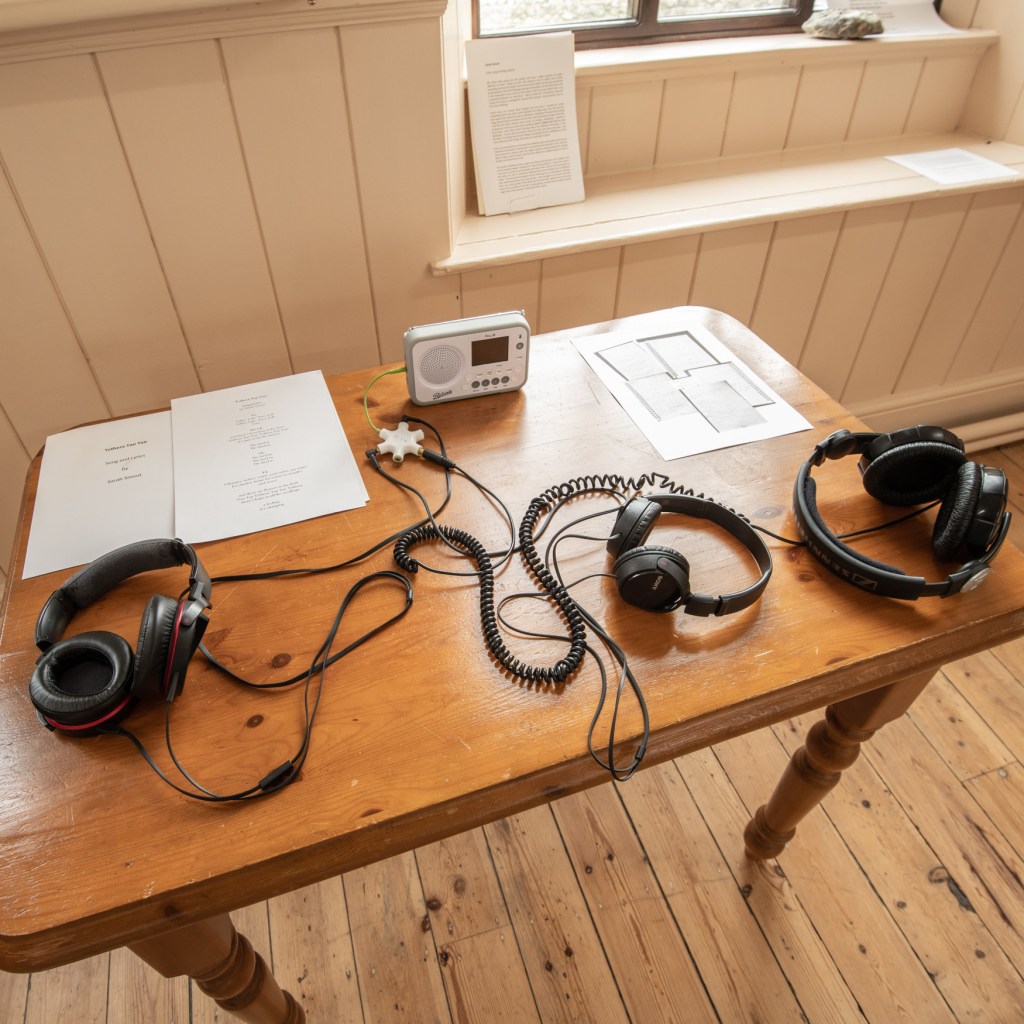
Sarah Smout played an acoustic version of the song she has written and recorded: ‘Tethera Tan Yan’.
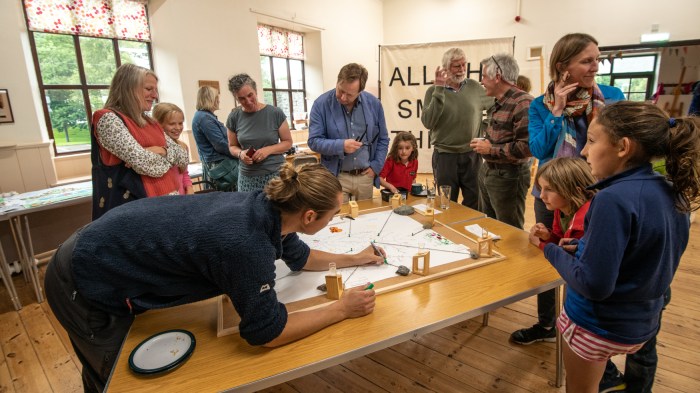
The map of waterways, with ten water samples, was a focus for conversations, and became animated with peoples comments and drawings.
Rob Fraser shared a series of portraits made on his large format camera.
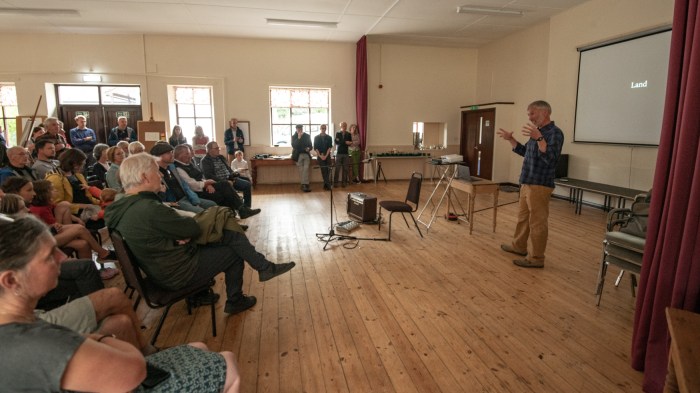
Matt Sharman introduces his film ‘LAND’
Harriet Fraser introducing the project
After the evening event, the exhibition was open to the public for three days – around 270 people came through the doors. Many stayed a long while, pondering the work, and then talking between themselves or with Harriet and Rob. Quite a few people commented that the work ‘made you think – it’s so easy to take things for granted’; and issues highlighted here resonated with issues in other parts of the country. People shared a sense of pride in the place, and a reassurance that many people care deeply for this area. There was a balance of visitors from the valley, from Cumbria, from further afield across the UK, and a few overseas visitors too. One visitor from New York went away motivated to bring artists into a volunteer project campaigning for improved water quality in their harbour.
‘All These Truths Overlap’ by Rob Fraser
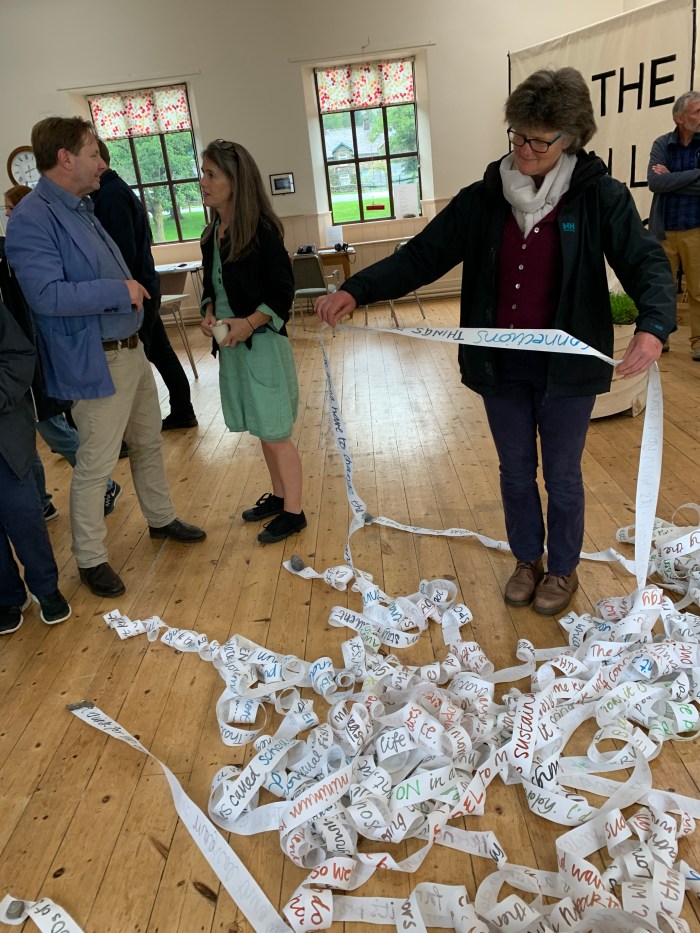
Kate Gilman Brundrett’s installation, an entanglement of conversations
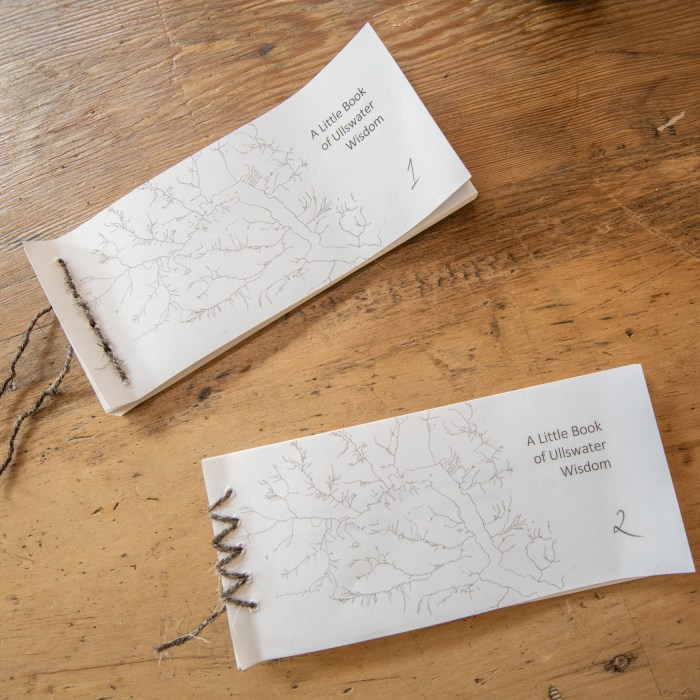
Harriet Fraser’s pair of hand-made books: containing phrases from conversations in the valley.
The research will be continuing for 12-18 months, as part of Harriet’s PhD. Within the broad frame of using art as a tool to explore different perspectives and relationships, and to create spaces for conversations, the direction of research will be focused by what has emerged from this stage: a close analysis of the interviews, reflections on the exhibition, and people’s response to the process. ‘I’m curious about cohesion, connections, discussions and joining things up; and what artistic processes may be a useful part of this,’ says Harriet. ‘In the next phase of research I’m looking forward to many more conversations, and to helping out with activities including habitat monitoring and tree planting, and I’ll be taking many long walks within the watershed.’
Watershed Artists: from left, Harriet Fraser, Sarah Smout, Matt Sharman, Kate Gilman Brundrett, Rob Fraser
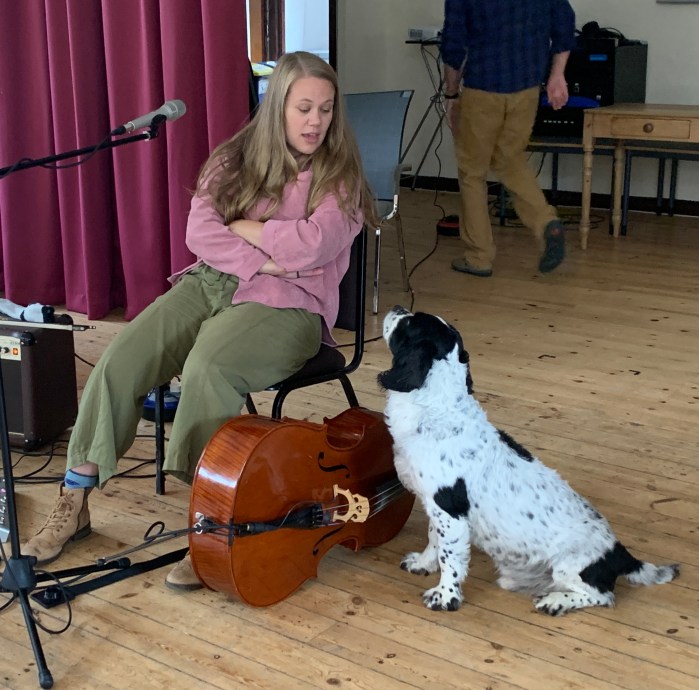
Is it possible to take musical advice from a dog? During sound check, Sarah Smout and Guilly the dog have a chat.
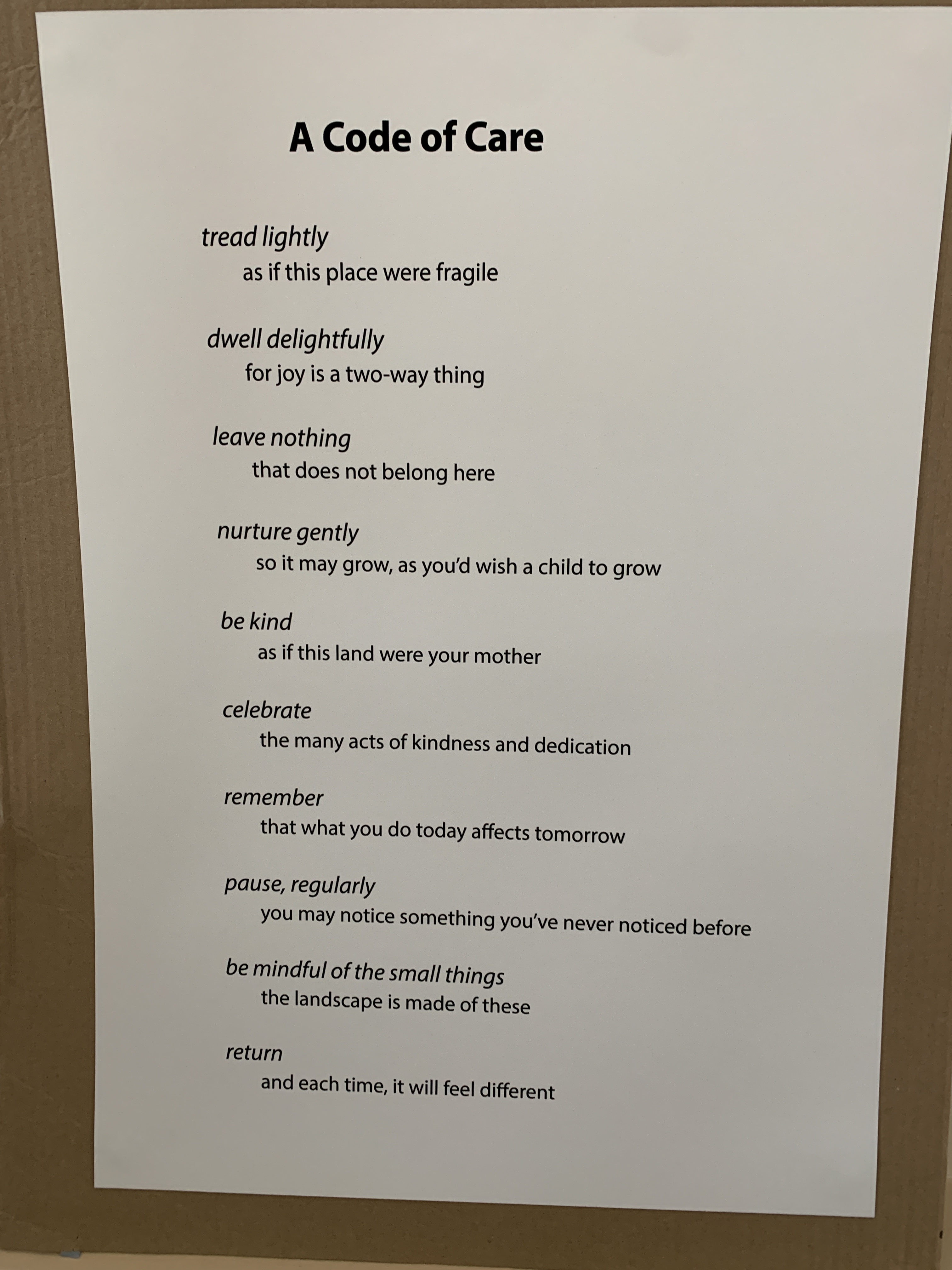
Harriet wrote 6 poems for the event. This ‘Code of Care’ was mounted on board outside the village hall, to welcome visitors. it was inspired by local concerns about wider education around caring for rural landscapes.
Watershed Canvas: Harriet Fraser and Rob Fraser installing the canvas on Glencoyne Beck, July 2023
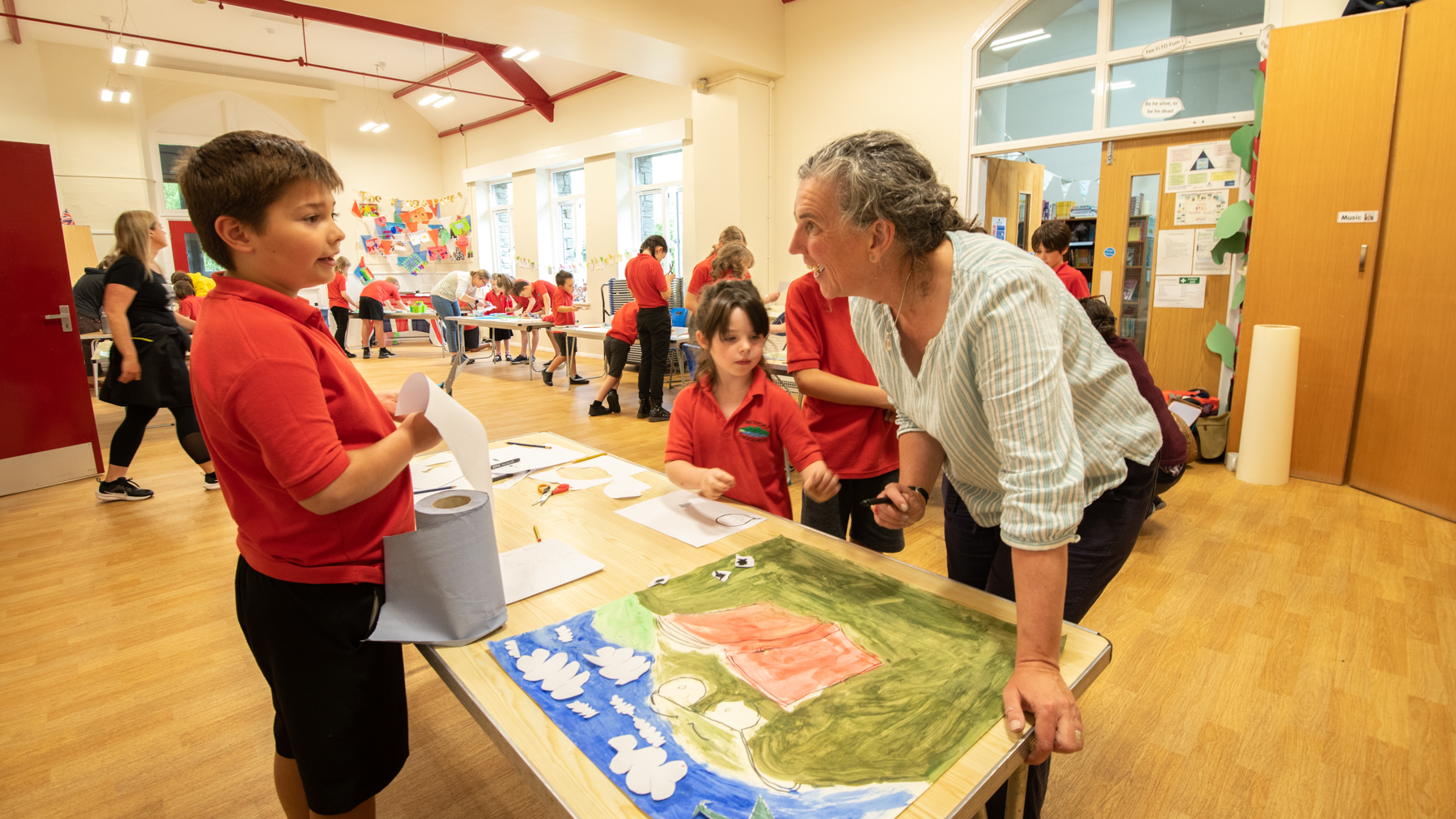
Children bring something that we adults just can’t. Their way of seeing, their ideas and their concerns are all really important. So, as part of the Watershed project, which brings many perspectives on the Ullswater Valley together through art, it was essential to involve children from the Valley.
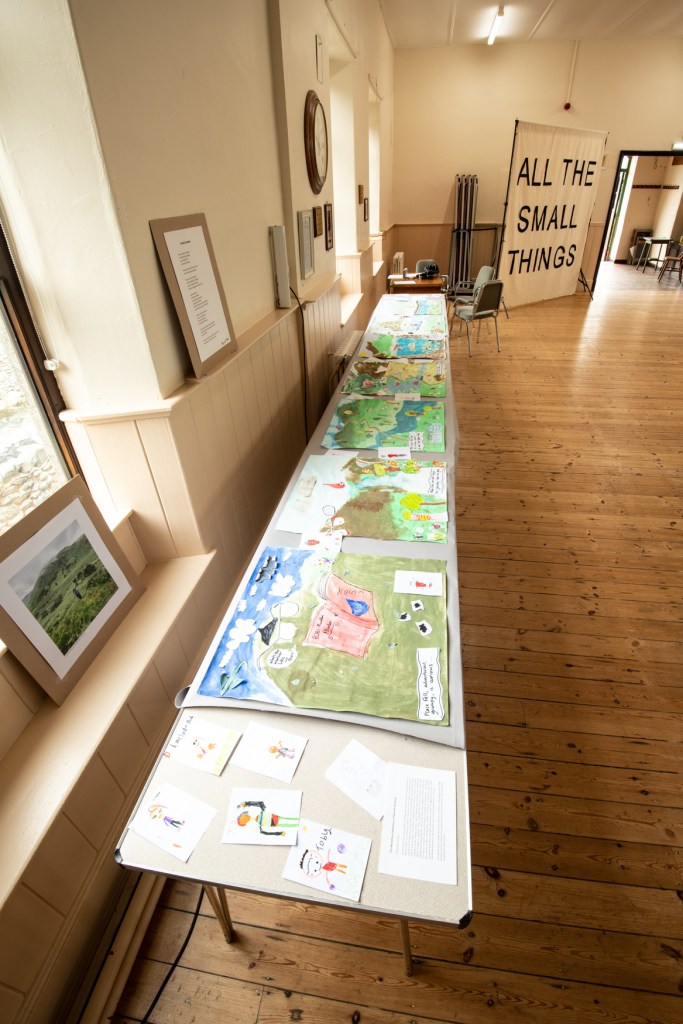
The children’s artwork will be shown at the exhibition in Glenridding Village Hall (July 19, 20 and 21, 10am – 5pm). Then it will return to the school to be mounted on a wall.
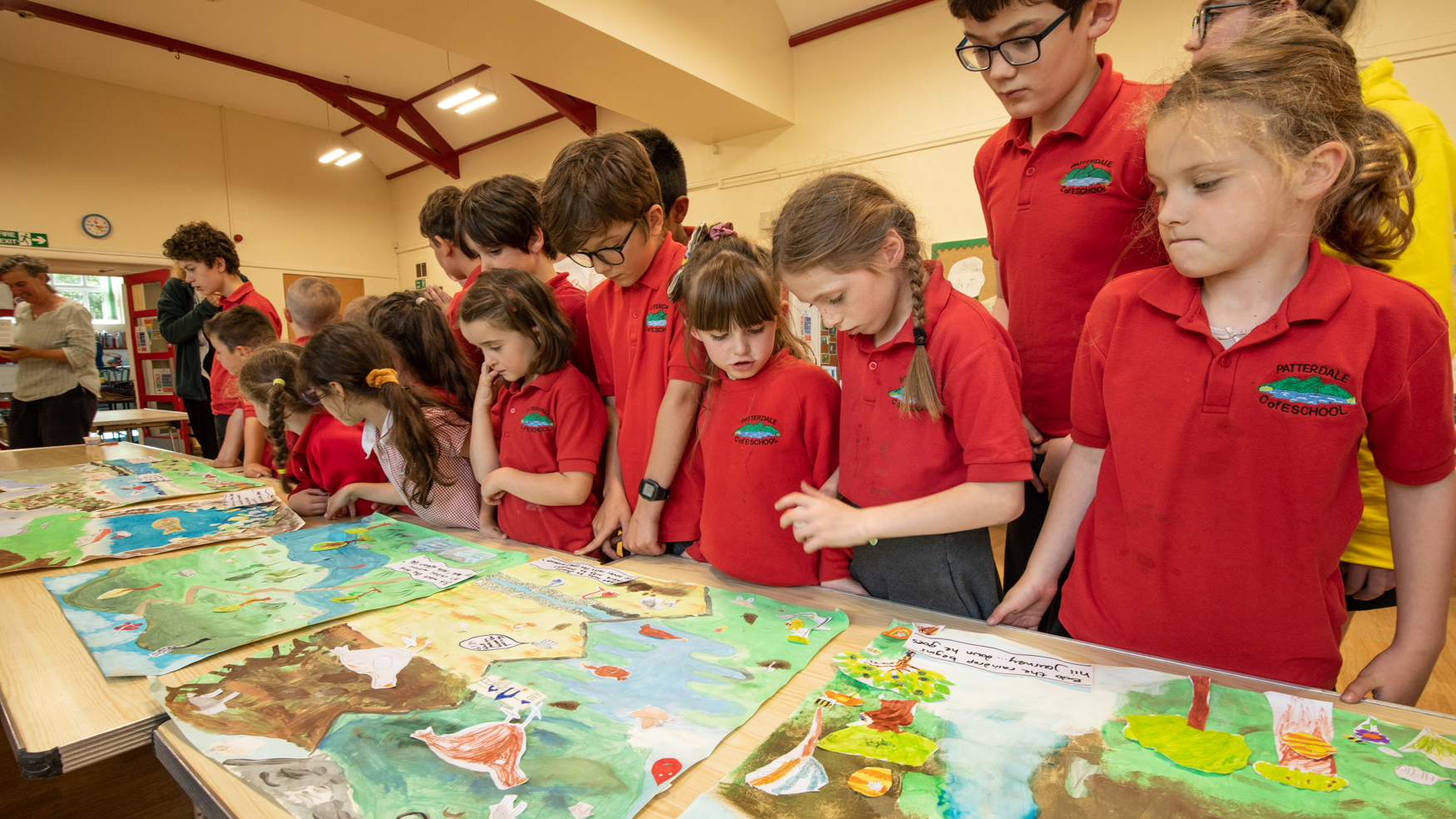
The children’s 7-part illustrative panel tells the story of The Marvellous Journey of Bob the Raindrop from the top of Place Fell, down into the lake, and all the way to Penrith. It allows us all to travel through a variety of habitats and consider what’s important in this place.
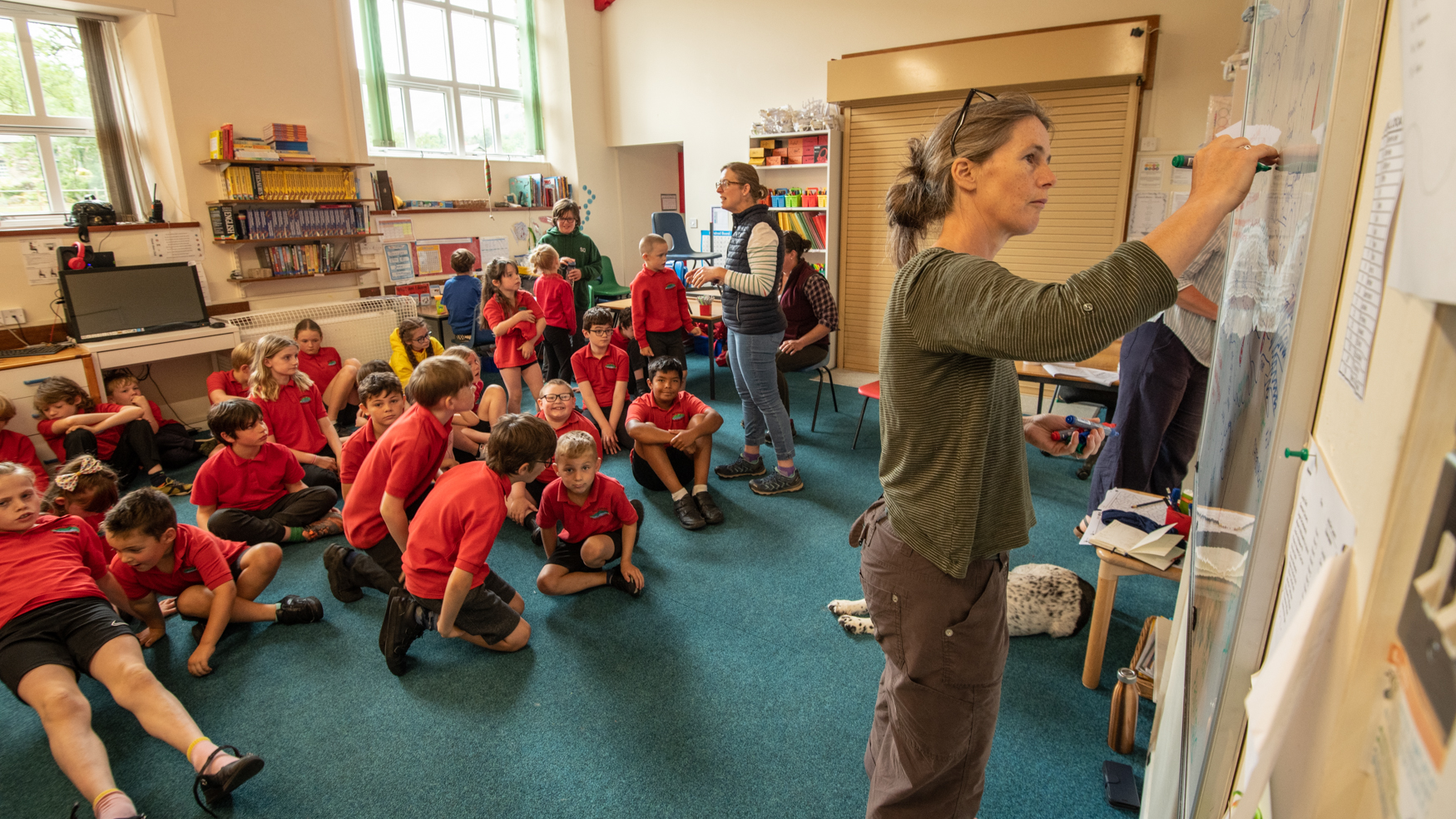
Harriet, Rob and Kate – three of the five artists on the Watershed team – started the day by taking the children outside. Lined up on a bridge straddling Goldrill Beck, they were able to look around them and discuss the different elements of the valley, and how they link up. They imagined what the fells, the sky, the water and other elements might be like if they were characters, and began to build the foundation for their story.
On the bridge above Goldrill Beck, with Place Fell in the background
The children are familiar with this valley: for most of them, it’s where they live. Most of them have walked to the top of the fells that rise above the lake, many of them come from farming families, all their hands went up when we asked who swims, paddles or sails here. They were able to weave all these experiences in; they shared their concerns about litter in the valley; they have experienced floods; they know the vagaries, and the impact of weather. We also talked about things that aren’t so easily seen, like the phytoplankton in the lake. Huge thanks to Ellie Mackay from UKCEH (Centre for Ecology and Hydrology) for helping Kate to explain this microscopic world to the children … it was easy to go from discussions about plankton to ideas of plankton-parties under water and the discussions that a water drop might have with schelly fish.
Introducing the children to microscopic phytoplankton that live in Ullswater lake
The work that the children has created, deciding every step of the way what they wanted it to be, brings together a delightfully playful element with a narrative of a place that is populated by many different species – the panels include birds, butterflies, fish, sheep, hens and dragonflies as well as people. And it offers some heartfelt observations – that this place is precious, and fragile, and needs to be cared for.
‘This is one of those pieces of work that just makes me smile,’ said headteacher, Nicky Steels. The smile comes not just from the finished piece, but the process that led to it. From choosing the central character of the story, to democratically selecting a name, and then working in 5 multi-age groups, the 34 children worked happily, energetically and respectfully. Quite aside from the piece that was created, what the day revealed to us all (and not for the first time) was the remarkable nature of relationships here, where a school is like a family, and where families connect with one another.
These connections are part of life in Cumbria and we felt it too – Rob and Harriet knew some of the children from their work with local farmers over the years, and Kate knows one of the teachers, whose mother taught Kate in primary school. These links, and ripples of relationship, help to knit a community together not just in a valley, but across the fells. The need for a strong community has been expressed by many of the people we’ve interviewed as part of this project as an important aspect of living well, and shaping a good future together. A strong, committed, and connected community is vital when it comes to caring for the valley.
Work in progress: Kate Brundrett takes notes from the children as they create their characters and weave a story
Cellist and poet Sarah Smout is one of five ‘Watershed’ artists. She is currently working on a musical composition that weaves together what she has learnt from speaking to people in the Ullswater valley.
Sarah says that she is interested in bringing the land’s voice into the composition through field recordings, extended techniques and improvisation. With this she hopes to convey the deep connection to Ullswater that these people have, and the urgency of the human task in caring well for a precious and fragile land. In this blog post, Sarah tells a story of her encounters with farmers Sam and Can Hodgson, from Glencoyne Farm, and skipper Christian Grammar, from Ullswater Steamers.
A tour round Glencoyne farm: view from the quad
if you give nature a chance …
“If you give nature a chance, it will come back,” says Sam, sitting opposite me in his farm kitchen. His hands are scarred and etched with lines that only a lifetime of working with the land will do. And that is exactly it: this land is his life. His and Can’s, and their family’s. And it is their preoccupation to make sure it is a life worth leaving for future generations.
So much joy glints in Can’s eyes as she tells me about the wildflowers returning – milkwort, butterwort, lousewort – and Sam’s newest revelation in life, swimming in the lake, makes him sit forward and gesture with his arms his feeling of being in his own air bubble, as he bobs in the water, looking back up the fell. They both agree: closing the gate at the end of the day is one of the wonders of being here – a moment when they can look out at the land, a day’s work done, and wander down the fell back to the farmhouse.
Can and Sam Hodgson have been at Glencoyne Farm for many years as National Trust tennants
—
It’s not every day you get to drive a boat across the lake … Sarah with skipper Christian Grammar, who has been working on the boats for decades
Before we set sail, Christian feeds his friendly rook, who perches on the bow of the Raven. It has learnt to say hello back to him, but Christian refuses to give it a name. As we motor out, I sit in the wheelhouse with my zoom recorder ready to catch any one-liners, any moments that might make it into my composition. But it doesn’t feel like an ordinary interview, because Christian’s connection to this lake runs deeper than the North Sea. He tells me how he belongs here, feels more at home here, on the water, than anywhere. He seems to know every ripple, and loves to show people this elbow-shaped bit of water.
We both notice how everyone enthusiastically waves at each other from the other boats, something that doesn’t happen on other modes of transport very often. Time always seems to enter a different realm out on water, and this seems to amplified for Christian when he tells me how his Synesthesia makes everything feel connected. It’s a type of hyper-sensitivity to sound. He drives the boat but his ‘elbow room’ is the side of the lake, he hears the engine but his listening stretches far beyond the edge of the boat, the wake, the wind, the people, the birds. Swallows swoop in front of us, and he tells me how he does a similar thing with the ripples that sometimes form in patches on the lake – cat’s paws, he calls them. And when he’s on his last sail home, he likes to weave through them, joining the dots, and then looks back to see what he has drawn. An artist in him yet. It makes me wonder, how through joining the dots, listening far beyond our reach, we might help this planet of ours heal faster its scars that we have etched – some that run deeper than a human lifetime, and may still be healing long after we are gone.
Sarah will be giving a performance of her piece, with cello, song and looped sounds collected during her research, at the exhibition preview; a digital recording of her composition will be shared through this website.
As part of the Watershed project, Matt Sharman has been meeting people in locations across the Ullswater Valley. In this blog, Matt shares his reflections, some images of the people he’s come to know, and how he’s settled into what feels like an unusual process.
Trust the Process …
Five people – my ‘interviewees’ – have generously given their time and insight. The conversations have been ranging, heartfelt and interesting – I’ve learnt a lot. We moved through many different perspectives but some key ideas have been constant. Everyone, including me, holds the hope that any visitor to the exhibition space in Glenridding village hall leaves with a deeper understanding of the many living layers the Ullswater catchment has. This is an exceptionally beautiful environment and many people visit for this reason alone, but there’s also a rich cultural heritage, tightly-knit and hard-working communities with a strong sense of belonging, working with the land and connected to it. Everyone, in a variety of ways, is of this place.
This process continues to be an interesting creative journey for me. Usually, with film making, there’s more clarity about the form and shape the finished material will take. This project is different, and is a fascinating way of working – it’s far more organic, the connections and subject matter have been given the space to grow naturally from the conversations we’ve had. In this way it’s been more collaborative, and less directive. I’ve found myself relaxing into the complexity. I’ve been discovering and learning as I go, and it’s not over yet …
Animals have featured in many of Matt’s interviews. Here’s farmer Claire Beaumont, with Lilly (and piglets).
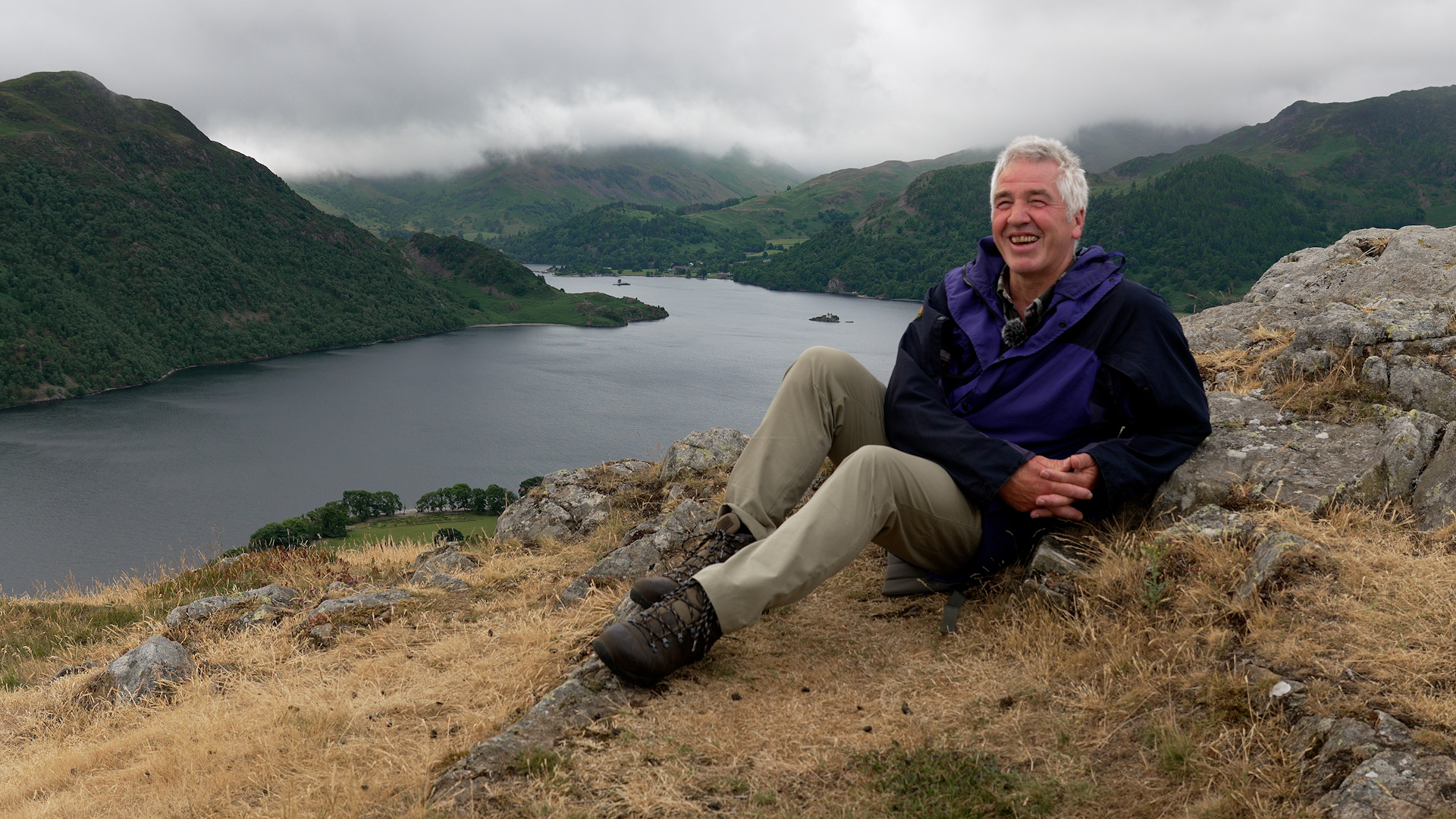
Gordon Lightburn, Chair of the ‘Friends of Ullswater’ and local Blue Badge Guide.
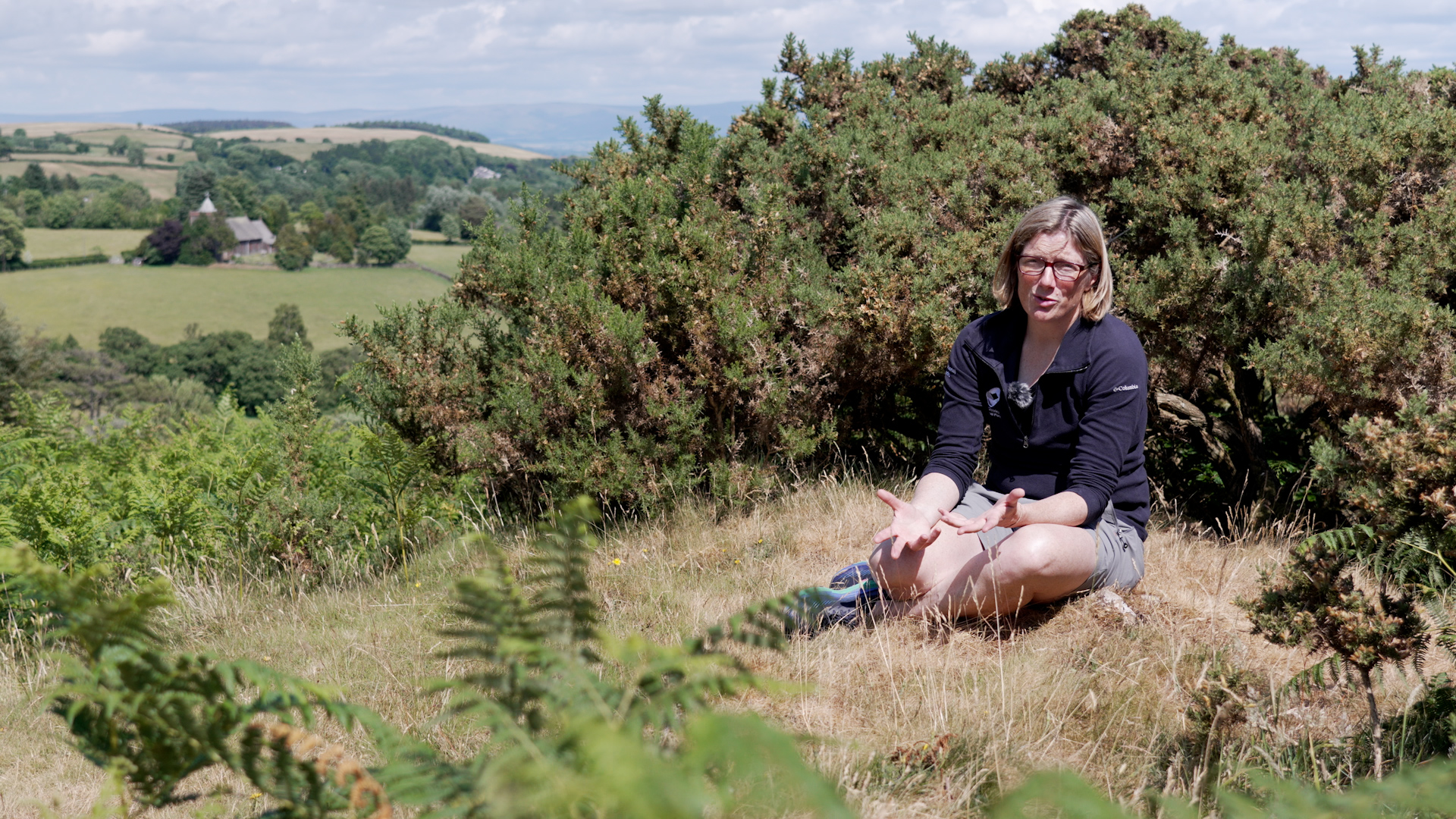
With Kate Gascoyne from Cumbria Farmer Network, looking across the Ullswater Valley.
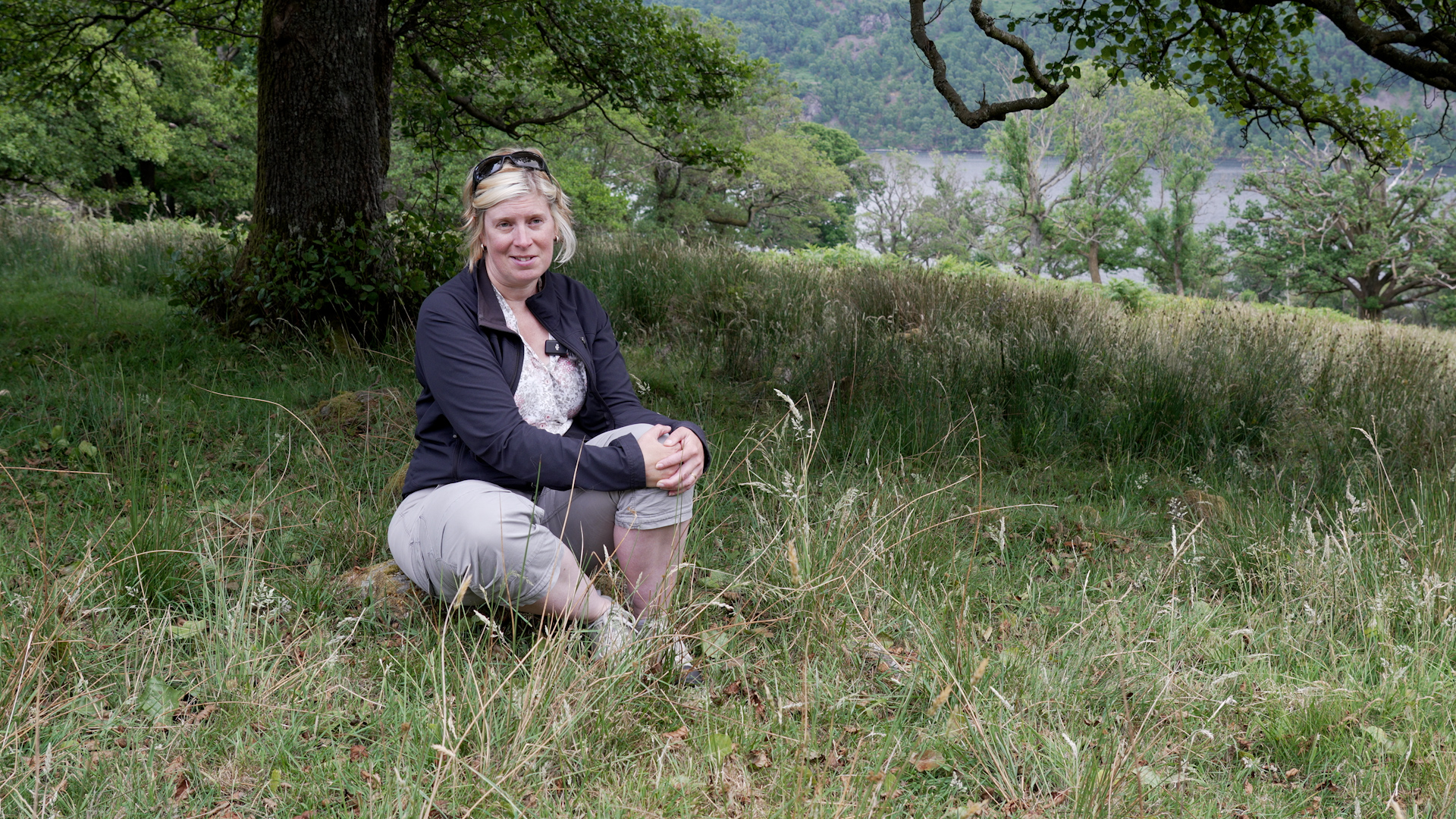
Matt met Kerry Rennie, from Natural England, and chatted in an area of woodland pasture
Suzy Hankin, from the Lake District National Park authority
Matt, who lives in the Ullswater valley, is one of five artists taking part in Watershed, with each artist meeting five different people and creating work in response. The film will be part of the exhibition in Glenridding village hall, July 19, 20 and 21, 10am – 5pm.