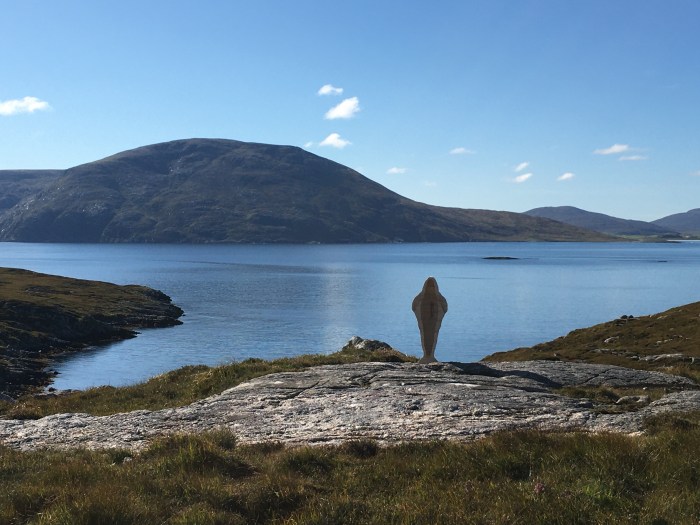
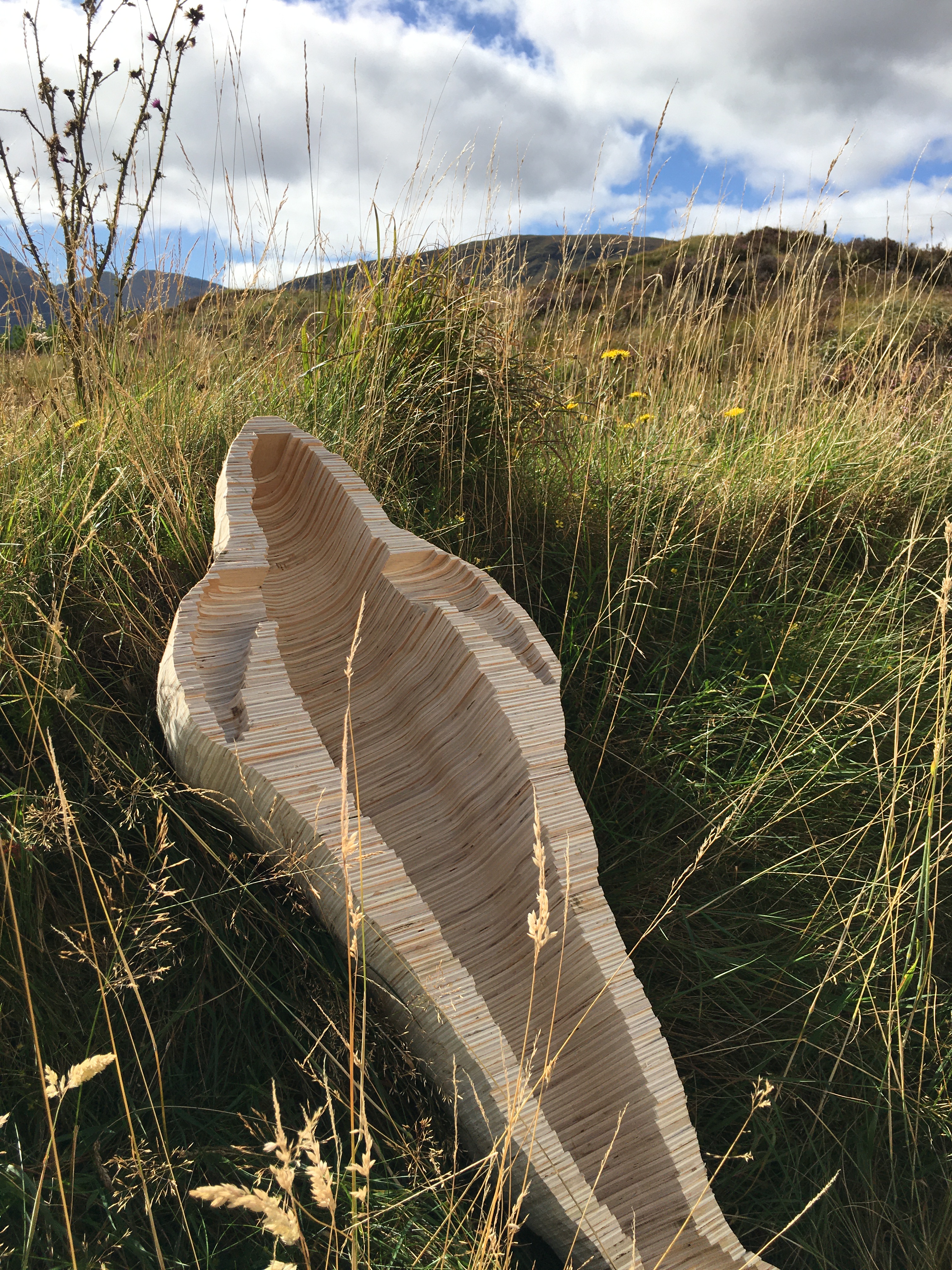
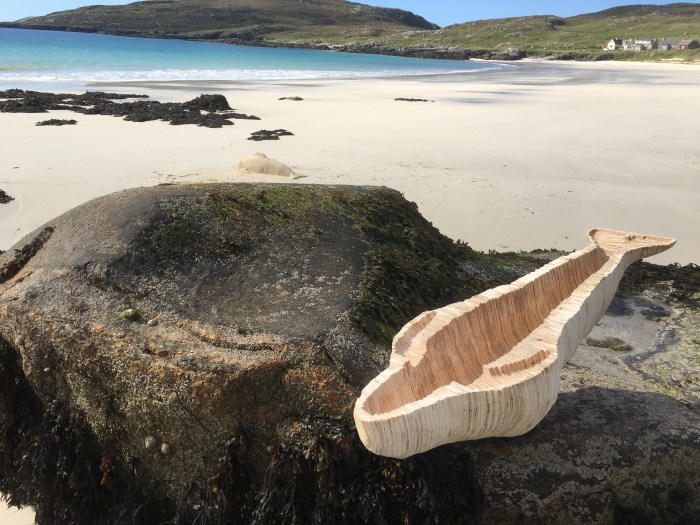
‘It all began with a haunting image I couldn’t shake: 55 long-finned pilot whales stranded on the shores of Traigh Mhor beach in 2023 …’ Sam Gare exhibits a wooden mould of a stranded whale in the SEE HERE NOW EXHIBITION. The mould is part of the research and development for a ‘Keening, The Song of the Stranding’, a multidisciplinary performative artwork that will take place in July 2025.
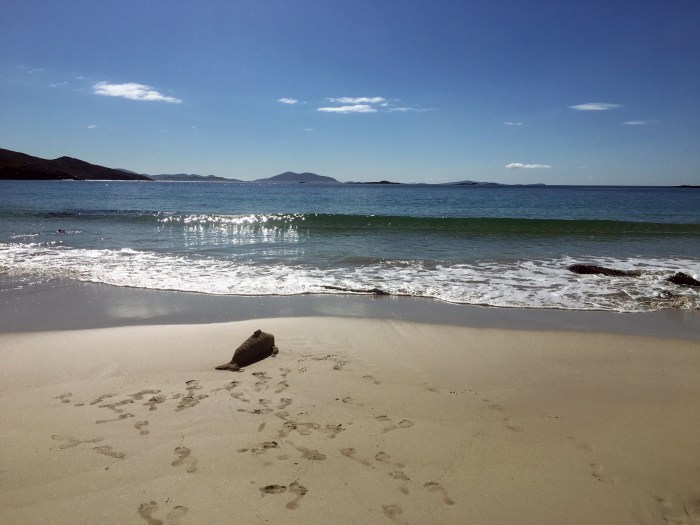
It all began with a haunting image I couldn’t shake – 55 long-finned pilot whales stranded on the shores of Traigh Mhor beach in 2023. For eight long hours, the beach became a liminal space between life and death.
Here, two species who live in such different worlds encountered each other in a profound and tragic way. As I saw these images, witnessing the sorrow of the moment, it wasn’t just about the loss. It was about everything that remained—the silence that spoke louder than words, the memories of these majestic creatures, and the stories still waiting to be told.
This moment became the seed for Keening, the Song of the Stranding, a multidisciplinary artwork. It wasn’t just about remembering the stranding itself; it became about exploring the space between life and death, where the sea meets the land and where time, for a fleeting moment, seemed to stand still. It became about remembering the whales and imagining a way to symbolically return them to the sea—giving their stories a chance to be told, even in their absence.
As I reflected on the tragedy of the stranding, I found myself drawn to the idea of the “living specimen.” Now, and historically, whales from strandings are sampled or taken away for analysis and became specimens in scientific collections. These so-called “dead” animals continue to serve as valuable sources of information about the natural world, and their afterlives are lived out in the minds of researchers. In many ways, they continue to teach us, even after their death. This idea of life in absence fascinated me and became a central theme in my work.
How can we breathe life back into the memory of these animals?
How can we honour their presence, even in their loss?
A mould as an echo
One of the pieces at heart of this work is a wooden mould, cast from the echo of a whale’s form. This mould represents the negative space left behind, a vessel that holds the absence of life yet contains the potential for renewal.
The sand sculptures we will create during the performance will be made from these moulds, capturing the form of the whales in the sand. As the tide reclaims them, we will witness the transitory nature of existence – the way life and memory both ebb and flow.

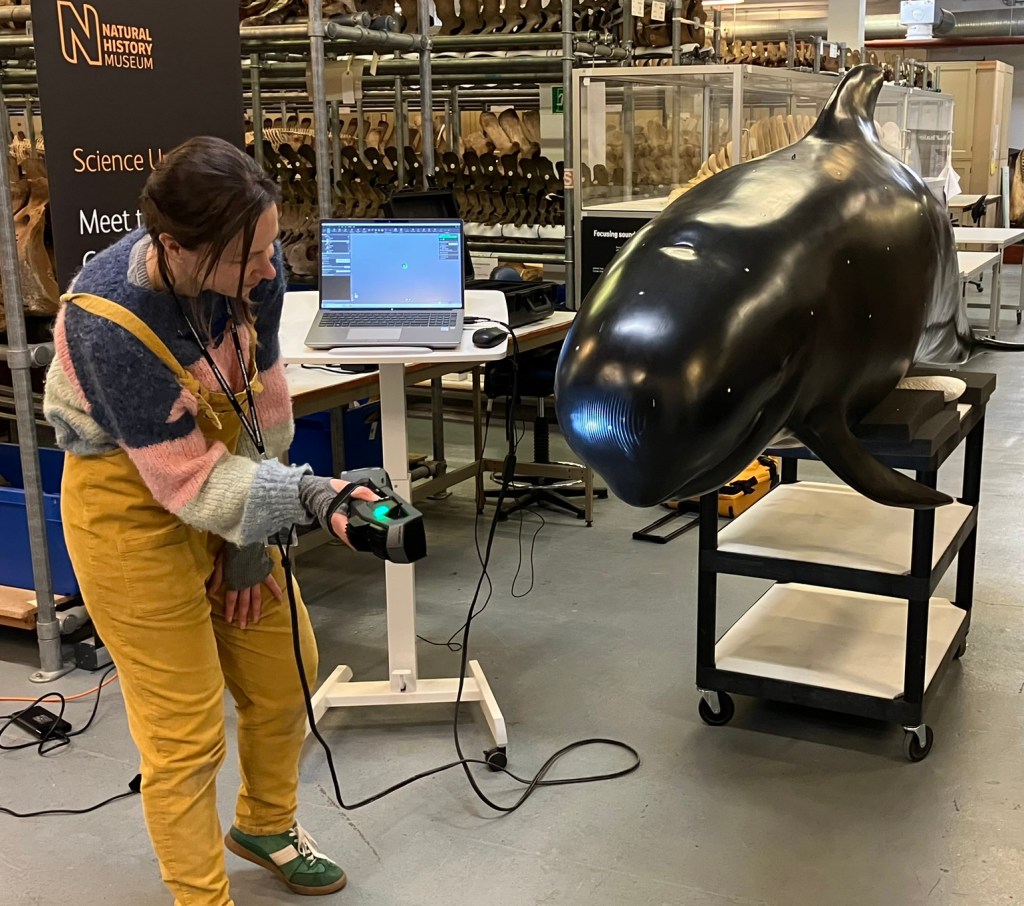
The moulds themselves are inspired by a model at the Natural History Museum, London, which was cast from a real stranded whale in 1930 by Percy Stammwitz, museum model maker. This female pilot whale was found on the shores of Wexford, and her story has been preserved through this model. I felt a deep connection to this preserved whale, her life captured in this form long after her death. I’m reimagining the original process, using 3D scanning to help me create wooden moulds. These moulds will serve as vessels that capture the presence of these whales once again, allowing us to connect with their forms in a tactile and symbolic way.
Exploring data, to shape understanding
Alongside these pieces, I’m pleased to be working with data provided by the Scottish Marine Animal Stranding Scheme (SMASS), which tracks and analyses strandings along the Scottish coast. The team at SMASS conducts necropsies and writes detailed scientific reports on stranding events. This data provides valuable insights into the individual animals involved, and it has helped shape my understanding of the whales beyond their mass stranding. Traditionally, stranding events are examined in terms of the pod as a collective, but I wanted to focus on the individuals within that pod—their relationships, their kinship, and their individual stories. Through this project, and beyond this project, we will be reimagining the lives of the whales, informed by the data and kinship studies provided by SMASS. We are no longer simply observing a tragic event, but rather, we are acknowledging the complexity and individuality of each animal.
Collaboration and performativity
As I delved deeper into the research, I began to see it as a collaborative effort, one shaped by both the community and the artists I’m working with. Aya Kobayashi’s choreography will guide the performance, helping bring the casting of the whale forms in the sand to life. The movements will mirror the act of remembrance and transformation, as we all come together to create something new from what has been lost.
Accompanying the performance is an original musical composition composed by Alex South, Nerea Bello, and Katherine Wren. The music weaves together the vocalisations of pilot whales, with the Gaelic tradition of keening—a mournful, vocal lament for the dead. The project allows the musicians to explore the musicality of the long-finned pilot whale, whose repetitive, ornamented, and plangent calls are used to negotiate their complex social relationships. This music will breathe life into the performance, connecting the mourning of the whales with the silence they left behind.

The project also features several community workshops designed to involve the public in the artwork’s evolution. In Oral History Workshops, locals are invited to share their memories of whales and their connections to marine life. These stories are an essential part of the project, helping preserve and weave together the memories of the community. In the Whale’s Way Workshops, school pupils will create life-size cardboard whales, painted with scenes of the whales’ imagined underwater journeys. These vibrant creations will be incorporated into the live performance, celebrating the lives of the whales and the rich marine heritage of the Hebrides.
In the end, Keening, the Song of the Stranding is more than just a performance—it’s a communal act of remembrance and renewal. It’s about exploring the boundary between life and death, and loss and renewal. It’s about coming together as a community to honour the stories of the whales, and to reflect on our own relationships with nature.
As the sea washes over the sand sculptures we create, we are reminded that while stories may be carried away by the tides, they are never truly forgotten.
Keening, the Song of the Stranding is due to take place on 12 July 2025, with workshops running during late spring and early summer. You can learn more about the project here – www.northharrisstudio.co.uk/keening