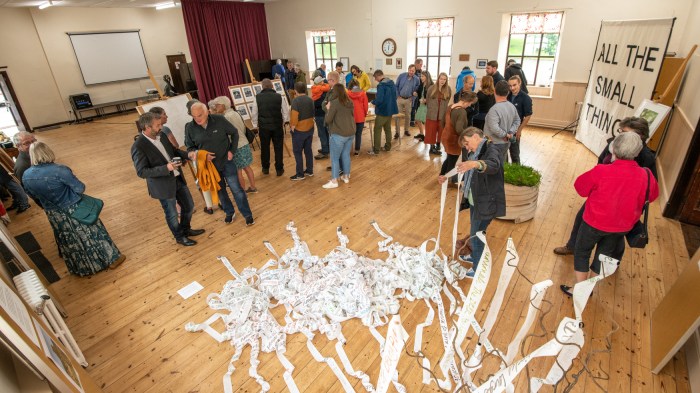
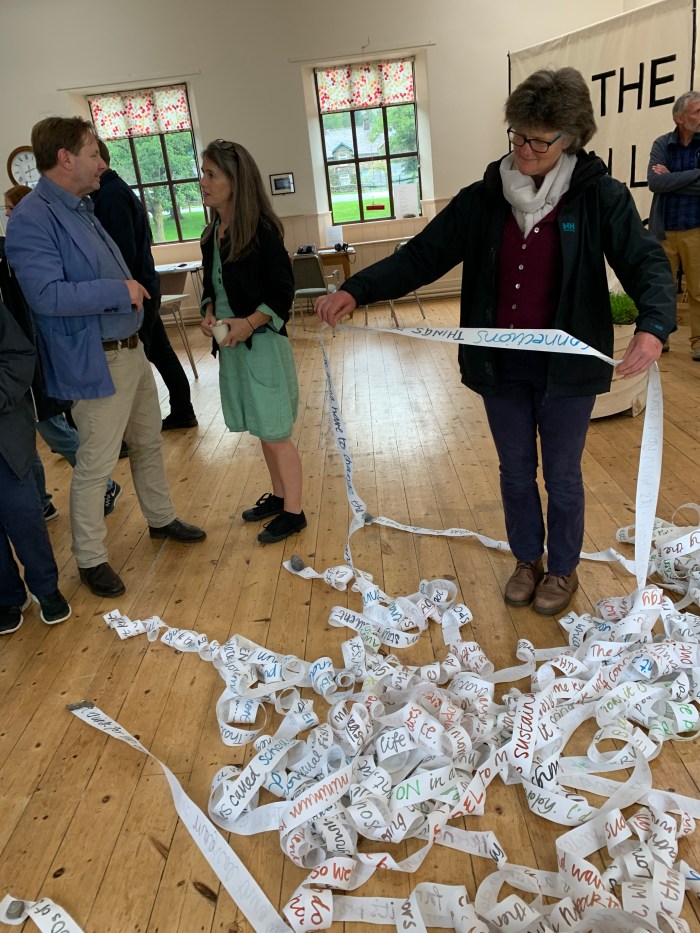
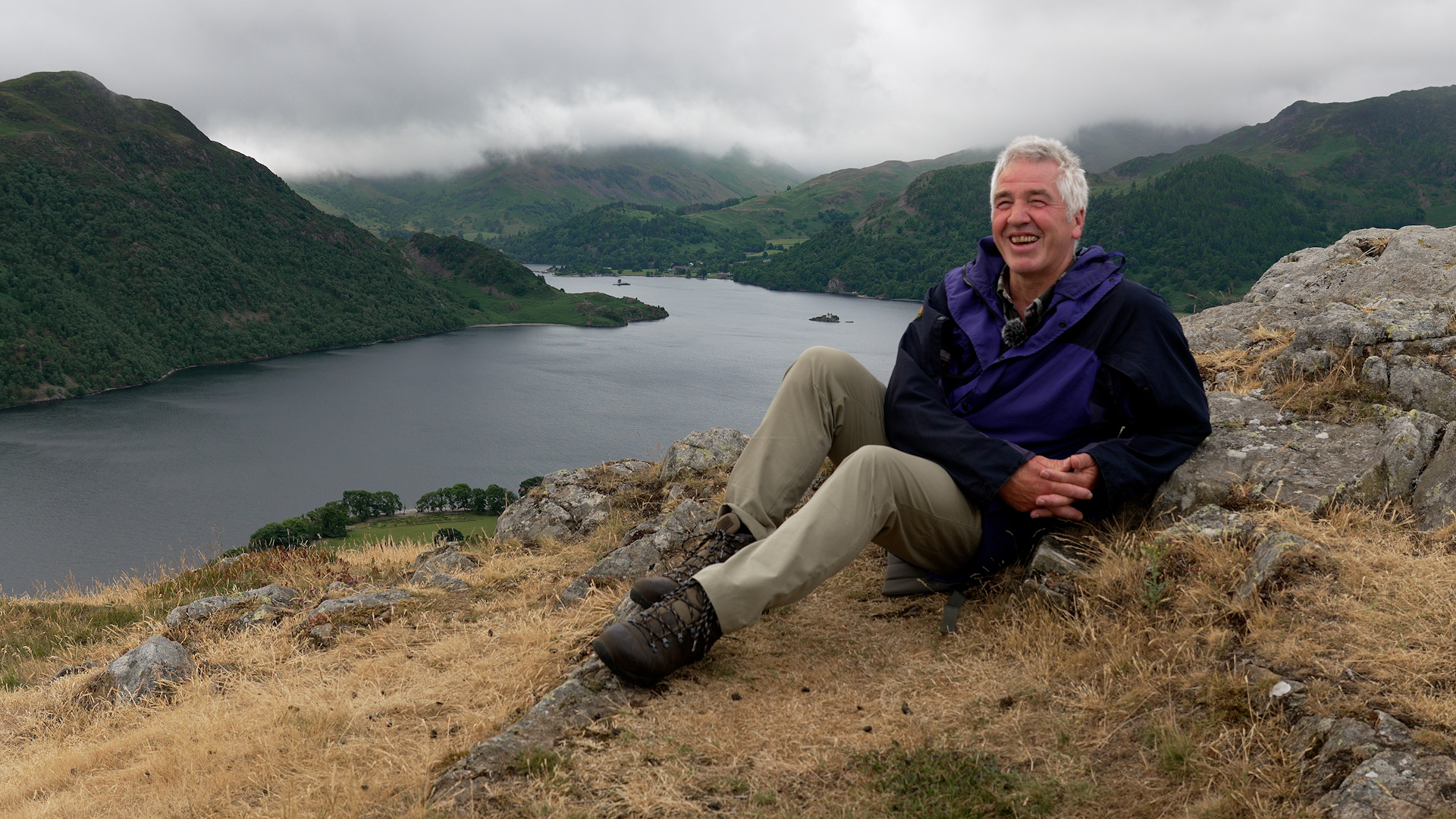
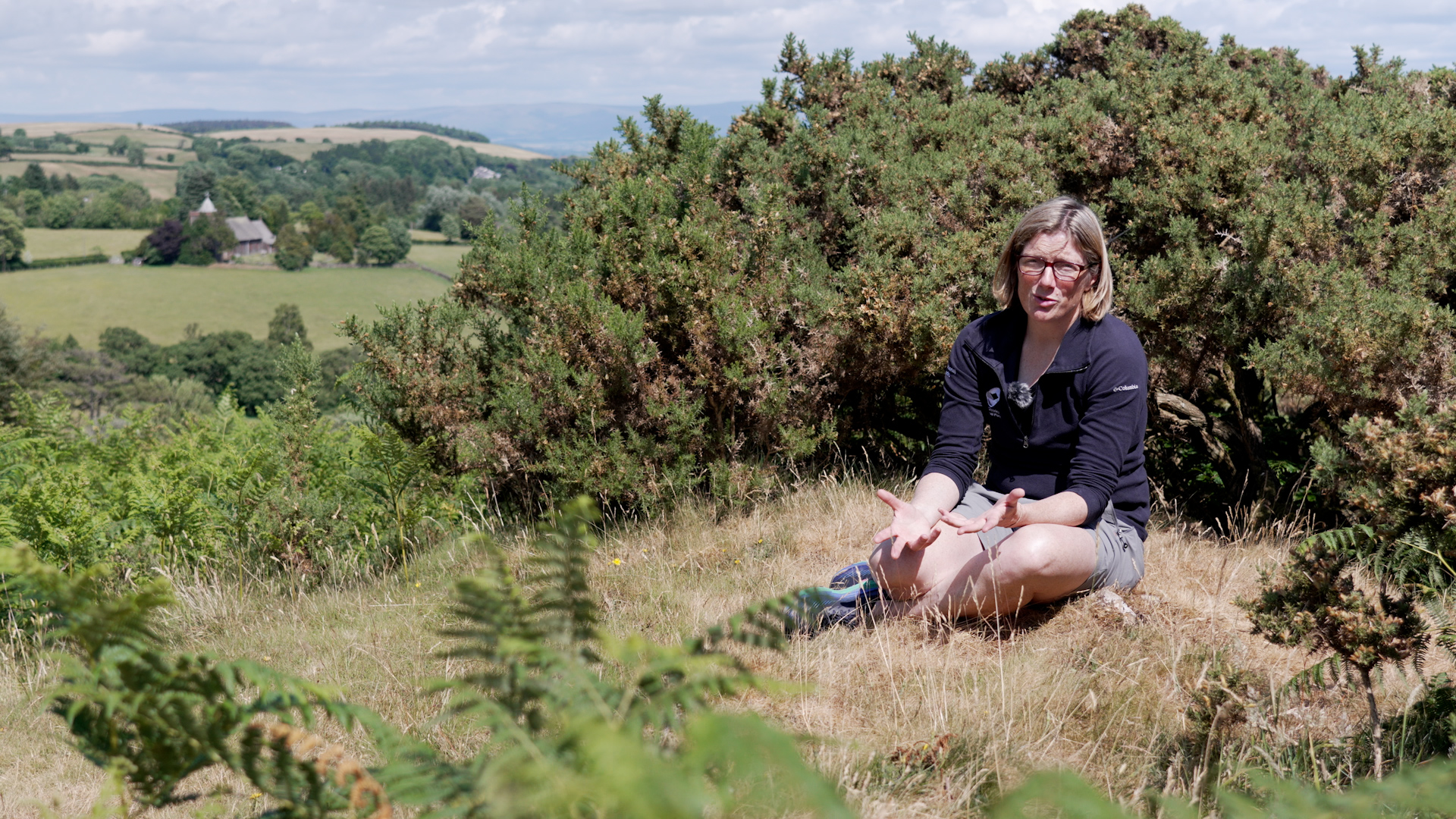
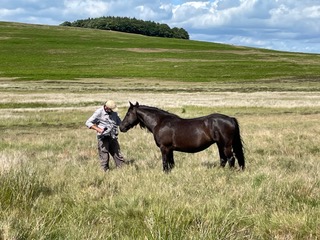
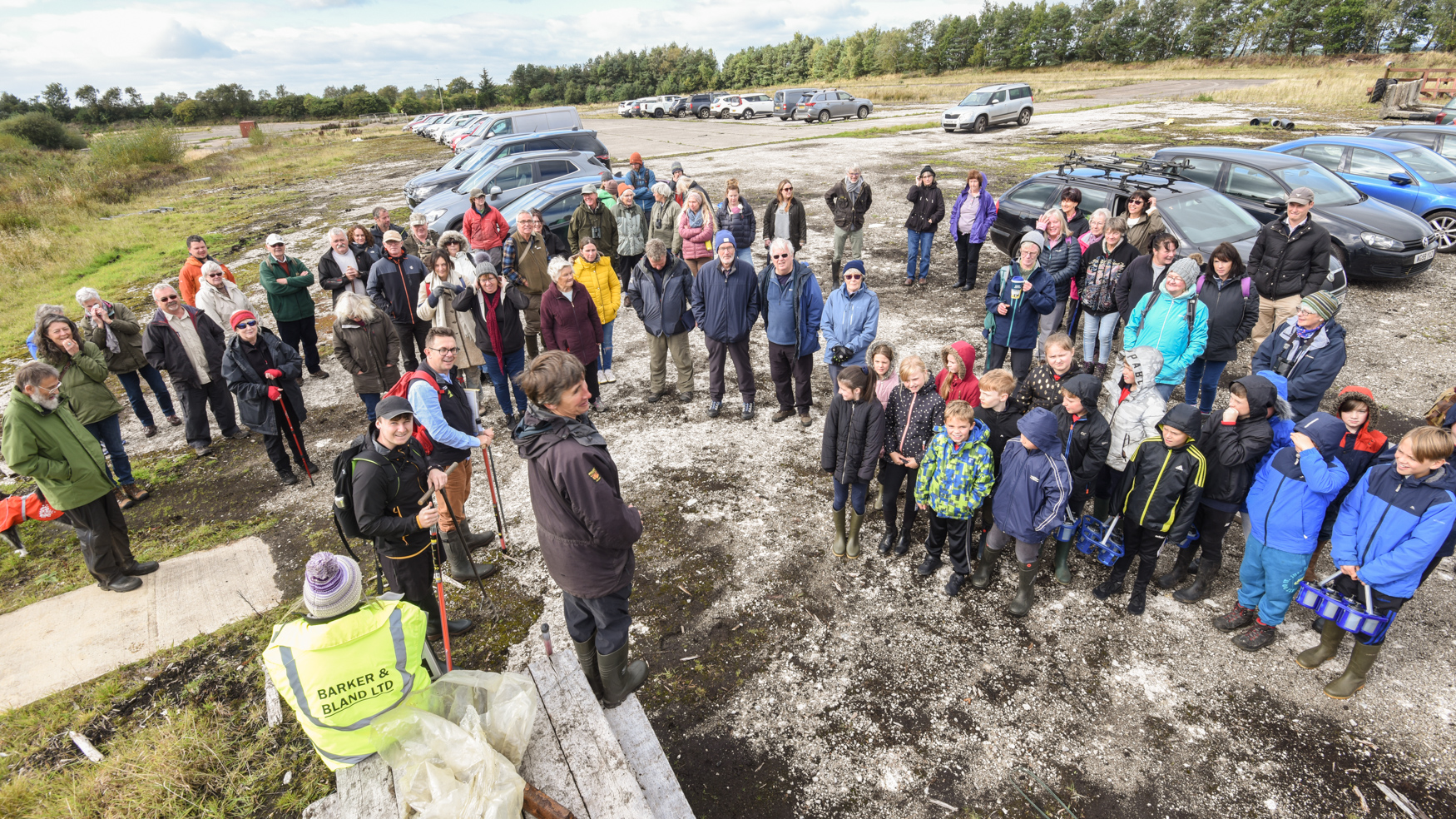
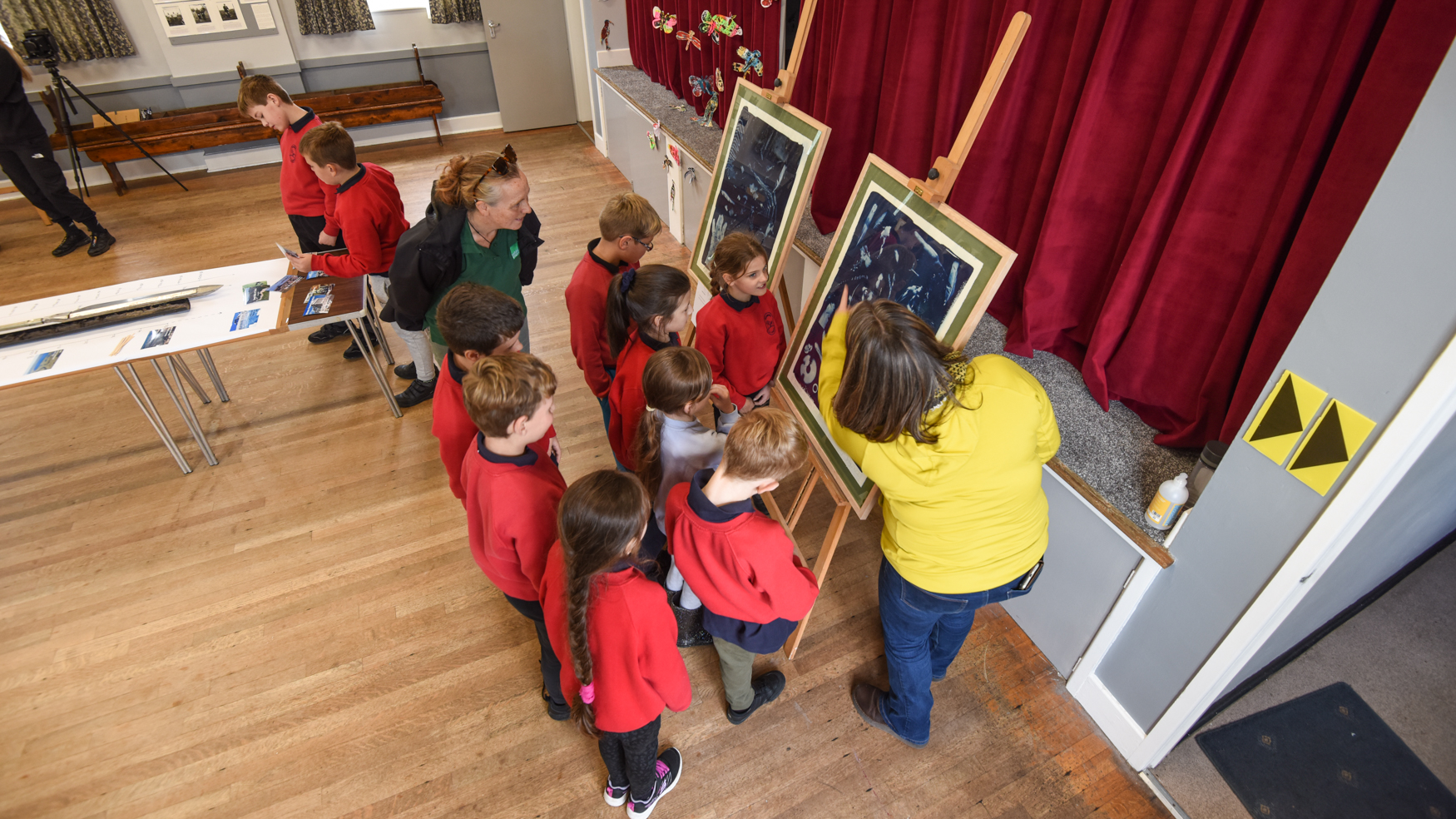
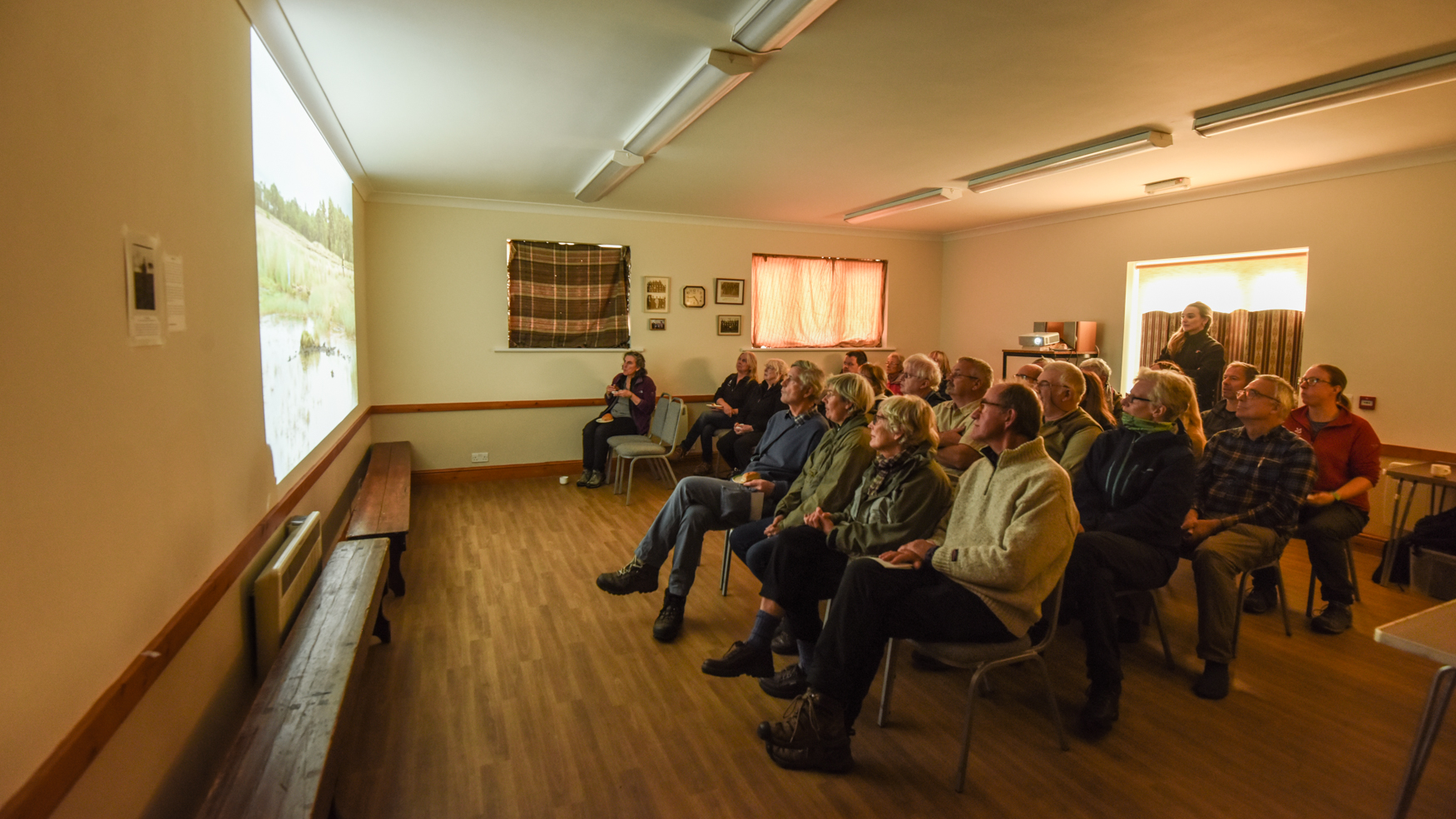
From North America to North Yorkshire, the Moss of Many Layers film has been journeying to different cinemas and film festivals across the world. The first showing (and for me the most important) was in a village hall in Hethersgill, close to the Moss. The audience was made up of the local community and the many people included in the film: the school children, neighbouring farmers, researchers, artists and conservationists.
But now the film is shared far and wide, telling the story of the moss beyond its neighbours and the scientific community.
Still from the film
Art within science serves as a mirror: it can communicate ideas and data accessibly as different attention is required. Additionally, it acts as a versatile tool, allowing us to manipulate scale, delve into details, and expand our understanding of the landscape.
When recording or decoding science – as an artist – it’s important to include the human story that is connected to the Moss. That’s my motivation for including the ‘breathing portraits’ of subjects in the film.
I certainly haven’t stopped thinking about Bolton Fell Moss, and am happy to keep going back. Here are two images from my last visit to the Moss, to see Harriet’s Poetry Signs and watch Dr Simon Carr and PHD Student Jack Brennan use a carbon flux monitor.
Simon Carr and Jack Brennand with the carbon flux monitor, on Bolton Fell Moss; image by Juliet Klottrup (taken using real film)
Poetry sign on Bolton Fell Moss, image by Juliet Klottrup (real film)
emma austin, natural england, in conversation with harriet fraser and rob fraser
It has been said more than once, and it’s true: it’s not possible to give a final ‘evaluation’ of the impact of a project until some time has passed. Arts interventions and multi-disciplinary engagement in community, scientific and conservation work have effects across a wide timescale: in the days, weeks or months in which direct research and engagement take place, and then in the months and years following that. Moss of Many Layers (MoML) is a case in point. So, 14 months on from the Wide Open Day celebratory event, we (Harriet and Rob) sat down with Emma Austin to hear her reflections.
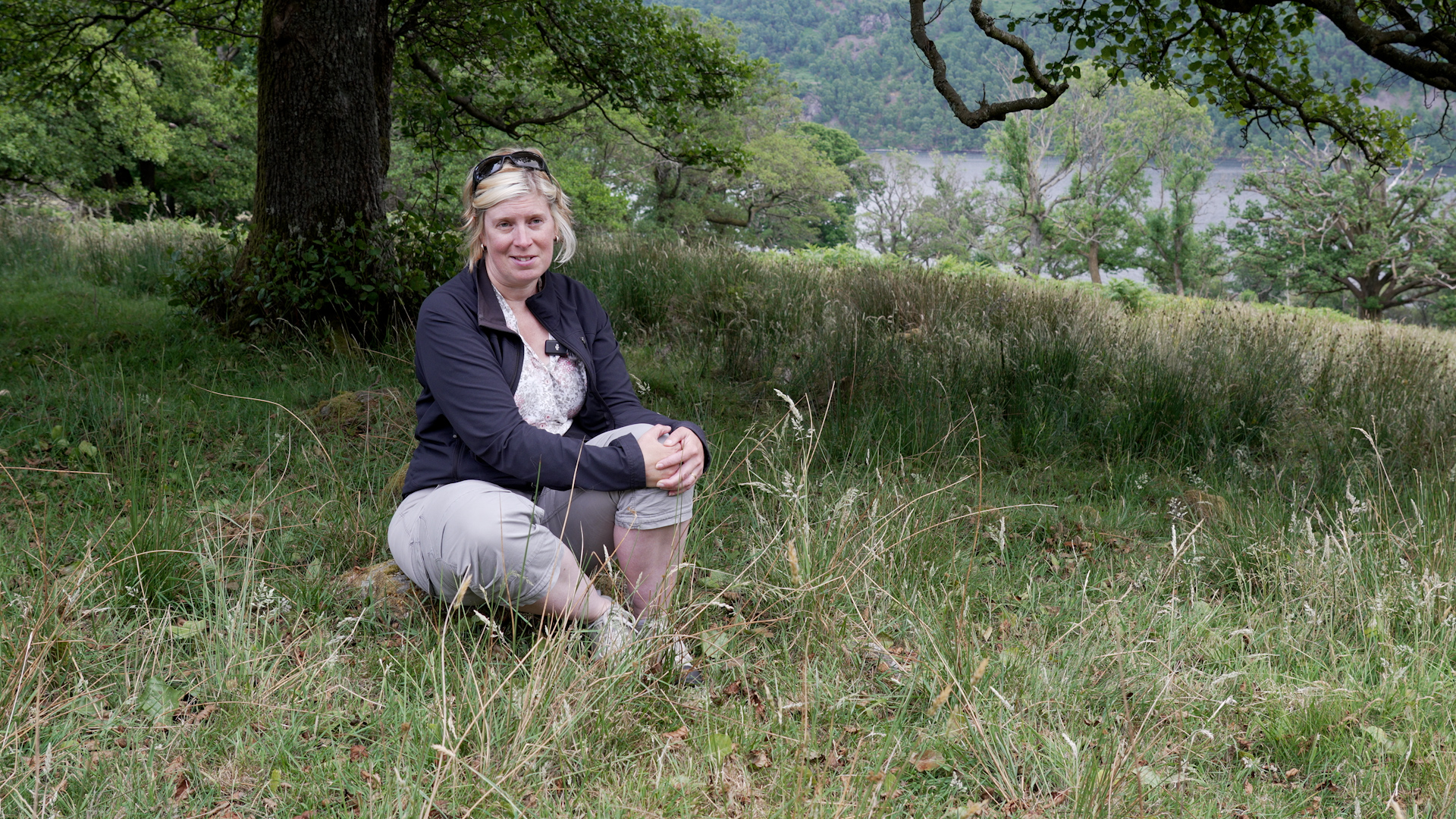
Emma Austin. Still from Juliet Klottrup’s ‘Moss of Many Layers’ film
Emma, Natural England Senior Reserves Manager for North Cumbria, was part of the MoML project team. She already had an established relationship with Bolton Fell Moss – the vast area of peatland that is currently under restoration – and with some of the residents living around the edges of the moss before the project began. So what was the impact, or the novelty, of a project that brought together artists, scientists, restoration specialists, reserve managers and local residents? This was the first question we put to Emma.
What was the impact, or the novelty, of a project that brought together artists, scientists, restoration specialists, reserve managers and local residents?
Emma tells us that she really hoped the project would focus on the local community, helping to build bridges where people had been impacted by the difficult transition from an industrial site of peat extraction with local jobs and income, to a National Nature Reserve. ‘Having new faces that had no prior history with the place, artists who were independent, scientist with new knowledge, was brilliant,’ says Emma. ‘And the things that were introduced – whether it was a camera, a poem, specialist kit – these were new, and fresh, and I think the local community who became involved perhaps felt involved in a way they hadn’t been before.’
Emma taking part in the schools events, co-designed with artist Anne Waggot Knott
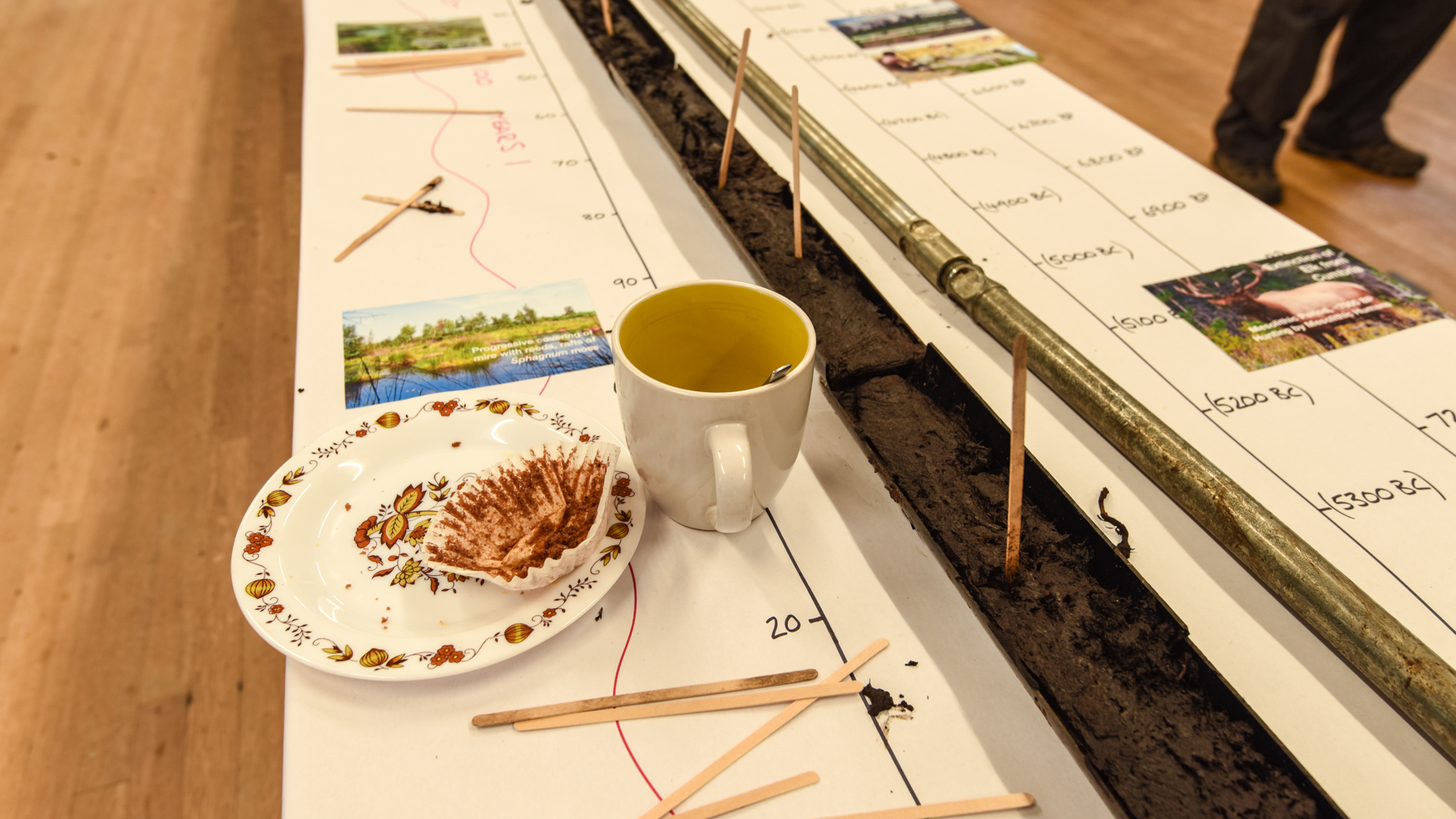
Emma says that she senses the project’s impact through the new links made with the local community. The first time this hit home for her was the huge turnout for the Wide Open Day. Emma always grins when she talks about this: the peat core extending the length of the hall, the room buzzing with conversation, curiosity about the artworks, school children and their parents, and local people meeting one another, some for the first time.
Emma tells us there has been a real growth in interest in the moss since then, nicely coinciding with the completion of the new 3km boardwalk. Juliet Klottrup’s film has been a feature at local discussion events, and there is a definite interest for more of these. The mailing list for news of Bolton Fell Moss has grown fourfold; and events on site run by an engagement officer over the summer were really popular.
In June 2023, during a nationwide heatwave, there was a fire at Bolton Fell Moss, and for six days people worked together to tackle it.
In June 2023, during a nationwide heatwave, there was a fire at Bolton Fell Moss, and for six days people worked together to tackle it. ‘It sounds strange,’ says Emma, ‘but I think the fact that we did the Moss of Many Layers project may have made a difference. I certainly felt able to ask for help in a way I would have been wary of in the past. It’s hard to say for sure that this is linked with MoML, but the project may well have played a part in the way it helped create new friendships and familiarity.’ The intervention of artists helped to bring people together, and the continuing use of the film in Emma’s meetings helps to spotlight local people who are connected with the moss – who live nearby, who once worked there, who are engaged in monitoring, or just love to visit, and who have stories to share.
Emma Austin (left) and Harriet Fraser with one of the seven poetry signs
Emma smiles as she talks about the poem signs on the bog. She often hears positive comments about them, and just last week she heard from a group of MSc students who had said they loved the poem and had a WOW moment when they learnt that the signs are anchored and so they will act as a measure of peat accumulation for centuries to come – a novel combination of art and science.
‘People get used to seeing things in a certain way,’ says Emma, ‘We all do. But seeing it from a different perspective – through the arts – can bring a different outlook.’
One of the central elements of Emma’s role with Natural England is to get to know people and liaise with land owners and farmers about changes that are needed to support restoration of the moss. Emma thinks that the inclusion of art, and the presence of the artists and scientists in the area during the project, has helped people understand the bog more and feel the importance of it, and has also helped to soften the edges of difficult conversations. ‘People get used to seeing things in a certain way,’ says Emma, ‘We all do. But seeing it from a different perspective – through the arts – can bring a different outlook.’
For her, the Moss of Many Layers project helped, above all, to put the community first. ‘How do you make sure that you create a discussion or a conversation where the person whose place you’re in feels as important, or the most important, part of the jigsaw. Because if we are going to achieve any of the things we want to achieve for nature, we’ve got to involve everybody – and the way the Moss of Many layers brought different strands together, through art and science, helped to create a neutral space of shared ownership.’
‘… if we are going to achieve any of the things we want to achieve for nature, we’ve got to involve everybody – and the way the Moss of Many layers brought different strands together, through art and science, helped to create a neutral space of shared ownership.’
Emma Austin and MoML team members welcome people to the Wide Open Day, 2022
Also tap into these blogs about the process, including work with schools, the Wide Open Day, Scientist Jack Brennand’s reflections and you can use the search function, looking for Moss of Many Layers to explore further.
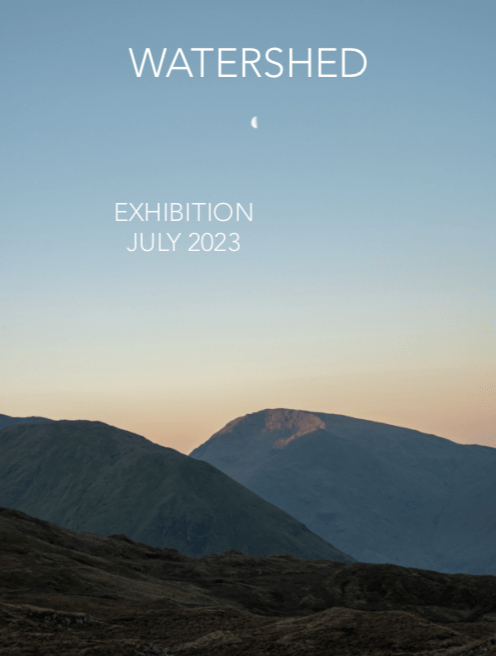
An exhibition comes to life when it’s installed, provoking conversations and offering food for thought. But that can’t go on forever. And the Watershed exhibition was a ‘pop-up’, in place for only a few days. So for those who didn’t catch it we’ve created a catalogue that you can view online or download as a PDF.
Head over to the Exhibition Catalogue page to access the PDF and discover the work of the five artists who took part in Watershed: Kate Gilman Brundrett, Harriet Fraser, Rob Fraser, Matt Sharman and Sarah Smout.
Last Tuesday evening, Glenridding Village Hall was buzzing: full of conversation, and a surround of artwork that’s been inspired by meetings these past few months.
This stage of the Watershed project has been guided by conversations with local residents and people whose work connects them with land use decisions in the valley. Back in March at a gathering in the village hall, the first conversations began, in a group setting. Since then, the five artists have been meeting people individually and building work in response. The event on Tuesday, and the exhibition, was a way to reflect back to the community what has been shared with us.
The work provides a frame for meetings and conversations, and prompts for thought. How do we individually and collectively care for the valley? What can we learn from each other? What does the natural living word express – and how do people ‘hear’ and respond to that? Where might decisions and actions be better joined up to support the local village communities, and the natural environment? These and other questions floated around the room nudging shoulders with conversations about music, water, poetry, farming, trees, maps and more.
Guided by Questions
Over the past few months, each artist has met 5 different people. As part of a longer informal conversation, we each asked the same five questions, covering five themes:
Wonder … Where is the wonder for you, in the Ullswater Valley?
Legacy … What would you, individually or as part of a community, like to pass on to future generations in the context of caring for this place?
Other-than-human perspectives … If we were to think about this landscape, with its vegetation and all the inhabitants that aren’t human, as having a voice – what do you think it or they might show us, or ask of us?
Curiosity … What are you curious to find out more about, in the context of this place?
Watershed ripples … What would you like visitors to the exhibition to come away with?
Meetings for the most part took place outside, in places chosen by the interviewees: locations included walks in woodlands and onto the open fells, wanders round farms, time on the lake (including at the wheel of a boat) and even underground, in the old lead mines. The layers of this place that have been shared are physical, historical, philosophical and metaphorical.
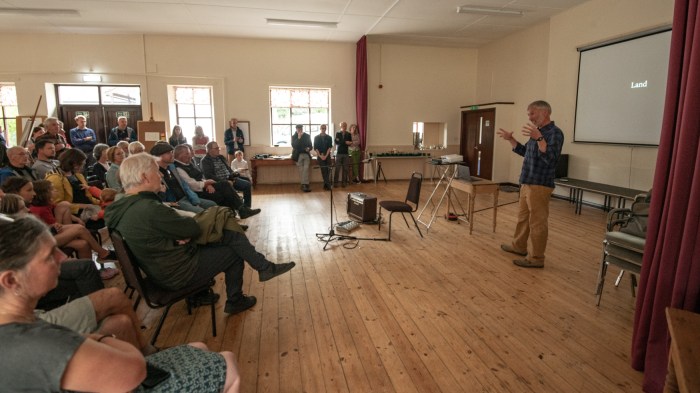
The opening event on Tuesday included a showing of Matt’s film, poetry from Harriet, and a performance by Sarah. You can revisit the material in the exhibition catalogue here, and there will be reflections from the artists about the process.
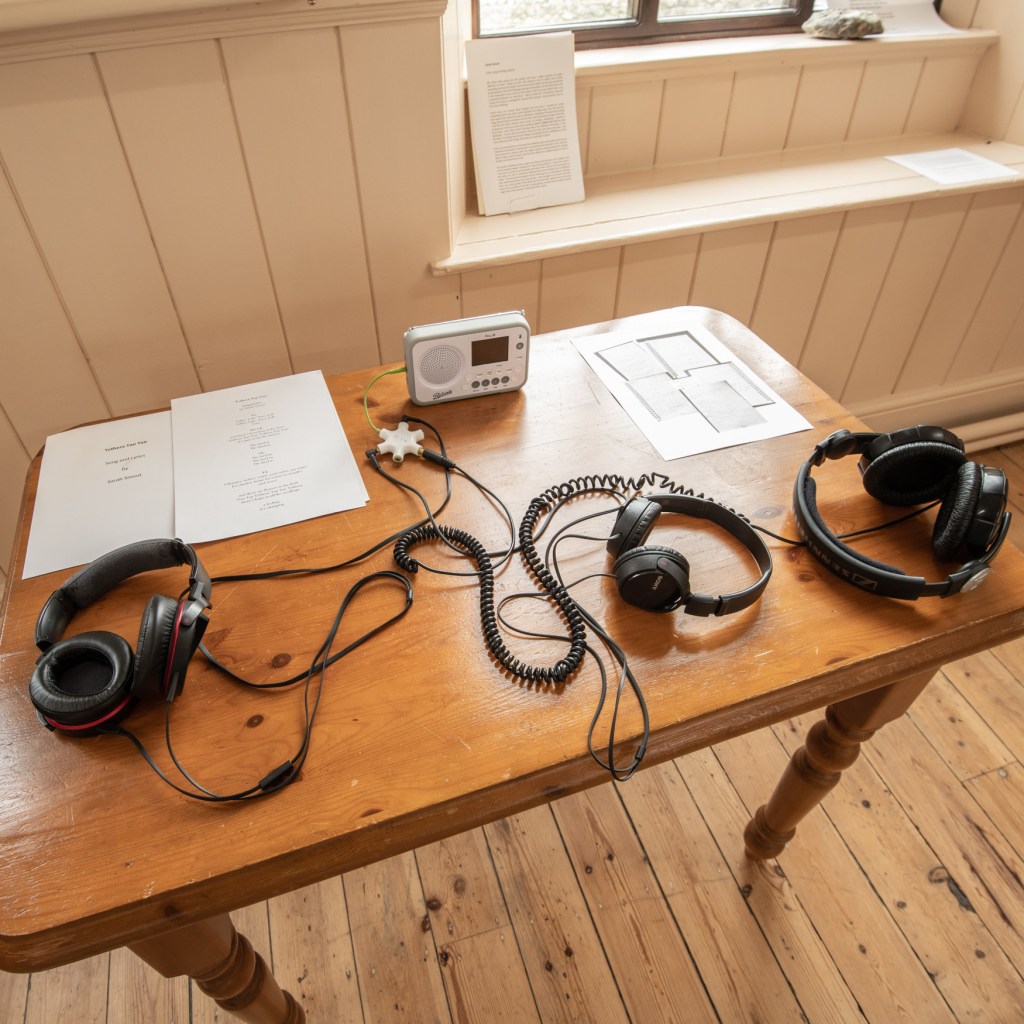
Sarah Smout played an acoustic version of the song she has written and recorded: ‘Tethera Tan Yan’.
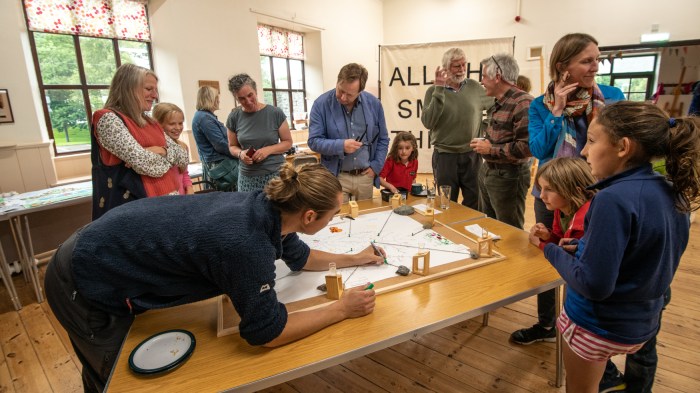
The map of waterways, with ten water samples, was a focus for conversations, and became animated with peoples comments and drawings.
Rob Fraser shared a series of portraits made on his large format camera.
Matt Sharman introduces his film ‘LAND’
Harriet Fraser introducing the project
After the evening event, the exhibition was open to the public for three days – around 270 people came through the doors. Many stayed a long while, pondering the work, and then talking between themselves or with Harriet and Rob. Quite a few people commented that the work ‘made you think – it’s so easy to take things for granted’; and issues highlighted here resonated with issues in other parts of the country. People shared a sense of pride in the place, and a reassurance that many people care deeply for this area. There was a balance of visitors from the valley, from Cumbria, from further afield across the UK, and a few overseas visitors too. One visitor from New York went away motivated to bring artists into a volunteer project campaigning for improved water quality in their harbour.
‘All These Truths Overlap’ by Rob Fraser
Kate Gilman Brundrett’s installation, an entanglement of conversations
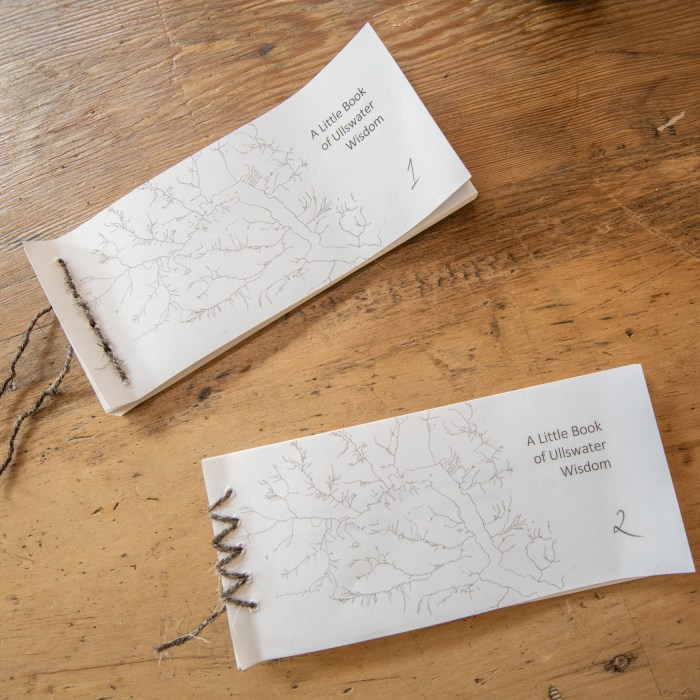
Harriet Fraser’s pair of hand-made books: containing phrases from conversations in the valley.
The research will be continuing for 12-18 months, as part of Harriet’s PhD. Within the broad frame of using art as a tool to explore different perspectives and relationships, and to create spaces for conversations, the direction of research will be focused by what has emerged from this stage: a close analysis of the interviews, reflections on the exhibition, and people’s response to the process. ‘I’m curious about cohesion, connections, discussions and joining things up; and what artistic processes may be a useful part of this,’ says Harriet. ‘In the next phase of research I’m looking forward to many more conversations, and to helping out with activities including habitat monitoring and tree planting, and I’ll be taking many long walks within the watershed.’
Watershed Artists: from left, Harriet Fraser, Sarah Smout, Matt Sharman, Kate Gilman Brundrett, Rob Fraser
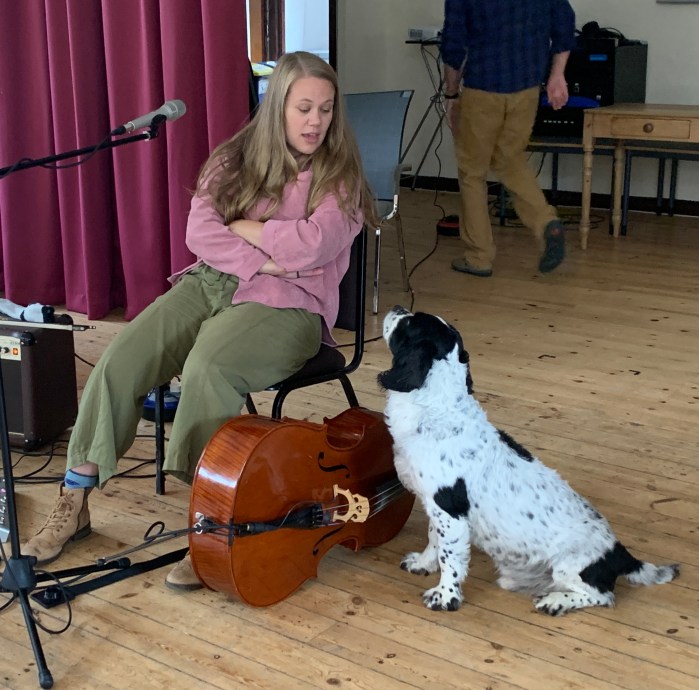
Is it possible to take musical advice from a dog? During sound check, Sarah Smout and Guilly the dog have a chat.
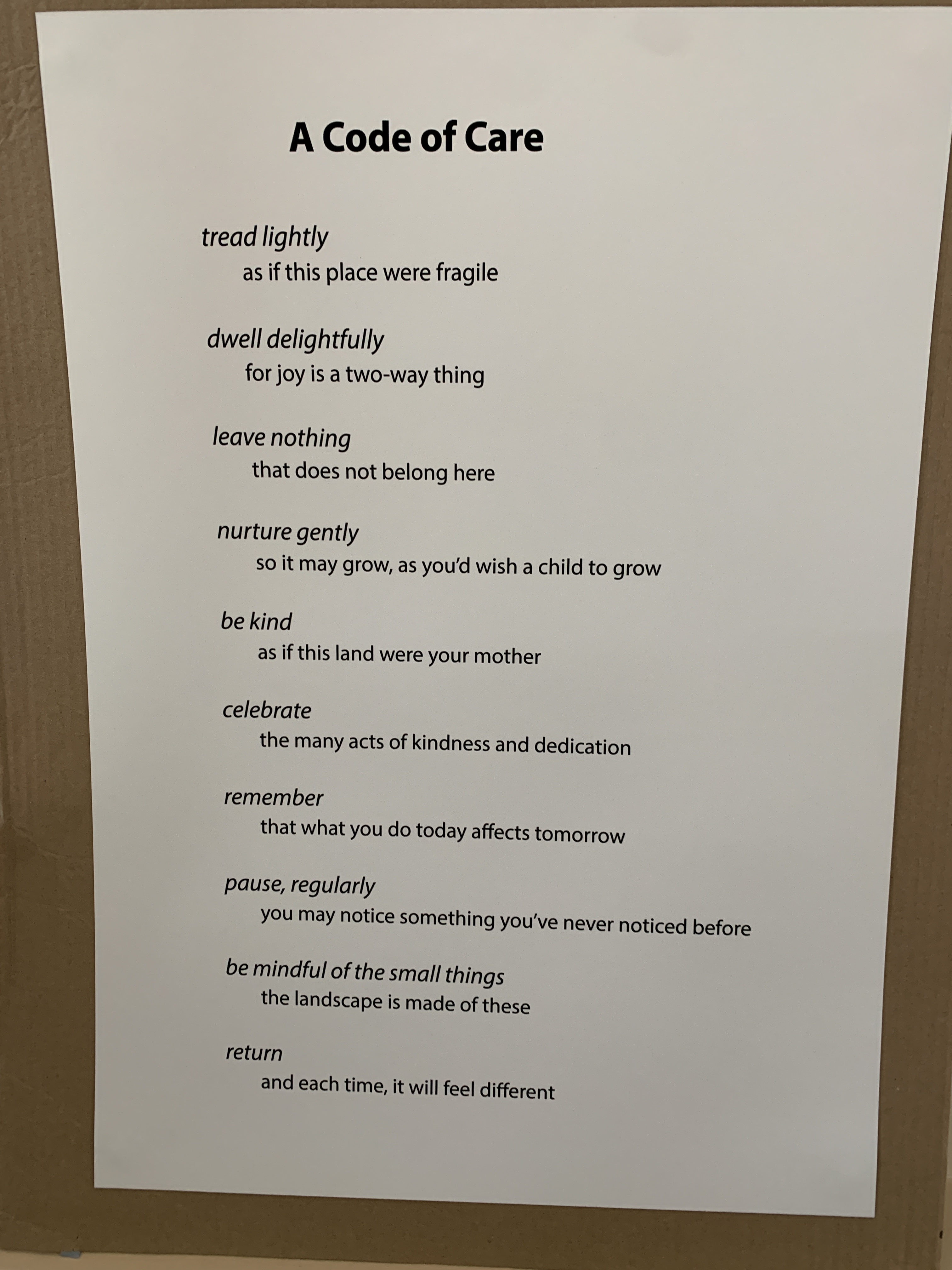
Harriet wrote 6 poems for the event. This ‘Code of Care’ was mounted on board outside the village hall, to welcome visitors. it was inspired by local concerns about wider education around caring for rural landscapes.
Watershed Canvas: Harriet Fraser and Rob Fraser installing the canvas on Glencoyne Beck, July 2023
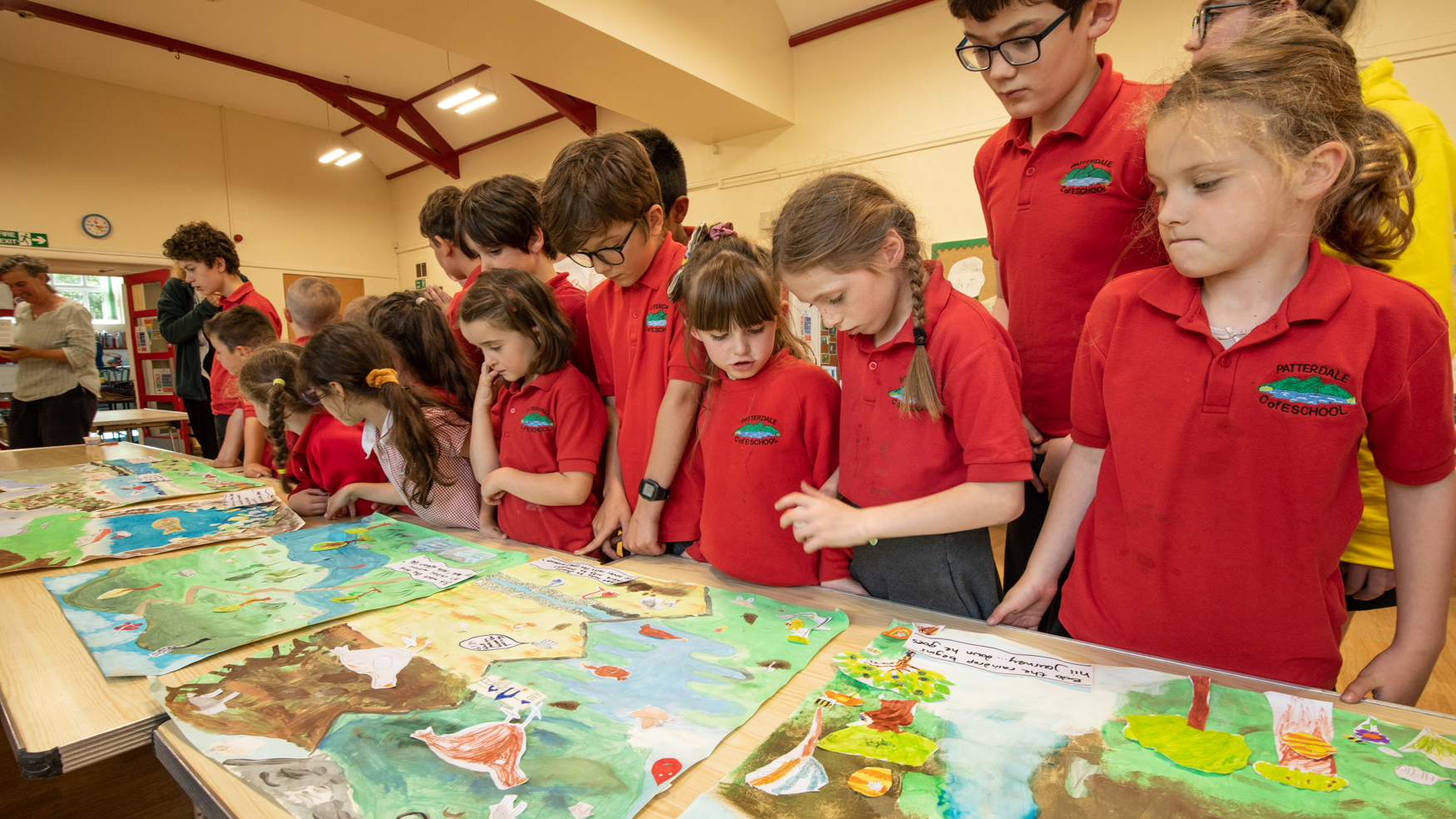
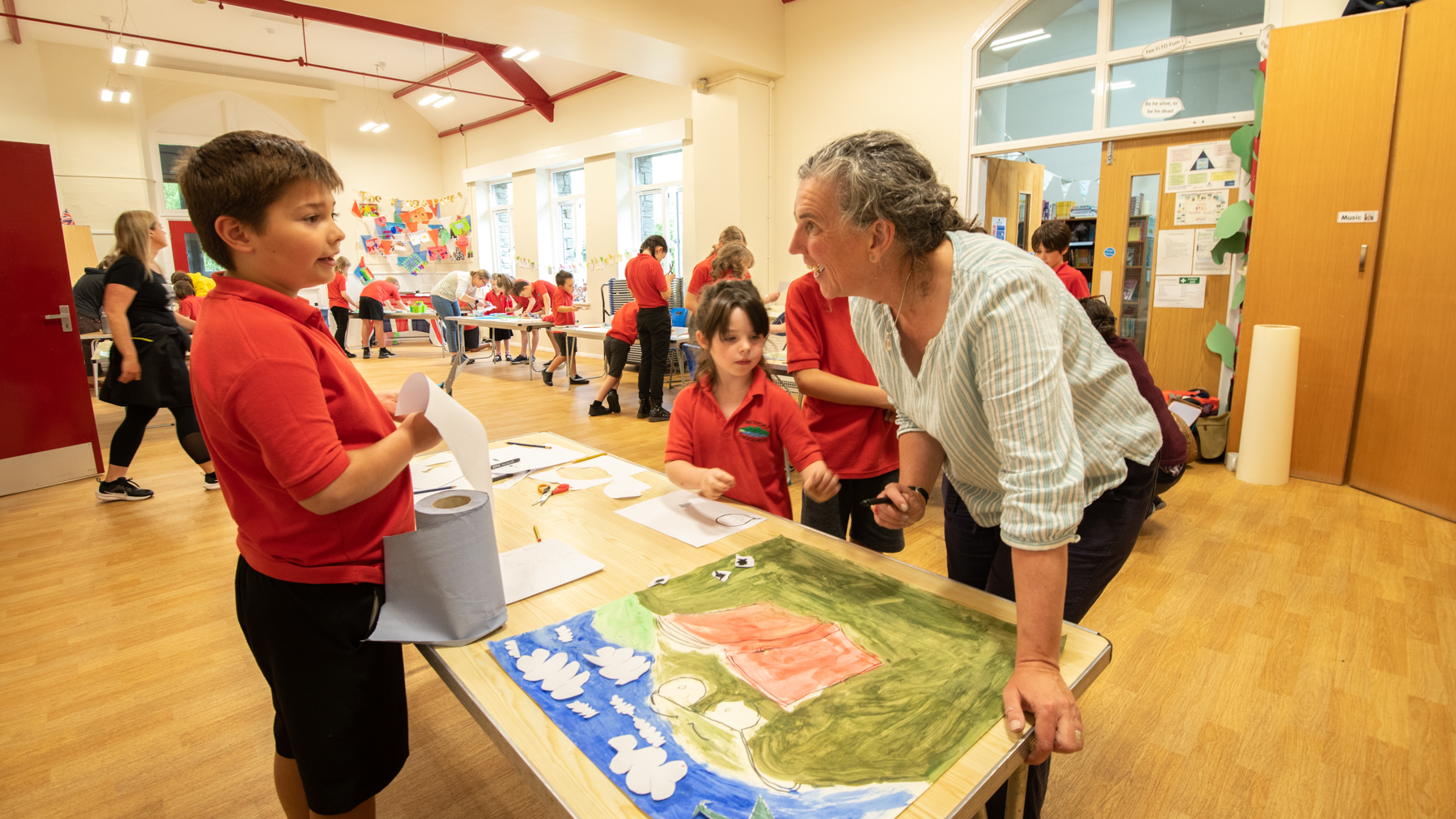
Children bring something that we adults just can’t. Their way of seeing, their ideas and their concerns are all really important. So, as part of the Watershed project, which brings many perspectives on the Ullswater Valley together through art, it was essential to involve children from the Valley.
The children’s artwork will be shown at the exhibition in Glenridding Village Hall (July 19, 20 and 21, 10am – 5pm). Then it will return to the school to be mounted on a wall.
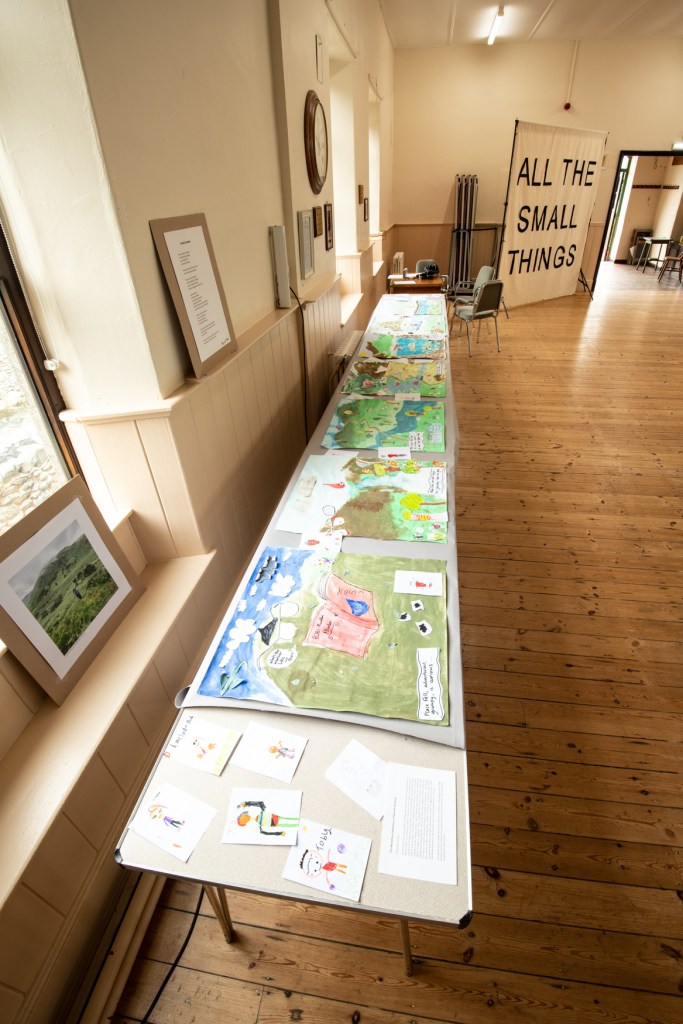
The children’s 7-part illustrative panel tells the story of The Marvellous Journey of Bob the Raindrop from the top of Place Fell, down into the lake, and all the way to Penrith. It allows us all to travel through a variety of habitats and consider what’s important in this place.
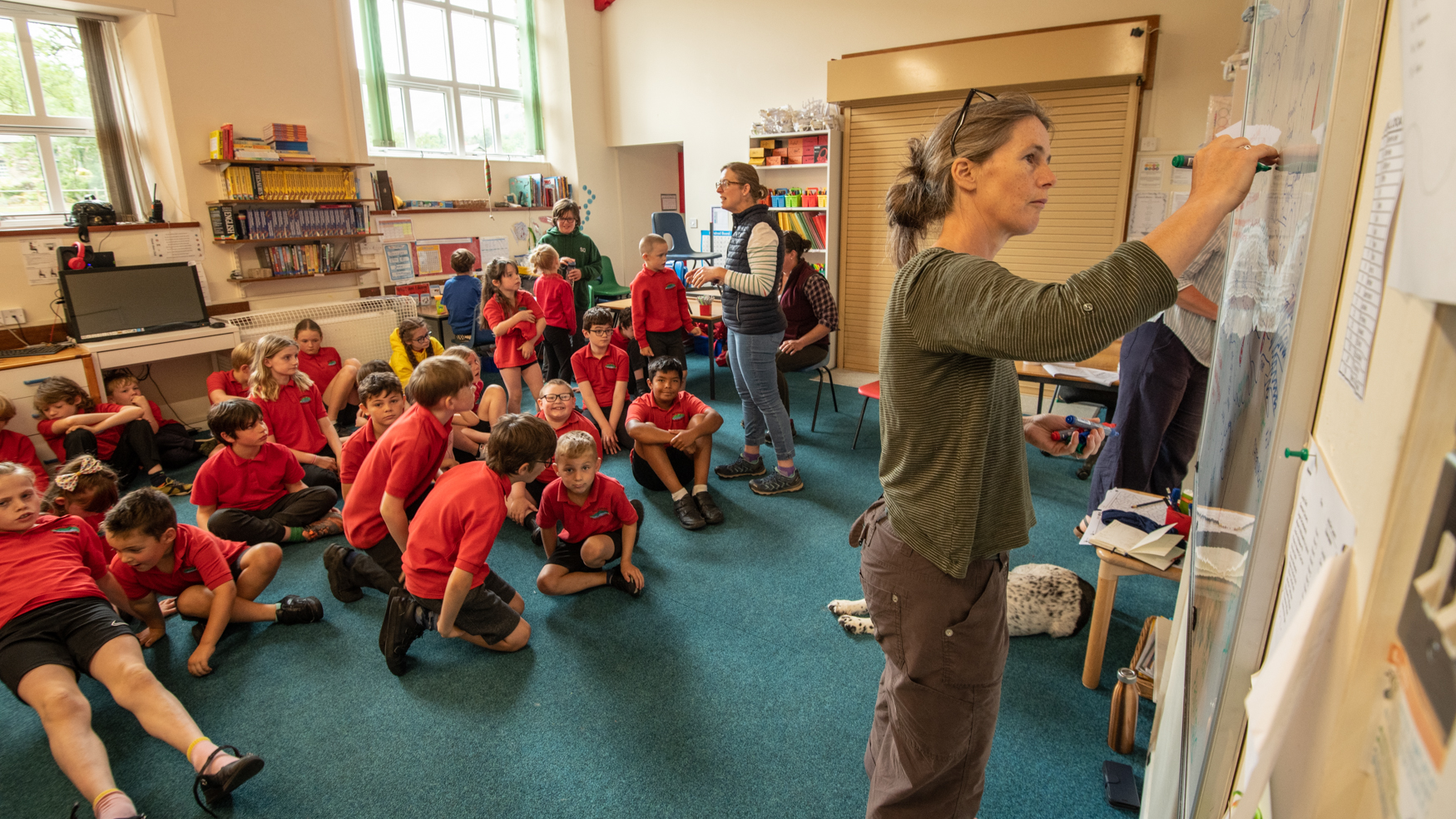
Harriet, Rob and Kate – three of the five artists on the Watershed team – started the day by taking the children outside. Lined up on a bridge straddling Goldrill Beck, they were able to look around them and discuss the different elements of the valley, and how they link up. They imagined what the fells, the sky, the water and other elements might be like if they were characters, and began to build the foundation for their story.
On the bridge above Goldrill Beck, with Place Fell in the background
The children are familiar with this valley: for most of them, it’s where they live. Most of them have walked to the top of the fells that rise above the lake, many of them come from farming families, all their hands went up when we asked who swims, paddles or sails here. They were able to weave all these experiences in; they shared their concerns about litter in the valley; they have experienced floods; they know the vagaries, and the impact of weather. We also talked about things that aren’t so easily seen, like the phytoplankton in the lake. Huge thanks to Ellie Mackay from UKCEH (Centre for Ecology and Hydrology) for helping Kate to explain this microscopic world to the children … it was easy to go from discussions about plankton to ideas of plankton-parties under water and the discussions that a water drop might have with schelly fish.
Introducing the children to microscopic phytoplankton that live in Ullswater lake
The work that the children has created, deciding every step of the way what they wanted it to be, brings together a delightfully playful element with a narrative of a place that is populated by many different species – the panels include birds, butterflies, fish, sheep, hens and dragonflies as well as people. And it offers some heartfelt observations – that this place is precious, and fragile, and needs to be cared for.
‘This is one of those pieces of work that just makes me smile,’ said headteacher, Nicky Steels. The smile comes not just from the finished piece, but the process that led to it. From choosing the central character of the story, to democratically selecting a name, and then working in 5 multi-age groups, the 34 children worked happily, energetically and respectfully. Quite aside from the piece that was created, what the day revealed to us all (and not for the first time) was the remarkable nature of relationships here, where a school is like a family, and where families connect with one another.
These connections are part of life in Cumbria and we felt it too – Rob and Harriet knew some of the children from their work with local farmers over the years, and Kate knows one of the teachers, whose mother taught Kate in primary school. These links, and ripples of relationship, help to knit a community together not just in a valley, but across the fells. The need for a strong community has been expressed by many of the people we’ve interviewed as part of this project as an important aspect of living well, and shaping a good future together. A strong, committed, and connected community is vital when it comes to caring for the valley.
Work in progress: Kate Brundrett takes notes from the children as they create their characters and weave a story
Cellist and poet Sarah Smout is one of five ‘Watershed’ artists. She is currently working on a musical composition that weaves together what she has learnt from speaking to people in the Ullswater valley.
Sarah says that she is interested in bringing the land’s voice into the composition through field recordings, extended techniques and improvisation. With this she hopes to convey the deep connection to Ullswater that these people have, and the urgency of the human task in caring well for a precious and fragile land. In this blog post, Sarah tells a story of her encounters with farmers Sam and Can Hodgson, from Glencoyne Farm, and skipper Christian Grammar, from Ullswater Steamers.
A tour round Glencoyne farm: view from the quad
if you give nature a chance …
“If you give nature a chance, it will come back,” says Sam, sitting opposite me in his farm kitchen. His hands are scarred and etched with lines that only a lifetime of working with the land will do. And that is exactly it: this land is his life. His and Can’s, and their family’s. And it is their preoccupation to make sure it is a life worth leaving for future generations.
So much joy glints in Can’s eyes as she tells me about the wildflowers returning – milkwort, butterwort, lousewort – and Sam’s newest revelation in life, swimming in the lake, makes him sit forward and gesture with his arms his feeling of being in his own air bubble, as he bobs in the water, looking back up the fell. They both agree: closing the gate at the end of the day is one of the wonders of being here – a moment when they can look out at the land, a day’s work done, and wander down the fell back to the farmhouse.
Can and Sam Hodgson have been at Glencoyne Farm for many years as National Trust tennants
—
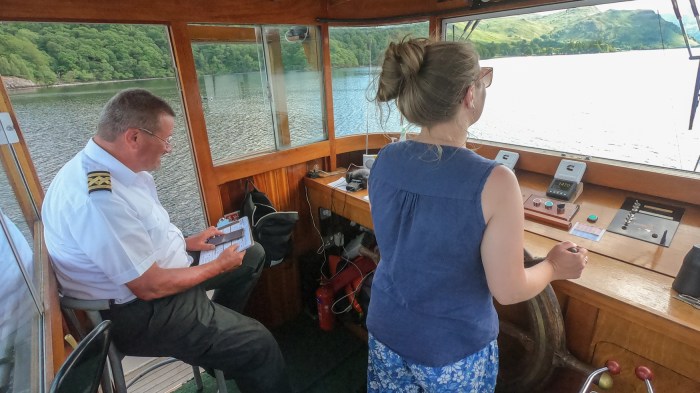
It’s not every day you get to drive a boat across the lake … Sarah with skipper Christian Grammar, who has been working on the boats for decades
Before we set sail, Christian feeds his friendly rook, who perches on the bow of the Raven. It has learnt to say hello back to him, but Christian refuses to give it a name. As we motor out, I sit in the wheelhouse with my zoom recorder ready to catch any one-liners, any moments that might make it into my composition. But it doesn’t feel like an ordinary interview, because Christian’s connection to this lake runs deeper than the North Sea. He tells me how he belongs here, feels more at home here, on the water, than anywhere. He seems to know every ripple, and loves to show people this elbow-shaped bit of water.
We both notice how everyone enthusiastically waves at each other from the other boats, something that doesn’t happen on other modes of transport very often. Time always seems to enter a different realm out on water, and this seems to amplified for Christian when he tells me how his Synesthesia makes everything feel connected. It’s a type of hyper-sensitivity to sound. He drives the boat but his ‘elbow room’ is the side of the lake, he hears the engine but his listening stretches far beyond the edge of the boat, the wake, the wind, the people, the birds. Swallows swoop in front of us, and he tells me how he does a similar thing with the ripples that sometimes form in patches on the lake – cat’s paws, he calls them. And when he’s on his last sail home, he likes to weave through them, joining the dots, and then looks back to see what he has drawn. An artist in him yet. It makes me wonder, how through joining the dots, listening far beyond our reach, we might help this planet of ours heal faster its scars that we have etched – some that run deeper than a human lifetime, and may still be healing long after we are gone.
Sarah will be giving a performance of her piece, with cello, song and looped sounds collected during her research, at the exhibition preview; a digital recording of her composition will be shared through this website.
As part of the Watershed project, Matt Sharman has been meeting people in locations across the Ullswater Valley. In this blog, Matt shares his reflections, some images of the people he’s come to know, and how he’s settled into what feels like an unusual process.
Trust the Process …
Five people – my ‘interviewees’ – have generously given their time and insight. The conversations have been ranging, heartfelt and interesting – I’ve learnt a lot. We moved through many different perspectives but some key ideas have been constant. Everyone, including me, holds the hope that any visitor to the exhibition space in Glenridding village hall leaves with a deeper understanding of the many living layers the Ullswater catchment has. This is an exceptionally beautiful environment and many people visit for this reason alone, but there’s also a rich cultural heritage, tightly-knit and hard-working communities with a strong sense of belonging, working with the land and connected to it. Everyone, in a variety of ways, is of this place.
This process continues to be an interesting creative journey for me. Usually, with film making, there’s more clarity about the form and shape the finished material will take. This project is different, and is a fascinating way of working – it’s far more organic, the connections and subject matter have been given the space to grow naturally from the conversations we’ve had. In this way it’s been more collaborative, and less directive. I’ve found myself relaxing into the complexity. I’ve been discovering and learning as I go, and it’s not over yet …
Animals have featured in many of Matt’s interviews. Here’s farmer Claire Beaumont, with Lilly (and piglets).
Gordon Lightburn, Chair of the ‘Friends of Ullswater’ and local Blue Badge Guide.
With Kate Gascoyne from Cumbria Farmer Network, looking across the Ullswater Valley.
Matt met Kerry Rennie, from Natural England, and chatted in an area of woodland pasture
Suzy Hankin, from the Lake District National Park authority
Matt, who lives in the Ullswater valley, is one of five artists taking part in Watershed, with each artist meeting five different people and creating work in response. The film will be part of the exhibition in Glenridding village hall, July 19, 20 and 21, 10am – 5pm.
Juliet Klottrup was one of the five artists who worked as part of the team on the Moss of Many Layers project – here’s the film she made after months of research. Click the link and enjoy – it’s a 15-minute watch.
The film now features in the COP26 Virtual Peat Pavillion – visit it there and find out more about peat, mires, mosses and bogs across the world.
To find out more about the project, and the extraordinary Bolton Fell Moss National Nature Reserve, visit the project page here.
What a day on Monday to celebrate Bolton Fell Moss and the work that’s been done through the Moss of Many Layers project. We were blessed with dry weather for the walk, and the buzz continued in Hethersgill Village Hall afterwards.
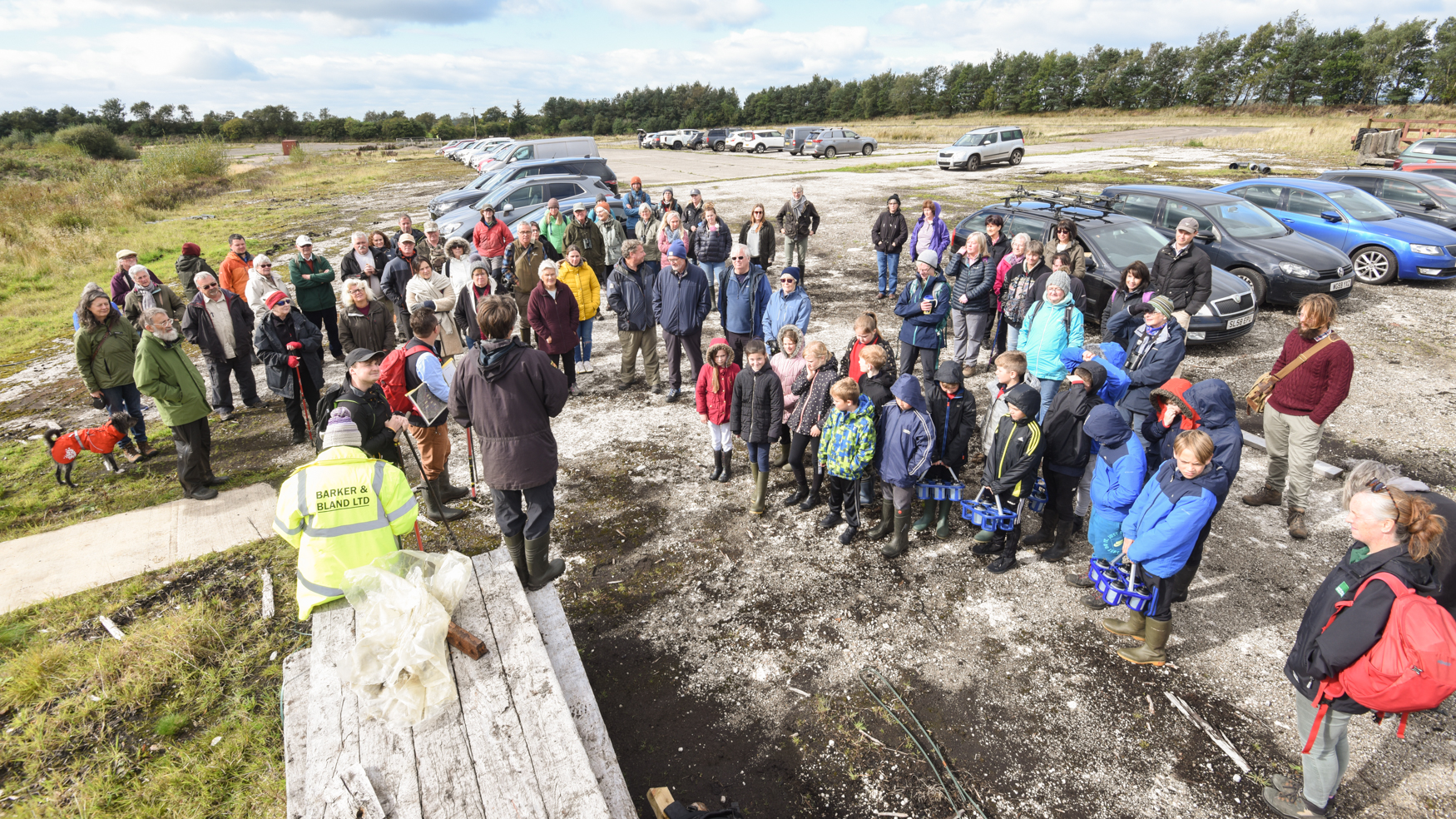
We were quite astounded with the uptake of tickets for the walk – more than seventy people came along. We separated into four smaller groups, each led by two members of the Moss of Many Layers team who shared insights about the bog.
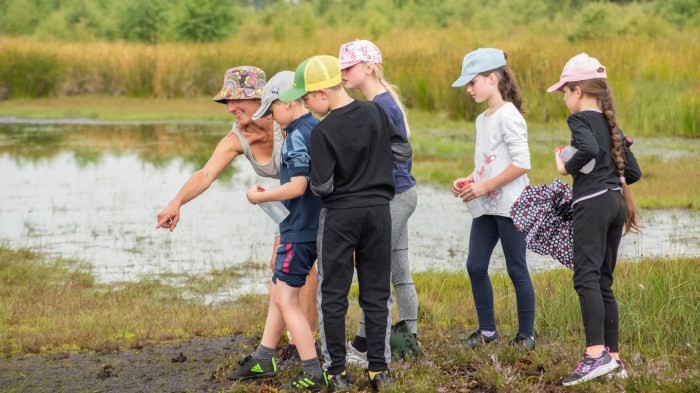
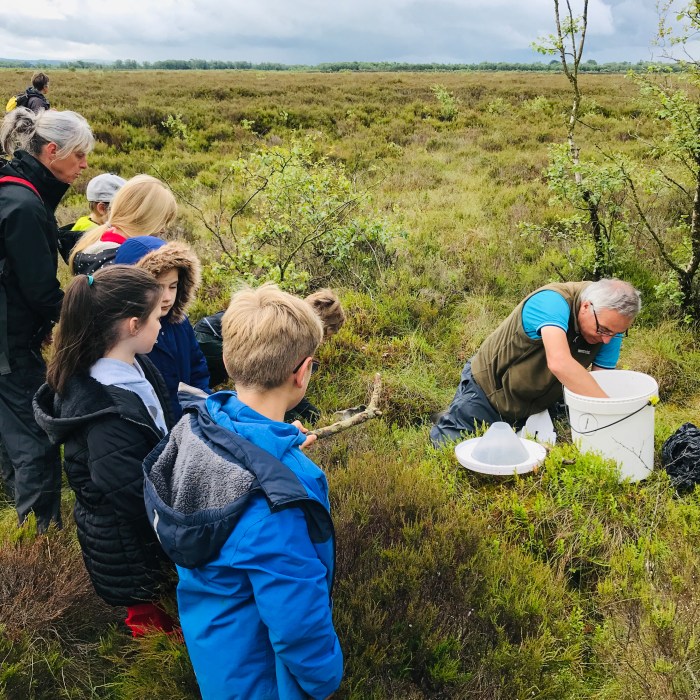
Huge thanks to everyone who came along – in each group there were people who had never been here before, as well as people who have connections with this place, so there was a lot to be shared, including stories of working here during the bog’s time as a site of peat extraction, or of working on restoration tasks, surveying and conservation. The children shared their own stories and the knowledge they’ve gained during the past year and were able to show others the peat ‘bunds’ they had created, which are now holding water, ready for sphagnum mosses to become established.
In the hall there was plenty of time for people to chat and find out more about Bolton Fell Moss and about the Moss of Many Layers project. People arrived who hadn’t joined the walk, it was a real pleasure to meet so many people who live locally and have their own connections with the bog. There is a lot of pride in this wonderful place!
The ‘star’ of the show was the peat core, which at more than 8-metres long took pride of place. Other work on display included Helen’s beautiful map; a series of portrait images taken by Rob, to share the faces and stories of people connected with this place; artwork from Shankhill Primary School children and young people from William Howard School who have worked with Anne; information about the Moss put together by Emma; a set of poetry written by Harriet; and a drone and GPS tracking devices that the scientists have been using for their research. And Juliet’s film had its premier with back to back screenings.
As with most gatherings, the party extended into the kitchen, and around the wonderful ‘Moss of Many Layers’ cake.
The best way to tell the story is through some images of the day. A digital collection of the work that’s been produced will be coming in due course, and we’ll be sharing the film as well. Watch this space!
Working with young people: Reflections from Anne Waggot Knott
Let’s burrow and borrow,
hand in hand, for tomorrow.
The crux of the Moss of Many Layers project has always been about facilitating a deeper connection between the community and Bolton Fell Moss, more than just visiting the bog and creating work inspired by our visits. Reflecting on our engagement with young people, I think we’ve achieved a rich and profound process of exchange and reciprocity, of sharing and balance, between the students and the bog itself. Not just sharing information and ideas, but a tangible, physical, corporeal exchange.
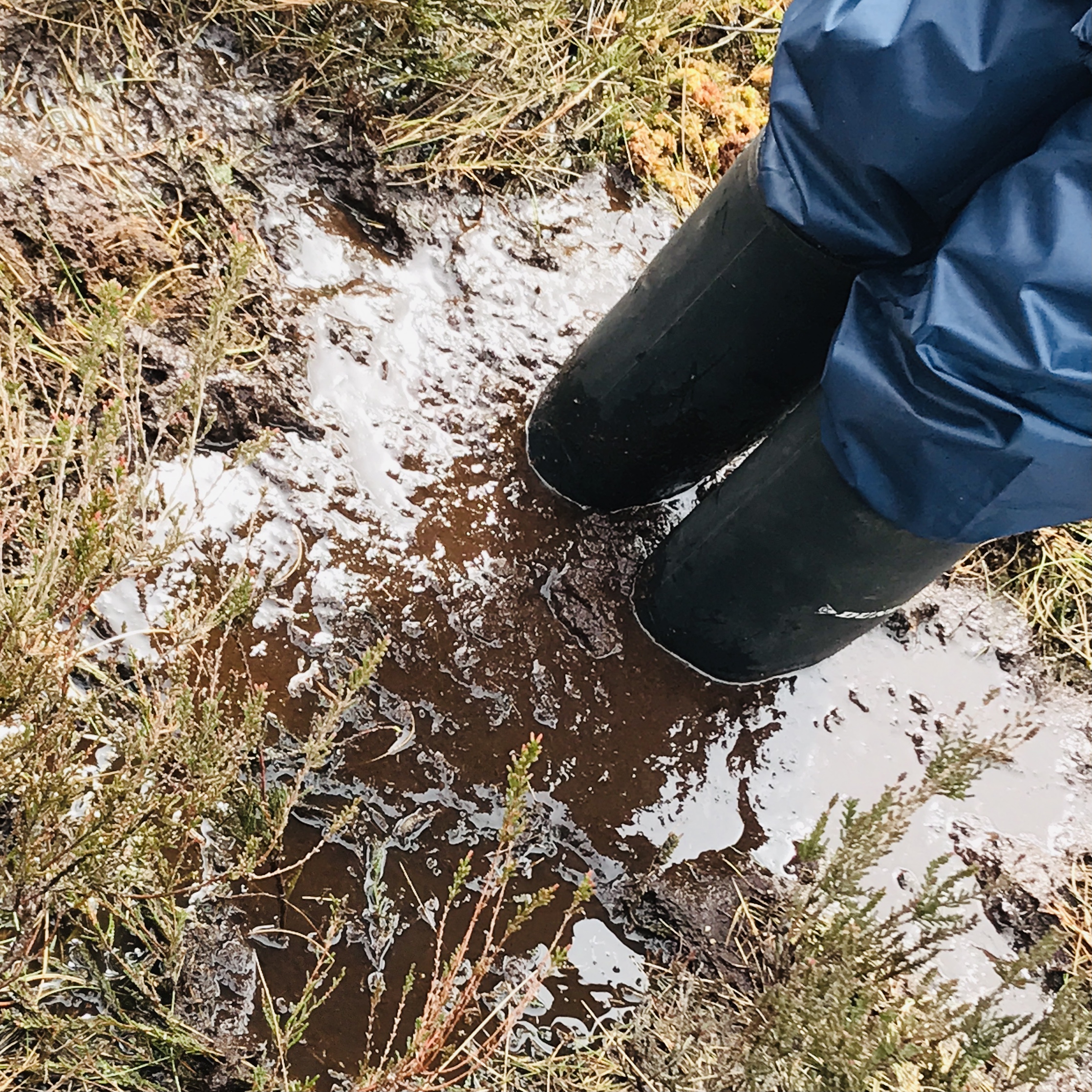
The students have contributed their time, their minds, their hands and their handiwork. They committed a level of bravery; physical and mental exposure to this unpredictable, new environment and its elements. They’ve been listening and looking and trusting and digging and pushing and probing deep into the peat itself, getting dirt behind their nails, and (literally, in some cases!) immersing themselves the bog. They planted restorative species, putting something back into the landscape, a physical symbol of their involvement.
In return, Bolton Fell Moss has given back to them. As new ambassadors and stewards for this valuable place, they have watched it change through the seasons and they carry with them fresh knowledge and understanding from the land. The bog also gave up pieces of flora and fauna to take away and use in their artwork.
Building relationships
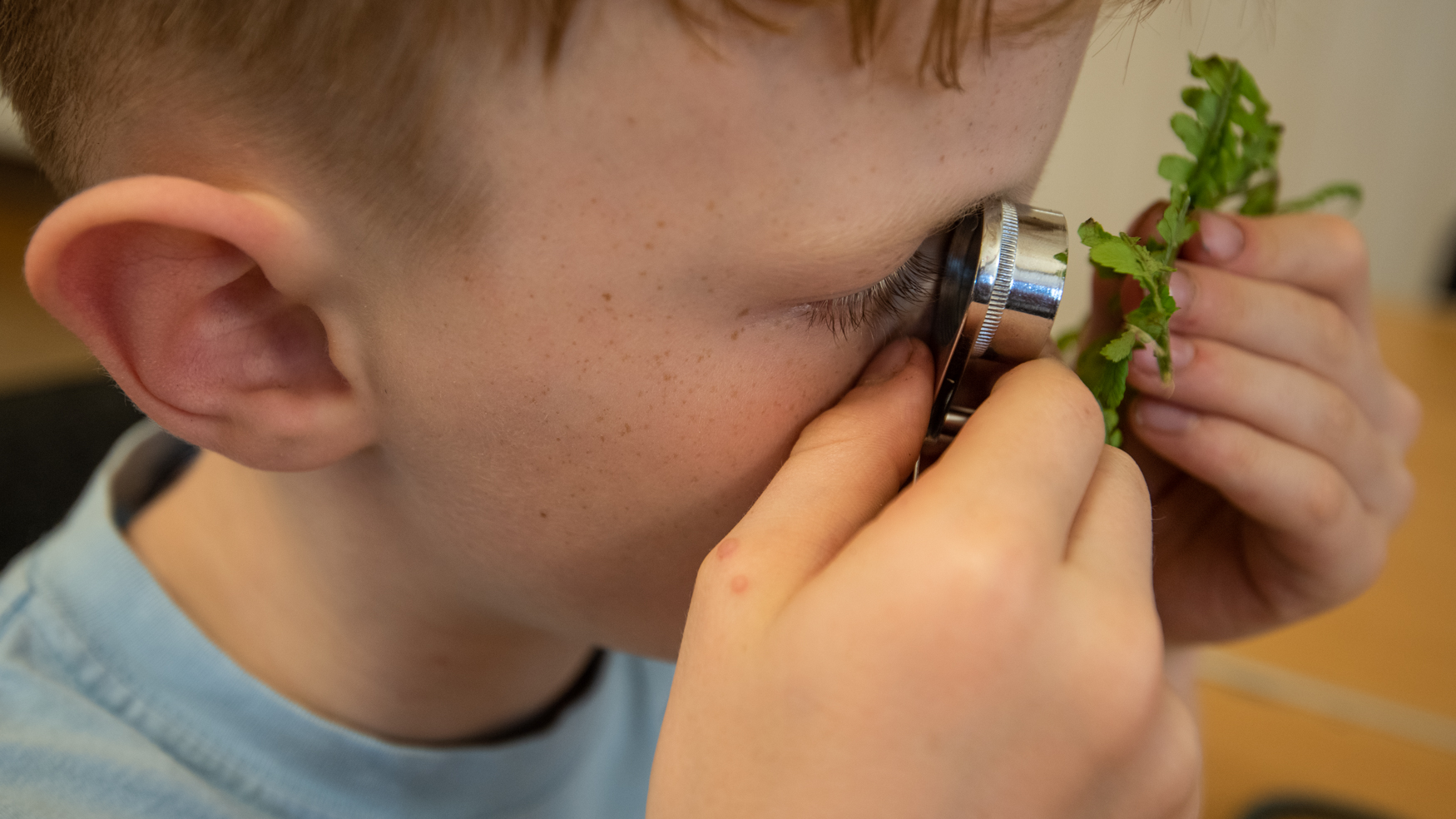
Foraging forces a slow, vigilant journey in the landscape. Through the careful acts of identifying, collecting, handling, protecting and transporting their finds, students developed a sense of ownership and responsibility for these tiny fragments. Their pride was evident in producing their foraged items back in the art room, examining them repeatedly and becoming familiar with the detail. This physical contact with the plantlife over a period of time, this guardianship and forensic examination, cements and reinforces a relationship, like hugging or holding hands.
Prior to industrial peat extraction, bogs were similarly part of the community as domestic sources of foraged foodstuffs. People picked berries, fungi and medicinal plants, and enjoyed a familiarity with their peat landscapes. It’s satisfying to have catalysed an intimate, tactile relationship between the bog and people once again. I like to think of the students’ work as a collective portrait of the bog, personifying and celebrating it as we would a prominent member of the family. We’ve welcomed it as part of the community again.
Letting things happen
I had very fluid expectations of these creative sessions. Although structured, I’ve assumed a broad acceptance of whatever the students and the bog bring to the table on the day. The act of making has proved fruitful as a vehicle for continued, pressure-free conversation and discussion. As we drew and stuck and printed, we’ve created so many opportunities for holistic conversations, anchored in the bog but relevant to the climate emergency and the way we use our natural resources. The students have enjoyed an opportunity to manifest their findings in a personal way, playing to their own strengths, reaching their own conclusions, and processing their experience with no judgement or assessment.
Art, science and community
I think we’ve also helped to embed the idea, early and subconsciously, that science and art don’t sit separately. And that this is a generation of connected, multidisciplinary young people who are broad, creative, confident, analytical thinkers, capable of bringing great breadth and depth to future environmental research and policymaking.
Artists and scientists work in similar ways: we research, experiment, create outcomes, disseminate and evaluate. From my perspective, Moss of Many Layers exemplifies the successful intertwining of approaches and processes, with funded time and space for experimentation. It has created a basis for triangulating art, science and community around our protected landscapes. It’s encouraging to see many more research and engagement projects take this approach as a matter of course, recognising the value of embedding artists and scientists in relationship with our natural world, hand-in-hand.
A blog from Anne Waggot Knott, reflecting on the Moss of Many Layers project
a school minibus in the distance, driven by sideways rain
heralds the widening of eyes
and the blooming of minds
in the wilderness
As we reflect on the second of three creative activity sessions with young participants on Bolton Fell Moss, I realise we have now really begun to unpack the many layers in the title of the project.
This visit was all about exploring what lives and depends on the moss: plants, insects, spiders, moths and birdlife.
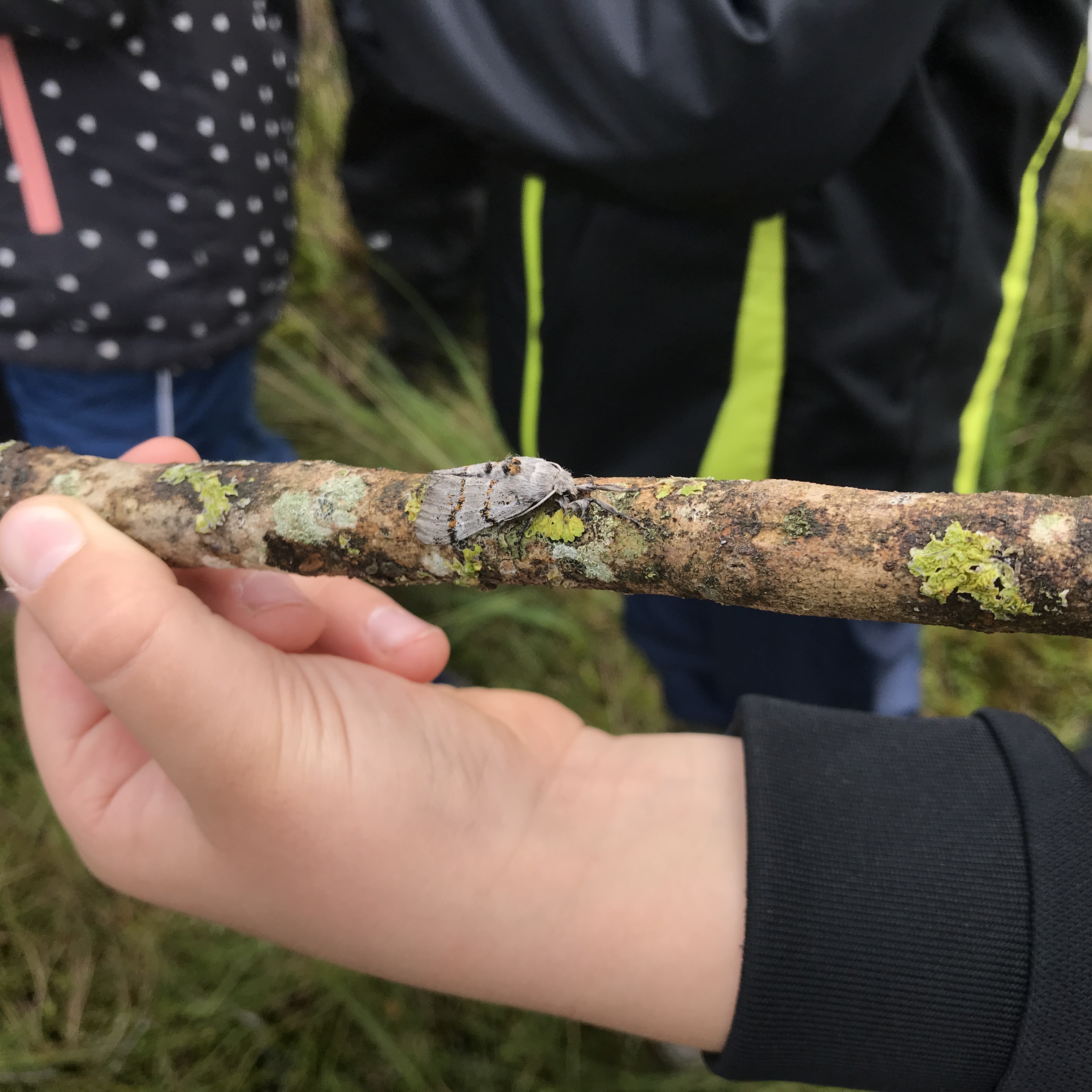
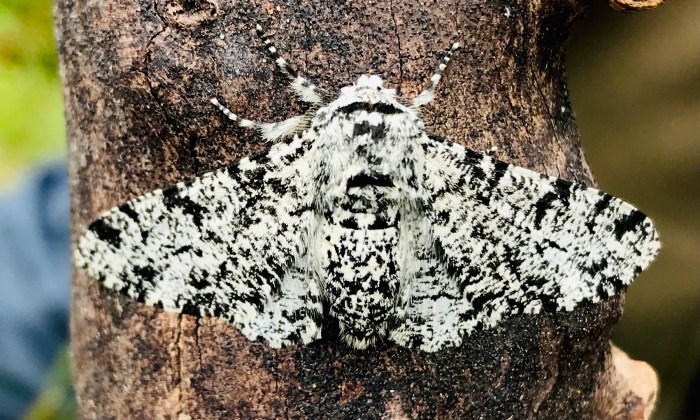
We unloaded moth traps, uncovering beautiful, fragile beasties camouflaged against lichen and logs. We foraged for slugs and beetles and squirmed as a mass of spider babies spilled from their mother’s egg sac. We wafted our sweep nets after butterflies and captured all of the breathless wilderness wonder we could find.
Looking in the moth trap
Our final exercise was to guard ‘curlew eggs’ (actually hardboiled chicken eggs), encouraging the students to understand the vulnerability of ground-nesting birds. I had to leave them at this point but the pupils each took an egg and spread out intrepidly to find their own nesting sites out on the reserve.
I turned to face the rain and my trudge to the car park. As I looked back across the vast expanse of heather, I could see little eight-year-old heads hunkered momentarily alone in the moss; sitting grounded like curlews on a nest, looking quietly around themselves with a new wonder and awareness, fully entrenched in their environment. They were totally absorbed, individually forming new ways of understanding the world.
Collograph plate
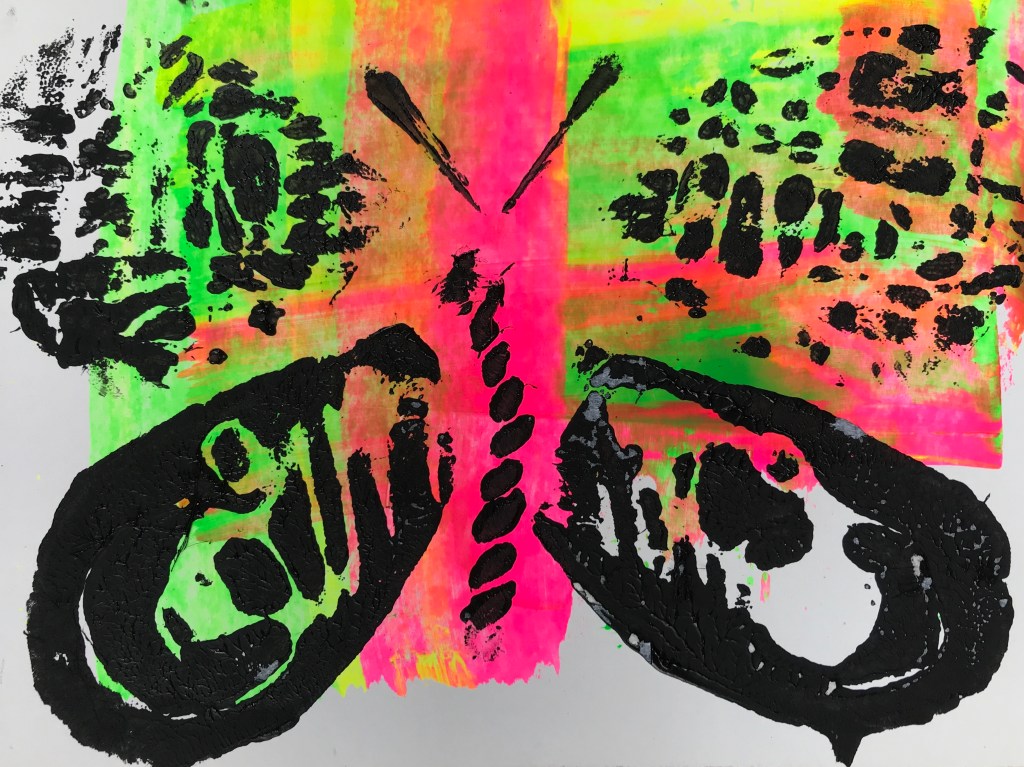
Reinforcing and embedding this experience through creative activity is a challenge, a layer of learning for me and for the other delivery partners too. This time we made collagraph printing plates inspired by the beasties we found, using recycled and repurposed collage materials, embedding another level of environmentally sensitive practice into the project.
One of the most rewarding things about truly multi-disciplinary science-arts engagement is that we can find ways of reaching every individual participant. As an accompanying teacher pointed out last time, literally everyone enjoyed it. A neurodivergent student was completely mesmerised by the insects and moths. This generated a new admiration from their classmates and helped them focus on the follow up creative session too as they were already hooked. Abstract printmaking is satisfyingly inclusive – it doesn’t matter if you ‘can’t draw’ – it’s just mark-making at the end of the day – and the vibrant effects look enticingly cool.
Also enticingly cool are these climate change faces produced during our reflective debrief. We hadn’t talked much about the bigger picture of carbon capture and storage during this session, focusing instead on flora and fauna on quite an intimate scale. But these expressive, striking images paint a thousand words and give me confidence that pupils have made the connection with the broader environmental catastrophe. I hope that by delivering sessions like this, we will help them develop a broad range of tools and knowledge to really make a difference.
The ‘What is Natural Beauty?’ Symposium, run by the PLACE Collective through the Centre for National Parks and Protected Areas, and in partnership with Wye Valley AONB and the Lake District National Park, took place on December 1st, 2021. And what a success it was – the provocative (and unanswerable?) question raised through the symposium invited a diversity of views and opened up many avenues for discussion among more than 100 participants.
A formal report will be shared early in 2022, but for now we thought a perfect way to summarise the symposium would be to share this reflection from Howard Davies, former CEO of the National Association for Areas of Outstanding Natural Beauty. Read on …
Howard begins:
“I think it begins with 3 main sets of questions:
What is beauty?
Does it exist objectively in things themselves? Is it an inherent quality of some landscapes, and not others?
Does it exist only subjectively in the mind of the perceiver?
Do landscapes possess special qualities that are perceived as beautiful in the mind of all perceivers? Is there a shared, cultural component to this? Do perceptions of landscape beauty vary, dependent upon societal values and norms?
What is the scope of things to which beauty can be applied?
Purely sensible – perceived through the senses? See, feel, hear, smell …
Or is it something more profound – is there an Intellectual or moral quality to beauty?
And if the scope is this wide does sensible beauty lead you to moral or intellectual beauty?
The romantic poets spoke of natural beauty as a spiritual, almost other-worldly experience that was accessed through our relationship with nature. For example, Shelley’s ‘Hymn to Intellectual beauty’ – Natural Beauty was what you experienced, as a result of your relationship with nature. It was a natural phenomenon connected to the experience of nature, not nature itself.
How does natural beauty relate to other value concepts?
The functional, the sustainable, the spiritual? And does natural beauty align with the concept of a sustainable, ecologically rich and functioning landscapes?
Presenters and performers
Kate Humble opened this seminar with reference to the picturesque and the role of landowners in transforming landscapes in accordance with the aesthetic of counterfeit neglect. She challenged us to reconsider what makes our landscapes beautiful and suggested we take a steer from nature.
Desperate Men provided an entertaining take on the notion that the map is definitely not the territory and questioned the full scope of outstanding natural beauty, and whether beauty is entirely in the eye of the beholder
PennyBradshaw introduced us to the romantic poets and writers, the picturesque in more detail, and Edmund Burke’s notion of the sublime – the agreeable horror associated with some of our more dramatic landscapes.
Crystal Moore challenged us to rethink how we value our environment within the frame of the climate and human emergency that now faces us, and to reinvent ourselves. SteveRatcliffe also framed natural beauty within the wider context of sustainable development and personal impact, with examples drawn from his experience in the globally important, vibrantly lived-in, distinctively special, Lake District National Park
Mike Collier introduced colonialism into the argument, and talked about the impact of race, class, power and privilege and the history of land ownership. Touching on identity, beliefs, and deep-seated cultural values. He made the case for celebrating beauty in difference, rather than the industrial green landscapes of curated, ‘rural’ Britain.
Anjana Khatwa gave a personal reflection of her lived experience as a woman of colour, geologist, earth scientist, and mother in the British landscape and how these lenses affect her view of beauty. Ruth highlighted the benefits of performing in the natural environment, and some of the barriers that exclude people of colour from the countryside. She asserted that no environment can be outstandingly beautiful if it is exclusive.
Sally Marsh examined how we might consider natural beauty today if we embraced its full scope, not just visual amenity, in the planning and management of landscape.
Matt Larsen Daw drew on our nurturing love-affair with nature and our ultimate inter-dependency on this for the wellbeing of our body and mind. I was particularly taken by his description of landscape as “Time and nature made solid”.
Neil Heseltine took us beyond physical attributes and face value, to remind us of the complexity of nature. He made the point that nature needs space and time to play out its processes and intricacies and that the way land has been stewarded over the last 50 years has limited this. He highlighted the important role that National Parks and AONBs can play in helping people understand the complexity of nature and their impact on it, especially with regards the way we produce our food.
So, by way of a summary – for me, sensible and intellectual beauty strike at the heart of what it is to be human. It is the tension between the finite and the infinite, life and death, permanence and transience, lost and found, past and future, harmonious and discordant – it is this symmetry that we inherit from the classical approach to beauty. The wonder, awe, majesty, and drama of nature and our small place within it, we inherit from the notion of the sublime. These marry together to form the yardstick by which we have historically qualified our current suite of protected landscapes, protected for their natural beauty … a concept that is still valid, and indeed important for our wellbeing. Many landscapes however have difficult histories that have given rise to multiple challenges, many of which have been clearly expressed today, and all landscapes are subject, like us, to the existential crisis that is now upon us.
Landscapes are the product of processes and interventions. Ultimately I think, we need to focus less on the product, and more on our relationships with each other and the environment within which we exist, and on which we depend.
We need to be more creative, recalibrate these relationships urgently, and reposition ourselves, our economic systems, and the way society operates, such that a supportive, functioning, environment is the natural outcome. We might therefore focus our search for natural beauty and elegance in these relationships, and become more comfortable in letting our environment be what it will be.
AONBs and National Parks are the perfect vehicles to lead this change and champion what essentially needs to be a new, more diverse, social contract around landscape and natural beauty, but to do this with the intention of triggering systemic change on the basis of kindness, and active and open listening – the point made my Harriet in the poem that started this discussion.
Thank you.
To find out more about Howard Davies, and the other presenters and performers who took part in the symposium; and to browse through some resources, view the symposium programme here.
Kate Gilman Brundrett’s reflections on the symposium … evolving!
This question from Catriona Manders, Youth Committee & Junior Ranger, Loch Lomond & the Trossachs National Park, introduces the Protected and Conserved Areas Joint Statement on Climate Change and Biodiversity, which was announced at COP26.
Why are we sharing this? Well, we think it’s spot on – surely it’s a responsibility of protected places to care for life and set a strong example. And, with PLACE sitting within CNPPA, it’s great to know that CNPPA was among the founding signatories pledging to take action to better care for landscapes and seascapes, and to join together – as no one place can do it alone.
To reflect, here’s Lois Mansfield, Director of CNPPA:
“The significance of this accord cannot be overestimated. For the first time ever, those involved in protected and conserved areas have come together to call on world leaders to support their work in the fight against climate change ad biodiversity loss. We are one enormous family of protected areas. The sheer power of multiple agencies coming together to make one statement of intent means we can now work collaboratively and internationally.
Protected areas are not just pretty places, they are the pinnacle of biodiversity, interrelated to living landscapes in many parts of the world. If the battle against climate change and biodiversity loss is to be won, we must win it first in these special and conserved areas. Our role can be transformational.
Signing this Joint statement is really exciting for CNPPA, and it’s happening in the 70th anniversary of our local national Park, the Lake District. It really brings home the importance of being part of wider family, and the need to help each other achieve a sustainable future for everyone who lives and works in, and enjoys, our national landscapes. Finding common ground and being able to speak with one voice empowers protected and conserved areas to address the challenges of the 21st Century.”
Some of the text from the signed document …
“Over 70 countries are members of the High Ambition Coalition (HAC) for Nature and People that champions a global deal for nature and people with the central goal of protecting at least 30 percent of world’s land and ocean by 2030 (30×30). The 30×30 target is a global target which aims to halt the accelerating loss of species, and protect vital ecosystems that are the source of our economic security.
We believe the global family of Protected and Conserved Areas is well placed to respond to the calls to action from the IPCC, IPBES, IRP and UNEP and to support the ambition of countries around the world, including the G7 and the members of the HAC, by taking rapid and far-reaching actions to tackle climate change and biodiversity loss.
… we can be the first 30 percent that inspires and informs land and sea use choices across the remainder of the planet, and we can be the places where billions of people connect with nature and become inspired to play an active part in combatting the dual crises.
So the PLACE Collective is here – but how did it come about?
The PLACE Collective is an ambitious and exciting venture. And for the first blog we thought we’d share some musings about the early sparks of ideas, and the journey to get to here.