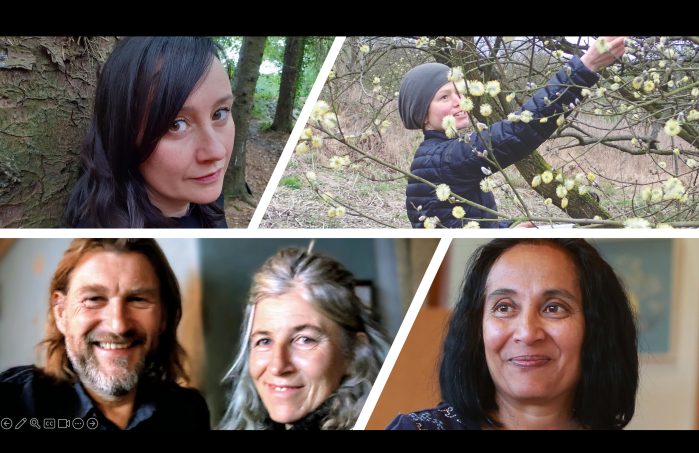
A portrait of a man and a woman, smiling at the camera

CCP Scotland Artists – Arc/Rebearth

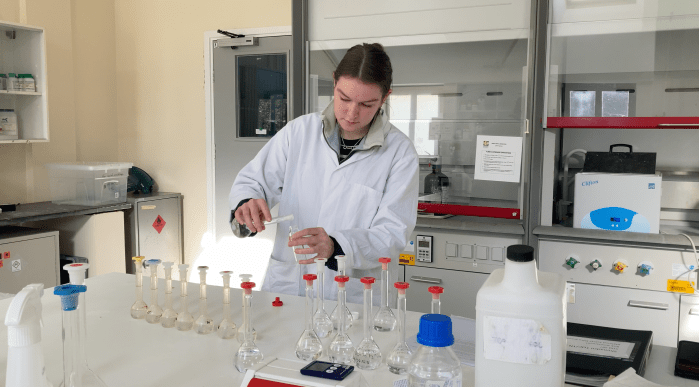
Tom Morton (Arc) and Becky Little (Rebearth) join the team of Creative Collaborative Placement artists. They will be working in Scotland, liaising initially with specialists at the James Hutton Institute, with an enquiry focused on soil.

Read on for more about the artists, and their placement focus.

Continue reading “CCP Scotland Artists – Arc/Rebearth”
A woman reaching into a tree with pale green catkins

CCP WALES Artist – JACQUI SYMONS

Welcome to the LUNZ Hub Creative Collaborative Placement artist in Wales: Jacqui Symons. Jacqui will begin her enquiry in conversation with a team from the Centre for Ecology and Hydrology (CEH) in Bangor.

Read on for more about Jacqui Symons and the placement focus.

Continue reading “CCP WALES Artist – JACQUI SYMONS”
Kate Arthur portrait shown with words cfreative collaborative placement: northern ireland

CCP northern ireland Artist – kate Caoimhe Arthur

In Northern Ireland, poet Kate Caoimhe Arthur will be enquiring into Land, Livestock and Livelihoods, meeting with researchers at the Agrifood and Biosciences Institute and livestock farmers across Northern Ireland.

Read on for more about Kate Arther and the focus of this placement.

Continue reading “CCP northern ireland Artist – kate Caoimhe Arthur”
Daksha Patel image shown as the Creative Collaborative Placement artist

CCP England Artist – Daksha Patel

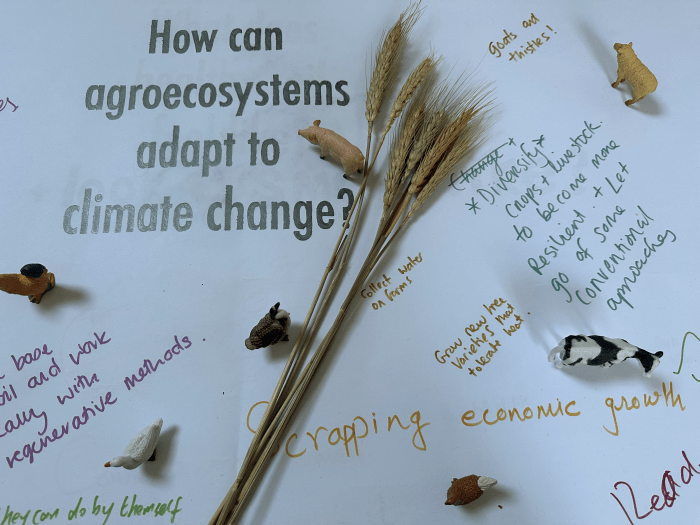
In England, the LUNZ Hub Creative Collaborative Placement artist Daksha Patel has begun her process of research with Rothamsted Research, working with an enquiry into agrosystems transition. Daksha has been liaising with Rothamsted to refine the direction of the enquiry and is underway with her research.

Read on for more about Daksha Patel, and the placement focus.

Continue reading “CCP England Artist – Daksha Patel”
Portrait images of people

NEWS! NEWS! NEWS! Artists Selected for LUNZ Hub PLACEMENTS

In the summer, the PLACE Collective put out a call for Creative Collaborative Placements with the LUNZ Hub, across the UK. There was a huge response and an extremely high calibre of applications – wow, there are so many brilliant artists out there – but after a long and thoughtful selection and interview process decisions were made.

We are delighted to announce the three new placements in Scotland, Wales and Northern Ireland, and the ongoing work in England.

Continue reading “NEWS! NEWS! NEWS! Artists Selected for LUNZ Hub PLACEMENTS”
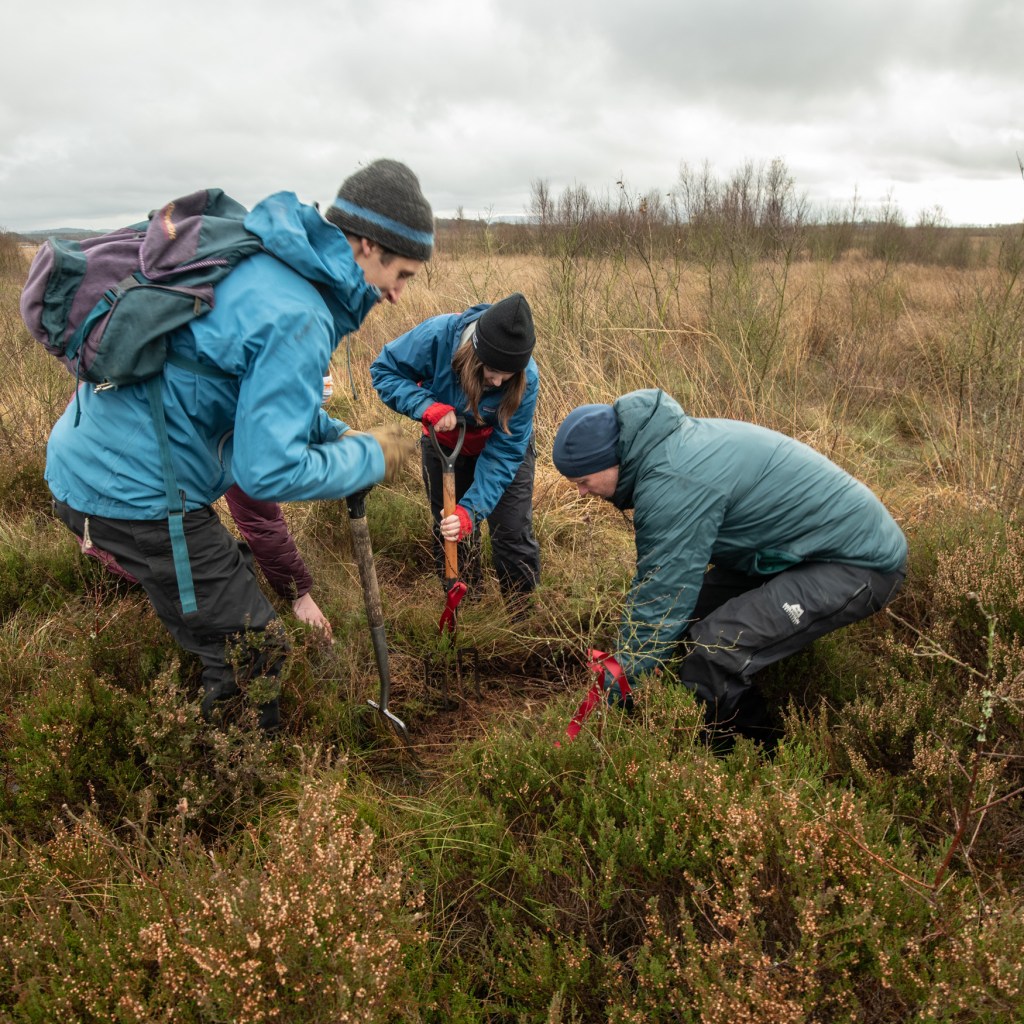
Three people lean into a whole, digging earth before planting a tree

Resonance Birch Circles – the plantings

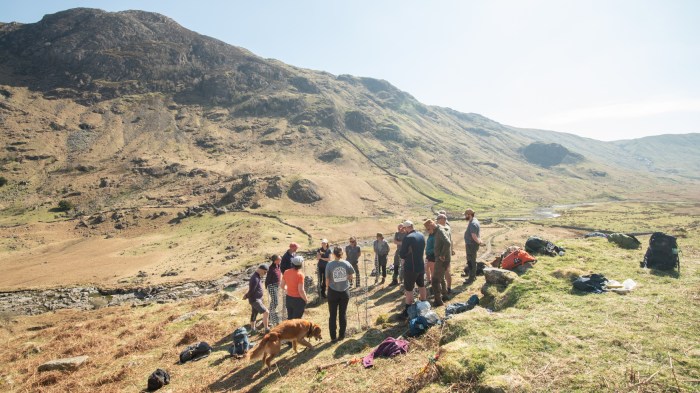
How can it take twenty people to plant seven trees? That’s a fair question, an out-loud wondering from one of the participants joining the group to plant a Resonance circle in the Langstrath Valley. And it kind of gets to the point – the act of planting a Resonance circle is not about function, speed or efficiency, but about taking time, and about connection.

A group of people on a hillside in sunshine. They are standing in a circle around newly planted trees
Planting a Resonance circle in the Langstrath Valley

The seven trees planted on the fellside in the Langstrath valley where the last seven to go in during the year’s planting season – just enough time to get the trees into the ground before they woke from their winter slumber and began to open their leaves. Around the country, people have been planting trees maybe hundreds or thousands at a time, but for the Resonance circles, there are just seven trees. Each circle is planted with the same precise measurements: a diameter of 3.5 metres, with the seven trees set around the circumference of the circle in an equal spacing, angled 51.4 degrees from the centre.

Continue reading “Resonance Birch Circles – the plantings”
An art exhibition showing a wooden piece and images behind

Review of ‘See Here Now’, in Ecoartscotland

When environmental change is happening at planet-wide scale, and in cumulative increments of time, we can be psychologically and culturally distanced from perceiving it ‘here’ and ‘now’. The exhibition … is a compelling effort to bring the meanings closer.

So begins the review of the See Here Now exhibition currently showing in the gallery at Grizedale Forest, written for ecoartscotland by Dave Pritchard, an independent consultant in environment, culture, heritage and the arts.

In this review, Dave highlights some of the work that particularly struck him when he visited. He also asks about what art and artists can or might ‘do’, and shares some questions that arise from this exhibition: If things feel urgent, does the art also need to be urgent, or might it paradoxically be slow? and: What might an exhibition, or individual artworks, urge others to do?

To read the full review, visit ecoartscotland.net here.

We recommend making a brew before you do – while you’re on that site you’ll almost inevitably want to delve deeper. Ecoartscotland is a rich resource, focused on art and ecology for artists, curators, critics and commissioners as well as scientists and policy makers. It has been established by Chris Fremantle, producer, and research associate at Gray’s School of Art.

Huge thanks to Dave for the review.

A woman stands among grass and heather in a flat landscape, holding an object covered in white fur

This image from ‘Hakoto’ by Collins + Goto Studio is one of the pieces featured in Dave Pritchard’s review.

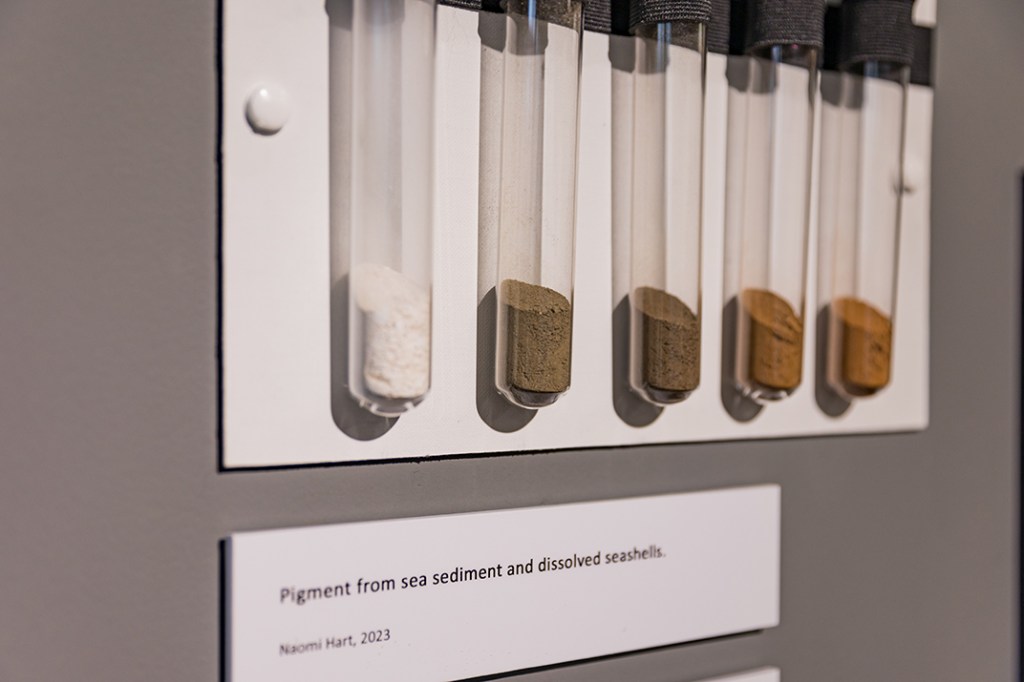
Header image shows Sea sediment pigments, created by Naomi Hart (more on this here)

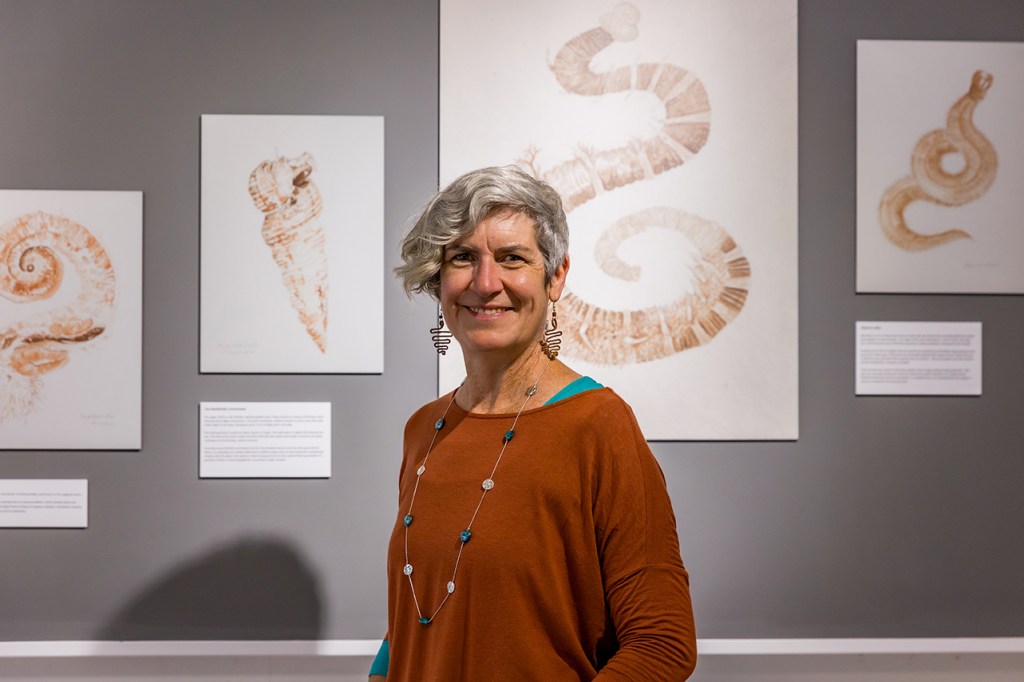
Naomi Hart – inspired by the convex seascape survey

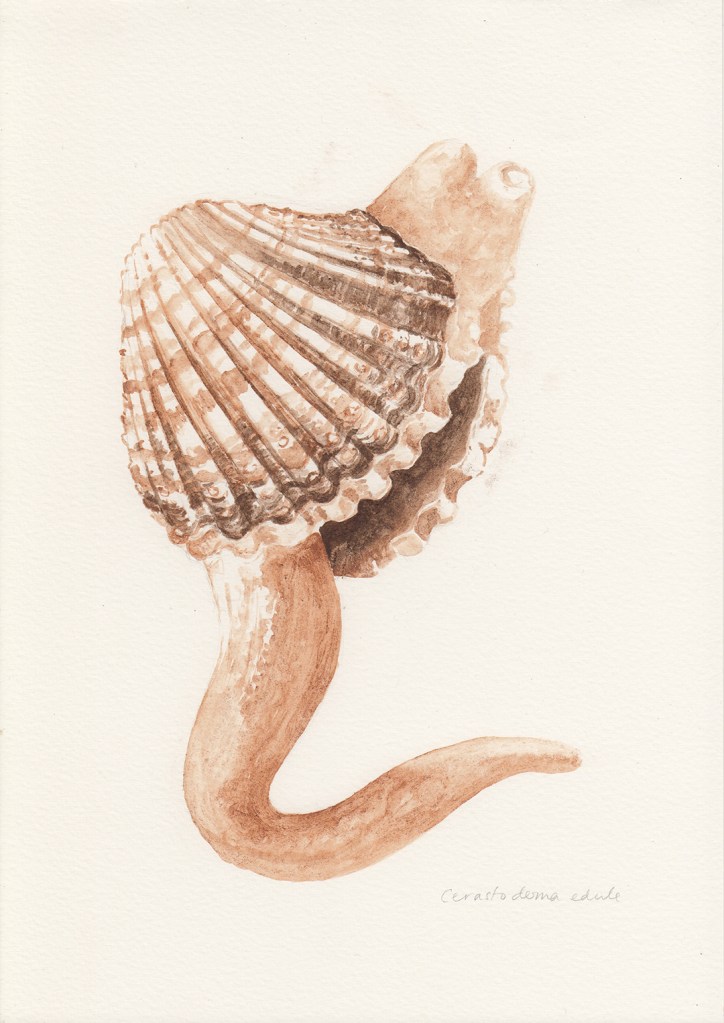
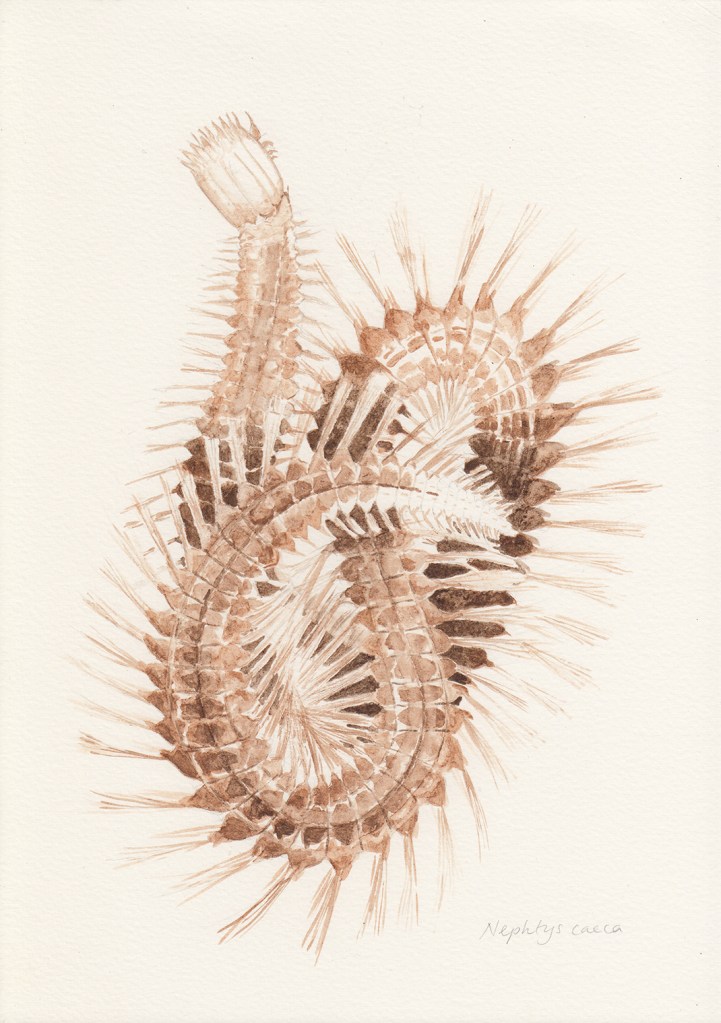
Naomi Hart is artist in residence with The Convex Seascape Survey, a pioneering collaboration of world-leading scientists working to quantify and understand blue carbon stored in the coastal ocean floor, the effects of marine life upon it, and how this might impact rates of climate change. Her paintings ‘Amphiura chiajei‘ (brittlestar), ‘Cerastoderma edule’ (common cockle), and ‘Nephtys caeca’ (catworm), will be on display at the SEE HERE NOW exhibition.

A team of researchers from the University of Exeter, alongside project collaborators at the University of Southampton, have been studying benthic invertebrates – worms, shellfish and similar creatures – that live in the mud beneath the sea. These invertebrates form a vital, but unseen ecosystem, which may be critically important in our fight against climate change. The tiny creatures create tunnels and burrows in seabed sediments, bioturbating (mixing) the mud, and moving nutrients and carbon within the mud to create a unique seabed habitat, the world’s largest carbon sink.

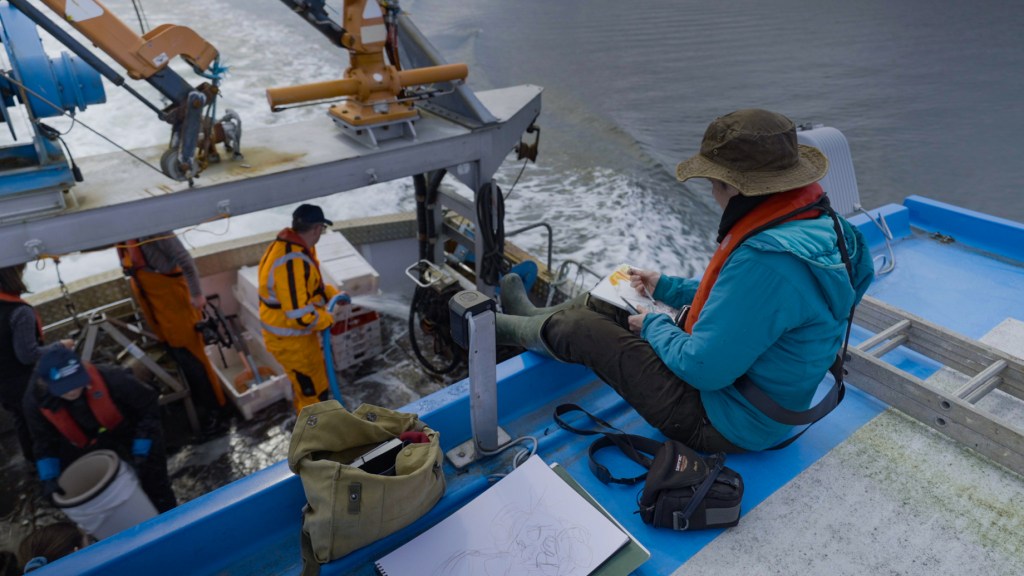
Naomi has been working alongside these researchers for two years, involved in and documenting all aspects of the research: hauling mud from the bottom of the sea, identifying sea creatures, and witnessing complex, delicate chemical measurements in the laboratory. She created action sketches of the researchers collecting samples of ocean bottom dwelling invertebrates while at sea.

Naomi studied the invertebrates under a microscope and then created pigment from the sea sediment, by heating it to different temperatures. This has led to a unique colour range completely specific to the waters around the Isle of Cumbrae, where the research took place, so with a nod to traditional earth colours like ‘Raw Umber’ and ‘Burnt Umber’, she has named the pigments ‘Raw Cumbrae’ and ‘Burnt Cumbrae’.

To extend the palette, she also experimented with white chalk made from dissolving sea-shells in acid/lemon juice – mimicking ocean acidification as the oceans warm – and has created highly detailed ‘portraits’ of the invertebrates out of the actual mud in which they live. Hugely magnified, these creatures may seem like aliens from another world, but they are found in our oceans, creating tunnels and burrows in the mud and drawing down nutrients and carbon in the world’s largest carbon sink. The colours themselves demonstrate the capacity of the sediment to hold nutrients and carbon: Raw Cumbrae is a mid-greybrown; as it is heated, the organic matter begins to burn and darken, and reveal the carbon stored within. Further heating burns off this carbon entirely to reveal the iron-rich red sandstone of the underlying geology.

Through these paintings, Naomi hopes to raise awareness of these incredible creatures and the vitally important habitat they create.

Naomi has also worked with The Convex Seascape Survey to run art workshops for adults and children, making muddy sea creatures in clay and with mud-paint, with researchers on hand to explain the science behind the project.

The work has been exhibited in Exeter, Penryn, Falmouth, Bristol and at the Royal Geographical Society in London. For more information about the invertebrates, you can read about them here.

The Convex Seascape Survey seeks to discover exactly how the ocean performs its vital role as the world’s largest carbon sink. Over five years, the project will not only scrutinise the carbon locked in the continental shelf seabeds but will assess the role of ocean life on carbon storage, as well as assessing human influences on seabed carbon. Funded by Convex Group Ltd., the project is facilitated by Blue Marine Foundation, with science led by the University of Exeter in collaboration with partners.

Find out more about Naomi Hart here: Naomi Hart.

An illustration of a group of people gathered on a flat, grassy landscape. There are clouds and sun rays in the sky. Some people have spades and forks. They all wear colourful outdoor gear, some have rucksacks, they are smiling and interacting with each other. The sky and landscape is black and white.

Ali foxon: RESONANCE ILLUSTRATIONS

Last autumn, geographer and green sketcher Ali Foxon joined Harriet and Rob Fraser at the LUNZ Hub event in Edinburgh. The ‘Land Use for Net Zero Nature and People’ Hub works at the interface between science, policy and practice, to support the UK in achieving Net Zero and other environmental and societal goals. This is a massive topic and a challenging task, involving many different stakeholders.

The PLACE Collective is involved as one of the LUNZ Hub consortium members (as we introduced in this blog here), working alongside other specialists within the Hub and stakeholders beyond the consortium. The Resonance project is one of the strands of work that has emerged from this – and in this blog, Ali reflects on her work within the Resonance team and shares some of the illustrations from the Big Dig Day.

Resonance and Illustrations – reflections from Ali Foxon

As an artist, geographer and founder of the green sketching movement, my practice is focused on observation and nature connection. I love opening people’s eyes to nature’s everyday beauty. That’s why I’m delighted to be participating in Resonance. The seven birch tree circles are going to become such beautiful living artworks as they establish and grow. At first glance, birch trees are quite unassuming. And yet, as you look more closely (with or without a pencil!), you soon see their striking bark, airy canopy, slender trunks, triangular leaves and spindly twigs; it’s hard to find a more elegant tree.

I believe real change depends on our hearts, not our heads.
When faced with so much fear, resistance and uncertainty, we must harness hope and possibility.
That’s why Resonance is so promising.

Five people are in conversation around a table. there are others behind them, sitting at tables in a village hall.

Ali in conversation in the village hall, at the Big Dig Day, November 2024

a boggy background

I’m participating in Resonance as an illustrator, albeit an illustrator with an unusually boggy background! As a young geographer, I studied peat bogs at Oxford and later I completed my PhD, funded by a consortium of UK conservation agencies, on the carbon consequences of habitat restoration and creation. I investigated the carbon impact of restoring afforested peatland among other things. LUNZ and Resonance have taken me full circle back to my boggy roots.

It’s been surreal and eye-opening tiptoeing back into an area of work I once knew so well. I’ve experienced so much deja-vu; so little seems to have changed. Obviously, we have made progress – not least the spectacular restoration of Bolton Fell Moss. Targets and ambitions have been refined. There’s much greater awareness about soil and forest carbon. And yet, we’re still bogged down in scientific uncertainty, regulatory frameworks, short-term projects, bureaucracy and lack of money; we’re still neglecting the importance of adaptation, wellbeing, social and behavioural change. This isn’t surprising. Land use change is such a hugely complex topic. But, at a time when we need rapid, urgent action, it’s hard not to conclude peat is accumulating faster than we’re making progress.

Hopefully, the LUNZ Hub’s work will speed up the process, bridging science and policy, generating the clarity and momentum necessary to accelerate change.

Yet, I believe real change depends on our hearts, not our heads. When faced with so much fear, resistance and uncertainty, we must harness hope and possibility.

That’s why Resonance is so promising. It’s already demonstrating the role nature connection and creativity can play in fostering the positive energy and conversations we need to collaborate and tackle the complex challenges of land use change together. I can’t wait to watch the magic and momentum of Resonance ripple across Cumbria and beyond in 2025. As for me, I’m looking forward to doodling more birch leaves, visioning beautiful futures and helping world-weary, nature leaders strengthen their creative resilience.

navigating challenges

For me, the beauty of Resonance, especially from a geographer’s perspective, is how the project’s heart and positivity extend through time and space, connecting so many different people and places. Resonance is drawing much-needed attention to peatland restoration, upland land use and the implications and challenges of meeting NetZero. But it’s also highlighting the immense value – intellectually and emotionally – of gathering outdoors, in-person, off our screens. As we navigate the challenging decisions that lie ahead, I hope the Resonance circles become treasured focal points for nature connection, symbols of care and gentle reminders that land use change can be positive, collaborative and beautiful.

Find out more about the LUNZ Hub here, and read about Ali’s practice here.


An illustration of a group of people gathered on a flat, grassy landscape. There are clouds and sun rays in the sky. Some people have spades and forks. They all wear colourful outdoor gear, some have rucksacks, they are smiling and interacting with each other. The sky and landscape is black and white.

An illustration of seven silver birch trees with golden leaves

Trees, Peat bogs, and seven circles of seven birches …

Since last November, the Resonance project has been moving on. It revolves around 49 silver birch trees, which have been collected from Bolton Fell Moss peat bog that’s in a process of restoration, and are being planted out in seven tight circles, each of seven trees, across the Lake District National Park.

This is part of the PLACE Collective’s work through the UK-wide Land Use for Net Zero, Nature and People Hub – or LUNZ HUb for short. Working within the LUNZ Hub team, we’re convening opportunities for people from across practice, research and policy to get together, share learning, and focus on actions; all part of a just transition in a time when changes in land management need to be big, and at scale, to mitigate impacts of climate change, nurture recovery of biodiversity and ecosystems, and embed resilience and natural regeneration in UK land use.

Head over to the project page for Resonance to find out more, and watch for updates – there are reflections on the Big Dig Day here, and a reflection on the key take outs from that event on the LUNZ Hub website.

LUNZ Hub Films: issues of Land Use

What might farmers and other land users and land managers do in the quest to reduce greenhouse gas emissions and increase their sequestration of carbon? This is a pressing question. It’s nested within many actions spanning policy, practice, supply chains and consumer choices that will be required for the UK’s land use sector – and there certainly isn’t a one-size-fits-all answer. One of the many groups that is looking at this challenge is the Land Use for Net Zero, Nature and People (LUNZ) Hub – and recent films have been created as part of the PLACE Collective’s involvement with the LUNZ Hub consortium.

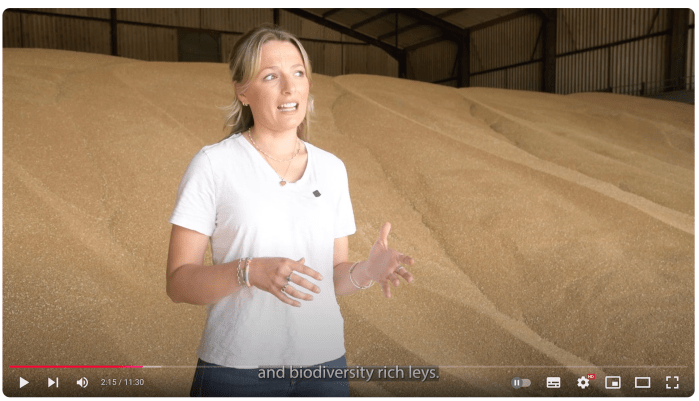
“There’s the stereotype that farmers are old boys with their trousers tied up with baler twine, but actually that’s not really the agricultural industry we’re seeing anymore. I think for young people it’s starting to look a really exciting place, and something that you want to get involved with.”
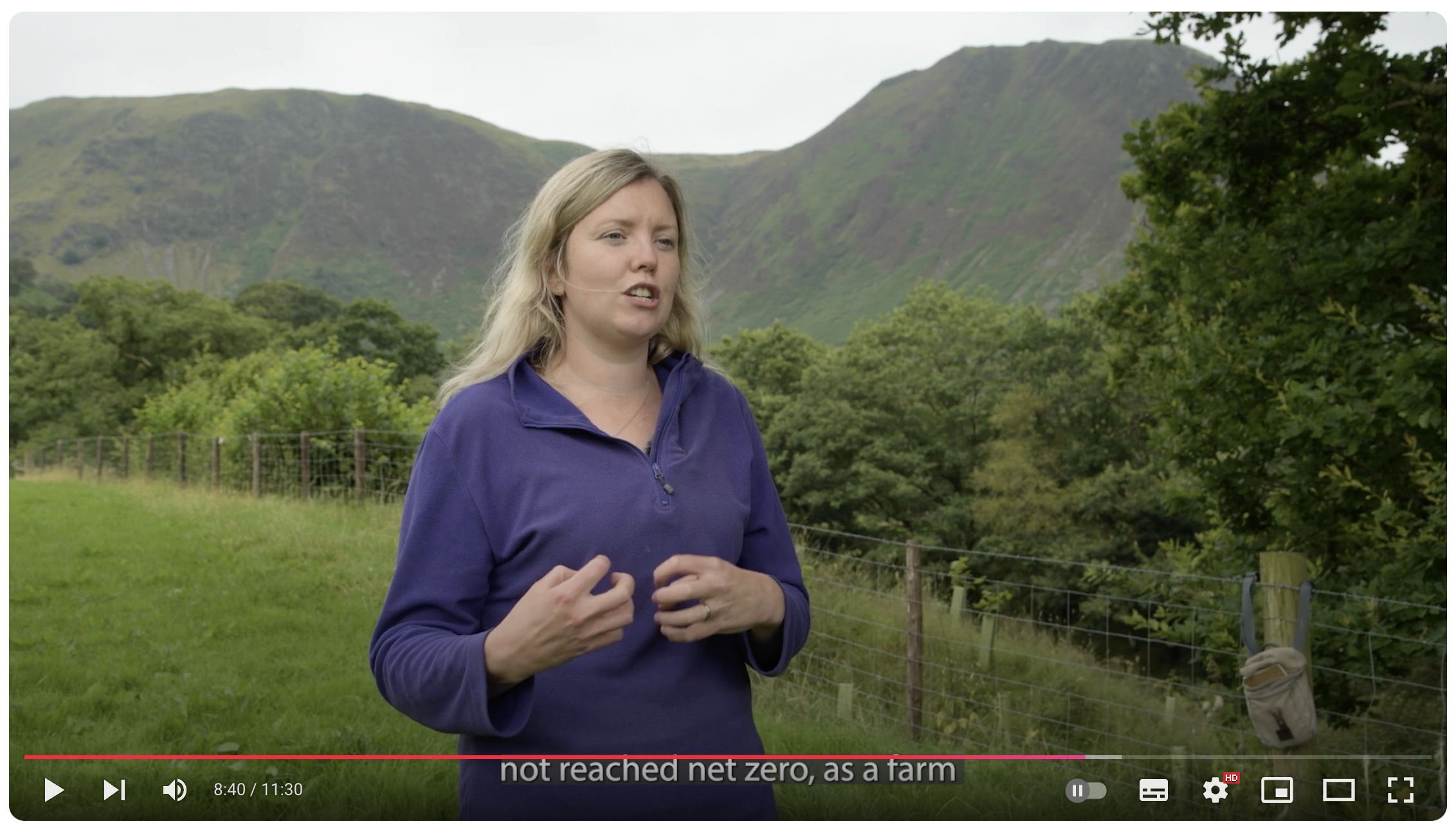
Martha Hayes, farmer, Lincolnshire

What land use change is needed … and how do we get there?

To kickstart discussions at the recent LUNZ Hub ‘Big Tent’ event in Edinburgh, where almost 100 people from practice, research and policy met to discuss challenges and opportunities around land use change, Rob Fraser created two short films. The films demonstrate a diversity of land use, land types, governance and policy in the four nations, and share some passionate calls to action from seven individuals.

The film-making journey took Rob around the UK, with Harriet Fraser (also from the PLACE Collective) conducting the interviews – asking each person the same set of questions.

The reason for optimism is that the changes that are necessary are actually positive: positive for the farming businesses and positive for the world in which we live.

Andrew Barbour, famer

The Frasers went to the flat lands of Lincolnshire, where they met arable and beef farmer Martha Hayes; and to windswept peatlands and intimate valleys of Wales, to meet hill farmer Lisa Roberts. They spent time among rolling fields of Northern Ireland, where they met dairy farmer Hugh Harbison; and visited the small mixed farm of Flavian Obiero in southern England. In Scotland, the Frasers visited Andrew Barbour on his organic hill farm, which embraces woodlands, moorland and mixed-use land; they wandered through old and new woodlands with Balbeg Estate owner Andrew Sinclair; and chatted among cucumbers and tomatoes on an Edinburgh city farm with Land Workers Alliance Scotland Policy and Campaigns Coordinator Tara Wight.

“This is maybe not what you want to hear, but it’s not really financially worthwhile for us to go down the road of trying to get to net zero…. nobody’s going to pay us to be net zero. People pay us to produce really good quality milk.”

Hugh Harbison, Aghadowey, Northern Ireland

A man and woman talk while a camera is filming. There are cows in the image, in a grassy field.

Hugh Harbison

Common Threads

The films reveal different views about change, opportunities and challenges: and many commonalities too, including experiences of unpredictable, volatile weather and uncertainty around policies and markets.  They share calls for more joined-up thinking among decision-makers, greater recognition of effective low-tech solutions, reform in land ownership, more trust in farmers, food sovereignty, and greater clarity about ‘net zero’ as well as carbon auditing and soil testing – among other things.

The interviewees discuss experiences of positive measures, including using Lidar scanning and soil testing to better understand a farm’s ability to store carbon, planting hedges and trees, changing grazing patterns and supporting resilient communities – and an enthusiasm for increasing understanding, skills and community efforts that can help in the move towards net zero.

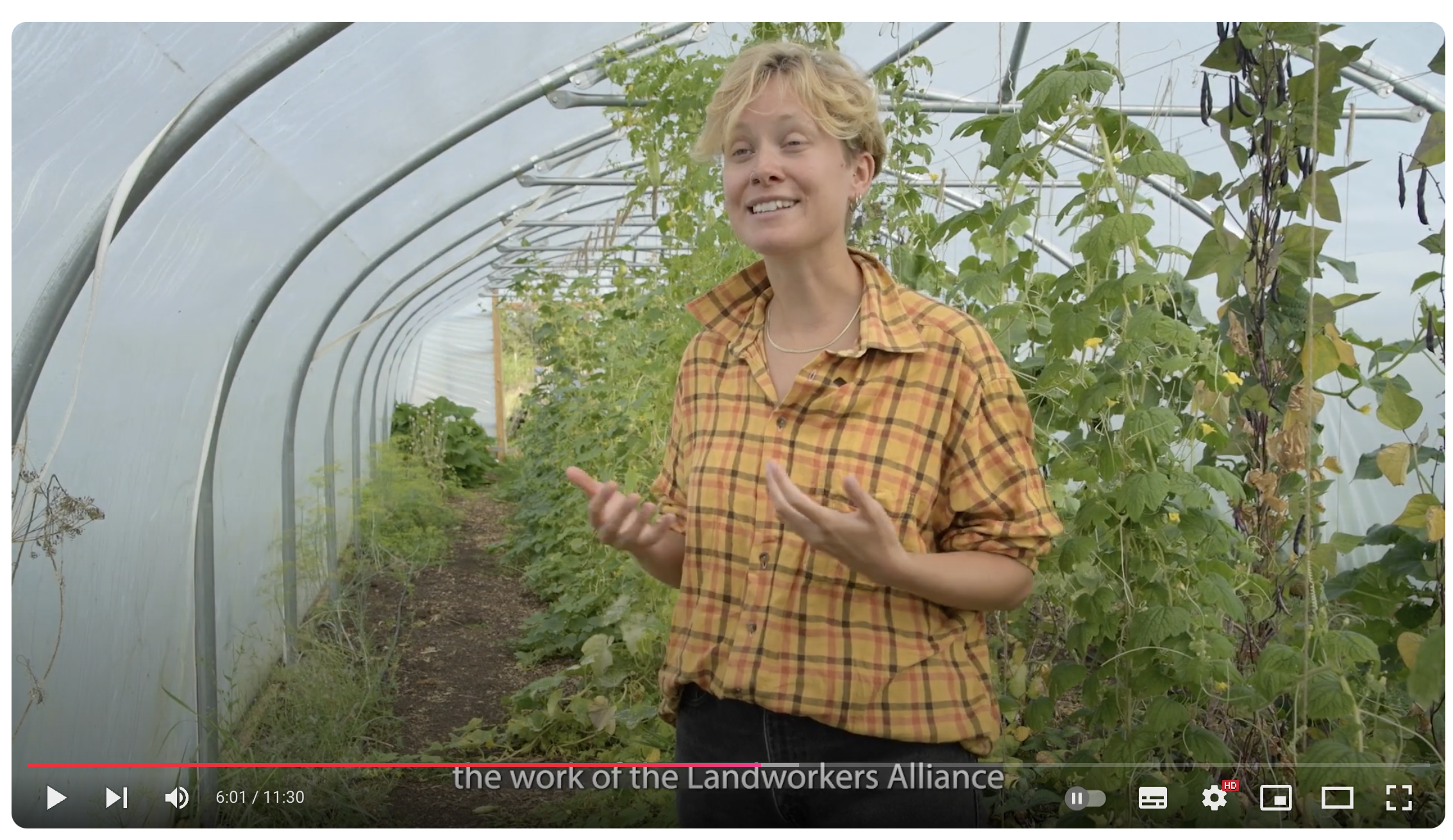
“One of the things that brings me joy through working with the Landworkers Alliance is getting to see the work that our members are doing. They are literally growing beautiful things, producing delicious food, creating amazing habitats.”

Tara Wight, Scotland Policy and Campaigns Coordinator and Research Coordinator, Landworkers Alliance

a Woman in a yellow shirt stands in a polytunnel; the image is a still from a film

Tara Wight

“It’s a challenge to select short excerpts from seven incredibly rich conversations,” says Rob. “And of course the conversations during each visit extended beyond the formal interview. I’ve tried to include the wider context by sharing footage from each person’s location. Everyone has been extremely generous with their time – there’s no better way to learn about a patch of land than to walk it with someone who knows it well, cares for it, and has a vision for its future.”

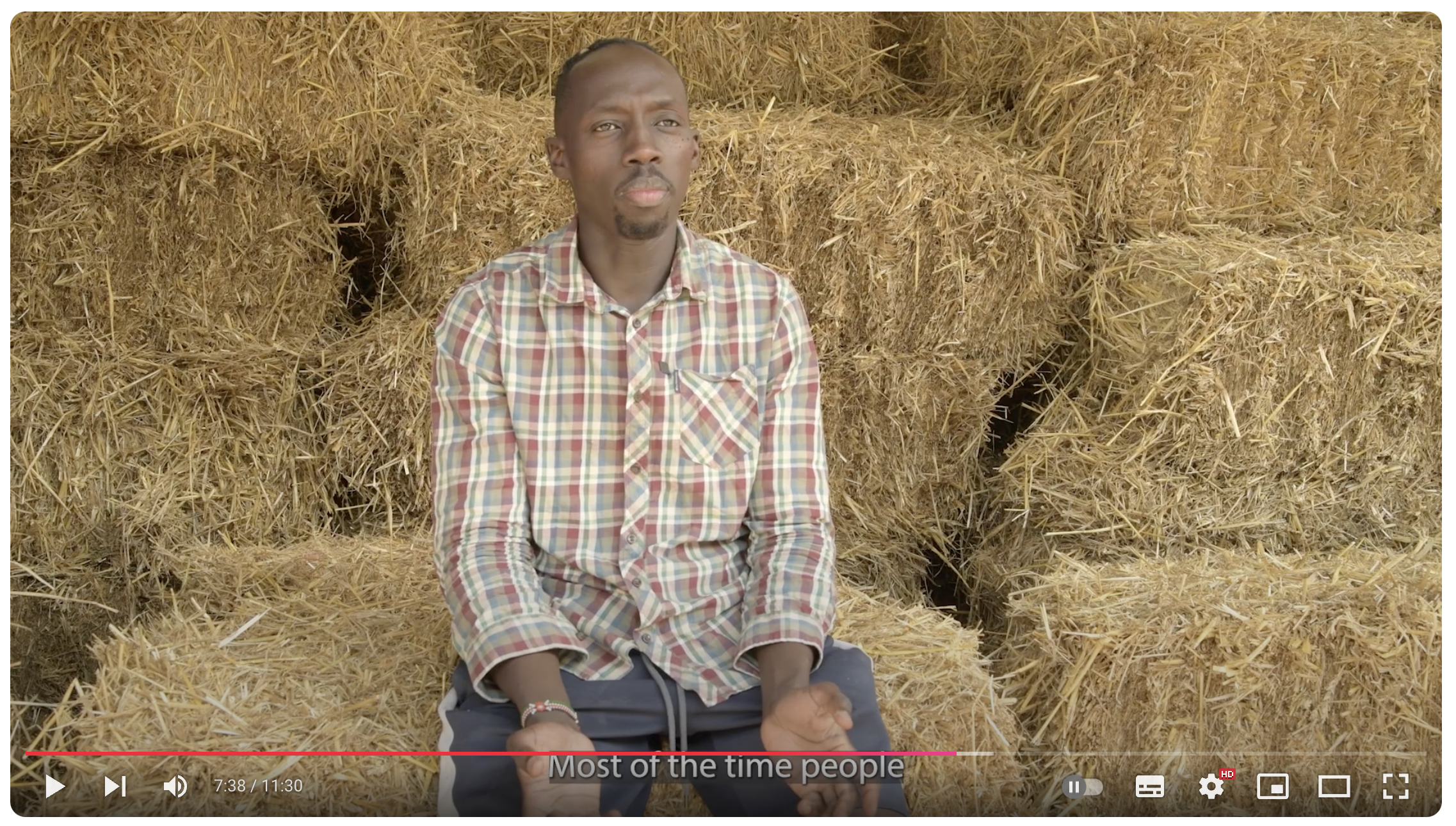
A man sits on a hay stack

Favian Obiero

The pressure is on for the Land Use sector to build on existing good practice and scale up transformative changes to contribute to the UK’s target of reaching net zero by 2050. But the focus is not exclusively on carbon or net zero. The voices in the films show that carbon sequestration is in an inseparable relationship with nature and people: and there’s emphasis that actions to reduce greenhouse gas emissions and increase sequestration need to be integrated with actions that improve habitats and connectivity in the landscape for wildlife to thrive, and will also support land use businesses, not just for the provision of food but also as foundations for rural communities.

“When you’re trying to get to net zero, you can’t do it in little silos. You can’t just look at farming, you’ve got to look at the whole food system. You’ve got to look at what the land can produce and therefore what should be supported in a sustainable fashion … You should stop trying to produce foods that are damaging to the world that we live in – simple as that. And just because it can be done, doesn’t mean that it should be done.”

Andrew Barbour, Fincastle, Scotland

Two people stand beside some trees, with a stand of trees behind them

Andrew Sinclair

The two films aim to highlight experiences of change among land users and provoke further discussions about finding ways forwards that are positive for nature, people, and the target of net zero. Their first showing at the Edinburgh event did just this; following on from a speech by Professor Mathew Williams, Chief Scientific Adviser (CSA) Environment, Natural Resources and Agriculture for Scottish Government outlining the link between science and policy, the views shared in these films spurred on some lively conversations in breakout sessions.

There’s an ambition to create more films to bring in a wider range perspectives, to feature other land managers, specialists in conservation and forestry, scientists, community movers and shakers, and those involved in shaping governance and policy. Watch this space!

A man is facing forwards, speaking to camera: the camera in the foreground, and the interviewer with a blue hat

Andrew Barbour

The PLACE Collective and the LUNZ Hub

The PLACE Collective is one of the consortium members of the UK-wide Land Use for Net Zero, Nature and People Hub (or LUNZ Hub for short) – an innovative research initiative whose focus is to bring people together and help drive the transformation of UK land use needed to achieve net zero by 2050. It aims to equip UK policy-makers, industry, civil society and communities with the evidence they need to drive transformational change in land use – and understand and present pathways of change, so that it’s not just about theory, but about practice.

Over the next few years, in collaboration with other members of the hub, PLACE Collective artists will be devising and delivering a suite of creative practices, interventions and presentations, to suit specific purposes, and, importantly, to open up questions and challenge preconceptions.

A fuller version of this article was first published on the LUNZ Hub website here.

For more films related to the LUNZ Hub, check out their YouTube page here: https://www.youtube.com/@LUNZHub

Martha Hayes

Featured on the films, in running order:

Huge thanks to the seven people who generously shared time with us and showed us around their places; and to the team in Wales who helped with accurate translations.

Andrew Sinclair, owner, Belbeg Estate, Ayrshire, Scotland

Martha Hayes, arable farmer, Lincolnshire, England

Hugh Harbison, dairy farmer, Aghadowey, Northern Ireland

Tara Wright, Scotland Policy and Campaigns Coordinator and Research Coordinator, Landworkers Alliance

Flavian Obiero, farmer, Hampshire, England

Lisa Roberts, farmer, Dovey Valley, Wales

Andrew Barbour, farmer, Fincastle, Pitlochry, Scotland

A woman speaks while standing in a field, with trees and a hill behind her

Lisa Roberts


A woman leans towards trees. She is wearing a device on her arm that enables the translation of photosynthesis to sound.

Hakoto : Reiko Goto Collins at Glasgow international Festival of contemporary art

How might we hear leaves speaking? What does it mean to share soil, water and air with trees and other living things? Can sound and technology open up new empathic relationships? Reiko Goto Collins (Collins + Goto Studio) will be sharing Hakoto performances, followed by a discussion, this June at Glasgow International Festival of Contemporary Art. She’ll be coming to Glasgow after performing in Vienna and Cologne.

A woman wearing a hat with a net over her face holds a listening device up to the leaves of a hawthorn tree.

Reiko’s work also features in the Peace Arbour: her creation of a fruit tree nursery alongside Yoko Ono’s Wish Tree and Zana Araki’s Diverse Beings – Feel My Frequency – Lines of Connection. The trio’s work responds to the themes of trees, hope and healing; it offers a space for discussions and the expression of wishes, needs and aspirations for peaceful futures.

HAKOTO: Reiko Goto Collins, Performances at Glasgow Womens Library*
Friday 7th June: 7am
Saturday 8th June: 1pm, 3pm
Saturday 22nd June: 1pm, 3pm, 8.30pm

PEACE ARBOUR
Sat 1 June – Sat 31 August
Tue, Wed & Fri, 10am – 4.30pm 
Thu, 10am – 7pm; Sat, 12pm – 4pm

*23 Landressy Street, G40 1 BP

More information on Reiko’s performances here

A woman leans towards trees. She is wearing a device on her arm that enables the translation of photosynthesis to sound.
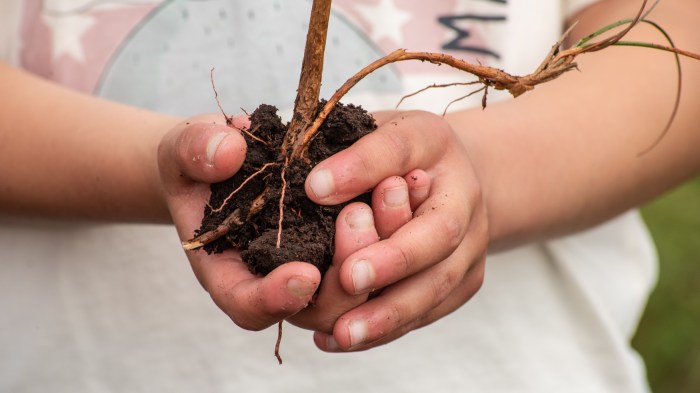
a child's hands holding the root ball of a plant

Land Use for net zero, nature and people: lunzhub and finding ways forward

What’s under our feet …

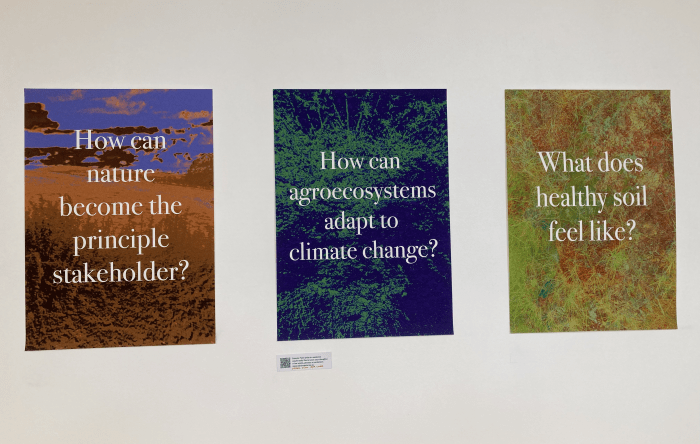
Soils contain more carbon than in the atmosphere and all vegetation on the planet combined. In the UK, soils store over 10 billion tonnes of carbon in the form of organic matter; this is roughly equal to 80 years of annual UK greenhouse gas emissions. The health of soil is impacted by how land is used and managed – but when it comes to improving soil health, action and inaction are influenced by a range of economic, social and environmental factors …

finding ways forward, together

Making changes in land use that will help the UK reach its Net Zero targets, while boosting diversity and abundance in vegetations and wildlife species, and supporting thriving human communities is a huge challenge. There are many teams initiatives across the UK focussed on finding ways forward. And we’re delighted to be joining one of these: the LUNZHub – Land Use for Net Zero, Nature and People.

The PLACE Collective has joined the LUNZHub consortium with more than 30 organisations, and a wider network of 60+ partners. Artists with a diverse range of specialist interests, different media, and in different locations, will be joining people from across UK policy, academic, farming, forestry, food and community sectors.

  • The consortium includes a variety of stakeholders, ranging from those at the cutting edge of climate change modelling to farmers groups, advisory organisations, NGOs, social sciences and creative practice.
  • The Hub will address questions of land use, from renewable energy to green finance, and will help to inform policymakers what is needed to achieve net zero, for nature and people. It will play a role in communicating the critical importance of land and how it’s used as a major carbon sink or source.

Collaboration

We’re looking forward to being part of this novel approach to collaboration. It’s a huge opportunity to bring art and artists into conversations and the development of pathways, policy and actions that may have meaningful impact and legacy.

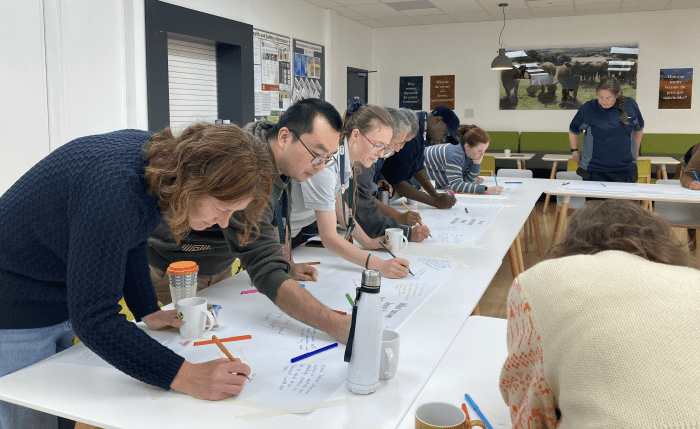
We’re at the start, and Harriet and Rob Fraser are joining meetings around the UK to learn from the wider team and get a feel for where and how art and artists will be effective. Artists from the PLACE Collective will be working within the LUNZHub team to encourage critical reflection and discussions that cross and connect different areas of knowledge, and we will be meeting and working with individuals and communities beyond the team who face the real-life impact of change and have valuable experience and ideas to share.

We’ll be imagining and creating spaces and opportunities for people to come together, and working with others to assist knowledge exchange, and to bridge the gaps between policy makers, science, and people ‘on the ground’, across all four nations. Not a small ambition … and it may not be smooth, but the Hub has many brilliant people in it and we’re all optimistic.

Leaders and funders

The LUNZHub – Land Use for Net Zero, Nature and People – is being co-led by the James Hutton Institute and the University of Leicester, with funding from UK Research and Innovation (UKRI), the Department for the Environment, Food and Rural Affairs (Defra, on behalf of England and Wales), the Department for Energy Security and Net Zero, the Department for Science, Innovation and Technology, and the Scottish Government. It has been co-designed with Defra and the Welsh and Scottish governments. (Website soon to be launched … and we’ll insert a link here when it’s live.)

Sunlight streaming through the trees at Lady Wood, just off the edge of the River Wye north of Monmouth.