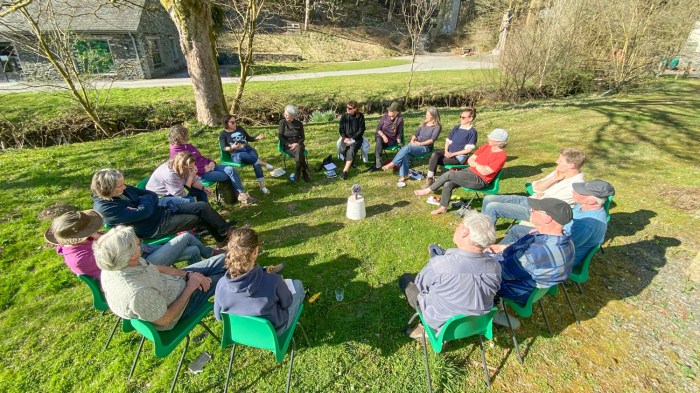
People sit in a circle having a discussion outdoors on green chairs, they are on grass and there is a stream and trees behind them. There is a slate building and small road in the background.

REFLECTIONS ON THE PLACE COLLECTIVE MEMBERS GATHERING – Kate Gilman Brundrett

One thing rings true, repeatedly. We need to connect again, not with the internet but with ourselves, our families, our earth. Perhaps this gathering of people and art practices is just the antidote we need.

It is amazing to be part of the PLACE Collective, and to be one of the exhibiting artists contributing to ‘See Here Now‘. The exhibition brings together work from artists exploring our connection with the planet, the earth, the land. It’s not a ‘pretty’ exhibition – it’s an exhibition asking, investigating, celebrating, hurting – responding to our relationship with our home, and who we are within it.

The exhibition launch coincided with a gathering of PLACE Collective members, with networking, talks and workshops, at Grizedale, and of course, I went along. The day was curated by a PLACE Collective panel – curated beautifully with creative, insightful and embodied interventions to explore and stretch our thinking and our ways of being.

Having attended a previous PLACE Collective gathering in 2022 I really enjoyed reconnecting with some familiar people – we’d already sparked conversation (and creative friction) in that residency and the ground was prepped for new ideas to emerge. It was also brilliant to meet new members, adding to the tapestry of creative insight and igniting new thinking and new energies.

We connected in different ways throughout two days, beginning with a thinking framework that was beautifully proposed, and gave space for input and replenishment, with thanks to Wallace Heim.

Five pieces of paper attached to a wall, reading Urgency, Touch, Friction, Beauty and Vital Matters. The smaller writing under each title is not legible.

We broke into small groups for some critical thinking inspired by the suggestion of the five themes, and then came back together to discuss the main insights. It was intense! Our brains needed recuperating after that, and a somatic movement session with Jools Gilson was such a wonderful, reconnecting treat. We explored our own sense of space, body and movement, working in pairs and then in sets of four to create an immersive ‘performance’.

The results surprised us all – and led to a lot of smiling and laughter. The elements came together in such an exciting way, one exercise building on the last in gentle momentum until the final delight of sharing and bearing witness to each other’s. Reconnecting with self in this way is a strong reminder to ground ourselves and strengthen our sense of who we are in connection with an other … I’ve since repeated elements of this practice you’ll be pleased to hear Jools!

Our conversations over coffees and lunch were expansive, deep and uplifting – bringing together an eclectic mesh of minds, and refuelling us in a space full of warmth and generosity of ideas.

One thing that brings the group together is the research element of practice. The questions posed by Wallace provided deep reflection and I’ll use those in my own research and explorations.

sowing seeds and energy

The PLACE Collective continues to become a rich field by which seeds can emerge and flourish … a network of nodes bringing many elements to view, and a platform by which to ask, enquire, analyse, propose.

Needless to say, I came away filled up – new lines of thought, connections and my own ‘nodes’ coming together, a reflection on my own practice and a community of inspired and rich minds who generously contributed to the space that is the PLACE Collective.

There are so many other networks and industries that can tap into this energy, this beautiful collective. Here, it feels the soil is being well prepared and becoming fertile for ideas and connectedness in a way that will sustain and be resilient to the world’s collective anxiety, that so many people are feeling just now. And the atmosphere feels open and embracing – not at all exclusive.

It feels the soil is being well prepared and becoming fertile for ideas and connectedness in a way that will sustain and be resilient …

As well as practising as an artists, I’m a leadership coach. I see on a daily basis the struggles that people face, linked with issues such as climate and political threats to humanity, as well as the consequences of sustained desire for commercial, capital, profit and ‘more, more, more’. These manifest in our lives and in our work places, and in our families, as burnout, overwhelm, procrastination, numbness, addiction, mental health epidemics and dis-connection. I often coach as much on ‘how to deal with things’ as on how to make the kind of impact we want to see in the world.

One thing rings true, repeatedly. We need to connect, again, not with the internet but with ourselves, our families, our earth.

Perhaps this gathering of people and art practices is just the antidote we need.
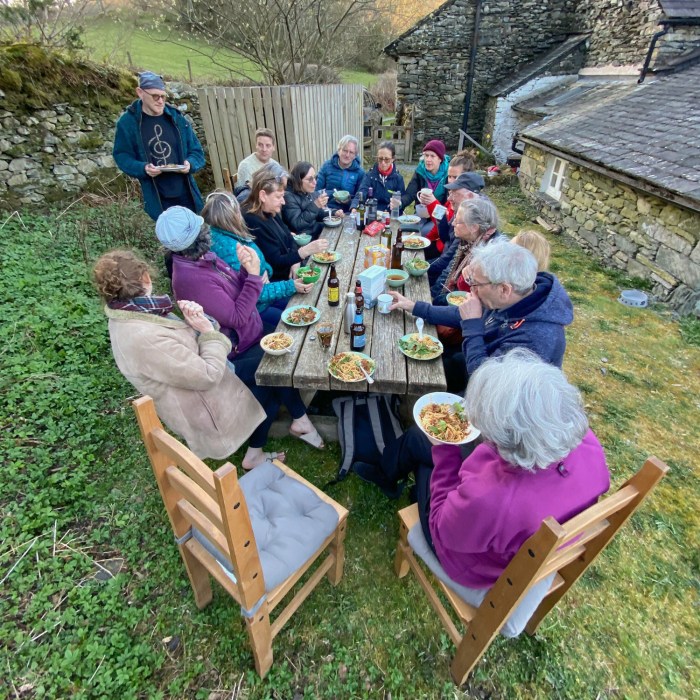

Thanks to Kate Gilman Brundrett for sharing her reflections after the members gathering in April 2025. You can find out more about Kate’s practice here.

A brown circular image of circles where dye takes on different shades of brown; made using soil in a process known as chromatography

Becky Nunes in See Here Now

Becky’s contribution to the See Here Now exhibition emerged from her visits to Grizedale Forest, research into historical records of the forest and planting regimes, the collection of soil samples, production of chromatographs, and challenges to AI. Read on to find out from Becky about the process and the work currently on show.

Continue reading “Becky Nunes in See Here Now”
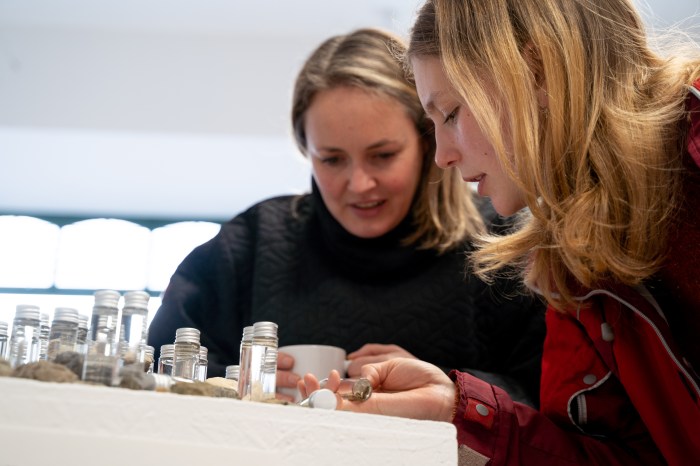
Two women lean over bottles and stones placed on a table

Small Water – Anne Waggot Knott

When Anne Waggot Knott discovered that many of Manchester’s residents don’t know where their drinking water comes from, she set about making work that laid bare the origins of the water that nourishes the city. In this blog, Anne shares the background to the creation of her artwork ‘Small Water’, which features in the See Here Now exhibition.

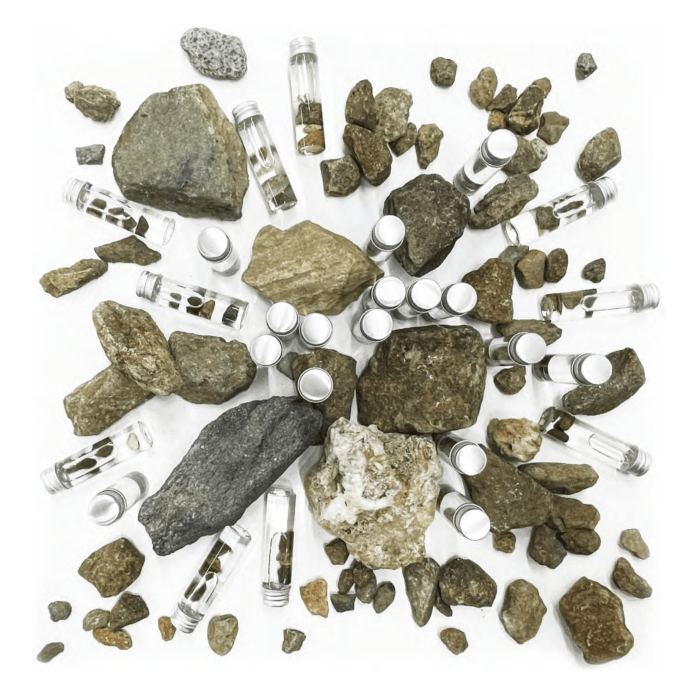
Cumbria’s water supply feeds and nourishes not only the immediate fells and surrounding region but great swathes of urban north west England. This may seem like a simple statement, but many people do not know about the origins of their drinking water, or what the journey entails.

The commoditisation of our water and its transport out of Cumbria to slake the thirst of the city starts to represent a very real threat to the human and the more-than-human.

Continue reading “Small Water – Anne Waggot Knott”
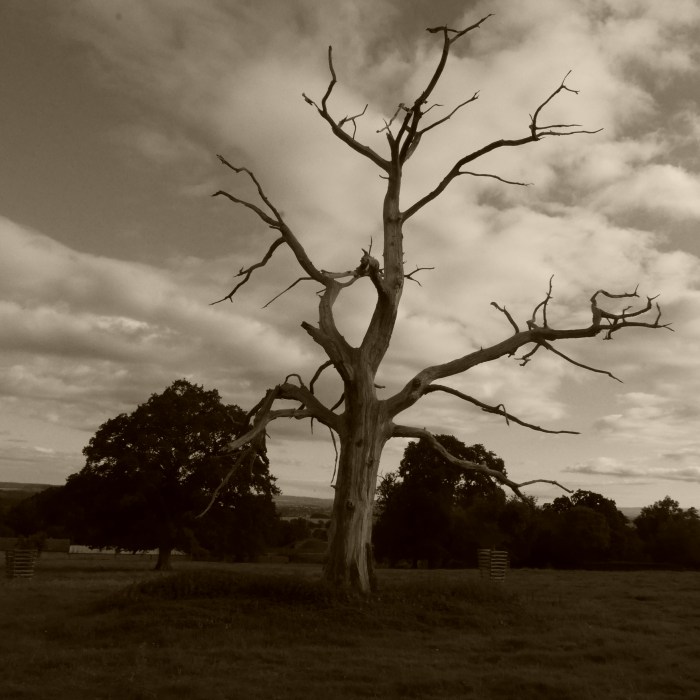
Black and white photograph of a dead oak tree standing in a field, live trees are visible behind it and the sky is moody with rolling clouds.

Ghost Trees – Richard Gilbert

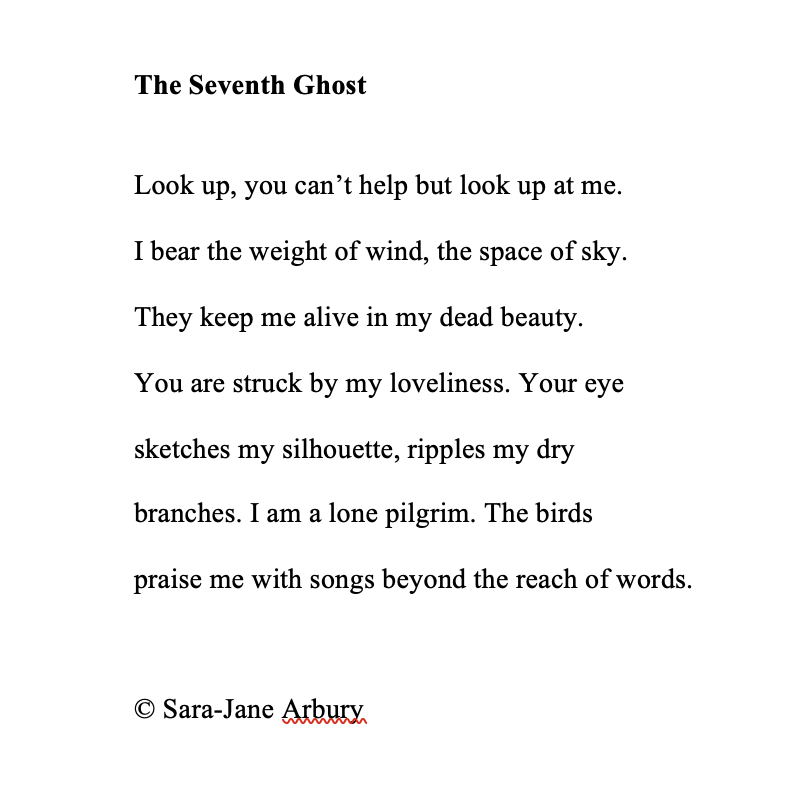
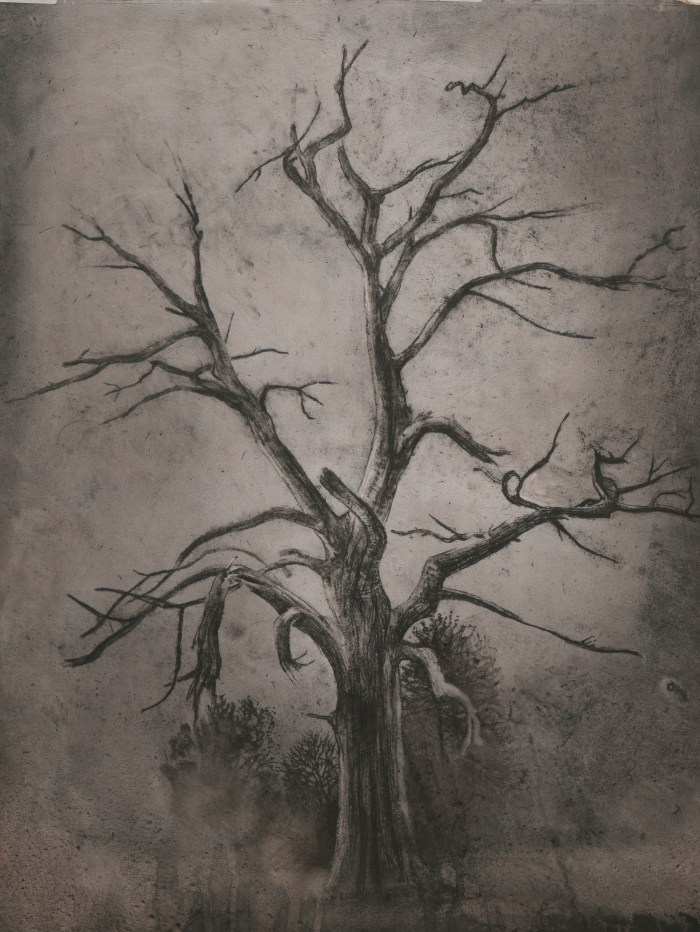
This blog explores ‘Ghost Trees’, a project led by Richard Gilbert including work by poet Sara-Jane Arbury and photographer Paul Ligas. Here, Richard delves into the ongoing project, process, and the threat that trees face as a result of human activity, and the image of the ‘seventh’ ghost, the charcoal drawing that is showing as part of the See Here Now exhibition at Grizedale Forest.

I hope this project will encourage more attention on and greater appreciation for these noble sentinels in our landscape. Even when dead, or ghosts of their former selves, they convey majesty, maybe menace, or simply mystery.

Ghost Trees is an ongoing project led by Richard Gilbert, with poet Sara-Jane Arbury and photographer Paul Ligas, commissioned by The National Trust in England that has taken a year to come to fruition.  Ghost Trees is a combination of a contemporary art walk with banners installed at seven sites depicting the ghost of a tree through which you can view, as a ghost, the actual tree. Additionally, there is an exhibition of the original drawings, photographs and poetry in Croft Castle, community and individual workshops, and a theatre performance at the Market Theatre Ledbury at Halloween 2024 presenting a virtual tour of the walk with music, word and image.

The purpose was to invite the viewer to bear witness to seven of the magnificent, ancient, dead or dying trees in the landscape of Croft. The walk unites in a timeline a chronology from prehistory to the 21st century that explores the history of Croft. The aim was to celebrate the past whilst reflecting how trees die before their time through human agency such as climate change or disease. This is hoped to be a reminder of the ever-deepening crisis that faces the human and the natural world.

Depicting Trees

Having drawn and painted the trees at Croft over the years, this project focusing on the ghost trees has been a catalyst to a new understanding. To my mind, each of these particular trees has an individual character that I set out to portray and animate through drawing. Making drawings intended as a banner embedded with text and photography presented its own challenges and prompted a kind of response that developed through the course of the project, shifting mediums from pencil through ink to charcoal.

Perhaps the act of looking closely at and representing the distinctiveness of each tree inevitably lures one into the collective cultural memory bank.  Three hundred years of depictions of trees in British art provides the ideal nursery to foster a creative response. Trees are fit subjects in themselves not just as compositional furniture in works of art but standalone subject matter that can invoke narratives about nationhood, politics, family, literature, and much more. This is in addition to the sheer pleasure of admiring the singular majesty of a tree. Climate change, disease and old age have undone so many at Croft but each tree has a story fit to tell about how Croft has endured, each has been a silent witness and perhaps a kind of transfiguration in the minds of many through the ages.

Heritage and loss

As one of the least wooded countries in Europe, 13% of our land area is wooded compared to 35% in Germany. The British cultural relationship to trees is, in part, informed by the loss of wooded habitats, field, and hedgerow trees to agriculture and infrastructure projects. The vulnerability of these individual trees, especially ancient trees, makes them icons of our heritage. Ancient trees are now largely confined to places like National Trust parks.

The IUCN (International Union for Conservation of Nature) is a membership Union of government and civil society organisations that work to advance sustainable development in a way that values and conserves nature. At the October 2024 ICUN conference in Cali, Columbia it was announced that of the 57,000 species of trees in the world, more than one in three tree species worldwide faces extinction. Thirty-eight per cent of the world’s trees are at risk of extinction according to the first Global Tree Assessment, lost to logging, agriculture, and infrastructure. To put that into the context of the UK, we have 86 species of trees and 35 are on the threatened list including rowan, whitebeam, pines, birches, junipers and more.

We are living in a time of crisis where the volatility of the climate threatens on many fronts. Tree diseases, pests and pathogens, pesticides, invasive species, changes in the growing season and increased rainfall are all potential hazards for woodland. Here we have evident examples, Camelthorn trees in the Kalahari that cannot grow in the arid baked clay; 42 million acres of Whitebark Pine lost in 10 states across the Rockies decimated by the mountain pine beetle that now advance to higher altitudes or drowned forests on the eastern seaboard of the United States.

Ghost Trees was launched at Croft Castle on Friday 21 June 2024. The exhibition at the Castle Stables is open until 31 October 2025, and the Ghost Trees art walk in the Croft parkland will be in place until early 2026.

Find out more about Richard Gilbert’s practice here.
An art exhibition showing a wooden piece and images behind

Review of ‘See Here Now’, in Ecoartscotland

When environmental change is happening at planet-wide scale, and in cumulative increments of time, we can be psychologically and culturally distanced from perceiving it ‘here’ and ‘now’. The exhibition … is a compelling effort to bring the meanings closer.

So begins the review of the See Here Now exhibition currently showing in the gallery at Grizedale Forest, written for ecoartscotland by Dave Pritchard, an independent consultant in environment, culture, heritage and the arts.

In this review, Dave highlights some of the work that particularly struck him when he visited. He also asks about what art and artists can or might ‘do’, and shares some questions that arise from this exhibition: If things feel urgent, does the art also need to be urgent, or might it paradoxically be slow? and: What might an exhibition, or individual artworks, urge others to do?

To read the full review, visit ecoartscotland.net here.

We recommend making a brew before you do – while you’re on that site you’ll almost inevitably want to delve deeper. Ecoartscotland is a rich resource, focused on art and ecology for artists, curators, critics and commissioners as well as scientists and policy makers. It has been established by Chris Fremantle, producer, and research associate at Gray’s School of Art.

Huge thanks to Dave for the review.

A woman stands among grass and heather in a flat landscape, holding an object covered in white fur

This image from ‘Hakoto’ by Collins + Goto Studio is one of the pieces featured in Dave Pritchard’s review.

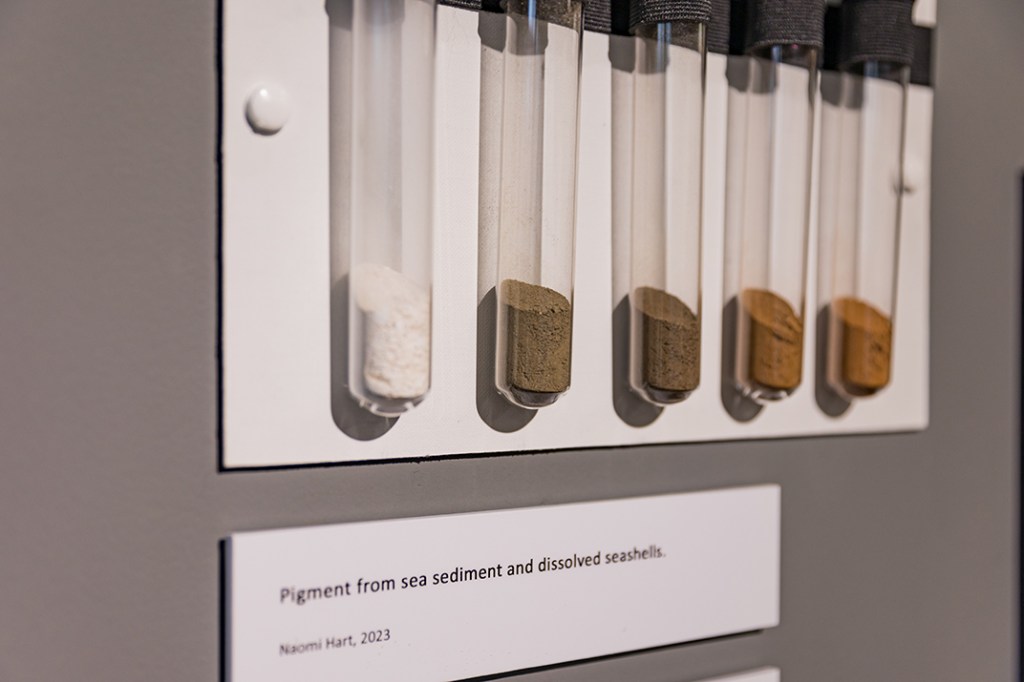
Header image shows Sea sediment pigments, created by Naomi Hart (more on this here)

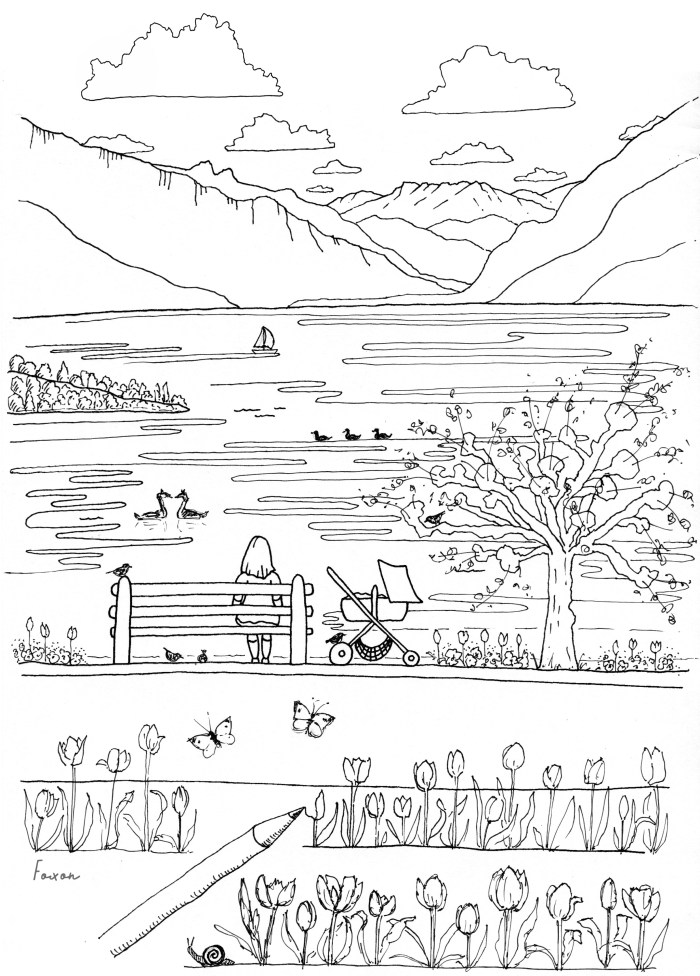
A black line drawing of many types of plant layered over one another, with flowers, ferns, leaves, berries, vines, and brambles. Behind the plants in faint grey lines there is a coastal scene and clouds.

Ali Foxon – Put Down Your Phone / Pick Up a Pencil

As an artist, my practice is centred around observation, nature connection and wellbeing. I used to work as a climate change advisor but, over time, realised I could have greater impact as an artist, helping people see and engage with nature’s beauty. After all, we care about nature with our hearts, not our heads.

The minute you sketch something, no matter how wobbly your lines, you see it with fresh eyes. You form a little connection with it. You start to care.

The See Here Now exhibition is a wonderful and timely opportunity to share some of my narrative illustrations from my beginner’s guide, The Green Sketching Handbook: Relax, Unwind and Reconnect with Nature. For the show, I chose two pieces that are ‘before and after’ pairs : what you might see at first glance, without looking closely; and what you might notice when you look more closely (and put down your phone!).

I believe that there’s an urgent need to find affordable and accessible ways to reconnect with nature. Thankfully, repairing a personal relationship with the natural world needn’t be difficult. As soon as we start to notice and engage with the nature in our lives, we tend to adopt more pro-environmental behaviours.

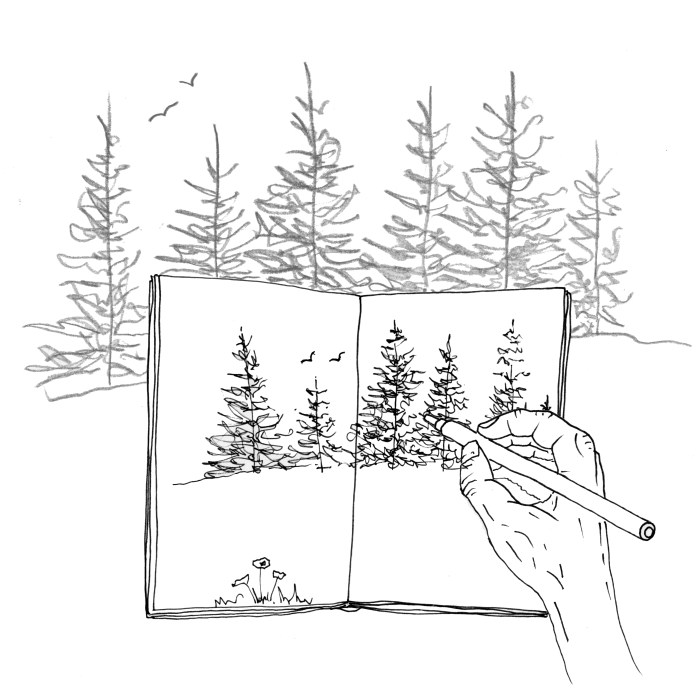
But how can we notice nature if we’re glued to our screens? It’s a well-kept secret that one of the best ways to see something – really see it – is to try and sketch it. The minute you sketch something, no matter how wobbly your lines, you see it with fresh eyes. You form a little connection with it. You start to care.

The challenge is that most of us are convinced we can’t draw and haven’t time to learn. That’s why I decided to develop an accessible approach to nature sketching, which I’ve called green sketching.  The aim of green sketching isn’t to create more artists, but happier, resilient nature lovers.  The quality of your sketch is irrelevant – it’s the looking that matters and changes how you feel.

Green sketching is now a quiet art movement spreading around the world. I’m on a mission to save the world, one doodler at a time! Why not have a go? All you need to do is put down your phone, pick up a pencil and step outside. It’s a beautiful world out there. Go see for yourself!

Read more about Ali Foxon here.

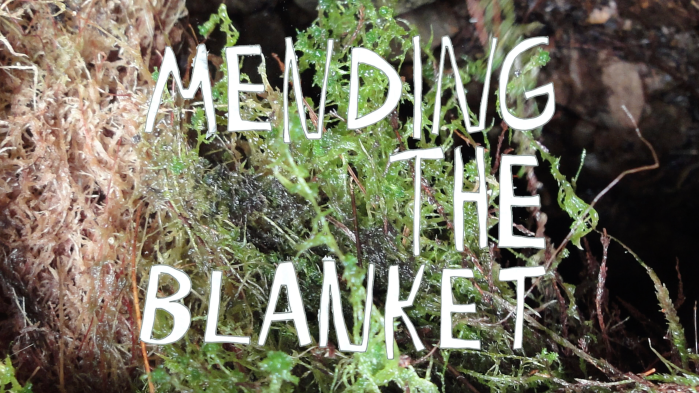
A close up of wet moss, white and green, with a darker background, and the words 'Mending the Blanket' digitally imposed over the top.

Kate Foster – INSPIRED BY PEAT

For the See Here Now exhibition in Grizedale Forest, Kate Foster shares two Peatland Figures; and has also contributed a film made in collaboration with multidisciplinary artist, pantea.

MENDING THE BLANKET: FILM

Peat is a precious wetland soil that creates a blanket over moors and uplands.  Too often this ‘blanket’ is worn and degraded by different land uses, meaning habitat is lost, less water is absorbed in the uplands, and carbon is released to the atmosphere.

This film celebrates a restoration project in a remote valley of Southern Scotland. Kate and pantea made this during lockdown in Iran and the Netherlands from shared memories of Scottish peatlands.  They learned about technical aspects of restoration of these complex ecologies and wanted to insert emotions of care, wonder and curiosity.  Mending the Blanket has been shown in policy and scientific settings as well as the arts.

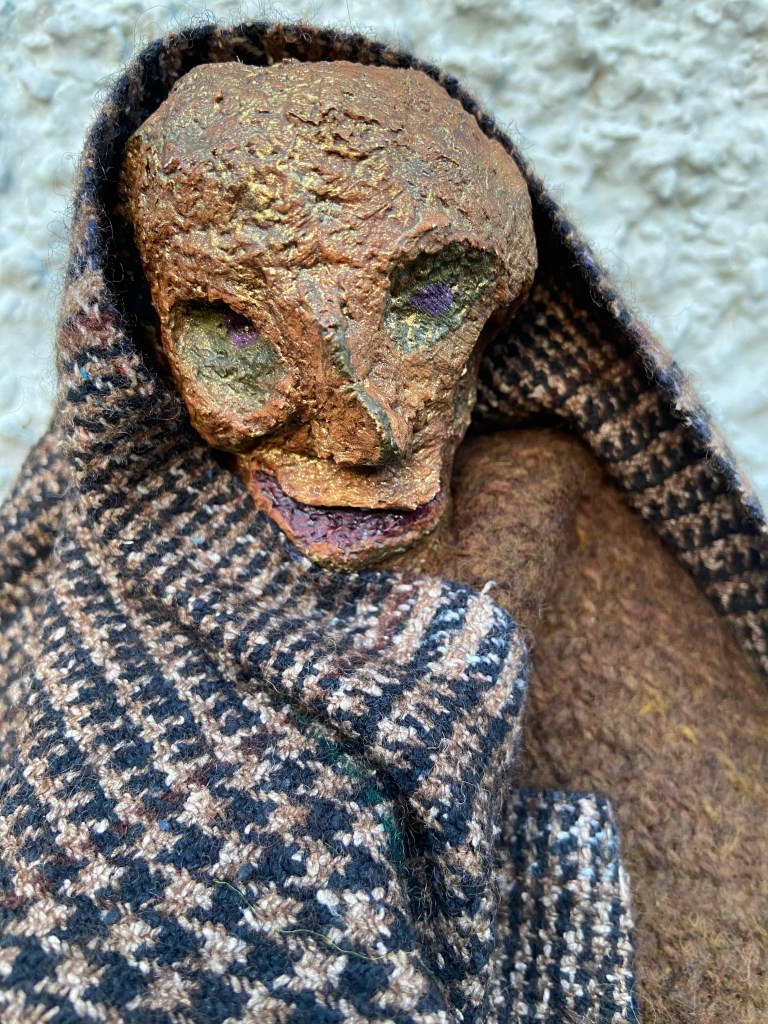
Peatland Figures

Industrial mining of peat bogs revealed both Bog Bodies and Will o’ the Wisps. Folk tales across Northern Europe tell of flickering lights – which might have arisen with the oxidation of marsh gases. Peat-diggers uncovered dark leathery remains of bog bodies which continue to fascinate people.

Kate made the series Peatland Figures during in art-science residencies in the Netherlands.  She wanted to enliven scientific discourse and symbolise different human connections to peatlands. Bog Woman and Wisp seem to have strong individual characters, which can help prompt conversation about the tangles of life and death in contemporary peatlands.

For eight weeks, these two figures will be dwelling in the gallery of Grizedale Forest, their fully-dressed bodies held up by slender beaver-gnawed branches.

This blog is an extract of the blog that first appeared on Kate’s ‘mean sea level’ website here: https://peatcultures.wordpress.com/

To explore the work of Pantea, collaborator on the film Mending the Blanket, visit her website here.
For more about Kate Foster, read her profile here.

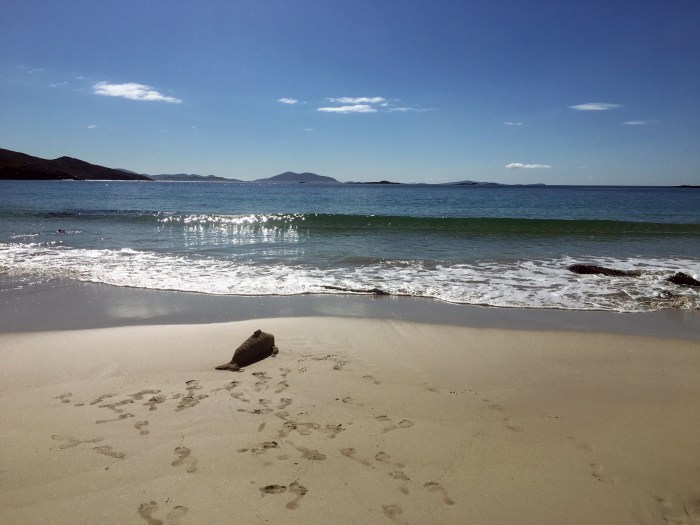
A beach on a sunny day. The sea is calm, with very small waves. In the background there are silhouetted hills. On the sand there are footprints leading to a small cast of a whale facing the sea.

Tides of Remembrance: The Making of ‘Keening, the Song of the Stranding’

‘It all began with a haunting image I couldn’t shake: 55 long-finned pilot whales stranded on the shores of Traigh Mhor beach in 2023 …’ Sam Gare exhibits a wooden mould of a stranded whale in the SEE HERE NOW EXHIBITION. The mould is part of the research and development for a ‘Keening, The Song of the Stranding’, a multidisciplinary performative artwork that will take place in July 2025.

A beach on a sunny day. The sea is calm, with very small waves. In the background there are silhouetted hills. On the sand there are footprints leading to a small cast of a whale facing the sea.

It all began with a haunting image I couldn’t shake – 55 long-finned pilot whales stranded on the shores of Traigh Mhor beach in 2023. For eight long hours, the beach became a liminal space between life and death.

Here, two species who live in such different worlds encountered each other in a profound and tragic way. As I saw these images, witnessing the sorrow of the moment, it wasn’t just about the loss. It was about everything that remained—the silence that spoke louder than words, the memories of these majestic creatures, and the stories still waiting to be told.

This moment became the seed for Keening, the Song of the Stranding, a multidisciplinary artwork. It wasn’t just about remembering the stranding itself; it became about exploring the space between life and death, where the sea meets the land and where time, for a fleeting moment, seemed to stand still. It became about remembering the whales and imagining a way to symbolically return them to the sea—giving their stories a chance to be told, even in their absence.

As I reflected on the tragedy of the stranding, I found myself drawn to the idea of the “living specimen.” Now, and historically, whales from strandings are sampled or taken away for analysis and became specimens in scientific collections. These so-called “dead” animals continue to serve as valuable sources of information about the natural world, and their afterlives are lived out in the minds of researchers. In many ways, they continue to teach us, even after their death. This idea of life in absence fascinated me and became a central theme in my work.

How can we breathe life back into the memory of these animals?

How can we honour their presence, even in their loss?

A mould as an echo

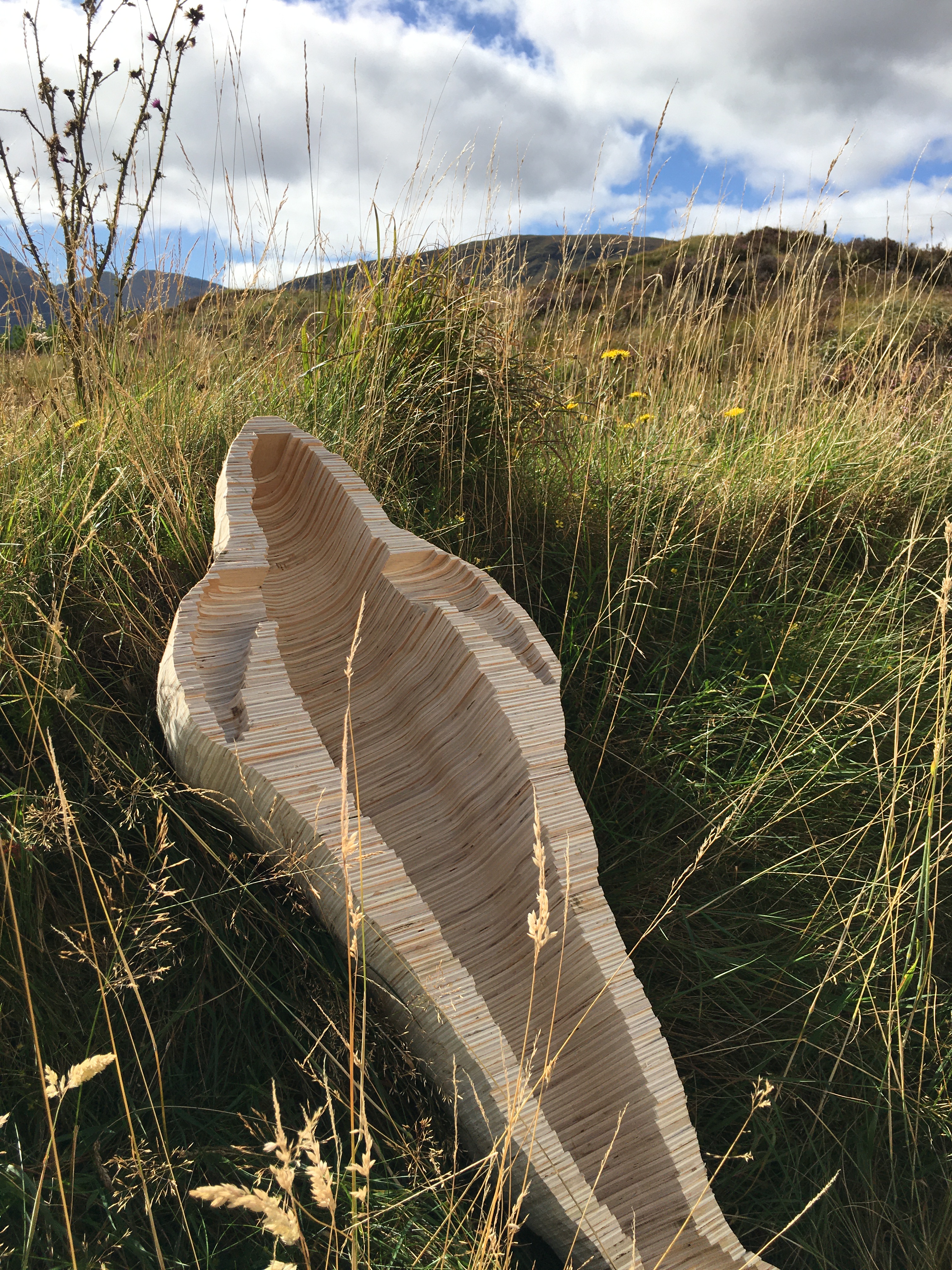
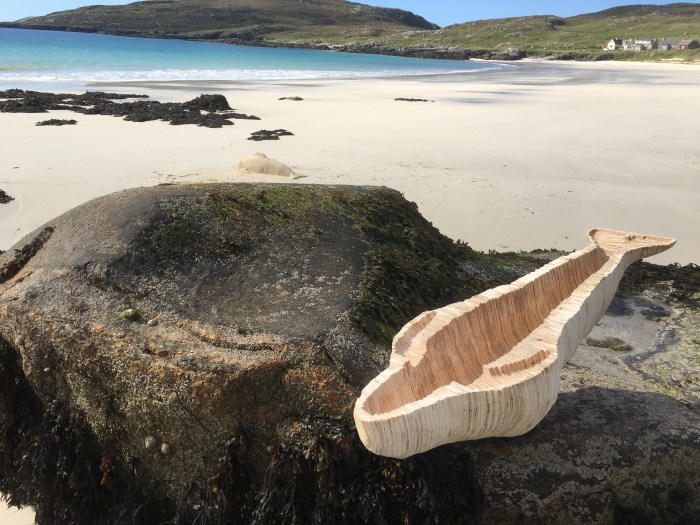
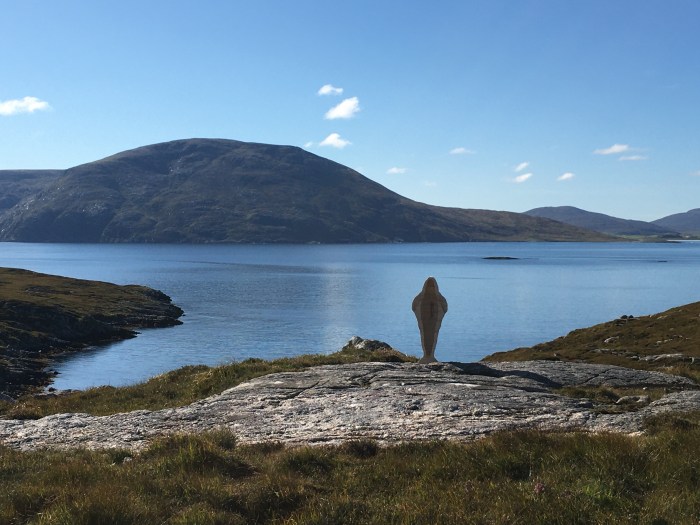
One of the pieces at heart of this work is a wooden mould, cast from the echo of a whale’s form. This mould represents the negative space left behind, a vessel that holds the absence of life yet contains the potential for renewal.

The sand sculptures we will create during the performance will be made from these moulds, capturing the form of the whales in the sand. As the tide reclaims them, we will witness the transitory nature of existence – the way life and memory both ebb and flow.

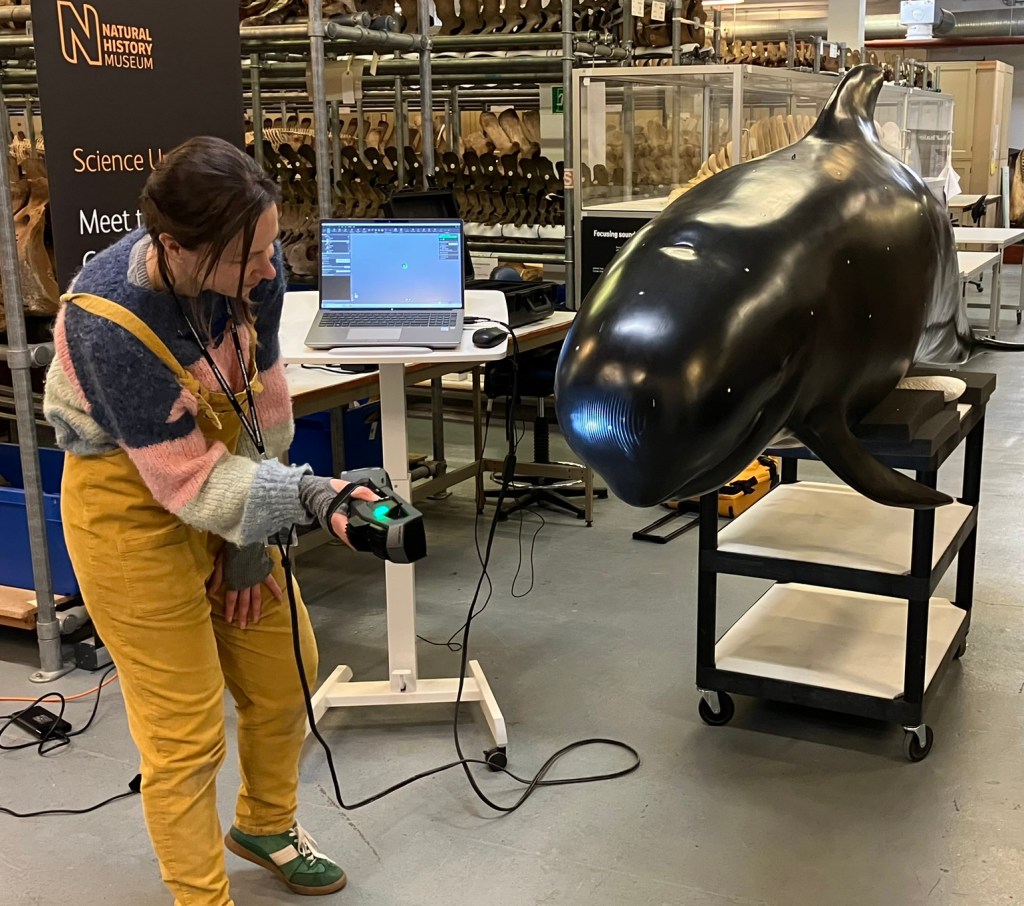
The moulds themselves are inspired by a model at the Natural History Museum, London, which was cast from a real stranded whale in 1930 by Percy Stammwitz, museum model maker. This female pilot whale was found on the shores of Wexford, and her story has been preserved through this model. I felt a deep connection to this preserved whale, her life captured in this form long after her death. I’m reimagining the original process, using 3D scanning to help me create wooden moulds. These moulds will serve as vessels that capture the presence of these whales once again, allowing us to connect with their forms in a tactile and symbolic way.

Exploring data, to shape understanding

Alongside these pieces, I’m pleased to be working with data provided by the Scottish Marine Animal Stranding Scheme (SMASS), which tracks and analyses strandings along the Scottish coast. The team at SMASS conducts necropsies and writes detailed scientific reports on stranding events. This data provides valuable insights into the individual animals involved, and it has helped shape my understanding of the whales beyond their mass stranding. Traditionally, stranding events are examined in terms of the pod as a collective, but I wanted to focus on the individuals within that pod—their relationships, their kinship, and their individual stories. Through this project, and beyond this project, we will be reimagining the lives of the whales, informed by the data and kinship studies provided by SMASS. We are no longer simply observing a tragic event, but rather, we are acknowledging the complexity and individuality of each animal.

Collaboration and performativity

As I delved deeper into the research, I began to see it as a collaborative effort, one shaped by both the community and the artists I’m working with. Aya Kobayashi’s choreography will guide the performance, helping bring the casting of the whale forms in the sand to life. The movements will mirror the act of remembrance and transformation, as we all come together to create something new from what has been lost.

Accompanying the performance is an original musical composition composed by Alex South, Nerea Bello, and Katherine Wren. The music weaves together the vocalisations of pilot whales, with the Gaelic tradition of keening—a mournful, vocal lament for the dead. The project allows the musicians to explore the musicality of the long-finned pilot whale, whose repetitive, ornamented, and plangent calls are used to negotiate their complex social relationships. This music will breathe life into the performance, connecting the mourning of the whales with the silence they left behind. 

The project also features several community workshops designed to involve the public in the artwork’s evolution. In Oral History Workshops, locals are invited to share their memories of whales and their connections to marine life. These stories are an essential part of the project, helping preserve and weave together the memories of the community. In the Whale’s Way Workshops, school pupils will create life-size cardboard whales, painted with scenes of the whales’ imagined underwater journeys. These vibrant creations will be incorporated into the live performance, celebrating the lives of the whales and the rich marine heritage of the Hebrides.

In the end, Keening, the Song of the Stranding is more than just a performance—it’s a communal act of remembrance and renewal. It’s about exploring the boundary between life and death, and loss and renewal. It’s about coming together as a community to honour the stories of the whales, and to reflect on our own relationships with nature.

As the sea washes over the sand sculptures we create, we are reminded that while stories may be carried away by the tides, they are never truly forgotten.

A sunny beach with white sand and a blue sea. The beach curves round the sea, with green hills in the background and some houses where the sand stops and the grass begins. In the foreground there is a large rock with a wooden mould of a whale lying on top of it.

Keening, the Song of the Stranding is due to take place on 12 July 2025, with workshops running during late spring and early summer. You can learn more about the project here – www.northharrisstudio.co.uk/keening 

Find out more about Sam Gare here.

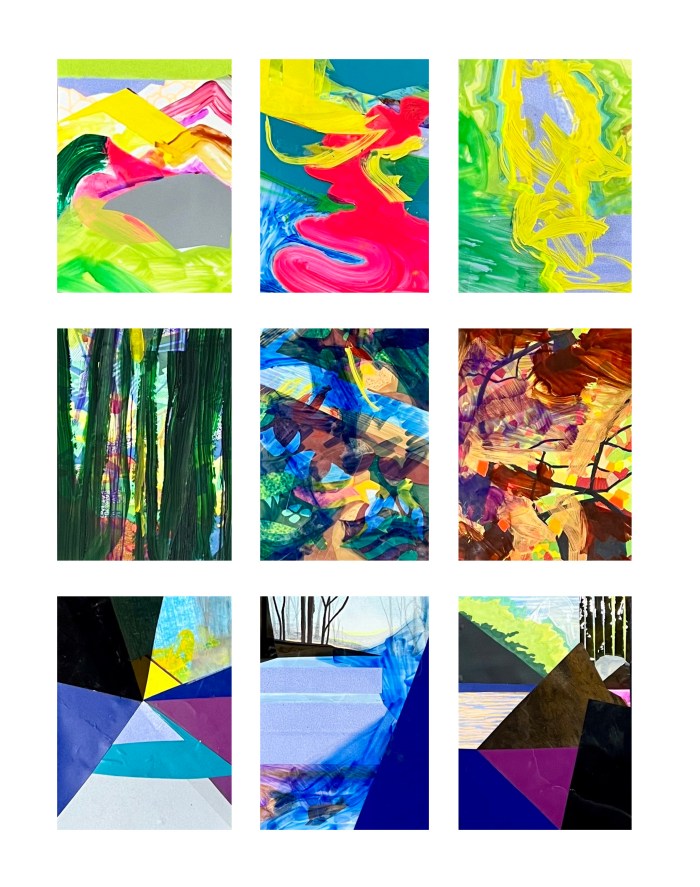
A grid of nine abstract artworks inspired by the gorge in Hubbard Brook Experimental Forest, each featuring a mix of colours, textures, and shapes vibrant hues. The top and middle rows showcase expressive, gestural brushstrokes and the bottom row transitions into geometric compositions with angular shapes and structured colour blocking, blending organic and structured elements.

How the light gets out – Rita Leduc and Dr. Rich Blundell

‘How the Light Gets Out‘ collages on display at the See Here Now exhibition are part of the Extending Ecology collaboration between Rita Leduc (artist), Dr. Rich Blundell (ecologist) and Hubbard Brook Forest in America. Read on for more on this piece, on light, and extended ecologies.

In 2021, we (ecologist Rich Blundell and artist Rita Leduc) began Extending Ecology, an ongoing collaboration with Hubbard Brook Experimental Forest in the White Mountains of New Hampshire, USA. Our Oika research is a shared experience of scientific and creative engagement, absorbing and extending nature’s healing, ecological dynamics through us, into culture, and toward “Beautiful Futures.”

An internationally renowned Long Term Ecological Research site, Hubbard Brook Experimental Forest rose to prominence in 1963 with the discovery of acid rain. Evidence from the forest led to the 1970 Clean Air Act and the threat was ameliorated globally. Thus, Hubbard Brook solidified its reputation as a forest where research leads to evidence, evidence to awareness, and awareness to planetary action. Through Extending Ecology, we have extended this legacy and the ecology of the forest into the cultural domain through visual art, media, writing, workshops, talks, publications, exhibitions, projects, and relationships.

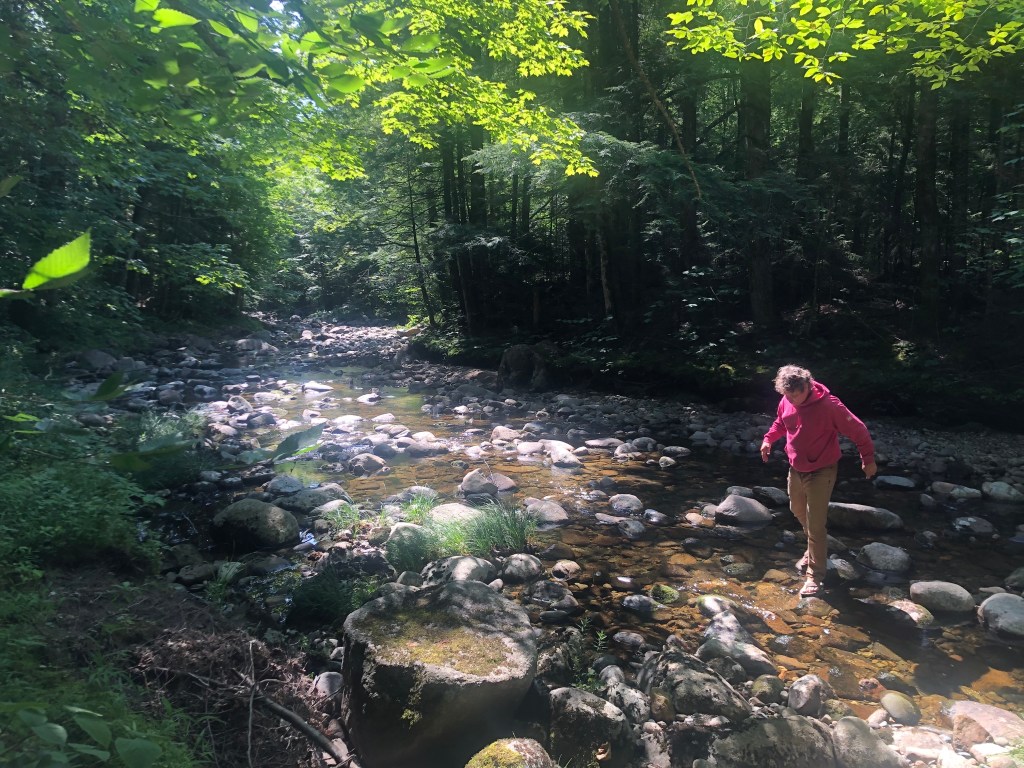
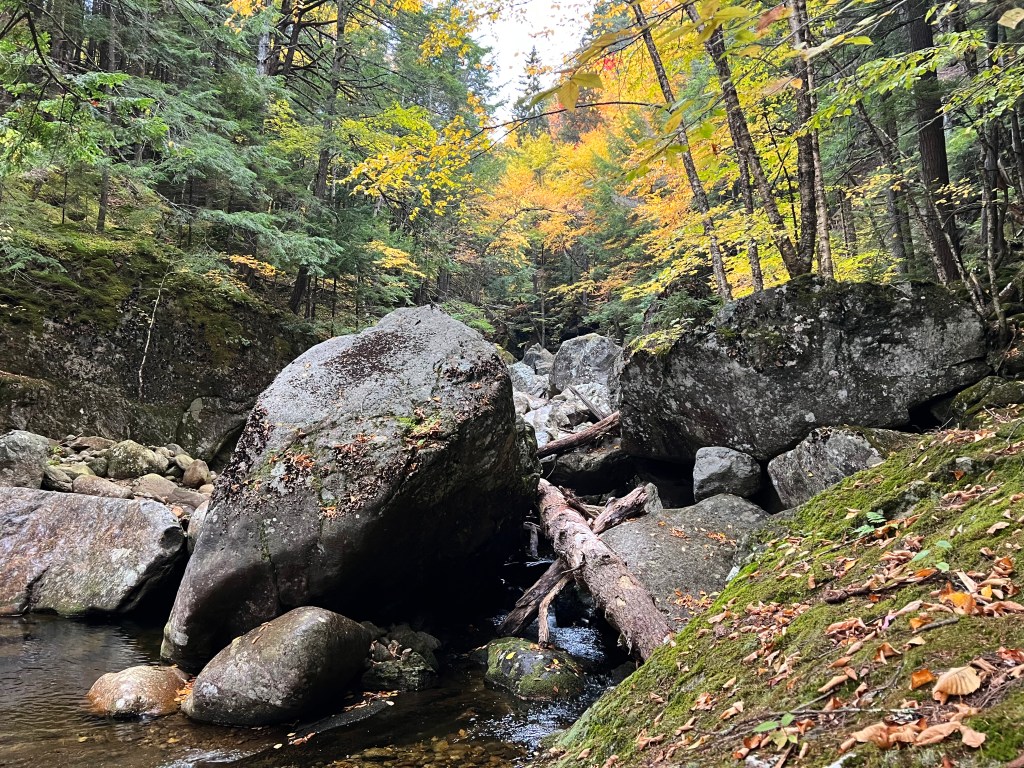
Within Hubbard Brook Forest runs its namesake brook. In that brook, about a mile upstream from the forest boundary, is a gorge. In 2022, light caught by this gorge piqued Rich’s curiosity. Before long, we found ourselves at the foot of a magnetic pool of light.

The gorge has since become a required stop during seasonal baseline checks. Standing there feeling the concentrated glow, we study how the gorge attracts and holds the light.

We observe how we ourselves can’t help but fill up with the very same light, phenomenologically, emotionally, and cognitively.

“How the Light Gets Out” is a series of investigations into, and manifestations of, how the light in the gorge sparkles, spreads, and shares itself into the forest, through us and our work, and into the world. Featured in the PLACE Collective ‘See Here Now’ exhibition, collages made with visual data collected in the forest use composition, form, texture, colour, and gesture to research questions such as:

“What is it to be fully saturated?”

“What are shadows?”

“Why does light wane?”

We believe that taking the continuity of these questions seriously reveals how reconnecting with natural intelligence provides essential guidance for navigating our unprecedented moment.

In the context of the exhibition “See Here Now – Art in a Time of Urgency,” Extending Ecology extends into a new forest – Grizedale – with an equally historical past. This time, however, the lineage is artistic. After four years forging a novel creative path alongside Hubbard Brook’s scientific trajectory, bringing Extending Ecology to Grizedale is a refreshing dip into a longstanding stream of artistic heritage and camaraderie.

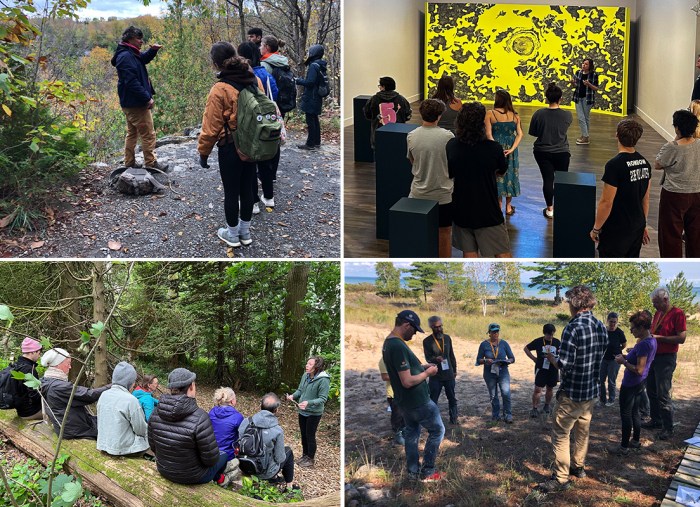
A collage of images showing people taking part in workshops outdoors and indoors

But to pin Extending Ecology’s trajectory to a disciplinary binary would shortchange Oika’s ontological point in favour of a trendy, epistemological one. What feels deeply – primally – exciting about bringing Hubbard Brook to Grizedale is not this contrast, it is the upstream common denominator that this contrast reveals.

Four years ago, a scientist and an artist cultivated common, fertile ground within a forest. What emerged – extended – from there was because of a kindred connection not to a scientific or artistic lineage but to a cosmic one.

When this is the case, “collaboration” takes on a wholly different shape. Outcomes are not created to appease categorical expectations; rather, they are born out of – and carry the Creative Life Force of – the very primordial light which we have been the beneficiaries of for 13.8 billion years.

Like the discovery of acid rain, the healing, ecological dynamics for which Extending Ecology provides evidence are not sequestered to the borders of Hubbard Brook Experimental Forest. Through visuals and conversation, “How the Light Gets Out” encourages others, wherever they are in this era of metacrisis, to learn from, become, and exude that light: “Here, Now.”

Find out more about Rita Leduc here and Dr. Rich Blundell here.

Rita’s previous blog on ‘Extending Ecology’ is here.
Lots of trees cover a hill, the ground is brown with patches of green moss, the tree trunks are long and straight. There is bright light coming from behind the trees.

SEE HERE NOW EXHIBITION

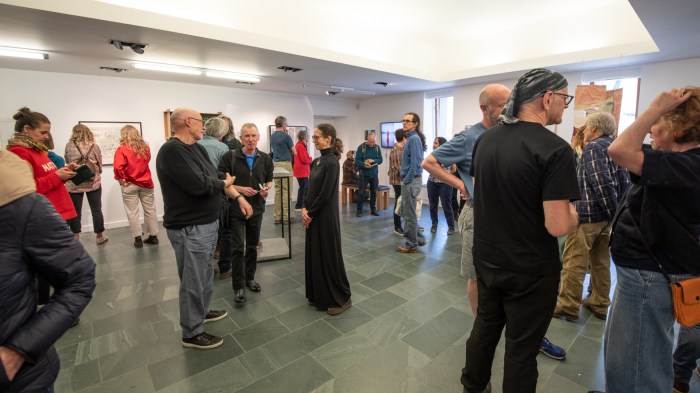
The See Here Now exhibition is in full swing in the gallery of Grizedale Forest. What a week! A joyful install, with perfect weather.

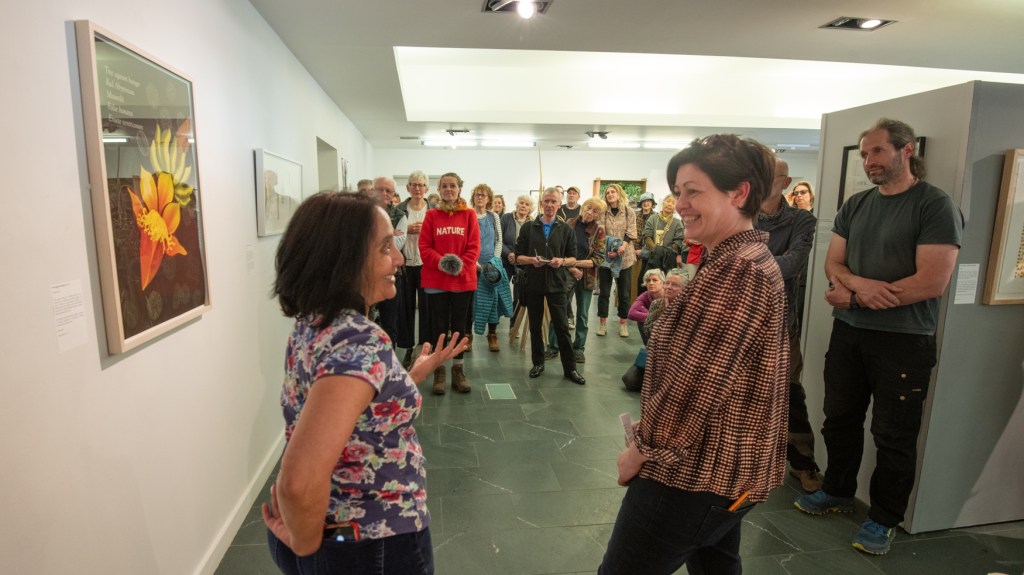
The preview was buzzing, with 25 of the exhibiting artists celebrating the launch. We were welcomed by Hazel Stone, National Curator of Contemporary Art at Forestry England; and a fascinating hour of conversation with five of the artists; then the evening fell into full swing.

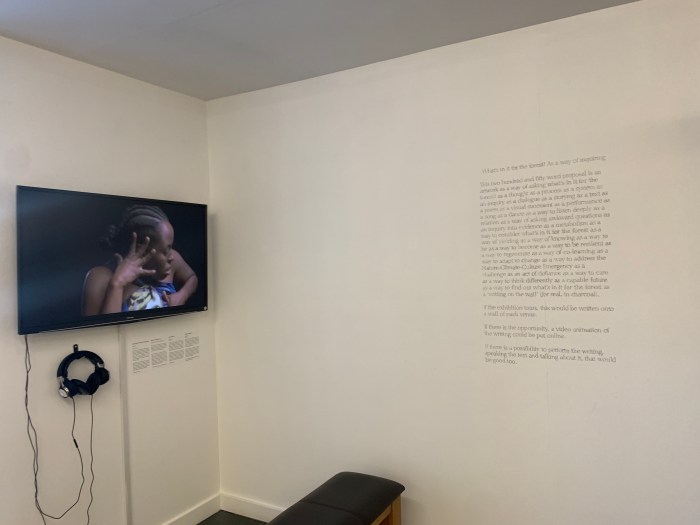
For now, here are some images of the exhibition and the preview. There’s more on individual pieces in a series of blog posts, and you can find out more about the See Here Now exhibition here.
SEE HERE NOW Art in a time of urgency, Grizedale Forest, Daily 10am-4pm, until June 8th.
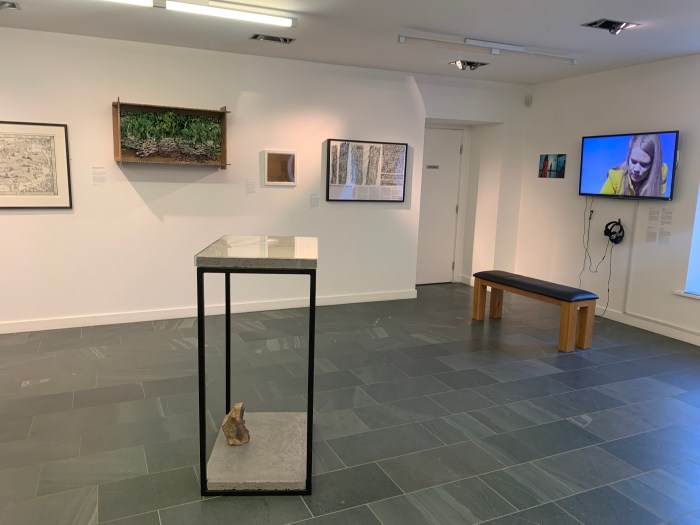
An image of a gallery
  • An image of a gallery
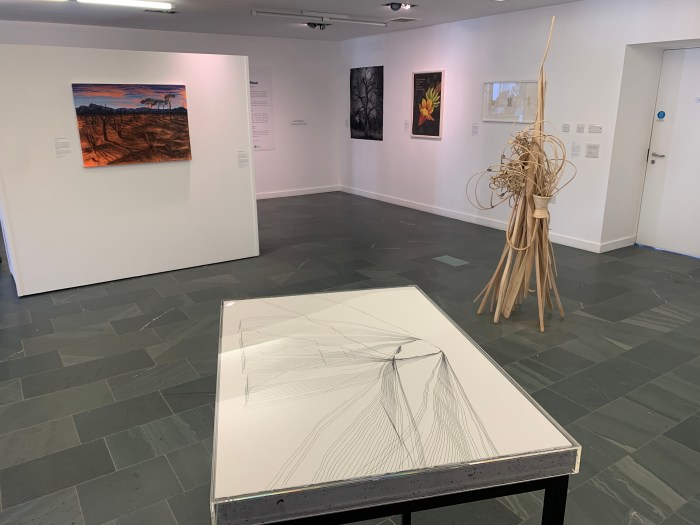
An art exhibition showing a wooden piece and images behind
A black and white line drawing, made by tracing shadows made by a single rock during the course of a day

06.58 Carron Crag 19.10 Epoch – SIMON HITCHENS

Simon Hitchens’ durational day drawings are made in, of and about the landscape, the result of a particular set of conditions, in a particular place, over a particular span of time. His work 06.58 Carron Crag 19.10 Epoch was created in Grizedale Forest, and is being shown in the SEE HERE NOW exhibition. Read on for more.

Read more: 06.58 Carron Crag 19.10 Epoch – SIMON HITCHENS

The British Isles have a rich and varied geology, with rocks ageing from the present to some of the oldest on our planet. Each day these rocks get a little older as we too get older. To be able to comprehend the deep time of rocks is to a shine a light upon our own short lifespan and to begin to understand the transient but interconnected nature of what we share with the world.  

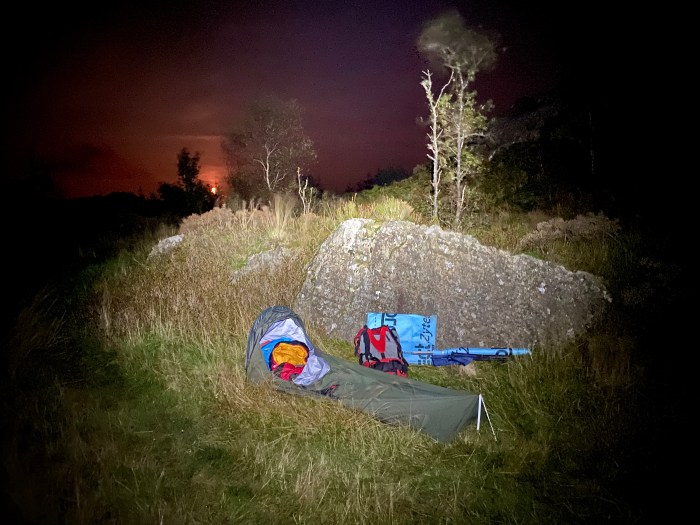
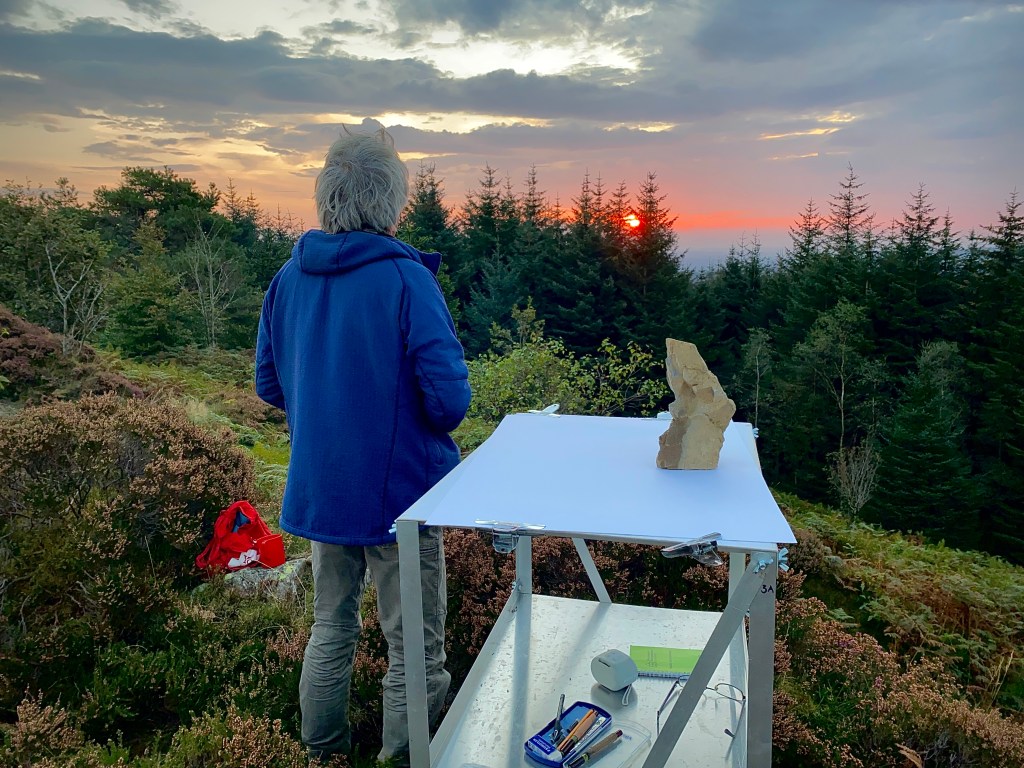
For this exhibition I have made a durational-day-drawing of a specific rock found on the summit of Carron Crag in Grizedale: Silurian, aged 443-419 million years old. The process was simple: arrive at Carron Crag at least half an hour before dawn, giving me enough time to set up my collapsable drawing table and materials. For this drawing I bivvied on the summit of Carron Crag the night before to save me a long walk in before dawn, as the combined weight of my rucksack full of drawing kit, clothes for all weathers, food and drink etc. was considerable. Once the paper is on the surface of the table and I have placed my chosen stone (which I found the night before) upon the surface of the paper, I waited for the sun to rise. 

A camp at night time with a small 1-man tent, rucksack, and some outdoor gear in a rocky, grassy area with a few trees. There is a red glow in the sky and the silhouette of trees in the distance. The camp is lit up by a torch while the area around it remains dark.

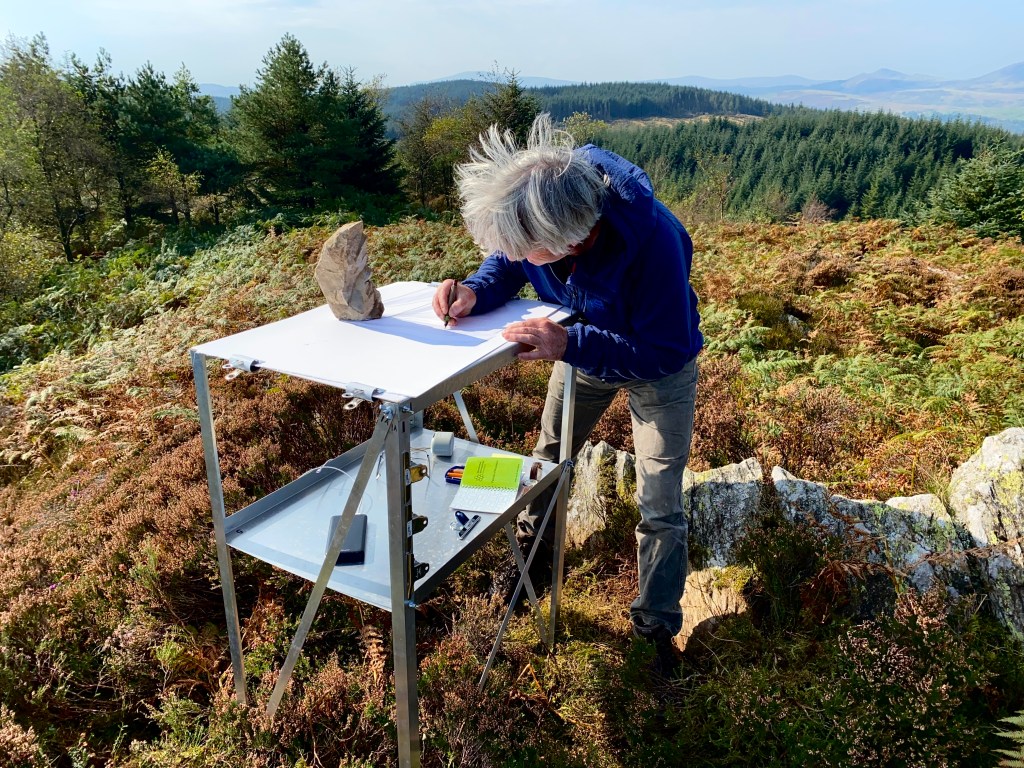
Simon Hitchens at work, tracing the stone’s shadow from dawn to dusk.

As the sun rose in the east, casting a shadow of an ancient geological object to the west, I traced its shadow lines on the paper beneath. It took between two and two and a half minutes to complete the drawn shadow line – once this is completed, I immediately start drawing the next line, as the shadow itself has shifted a little due to the incessant rotation of planet earth beneath my feet. This process was repeated relentlessly until either a cloud obscured the sun, and there was no shadow to draw, or the sun dipped below the western horizon at the end of the day. 

This is a process-based drawings made in, of and about the landscape, the result of a particular set of conditions, in a particular place, over a particular span of time. It records celestial time, geological time and human time as well as the weather patterns unique to that day and site: a meditation on time and space.

Even the solidity of rock and mountains given time, will eventually erode into nothing, echoing the transience of human life. 

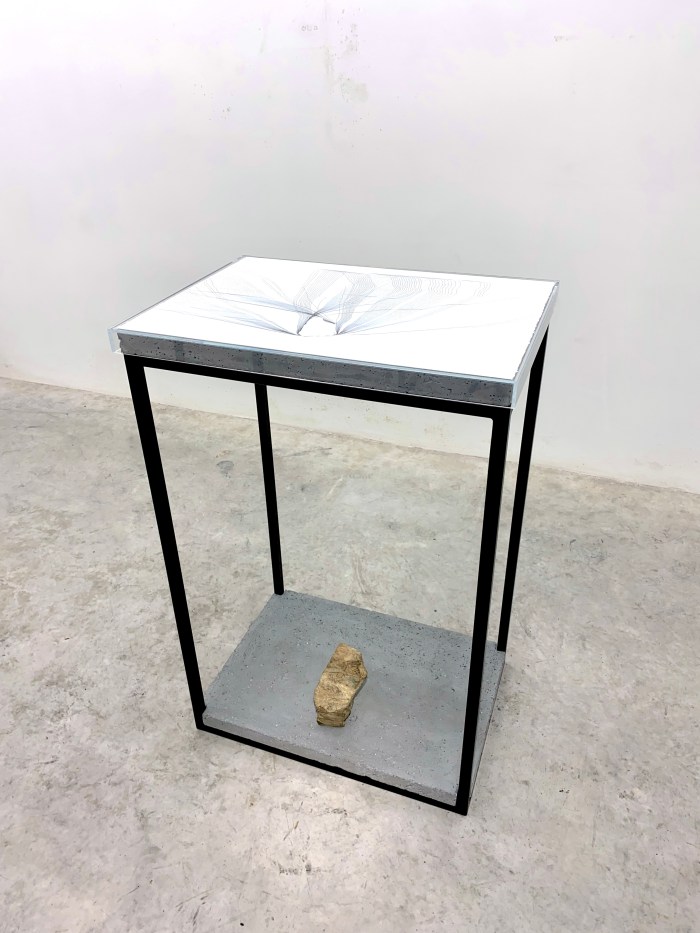
I have chosen to exhibit this drawing in combination with the rock itself, the source of the drawn shadows, on a purpose-made steel-framed table which is the same height and size of the drawing table I use to make the drawing. The drawing sits upon a low carbon concrete slab made with crushed Silurian rock sourced from Grizedale, the exact same rock type which I used to make my drawing.

A table with a black frame and concrete slabs at the bottom and top. A rock is stood on the bottom concrete slab. There is a drawing on top of the table and a clear case over the top. The table stands in a grey room.
  • Drawing size: 50 x 70 cm. (Rotring ink on 300gms Fabriano paper)
  • Rock: Silurian, aged 443-419 ma
  • Table size: H – 110cm, W – 51, D – 71 cm.
  • Date 2024/2025

The low carbon cement used to make the concrete has a 50% less carbon footprint than standard Portland cement. Under the drawing is another shelf of low carbon concrete, which supports the very stone that was used to make the drawing above it. It’s displacement from the drawing, and indeed the drawing itself, references time and transience. The work also speaks of presence and absence, subject and object, art and nature.

The drawing accurately records the haptic qualities of the Earth’s geology at a specific time and location, linking us to the past through the present and connecting us to something larger than ourselves. 

A black and white line drawing, made by tracing shadows made by a single rock during the course of a day

06.58 Carron Crag 19.10 Epoch


Read Simon Hitchen’s profile here.

Naomi Hart – inspired by the convex seascape survey

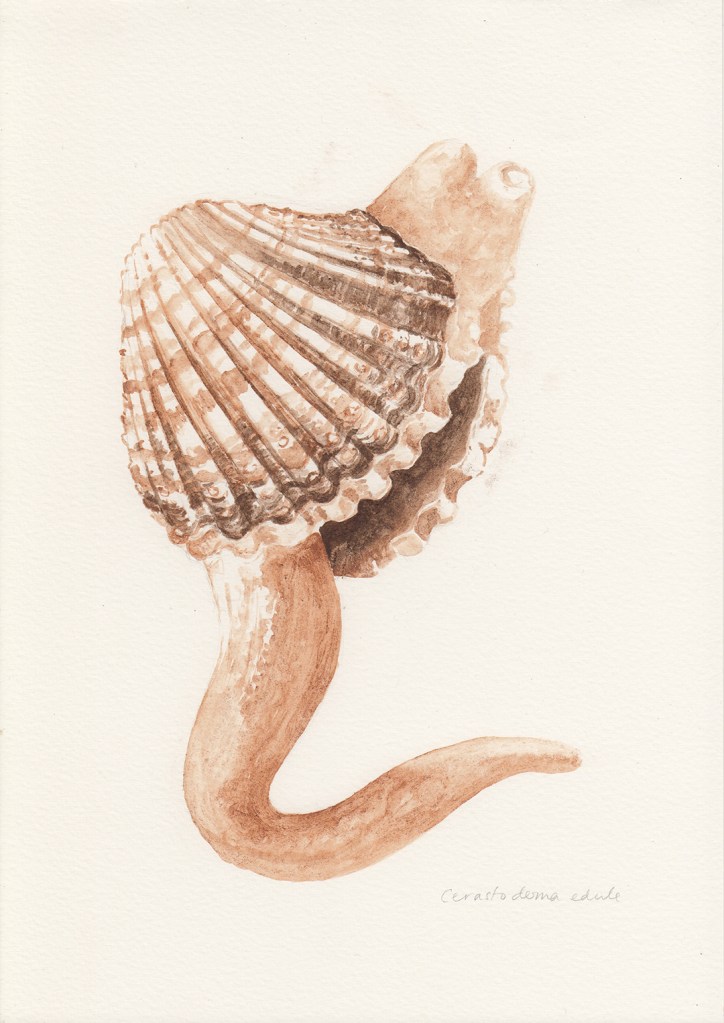
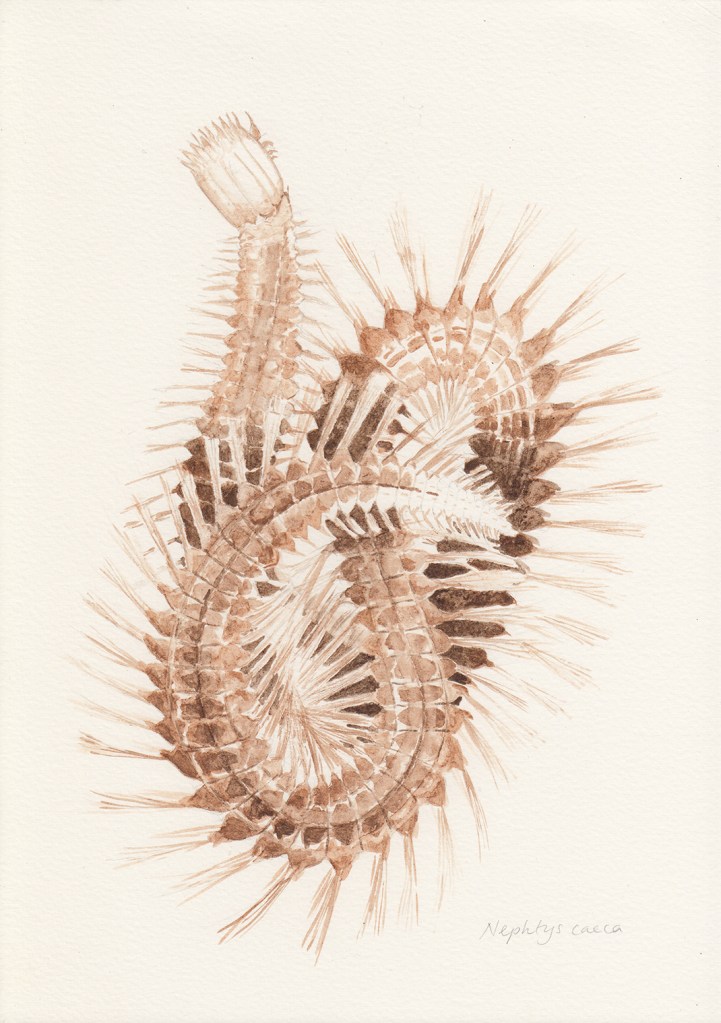
Naomi Hart is artist in residence with The Convex Seascape Survey, a pioneering collaboration of world-leading scientists working to quantify and understand blue carbon stored in the coastal ocean floor, the effects of marine life upon it, and how this might impact rates of climate change. Her paintings ‘Amphiura chiajei‘ (brittlestar), ‘Cerastoderma edule’ (common cockle), and ‘Nephtys caeca’ (catworm), will be on display at the SEE HERE NOW exhibition.

A team of researchers from the University of Exeter, alongside project collaborators at the University of Southampton, have been studying benthic invertebrates – worms, shellfish and similar creatures – that live in the mud beneath the sea. These invertebrates form a vital, but unseen ecosystem, which may be critically important in our fight against climate change. The tiny creatures create tunnels and burrows in seabed sediments, bioturbating (mixing) the mud, and moving nutrients and carbon within the mud to create a unique seabed habitat, the world’s largest carbon sink.

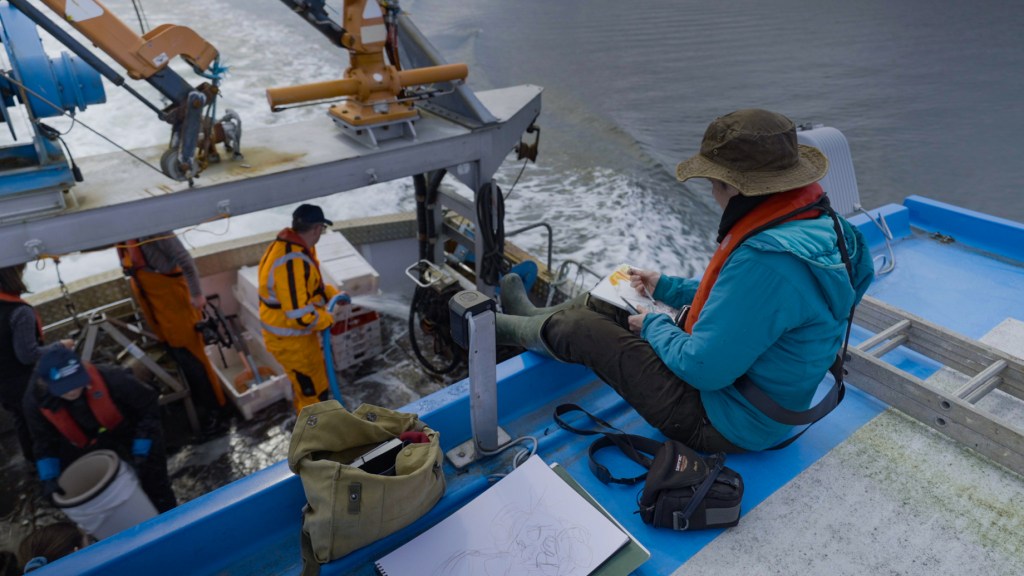
Naomi has been working alongside these researchers for two years, involved in and documenting all aspects of the research: hauling mud from the bottom of the sea, identifying sea creatures, and witnessing complex, delicate chemical measurements in the laboratory. She created action sketches of the researchers collecting samples of ocean bottom dwelling invertebrates while at sea.

Naomi studied the invertebrates under a microscope and then created pigment from the sea sediment, by heating it to different temperatures. This has led to a unique colour range completely specific to the waters around the Isle of Cumbrae, where the research took place, so with a nod to traditional earth colours like ‘Raw Umber’ and ‘Burnt Umber’, she has named the pigments ‘Raw Cumbrae’ and ‘Burnt Cumbrae’.

To extend the palette, she also experimented with white chalk made from dissolving sea-shells in acid/lemon juice – mimicking ocean acidification as the oceans warm – and has created highly detailed ‘portraits’ of the invertebrates out of the actual mud in which they live. Hugely magnified, these creatures may seem like aliens from another world, but they are found in our oceans, creating tunnels and burrows in the mud and drawing down nutrients and carbon in the world’s largest carbon sink. The colours themselves demonstrate the capacity of the sediment to hold nutrients and carbon: Raw Cumbrae is a mid-greybrown; as it is heated, the organic matter begins to burn and darken, and reveal the carbon stored within. Further heating burns off this carbon entirely to reveal the iron-rich red sandstone of the underlying geology.

Through these paintings, Naomi hopes to raise awareness of these incredible creatures and the vitally important habitat they create.

Naomi has also worked with The Convex Seascape Survey to run art workshops for adults and children, making muddy sea creatures in clay and with mud-paint, with researchers on hand to explain the science behind the project.

The work has been exhibited in Exeter, Penryn, Falmouth, Bristol and at the Royal Geographical Society in London. For more information about the invertebrates, you can read about them here.

The Convex Seascape Survey seeks to discover exactly how the ocean performs its vital role as the world’s largest carbon sink. Over five years, the project will not only scrutinise the carbon locked in the continental shelf seabeds but will assess the role of ocean life on carbon storage, as well as assessing human influences on seabed carbon. Funded by Convex Group Ltd., the project is facilitated by Blue Marine Foundation, with science led by the University of Exeter in collaboration with partners.

Find out more about Naomi Hart here: Naomi Hart.

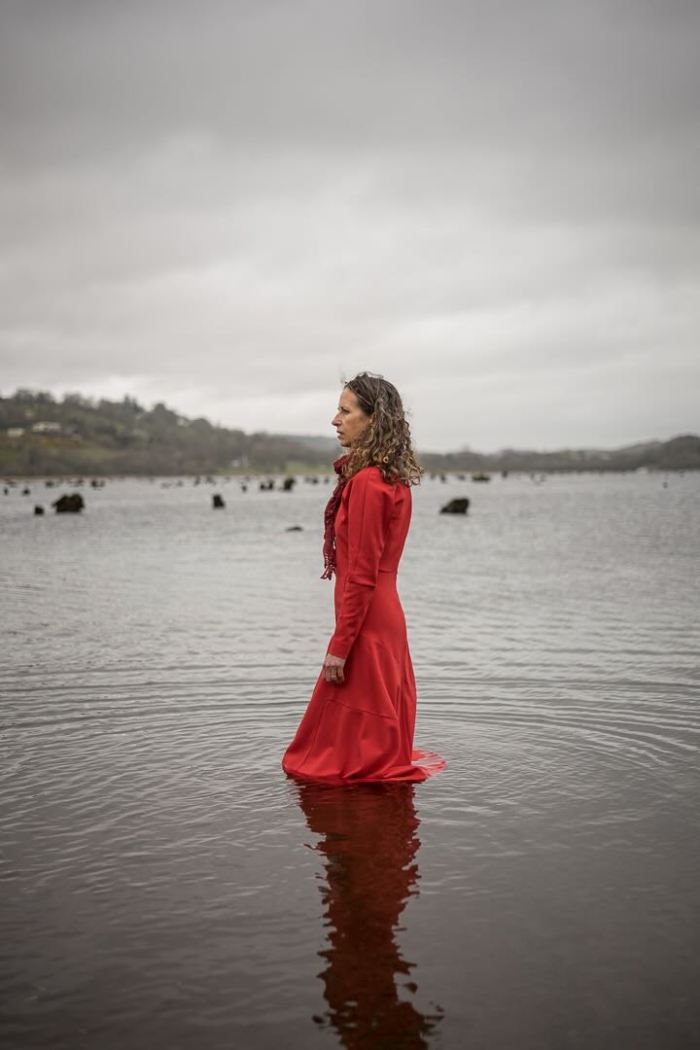
a woman in a red dress stands in a pool of water, with grey sky

Tree felling / weathering – Jools Gilson

In this Long Read, Jools Gilson shares the background to the collaborative work ‘Weathering’, which took a lost forest as its inspiration. The audio recording of Jools’ performance is shared in the Grizedale Exhibition: here, Jools recounts the story of its long, long production.

Thinking about this lost forest, this performance and the exhibition at Grizedale, I know that this tangling of time and presence enchants story and place in ways which feel urgent. Because all of this process of being present in front of you or being present in a beautifully shot tree, speaks to loss and the possibility of regeneration through poetic text and play.  

In the early months of 2020, I started work on a collaborative multi-screen performance project called Weathering directed by the Dance Artist and Film maker Mary Wycherley. I was asked to be part of the creative team because of my writing and performance skills.

The project was focussed on The Gearagh / An Gaorthadh in West Cork, an 11,000 year-old submerged glacial woodland. When it was felled in the 1950s to make way for the building of two hydroelectric dams, it was the last surviving full oak forest in Western Europe. In 2023, the remains of this river forest survive as stumps emerging from the floodwater. Our initial work involved studio based explorations and visits to The Gearagh itself. Soon after we began, the pandemic halted work for two years, although we did meet online. I continued to write, and when restrictions allowed, I would visit The Gearagh, which is about 30 miles from where I live in Cork City in Ireland. Eventually, the film shoot in The Gearagh was scheduled for April 2022 and the work was premiered just under a year later at Dance Limerick in March 2023. Weathering was a resonant hybrid work with a distinctive exploration of the space between film and liveness. It included film on two screens, live performance / choreography, sound and voice.  

The Gearagh is an unsettling place. Villages were evacuated to make way for the flooding, whole communities moved away. The outlines of the cut trees are often black against the reflection of the sky in the water.

There is an older history too – of a place where strangers would lose their bearings – lost amongst rivulet after rivulet – the distinctive ecology of an alluvial river valley. Sometimes there were deer here, and rare forms of plant and animal life. And so I visited alone, often walking out past the place where the village shop used to be, out beyond the haunts of walkers. I took photographs and notes, and then I wrote Tree Felling. Writing this was powerfully bound up in movement, both my own in research trips to the Gearagh, but also speculative history. Whatever else, the ESB (Ireland’s Electricity Supply Board) provided work at a time when it was scarce. These trees were mostly felled by hand, and I combined this with the glistening and discomfort of teenage boys. I wanted to tangle these accidents of history with the overwhelming living complexity of an old-growth oak tree.  

A woman in a red dress stands with her back to the camera in a lake. The sky is grey and there are spall tree covered hills in the background.

A year or so later, I’m driving to the second day of the film shoot for Weathering on location in The Gearagh. I know that Mary would like me to speak Tree Felling whilst walking into the flooded river, amidst the stumps of the old forest.

I’ve brought my wetsuit and wet shoes to put on under my red dress, but even so I’m concerned about the cold. I have to recite my text whilst only being able to do one take because the dress will be getting wet and it’s a chilly April afternoon.

The sound guy wires me up with a microphone and a battery pack concealed under the dress – best not fall over either. It’s a lot, but here I go. I walk into the water and begin to perform. Amazingly, I manage to get through the text and the water, and they’re happy with the take. As I turn towards the camera at the end, a fish jumps close to me.  

It’s almost a year later and I drive to Limerick for the premiere of this long-delayed work. Mary had told me that she wanted to work live on two of the texts I’d performed for the shoot – Tree Felling and Pearl Mussel. It’s a strange thing for someone who regularly performs her own writing that it isn’t that easy for me to learn and then re-learn my own text. I record it on my phone, and then listen over and over again as I’m walking to work, or up and down the hallway if I’m at home. For me these processes of walking whilst acquiring the embodiment of voiced text that arose from my body is disconcerting but also delicious. Something of the rhythm of it stays with me. I am less afraid of performance than I was when I was younger, I think because I trust my own body more, and inviting writing back into my flesh is somehow more comfortable.  

Dance Limerick is a converted protestant church. When I arrive into busy rehearsals, there are two screens positioned at an angle. I greet the dancers quietly, warm up and wait to be called. I have re-learnt Tree Felling as I have been asked, and soon it is my turn to rehearse. It is only then that I begin to understand what Mary would like me to do. She would like me to perform the first part of Tree Felling live in front of the audience, whilst the film of me entering the water is behind me, but I am out of focus, and the stumps of trees are in focus. There is a certain point where I come sharply into focus as I turn. What Mary wants is for there to be a seamless crossover between my live performance voice / presence into the filmed voice / presence, and it’s only then that I realise that the text I have learnt isn’t going to work for this performance.  

When you have one take and it’s an Irish April and you have a wetsuit and a microphone power pack under your dress, your navigation of the script will likely be a bit creative. I’ve been performing for decades and I knew I needed to get a good take in one go, but funnily enough the text wasn’t spoken exactly as I had written it, and so I drove back to Cork from this rehearsal and reflected. I realised that if I was going to conjure a seamless shift between live performance and this filmed performance, the text I had written wasn’t any good to me, I needed the exact text I had spoken on that day when I walked into the river in The Gearagh amidst the ghosts of the old forest. Mary had given me the audio recording from the film, and I listened and listened again and transcribed this, and drove back to Limerick for the dress rehearsal armed with a plan. There was an introductory section that I would speak live to audience, whilst the film played upstage from me, there was another section where I had to be precisely in synchronicity with the film, and there was a section where I left the stage and the Jools filmed in the river finished the text. Because I couldn’t see the film, I could only do this if I had a live audio feed of the original film sound recording played into my ear and because I also needed to have my voice amplified by a microphone to sound qualitatively the same as the film, I’d need two battery packs under the red dress (but no wet suit). We rehearsed, there was much discussion, and we tried it and tried it again. We thought it would work. I’ve never performed with an audio recording in my ear, let alone one that was from a previous on location film shoot. I learnt that during the first section I didn’t have to be completely in synch with the recording, but could use it as a guide, I knew the section where I was about to need to be absolutely in synch, and then the part when I would leave my ghost behind. That evening at the premiere, it worked. There was a magical moment, where voice, writing, presence were somehow blurred between present tense and the past of the recorded film.  

Thinking about this lost forest, this performance and the exhibition at Grizedale, I know that this tangling of time and presence enchants story and place in ways which feel urgent. Because all of this process of being present in front of you or being present in a beautifully shot tree, speaks to loss and the possibility of regeneration through poetic text and play.  


Read more about Jools Gilson here.


In the foreground there is a table covered with pieces of paper on which there are block prints of plants in various colours and handwritten text. Behind the table on the gallery wall there are two large framed prints of digital artwork of plants, between them is a panel of writing about the exhibition.

A sense of flora: Daksha Patel

Daksha Patel brings her artwork Tree Against Hunger to the SEE HERE NOW exhibition. This post describes the context for this piece, which was created during the project A Sense of Flora.

A Sense of Flora was an artist-led project delivered in partnership with Manchester Museum and Rainbow Haven, a charity which supports asylum seekers and refugees. It explored the inter-relationships between a sense of place and flora – particularly food crops which are intricately connected to cultural memories, traditions and practices. Themes of food security and climate change informed the artist’s research process. 

Crops for the Future

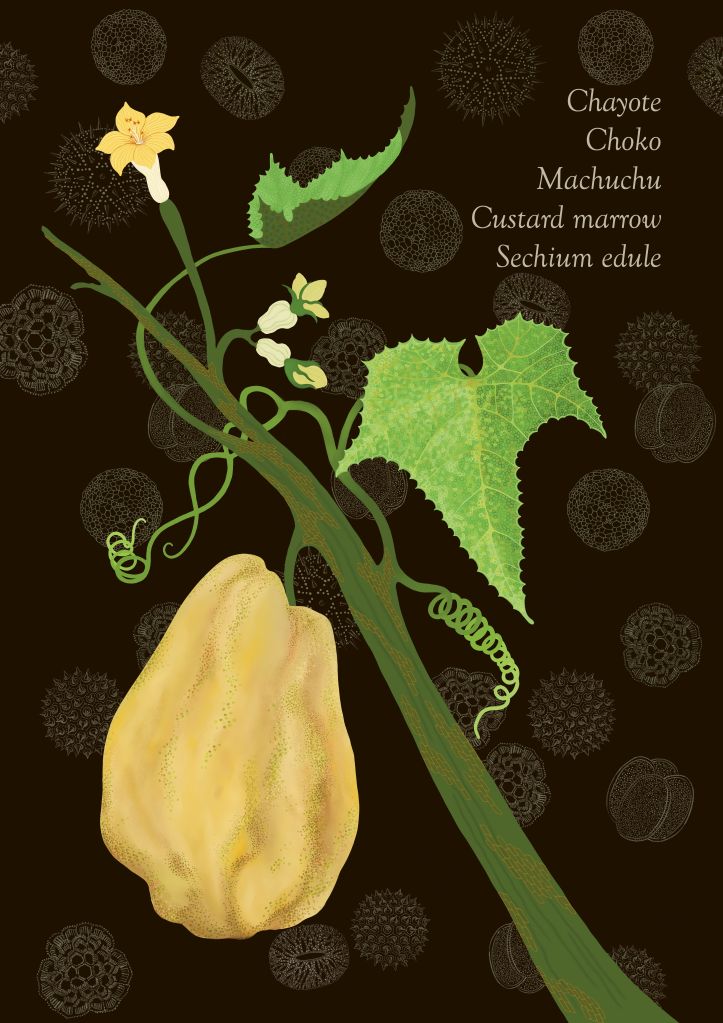
During the first phase of the project, Daksha explored botany collections at Manchester Museum with curator Rachel Webster, focussing upon ‘crops for the future’ – important varieties which scientists have identified as having remarkable versatility such as drought resistance, flood tolerance or disease tolerance. The artist’s early sketches of collections were eventually developed into large-scale digital drawings of three key plants: Sesbania grandiflora, Sechium edule, and Ensete ventricosum. Ensete ventricosum is widely grown in small holdings in Ethiopia and known as ‘The tree against hunger’; researchers at Kew Gardens point to the importance of protecting indigenous knowledge to support food security in the face of climate change. Crops such as Sesbania grandiflora not only provide food for humans and livestock, but also have potential to be used for medicinal purposes. Sechium edule is very vigorous in growth, and the whole plant  – leaves and pods –  are edible, proving a very versatile food source. 

Daksha’s digital prints include a list of names for each plant – its classification under the Linnaean system as well as its local names, which vary across different regions. The local names are wonderfully evocative of each place. In the background to each print, clouds of microscopic pollens allude to the ongoing scientific research into the genetic diversity of food crops and its potential to strengthen food security. 

Participatory workshops

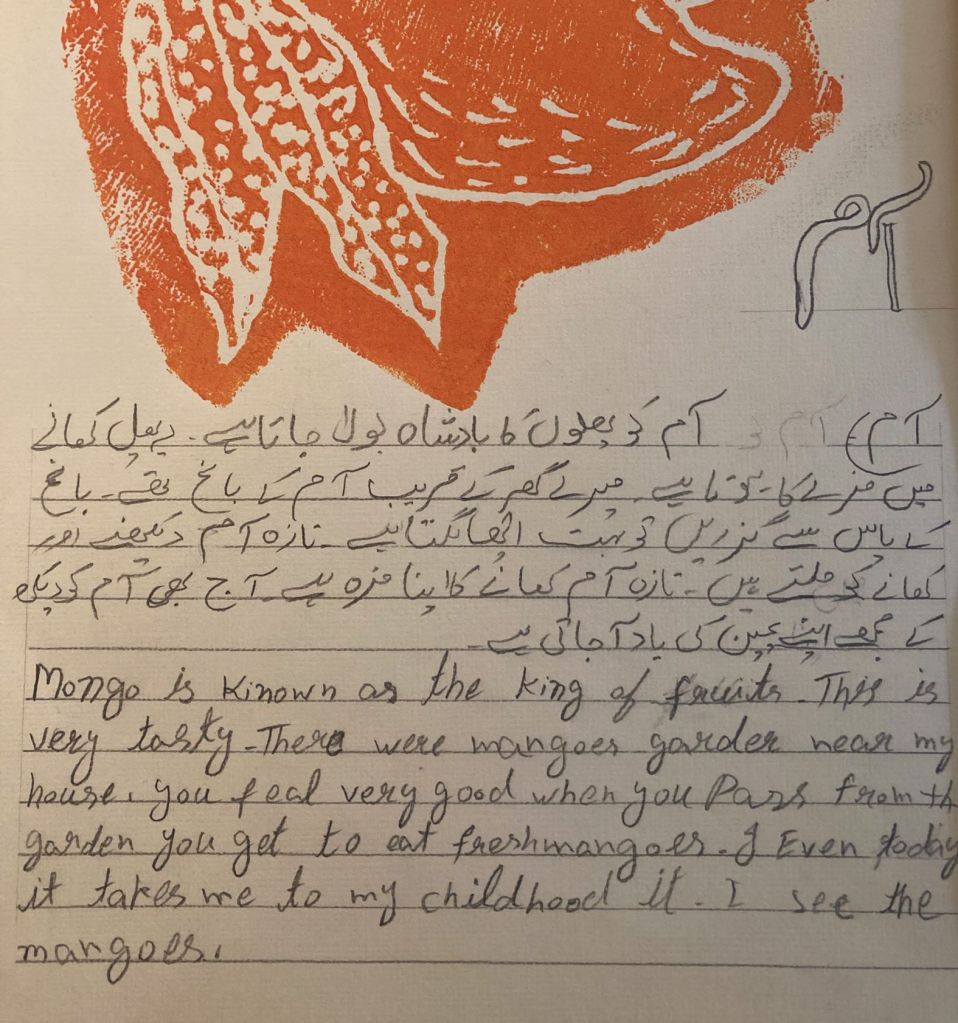
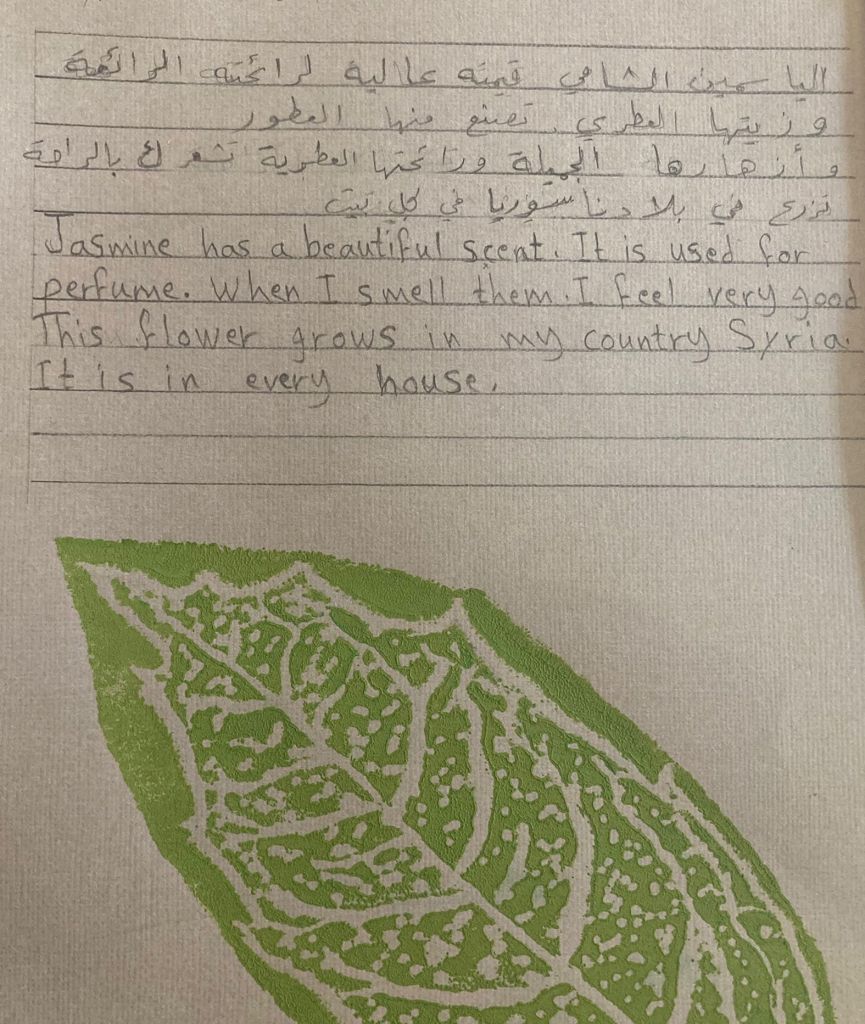
During the next phase of the project, Daksha delivered a series of art workshops at Rainbow Haven, focussing upon flora. Participants shared their stories and memories of favourite fruits, vegetables, trees or flowers from their countries of origin. They made colourful prints and added hand-written texts in different languages (Amharic, Arabic, English, Farsi, Kurdish, Tigrinya and Urdu) with English translations, giving wonderful insights into how a sense of place is intertwined with flora. The workshop aims included addressing barriers of isolation & social exclusion, encouraging self-expression and well-being through creative activities exploring sense of place & identity connected to flora & the natural environment.  

Mango is known as the king of fruits. This is very tasty. There were mango gardens near my house, you feel very good when you pass from the garden [and] you get to eat fresh mangoes. Even today it takes me back to my childhood if I see the mangoes.

Jasmine has a beautiful scent. It is used for perfume. When I smell them I feel very good. This flower grows in my country Syria. It is in every house.

Exhibition

The final stage of the project was the opening of A Sense of Flora exhibition at Manchester Museum in August 2024. It comprised of a large-scale print installation of all participants artworks alongside three new digital prints by artist Daksha Patel. On the opening day, participants and their families were invited to language specific tours of the museum – it was a very enjoyable day for all! There was a tremendous sense of pride and empowerment as participants visited the exhibition of their artwork in a public cultural space in Manchester. Museum visitors were fascinated to read the hand-written texts which accompanied prints; they helped to raise public understanding of the diverse experiences of asylum seekers and refugees through the language of plants, which we all share. 

A table laden with pieces of paper side by side. On the paper there are block prints of plants in various colours and handwritten text. In the background there are two windows.

Watch Daksha Patel explain the project further in this video:


Read more about Daksha Patel here.


exhibition news!!

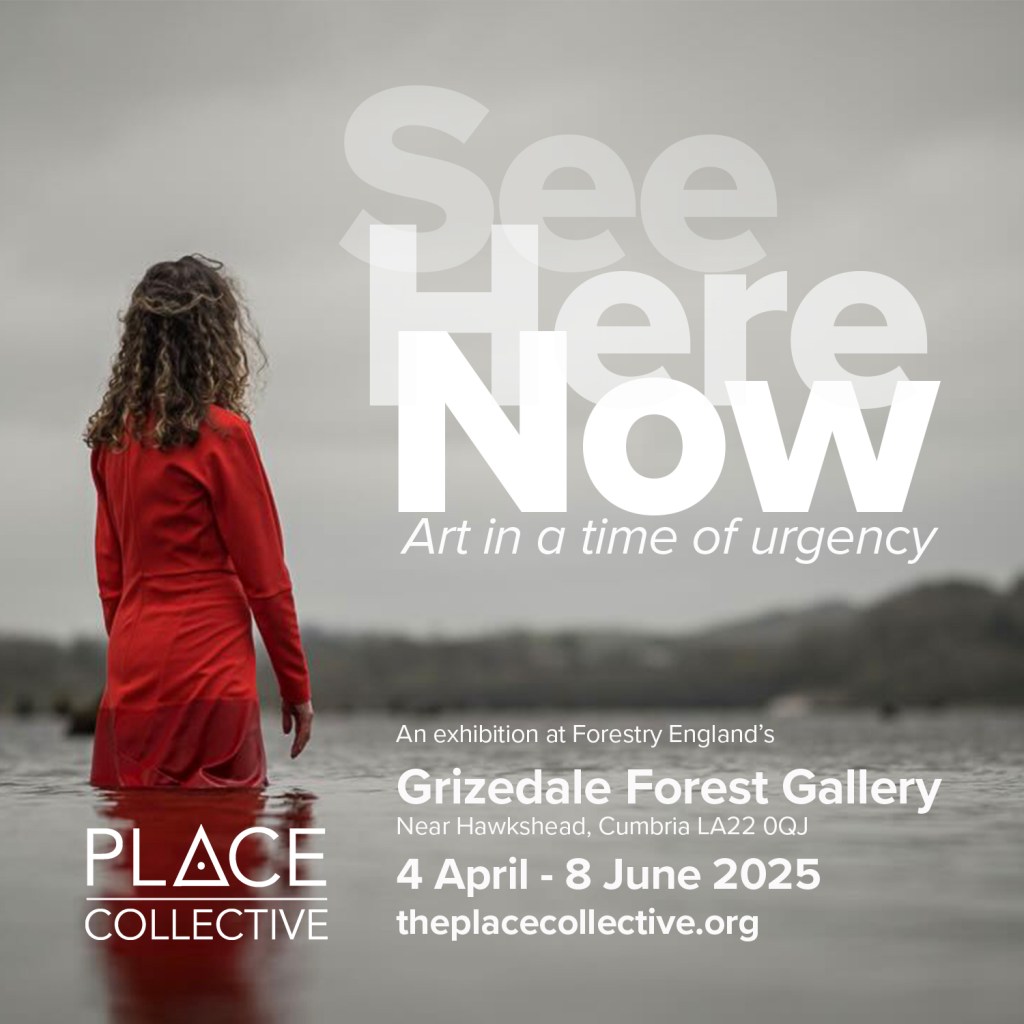
SEE HERE NOW – EXHIBITION APRIL 4 – JUNE 8

After a long time planning, a group of PLACE Collective artists will be exhibiting work in the stunning galleries of Grizedale Forest, Cumbria, in response to the theme of Art in a Time of Urgency.

All of our practices are concerned with better understanding and caring for the living world – yet in a time of increasingly frequent severe weather events, melting glaciers, political instability, and a critical need for nature recovery, what might artists do? What work do we create, what questions do we ask, what stories do we tell? What might we do differently?

MEET THE ARTISTS AND JOIN THE EXHIBITION PREVIEW, APRIL 5TH

Mark your diaries for a visit, and watch out for blog posts in the coming weeks featuring insights from exhibiting artists.

Exhibiting in Grizedale Forest is to build on a legacy of thoughtful and often boundary-pushing art. It’s a privilege to bring an exhibition to this venue, and while not all work centres on the forest, or even on trees, some artists have chosen to create work in and in response to Grizedale Forest – more will be revealed when the show opens.

More about the exhibition … head over to the exhibition page here!

Images: Left to right featuring Simon Hitchens, Anna Sharpe, Bryony Ella, Daksha Patel, Siobhan McGlaughlin, Richard Gilbert

Main image: Jools Gilson in Weathering by Mary Wycherley (2023). Photography by Marcin Lewandowski.